
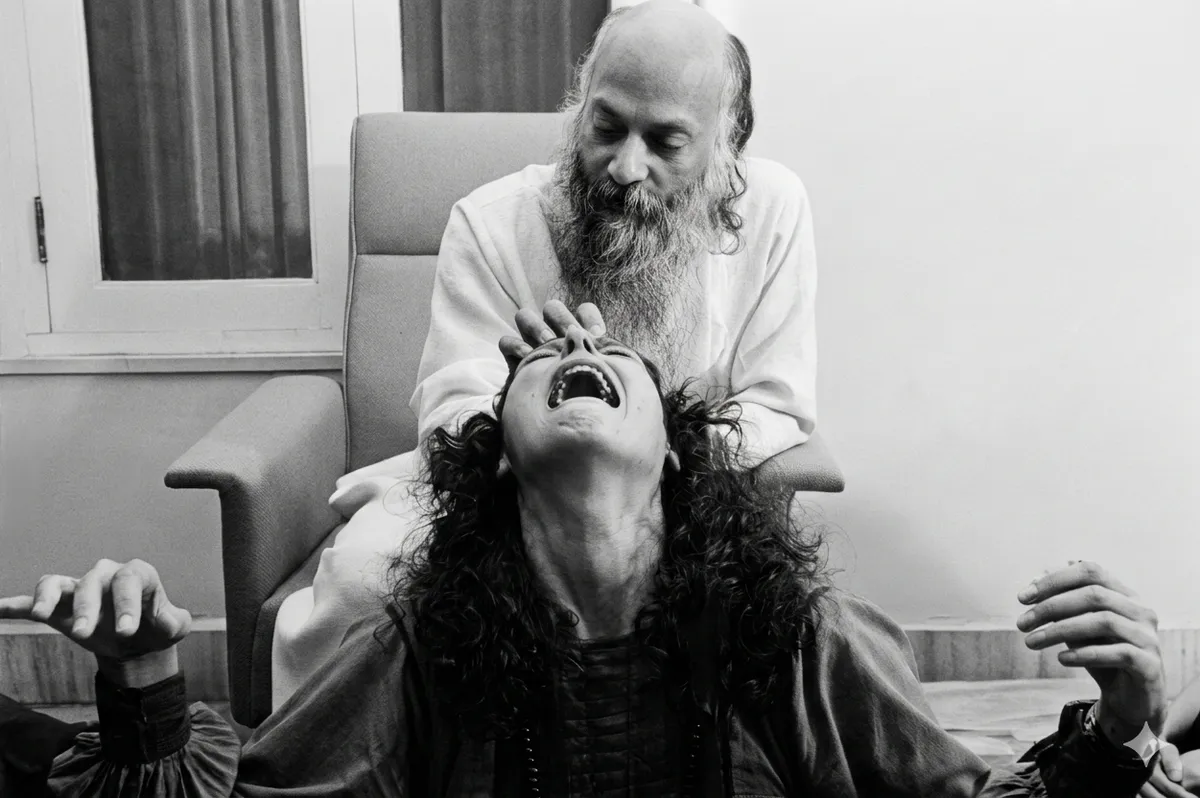
It’s your inner music starting—relax, listen, allow any shaking or tears, and keep listening until only the sound remains.
From the Discourses
Passages where Osho speaks to this question — each links to the complete discourse.
Osho, in moments of meditation or silence a sweet, drum-like sound begins to resound in my ears. In yesterday’s discourse, the moment I heard the words ‘anahat’ and ‘earthquake,’ that same sound started ringing in my ears and an earthquake shook my body. As soon as I left the discourse I burst into loud sobbing, and this state continued for a long time. Osho, would you graciously tell me what this is?
So there are distinctions among tears. Therefore don’t always think that if tears are coming, something is wrong, some mistake or lapse. And slowly you will begin to recognize that the taste of tears differs. You will know when tears flowed from peace, when from sorrow, when from happiness, when from bliss. The tears that have flowed in you are tears of bliss; flow with them; let them flow. They will purify and refine you. They will bathe you; they will wash your heart. Through those very tears, slowly all your impurity, all your blemish will be washed away. They will carry away all the dust. You will become pristine. In that pristine state God descends. In that pristine state you become a tirthankara—you rise to the highest a human being can rise. You have done what a human being can do. You have staked your all; held nothing back.…
Thus there are two ways to say it: either call it the soundless Word—the tone that is not born of collision, not born of the impact of two—or the saints have chosen another precious term: Anahata Nada. Anahata means: not produced by striking, not produced by collision. Is there such a sound that is Anahata? Is there a sound born without striking? If there is such a sound, that alone is the fundamental note of life. Several points need to be understood. Whatever is produced by collision will perish. For collision generates a quantity of energy, but how long will that energy last? I clap my hands; the impact of my hands releases a limited force. How long will it resound? Whatever has been produced will be destroyed. Whatever is made will be unmade. Buddha said: that which is compounded cannot be eternal, cannot be Sanatana. How could it be?
There are a few labs in the world for some scientific experimentation which are absolutely sound-proof. Once a musician was invited into such a lab which was absolutely sound-proof. He was surprised to hear the sound 'soham'. He looked all around, he enquired 'What is the matter? I don't see any sound coming from anywhere but I hear "soham".' The director of the lab said 'This is the sound of your own breathing. Because all sounds have been cut off, you are able to hear it.' If everything is absolutely silent, one can even hear the blood pulsating inside one's veins; then again the sound is soham. So this is a pure sound -- it is not a word but a pure sound. And the same sound is heard like a great explosion when one comes closer and closer to reality. Help people to know 'I am that.
Beloved Osho, whenever I am in a silent space I hear a sound -- something like `aum' or humming. I love this rhythmic, sweet, unending sound. In certain activities too, when I am total and silent, this listening happens. Is it okay to listen and enjoy this sound, or is it a projection or daydreaming?
First thing to remember: you should not repeat any sound as a mantra, as a chanting, because when you repeat you create -- then it is your mental projection. If you are simply silent and you hear a certain humming, then it is the sound of existence. That humming has been heard for centuries by meditators. That humming has been given a special name in the East, OM. It is not exactly OM but it is something similar. It has to be remembered that in Sanskrit -- which is the oldest language in the world, the mother language of all civilized languages in existence -- they don't write OM in letters. They have made a special symbol for it just to create a distinction, to indicate that it is not something to do with language, it is beyond language, and it is not part of the Sanskrit alphabet. The way…
You have said that the practice of chanting aum also brings about the nada, the inner sound. Does it come about spontaneously also? Which is the proper nada?
If it comes spontaneously it is more valuable. If it comes with the repetition of aum it can be imaginary. That which comes of its own accord is authentic, valuable. If the nada begins you should become a witness. Do not be merged into it, because that is the state of the seventh plane. If you tend to get lost in the nada before reaching the seventh you will halt there; it will act as a brake. As these inner sounds become more and more subtle, our witnessing too will have to become more and more subtle. We will have to go on observing to the end, when the sound is completely lost.