
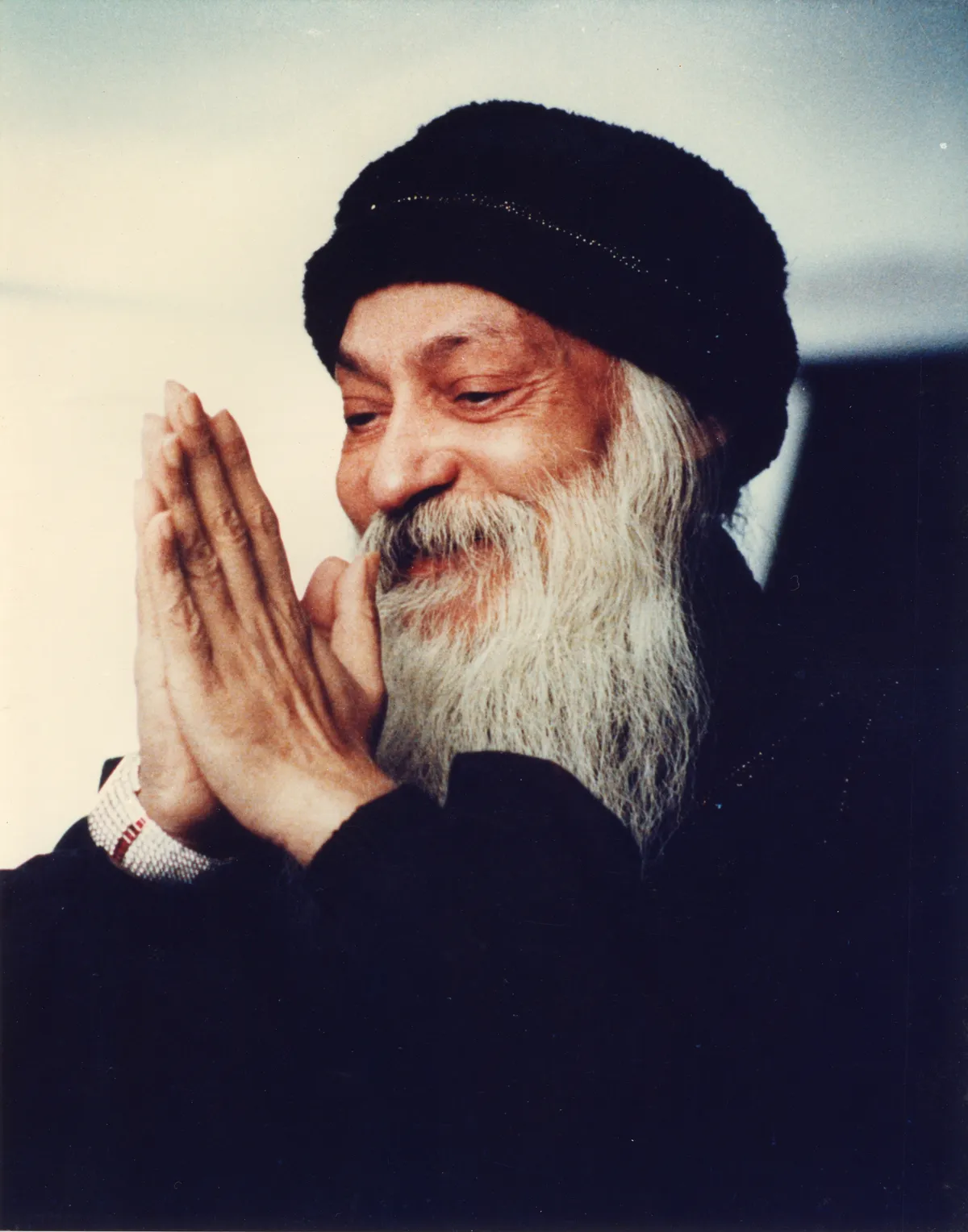
Going inside makes the small ‘me’ fade, bringing peace and a felt oneness with everything, where truth is found within you.
From the Discourses
Passages where Osho speaks to this question — each links to the complete discourse.
Beloved Osho, there is a growing awareness of when I am not "myself." in meditation, and being in your presence, in the good moments, there is no "myself." beloved master, what do you mean when you say, "be yourself?"
Prem Purna, it is one of the greatest statements made by Socrates: "Know thyself." But I have always thought it is incomplete. Unless another statement is added to it, it will not be complete, and that statement is: "Be thyself." To know thyself, first you have to be thyself; otherwise, how can you know? The second thing: as you enter into the inner world of mystery, of being oneself, of knowing oneself, you will come to a point where you become aware that the word `self' is confusing -- confusing in the sense that it has two meanings. Its true meaning is your soul; and its pseudo meaning is your ego. And that's what is creating your problem: whenever we use the word `yourself', usually we mean your ego, your I-ness. When Socrates says, "Know thyself," or when I say, "Be thyself," we are not using the word `self' in…
And whenever there is a man with a sincere enquiry the answer is not very far. In fact the answer is always hidden in the question itself; all that is needed is a sincere heart to enquire. When the question is authentic... Our questions also are not authentic, they come out of borrowed knowledge. For example if a Christian comes he will ask a question that no Hindu is ever going to ask. If a Hindu comes he will ask a question that no Mohammedan is ever going to ask. A Mohammedan asks a question which no Buddhist would ever ask. I have known all these people -- they come with different questions. I was puzzled, puzzled because if the question is real then it can't be that a Christian will not ask something and only a Hindu will ask it. If the question is real it is everybody's question.
Osho, upon reaching the goal the wise man finds that it is impossible to know the self, because there the knower, the known, and knowledge become one. In that state, why do they still tell us, “Know yourself”? What do they mean by it?
Certainly, in that ultimate state the knower is lost, knowledge is lost, and the known is lost. This trinity dissolves into a single current. Ganga, Yamuna, Saraswati—all three disappear; only the ocean remains. The one who went in search is no longer there; that which he went to search for is also no longer there. And yet, something remains. What remains is greater than the three; it is more than the three. What is lost was rubbish. What remains is the very essence. Still the wise say to you, “Know yourself.” Are they inviting you to be erased? If it were only erasing, and nothing were gained, the invitation would never be given. From one side, there is disappearing; from the other side, there is being. That which you presently are will fall away, and your real being will remain. Your false, counterfeit “being” will vanish; your eternal substance, your…
आखिरी प्रश्न: ओशो, मंजिल पर पहुंचकर प्रज्ञावान पुरुष को यही पता चलता है कि स्वयं को जानना असंभव है, क्योंकि वहां ज्ञाता, ज्ञेय और ज्ञान सब एक हो जाते हैं। इस हालत में वे हमें क्यों समझाते हैं कि स्वयं को जानो? इसमें उनका अभिप्राय क्या है?
निश्चित ही, उस परम अवस्था में ज्ञाता भी खो जाता है, ज्ञान भी खो जाता है, ज्ञेय भी खो जाता है। यह जो त्रिवेणी है, यह खोकर एक ही धारा बन जाती है। गंगा, यमुना, सरस्वती तीनों खो जाती हैं, सागर ही रह जाता है। वह जो खोजने चला था, वह भी नहीं बचता; जिसे खोजने चला था, वह भी नहीं बचता। फिर भी कुछ बचता है। और जो बचता है, वह तीनों से बड़ा है। जो बचता है, वह तीनों से ज्यादा है। जो खो जाता है, वह तो कचरा था। जो बचता है, वही सार है।
Beloved Osho, for years I have contemplated what seems to me to be the basic message for well-being: love yourself. When I was a therapist, all day hearing, "I hate myself; I feel sorry for myself; I am proud of myself; I want to destroy myself," I started wondering -- who is this self? I love when you say there is no self. That seems so freeing. Could you please say more?
The whole therapeutic movement has gone wrong on that point: Love thyself. Socrates used to say, "Know thyself." And there have been masters, particularly Sufis, who say, "Be thyself." But there is only one person in the whole history of man, Gautam Buddha, who said, "There is no self. You are an emptiness, utter silence, a non-being." His message was much opposed by all the traditions, because they all depended in some way or other on the idea of the self. There may have been differences on other points, but on one point they were all totally in agreement -- and that was the existence of the self. Even people like George Gurdjieff, who used to talk about a very novel idea -- that you are not born with a self, you have to earn it: "Deserve thyself" -- finally, he also ends up with the self. Gautam Buddha does…
Osho, is there any practical process for being in the realm of existence beyond thoughts, in the void?
The way to thin them out is non-cooperation. Right now we are their makers—that is, we are the ones maintaining them. When we sit idle, some thought or other is running, because without our cooperation they cannot run. Withdraw your cooperation from whatever thoughts are running, and do nothing else; regard just this as samayik, as meditation. If all thoughts dissolve, you will feel no ego and no person within. You will know only being—only being will be known, in which the distinction “I am an individual” or “I am the whole” will not be felt. Only pure being will remain—pure existence. In truth, because of the thoughts accumulated upon that pure existence, we appear to be a person. This sense that I am “A,” you are “B,” you are “C”—the A, B, C we have pasted on—is our thought-power. We commonly say, “I will become liberated”—this is not quite…
ओशो, क्या विचारों के पार अस्तित्व के जगत में, शून्य में होने की कोई व्यावहारिक प्रक्रिया है?
… जब खाली बैठते हैं तो कुछ न कुछ विचार चल रहे हैं। क्योंकि हमारे बिना सहयोग के वे चल नहीं सकते हैं। जो-जो विचार चल रहे हैं, उनसे सहयोग को खींच लें और कुछ न करें, बस इसी को सामायिक, इसी को ध्यान समझें। अगर सारे विचार विलीन हो जाएं तो आप में कोई ईगो, और कोई व्यक्ति नहीं मालूम होगा। आपको मालूम होगा केवल होना। केवल बीइंग मालूम होगा, जिसमें यह भेद मालूम नहीं होगा कि मैं व्यक्ति हूं या समष्टि हूं। केवल होना मात्र रह जाएगा। प्योर एक्झिस्टेंस मात्र होगा। वास्तव में उस प्योर एक्झिस्टेंस में जो विचार हमारे इकट्ठे हैं उन विचारों के कारण हम एक व्यक्ति मालूम होते हैं।