
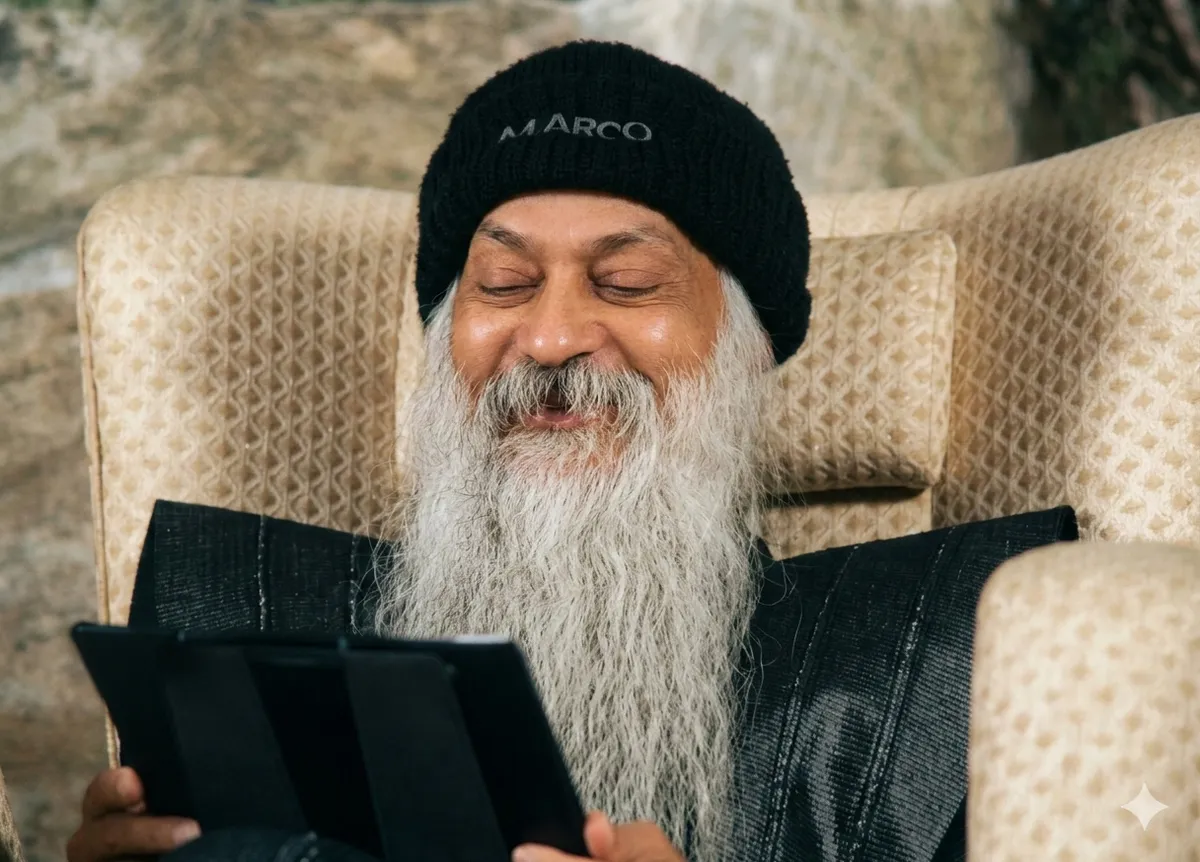
It means your heart is cleaning itself by letting old pain out; crying in meditation is healthy and makes you feel lighter.
From the Discourses
Passages where Osho speaks to this question — each links to the complete discourse.
Osho! While listening to you I start to weep. Now, even in the celebration of active meditation, tears burst forth. What is this? In the midst of meditation a feeling arises that this body is a hindrance now; how can it be shed—the feeling keeps growing more intense. Why? Please explain out of compassion.
Akshay Vivek! Human beings have been given such wrong conditioning that they have neither ever cried to their heart’s content nor laughed to their heart’s content. They have never really lived to their heart’s content. In no aspect, in no dimension, have they ever done anything totally; everything remains half-done! So many things hang inside, suspended like Trishanku. I say meditation is a celebration, but what is happening to you happens to others as well. While celebrating, suddenly tears arise from some unknown corner! They must have been suppressed somewhere—perhaps for lifetimes. Especially in men. Because from childhood we tell boys: Don’t cry! Girls cry. You are a man; crying is not for you. This is false. It is utterly false. Nature has made the tear glands in the eyes of men and women just the same. Men’s tear glands are not smaller than women’s. So one thing is certain—nature…
Osho, meditation increases sensitivity. But as sensitivity grows, living seems to become more difficult—because the mind’s reactions become sharp and intense, and it feels as if one’s whole life is at stake at every small turn. In such a state, how can one find and hold the point of balance?
Certainly: as meditation deepens, sensitivity will also deepen. And with heightened sensitivity, problems grow too. Sensitivity means you will experience everything—every event—in its full velocity, with full intensity. If someone insults you, the way that hurt reverberates inside a meditator will not be the same for a non-meditator. If a thorn pricks, the meditator’s awareness of that sting will be much clearer than that of the non-meditator—because the non-meditator lives in a kind of stupor, a haze of unawareness. The duller the awareness, the less the pain is consciously felt. Perhaps that is exactly why we reduce our awareness—so we can feel less pain. Ask a psychologist and he will say: every child learns early how to numb their awareness. All children are born sensitive. Then they begin to kill their sensitivity—because living with raw sensitivity is very difficult. A certain blunting of feeling becomes “necessary.” That is why, at…
Osho, why do devotees weep? What is the relationship between weeping and meditation?
If devotees did not weep, what else would they do? Why do little children cry when they are hungry? Why does the baby in the cradle cry when thirst arises? That is why devotees cry. Devotees are calling out to Existence itself. And before this vastness the devotee is as helpless as an infant—perhaps even more helpless. Do you see this immensity? What is our strength before it? Do you see this infinity? Where are we before it? Who are we? What are we? We are not even a speck. What standing does a speck have? If this speck does not weep, what else can it do? In helplessness, in darkness, wandering for lifetimes, what else can the devotee do? Had they not been threaded on the bond of sorrow, the pieces of the heart would have lain scattered. It is this cry, these tears, that bind them together— had…
[A visitor says that before he came here he found it difficult to cry. Over the past few days he has been crying a lot.] Mm mm, something has broken inside and you should be happy about it. Some ice has broken, some coldness has broken, some dead layer has broken. Whenever it happens, one starts crying because one again becomes a child. The cry is the first thing that the child does. That is his first entry into the world. Everybody enters the world crying. So if you can really cry deeply, it can become a rebirth. That's why you are feeling so full of change. Your old self will dissolve into crying. So don't stop it -- allow it, and on the contrary, enjoy it. It has a tremendous beauty in it.
Osho, we have to leave tomorrow. Out of your grace, please tell us: are the tears that flow in the beloved’s separation themselves his meditation, or is meditation something else? If meditation is something else, what meditation is that?
Honor these tears! Do not hold them back! In this, women are more fortunate than men, because women have not been taught the stupidity of “don’t cry.” Men have been taught this stupidity a lot. To small boys we say, “You are a manly child; don’t cry! Don’t do girlish things!” As if crying had anything to do with girls! The right to cry belongs to men exactly as it does to women. Crying is an extraordinary alchemy. One who has not passed through it will be deprived of certain experiences; some depths of life will never be known to him; some music of life will never be heard; some songs will never arise within. One who has not known tears will not know compassion, will not know love, will not know sympathy, will not know kindness. Without tears, life becomes arid—a desert—without oases. In this desert-like life, tears are…