
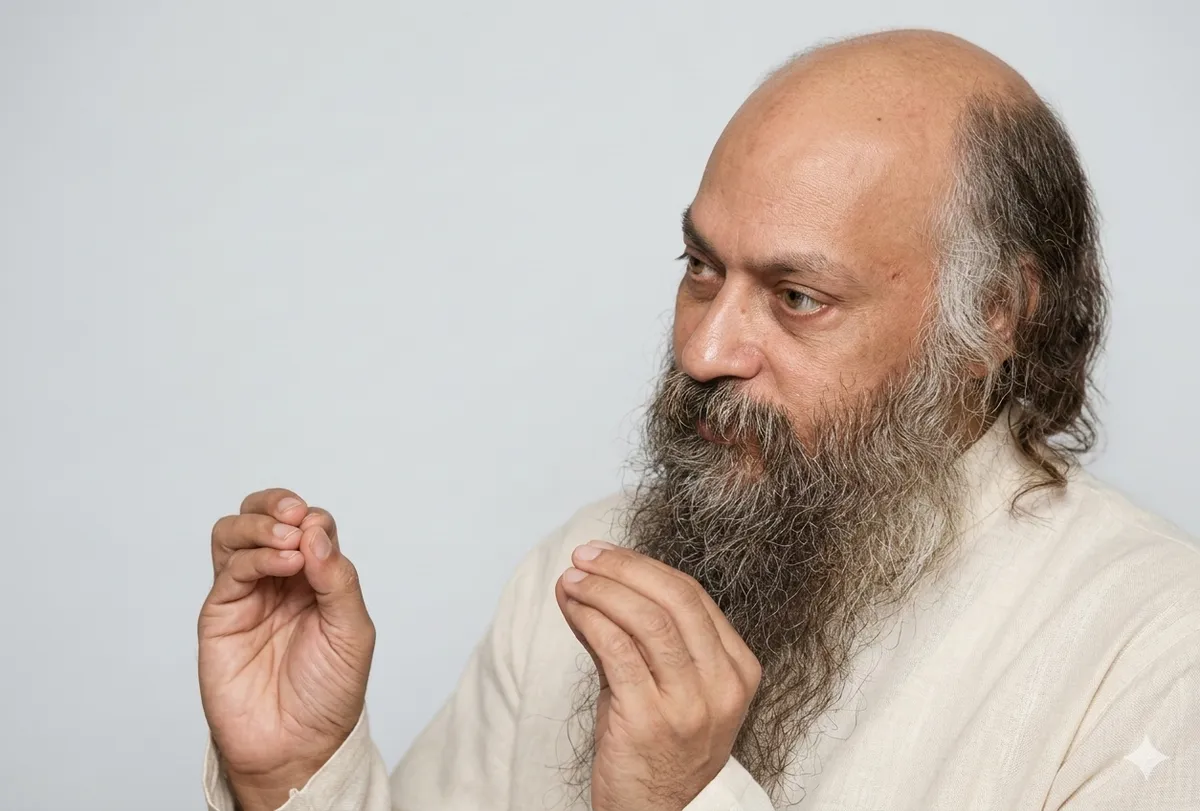
Use words to understand, then let them go and rest in quiet, direct knowing.
From the Discourses
Passages where Osho speaks to this question — each links to the complete discourse.
Question: THE PURPOSE OF A FISH TRAP IS TO CATCH FISH, AND WHEN THE FISH ARE CAUGHT THE TRAP IS FORGOTTEN. THE PURPOSE OF WORDS IS TO CONVEY IDEAS. WHEN THE IDEAS ARE GRASPED THE WORDS ARE FORGOTTEN. WHERE CAN I FIND A MAN WHO HAS FORGOTTEN WORDS? HE IS THE ONE I WOULD LIKE TO TALK TO. It is difficult to forget words. They cling to the mind. It is difficult to throw away the net because not only are fish caught in it, the fisher is also caught. This is one of the greatest problems. Working with words is playing with fire, because words become so important that the meaning loses meaning. The symbol becomes so heavy that the content is completely lost; the surface hypnotizes you and you forget the center. This has happened all over the world.
Osho, I go on forgetting your words. What should I do?
Who has told you to remember my words? That's how it should be, exactly, precisely. You have to forget my words; you have to remember the essence, not the words. And the essence need not be remembered, it has only to be understood. If you are listening to me rightly you need not remember what I have said. In fact, if you try to remember it you will miss the whole point. Then the words will be there and the essence will be missing. Go on forgetting the words otherwise you will be burdened by them, and you will lose track. You just try to understand. When I say 'try to understand' I mean just be silently, passively, alertly listening. Don't judge and don't argue and don't decide whether I am saying something which is right or wrong. Just listen silently. If you become too worried whether I am saying…
Words are like fingers pointing to the moon. A man who concentrates all his attention on the fingers misses the moon. The fingers serve their purpose if they lead you away from them. But on the contrary, they draw you to themselves, then they become not only useless but truly harmful. Haven't the words you have learned about truth become a source of misfortune to you already? Have they not separated you from one another, man from man? Aren't all the stupidities and cruelties perpetrated in the name of religion because of words? Aren't all those sects known as the various religions just based on the differences of words? Truth is one and can only be one, but words are many, just like the moon is one while the fingers pointing to her may be a thousand and one.
When I am with you I am speechless. If eel my mouth and throat become inappropriate and almost lose their function. Yet language is my best implement also my best weapon and without it I feel crippled. Am I as foolish as I feel to be squandering these chances of talking to you?
Your gestalt has to change. That is the difference between a student and a disciple: a change of gestalt, a change of attention, of focusing, a shift. The student listens to the word; the disciple listens to the gap between two words. The student reads the lines; the disciple, between the lines. If to a student I give an empty book, he will not be able to understand it. But if to a disciple I give an empty book, THE NOTHING BOOK, he will preserve it as a treasure. In the Sufi tradition there is a book called THE BOOK OF THE BOOKS. Nothing is written in it; empty pages, almost three hundred empty pages. You go on reading, but you can never finish it. It has been passed from one generation of masters to another. It has been lovingly preserved, worshipped, because it says nothing, but it shows much.…
The thirty spokes unite the one name; but it is on the axle that the use of the wheel depends. Clay is fashioned into vessels; but it is on their empty hollowness that their use depends. The doors and windows are cut out from the walls to form an apartment; but it is on the empty space within, that its use depends. Therefore, what has a (positive) existence serves for profitable adaptation, and what has not, serves for (actual) usefulness.
Freud has discovered a priceless truth. He says: "We also hate those whom we love." This was a startling discovery even for Freud himself. It was a terrible blow for all mankind especially for lovers. Lovers cannot believe they are capable of hatred towards those whom they love. The fact is, however, that all lovers know this within themselves, though they may not admit it. Therefore, Freud was resisted for a long time. Ultimately he could not be proven wrong. Gradually, the truth was accepted. Those whom we love we also despise, for love cannot stand without hatred. If you love somebody and you analyse it honestly, you will find yourself loving and hating alternately. You hate in the morning, love in the afternoon, hate in the evening and again love at night. Your love is periodical. The one you quarrelled with in the morning and decided it was impossible…