
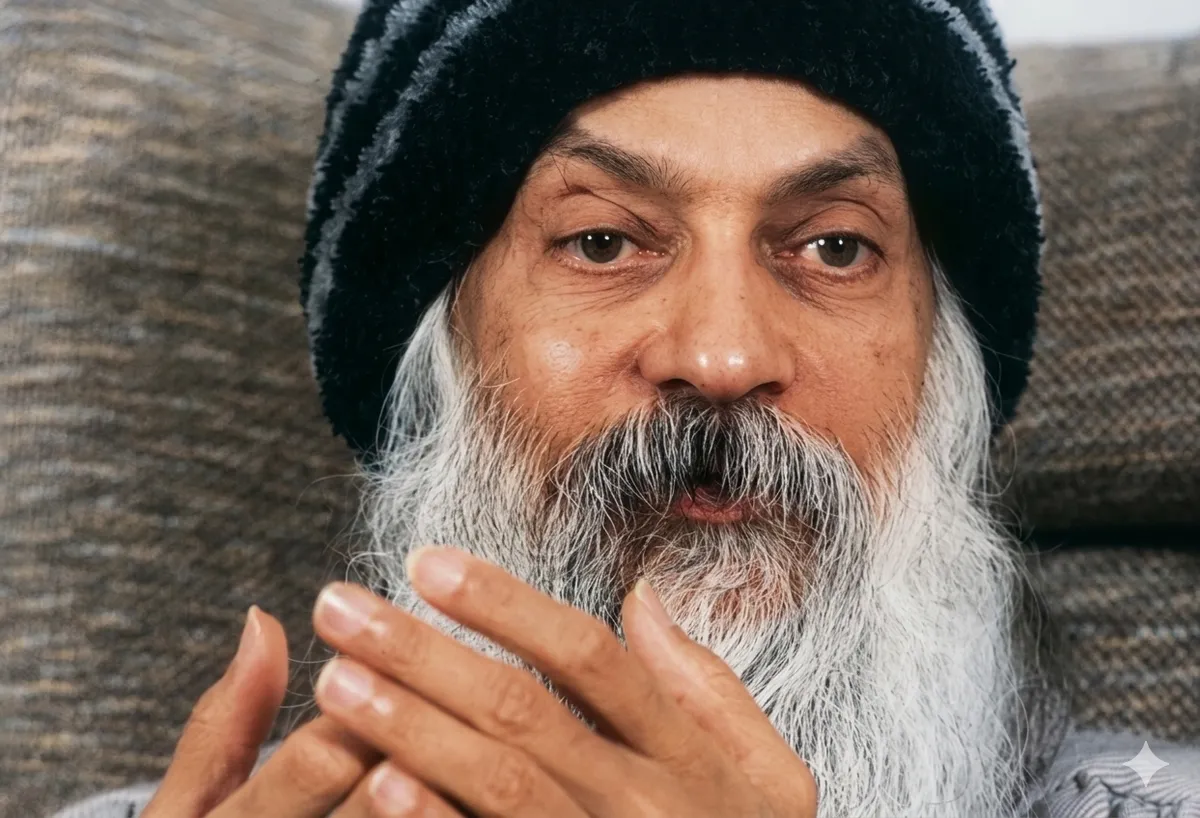
According to Osho, to be pure in heart is the culmination of humility: an egoless innocence, “poverty in spirit” that is empty of greed, anger, ambition, and aggression. When the self is surrendered and the inner space is empty, forgiveness, generosity, and anonymity bloom. Such innocence inherits the kingdom of heaven—losing everything, you gain all.
Purity of heart means dropping your ego and emptying yourself of wants and anger so you become simple, open, and childlike.
From the Discourses
Passages where Osho speaks to this question — each links to the complete discourse.
Questioner: you explained to us this saying of jesus: "blessed are the meek, for they shall inherit the earth" there is another saying of jesus: "blessed are the pure in heart, for theirs is the kingdom of heaven." can you say something about it?
Yes, there is another saying of Jesus: "Blessed are the pure in heart, for theirs is the kingdom of heaven." But there is a small difference between the two sayings: "Blessed are the meek for they shall inherit the earth," and "Blessed are the pure for theirs is the kingdom of heaven." In fact, humility is the beginning and purity is the end, the attainment. To be humble is to be on the first leg of the journey to purity. The humble has yet to be on the first leg of the journey to purity. The humble has yet to be pure; he is on his way to it. One cannot be pure without being humble, because there is no greater impurity than ego. One who is full of ego can never be pure, but one who drops his ego, who is humble, who is surrendered, is on the path…
Osho, you said, “Blessed are the meek, for theirs is the kingdom of earth.” But regarding “Blessed are the pure in heart, for theirs is the kingdom of heaven,” what do you say?
There is another saying of Jesus: Blessed are those whose hearts are pure, for the kingdom of heaven shall be theirs. There is a slight difference between the two. Blessed are the humble—the earth will be theirs, the kingdom of the earth. Blessed are the pure—the kingdom of heaven will be theirs, the kingdom of heaven. In truth, humility is the beginning; purity is the culmination. Humility is the first step; purity is the fulfillment. Those who are humble have stepped onto the first rung. They have opened the door to purity. They are not yet pure, but by becoming humble they open the door to becoming pure. Those who are not humble can never be pure, because there is no greater impurity than the ego. The ego-filled can never be pure; but those who become humble, who drop the ego, who bow down, who surrender—they open the door to…
The traditional sense of being holy is egoistic. It is a new form of egoism. Somebody is bragging about his money, somebody is bragging out his birth, blood, nobility, aristocracy, somebody is bragging about his political power. And somebody is bragging about his virtues, his prayers, his fasts, his austerities. But it is the same bragging -- no difference at all. The ego is the ego. By what it is nourished is of no consequence, it makes no difference. It can be supported by anything. You can support it with a rock, you can support it with gold, you can support it with diamonds, but it is the same ego. Only the support changes, the ego remains the same. When I use the word "holy" I use it in the sense of wholeness, in the sense of being total. To be whole is to be holy.
Purity means innocence, the innocence of a child, the innocence of a flower, the innocence of the dewdrops in the early sun -- that freshness. Purity does not mean that one has to become a saint, and one has to eat this and not eat that, and one has to sleep at a certain hour, and do certain rituals and has to do five prayers every day, five times. Those are all rituals. They don't make you pure, in fact they are the causes of your impurity. Your saints, the so-called saints are the most impure people in the world. Of course from the outside they seem to be utterly sacred, but deep down they are boiling because their whole process of life is repressive, and nobody becomes pure by repressing. It is repression that makes you impure. To be pure means to drop all repressive methods, all taboos.
Sarva karma niraakaranam aawahanam cessation of the cause of all actions is aawahanam -- the invocation.
RELIGION is not ritual. Really, when a religion dies it becomes ritual: the dead body of a religion becomes the ritual. But everywhere ritual is to be found. If you go to find religion, you will find ritual. All these names -- Hindu, Mohammedan, Christian -- these are not the names of religions, they are names of particular rituals. By "ritual" I mean something done outwardly in order to create the inward revolution. This belief, that something done outwardly can create an inward revolution, creates rituals. Why does this belief come into existence? It comes because of a very natural phenomenon. Whenever there is inward revolution, whenever there is inner mutation, whenever there is some inner transformation, it is followed by many outward things and sign -- sit is bound to be, because the inward exists in relation to the outward. Nothing can happen inside which will not affect the…