
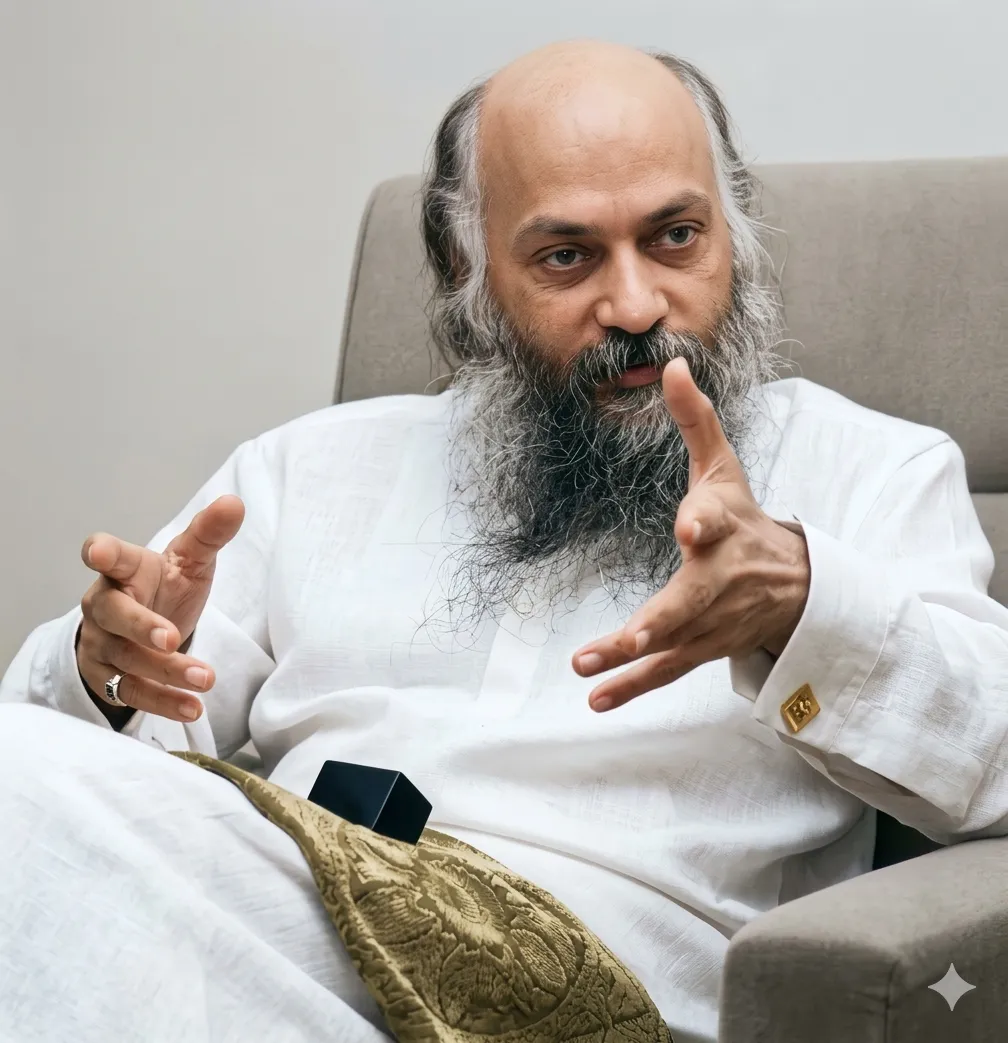
An avadhut stops chasing what fades, lives the deathless truth, sees worldly fuss as dust, and knows everyone and everything is Divine.
From the Discourses
Passages where Osho speaks to this question — each links to the complete discourse.
Deva means divine and aranya means wildness -- divine wildness, divine chaos. Chaos is the source of all, and the moment we become capable of entering chaos we become capable of entering god. God is wild: he is more like a forest than like a garden. The very disorder of it is its order, the very chaos of it is its cosmos. There is a subtle discipline but that discipline is not imposed from the outside; it grows from the innermost core. By becoming a sannyasin one enters divine chaos. Then all that is man-made becomes irrelevant and all that is man-imposed has to be dropped by and by. To be free of the human is to be ready to receive the divine, so an utter transvaluation is needed. A really divine person is neither good nor bad because all good and bad are human concepts.
Osho, you said that when awakening comes one should be aware of unconsciousness; there is no need to fight the various branches. Avrat alone is not enough; along with it, awakening is also necessary. So my point is: if awakening comes, then avrat will come on its own, won’t it?
No, no. Avrat is what we already are. That is, a vrati is one who lives by binding himself in rules; an avrati is one who does not live by binding himself in rules. We are already avrati, understand? There is no question of bringing it. We are already avrati. Some among us are vrati—temple-goers, mosque-goers, those who perform worship and rituals, who live by rules and religion—they are vrati; the rest are avrati. The vrati should become aware with regard to their vows; the avrati with regard to their non-vow. One has to become aware of exactly what one is doing. Then, with awakening, that which the vrati is trying to bring through vows will come. It will come—on its own.
प्रश्न: ओशो, आप बोले कि जागृति आती है तो मूर्च्छा के प्रति जागरूक होना चाहिए, अलग-अलग शाखा से लड़ने की कोई जरूरत नहीं है। अव्रत अकेला ही जरूरी नहीं है, साथ में जागृति भी जरूरी है। तो मेरा यह कहना है कि जागृति आ जाएगी तो अव्रत आ ही जाएगा न?
न, न। अव्रत है ही हमारा। यानी व्रती का मतलब यह है कि जो नियम बांध कर जी रहा है। अव्रती का मतलब है, जो नियम बांध कर नहीं जी रहा है। अव्रती हम हैं ही, समझे न? उसे लाने का सवाल नहीं है। अव्रती हम हैं ही। कुछ हममें व्रती हैं--मंदिर जाने वाले, मस्जिद जाने वाले, पूजा-पाठ करने वाले, नियम-धर्म से जीने वाले--वे व्रती हैं, बाकी लोग अव्रती हैं। व्रती को व्रत के प्रति जाग जाना चाहिए, अव्रती को अव्रत के प्रति। जो हम कर रहे हैं, उसी के प्रति जाग जाना चाहिए। तो जागने से वह आ ही जाएगा, जो व्रती चेष्टा कर रहा है व्रत से लाने की। वह आ जाएगा, अपने आप आ जाएगा।
Deva means divine, god, avesha means possessed by -- possessed by god... and from now onwards I will possess you! So relax and be possessed! Don't fight with me, because that is sheer wastage of energy. If you remain in a let-go, much is going to happen. If you allow me, nothing is impossible, but the whole thing depends on your allowing me; that is the very core of it. And it is difficult... not impossible but difficult certainly. We have been taught to fight, to struggle, to have our own way, to have our own will. We have been taught to be egoists -- and that ego has to be dropped; only then do you allow. When you are not, you allow me -- when you are, you cannot allow. So from this moment, be a nobody... almost a nothingness, empty.
Deva means divine, dwabha means twilight -- divine twilight... and that is the situation where you are. The past is gone, and the future has not come yet. The old is disappearing and the new has not come yet. Hence there is a chaos inside, a great confusion. You cannot go back to the old -- the old mind is no more relevant -- and you don't know what the new mind is. You cannot go on repeating your past, old pattern, and the new gestalt is not yet clear. But this is a beautiful situation -- if understood well it is the chaos out of which stars are born; then it is not destructive. If one does not understand it becomes destructive. One can be split, one can start falling into pieces.
Vedant means that which is beyond scriptures; Satyam means truth. The full name will mean truth which is beyond scriptures. Truth is not something that can be described. Truth is not a theory: it is an experience, an experience so deep, so tremendously intense, so infinite, so mysterious, that no word is adequate to explain it. Not only can words not explain it, they cannot even indicate it, they can't even give hints. It is like explaining light to a blind man. You cannot explain it, there is simply no way, no method. Light can only be experienced. One who has experienced knows; one who has not experienced can only believe. And belief is very dangerous. Doubt is far more beneficial than belief because doubt goads you towards the journey, it keeps you going in search, in inquiry.