
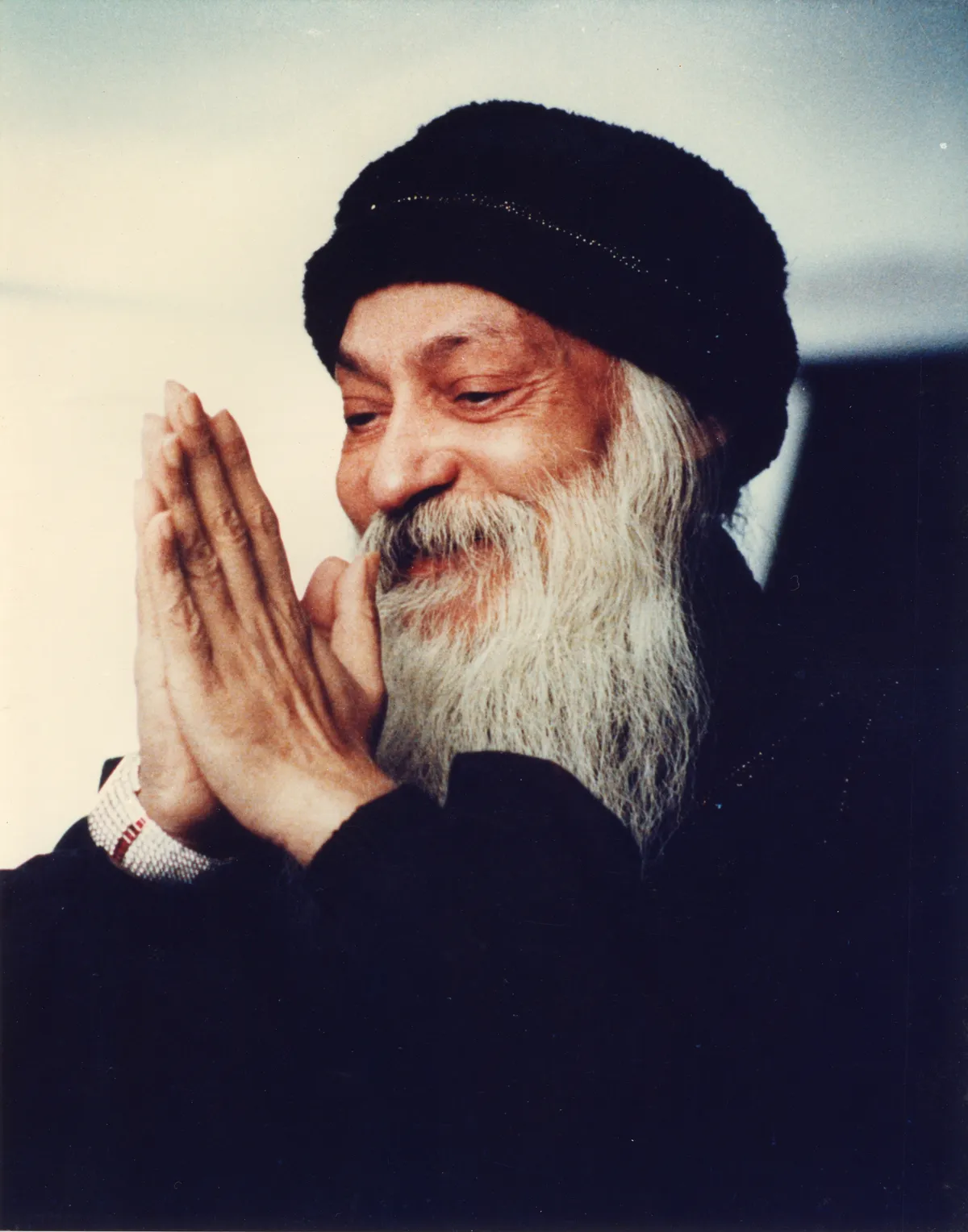
Who you really are—the quiet watcher inside—shapes you more than habits or labels, and some rare people live entirely from that space.
From the Discourses
Passages where Osho speaks to this question — each links to the complete discourse.
Drik swaroop awasthanam akshataha to be established in one's own witnessing nature is akshat -- the unpolished and unbroken rice used for the worship.
Breathe, be aware. And if you are trying to be aware of your breathing, you cannot think, because the mind cannot do two things simultaneously -- thinking and witnessing. The very phenomenon of witnessing is absolutely, diametrically opposite to thinking, so you cannot do both. Just as you cannot be both alive and dead, as you cannot be both asleep and awake, you cannot be both thinking and witnessing. Witness anything, and thinking will stop. Thinking comes in, and witnessing disappears. Witnessing is a passive awareness with no action inside. Awareness itself is not an action. One day Mulla Nasrudin was very much worried, in deep brooding. Anyone could look at his face and feel that he was lost somewhere in thoughts, very tense, in anguish. His wife became alarmed. She asked, "What are you doing, Nasrudin? What are you thinking? What is the problem? Why are you so worried?"…
Osho, we find that our tendencies are stronger than our understanding. When watched with awareness, the waves of hatred, jealousy, anger—all these tendencies—seem to rise from the navel center. The witnessing and the rising of the wave happen together. Please tell us why these waves arise from the navel center. Is the unconscious related to the navel center? And is there a large accumulation of these tendencies in the unconscious, or are they produced moment to moment?
The stream of consciousness itself is not divided. The split into conscious and unconscious exists because of repression. First understand this well. A child is born with consciousness one and undivided. There is neither a conscious mind nor an unconscious mind—no such two parts. But soon the division starts, because we teach the child what is right and what is wrong; what is auspicious and what is inauspicious; what to do and what not to do. And all that we brand as “don’t,” “bad”—what will the child do with it? Calling something bad does not destroy it. We say anger is bad. The child hears and understands—but anger doesn’t vanish just because we label it bad, because anger is natural. The child has not learned anger; he is born with it, just as he is born with a body, with eyes and hands. And existence uses anger: anger is energy.…
प्रश्न: ओशो, हम पाते हैं कि हमारी समझ से वृत्तियां ज्यादा मजबूत हैं। होश से देखने पर घृणा, ईर्ष्या, क्रोध,इन सारी वृत्तियों की लहरें नाभि-केंद्र से उठती हुई दिखाई देती हैं। साक्षीभाव और लहर का उठना एक साथ घटता है। कृपया यह बताएं कि ये लहरें नाभि-केंद्र से क्यों उठती हैं? क्या अचेतन नाभि-केंद्र से संबंधित है? तथा क्या इन वृत्तियों का अचेतन में बहुत बड़ा संचय है या क्षण-क्षण ये वृत्तियां पैदा होती रहती हैं?
चेतना की धारा विभाजित नहीं है। चेतन और अचेतन, दमन के कारण विभाजित हैं। पहले यह बात ठीक से समझ लें। बच्चा पैदा होता है, तो उसकी चेतना एक और अखंड है। न तो वहां कोई चेतन मन है और न अचेतन मन। ऐसे दो भाग नहीं हैं। लेकिन जल्दी ही भाग होने शुरू हो जाएंगे। क्योंकि हम बच्चे को सिखाएंगे, क्या ठीक है, क्या गलत है। हम उसे बताएंगे, क्या शुभ है, क्या अशुभ है; क्या तुम करो, क्या तुम न करो। और जो-जो हम कहेंगे न करो, जो-जो हम कहेंगे बुरा है, वह बच्चा क्या करेगा? बुरा कहने से कोई चीज नष्ट तो होती नहीं। कहा हमने कि क्रोध बुरा है। बच्चे ने सुना और समझा। लेकिन इतना कहने से कि क्रोध बुरा है, क्रोध नष्ट तो नहीं होता, क्योंकि क्रोध स्वाभाविक है। बच्चे ने क्रोध सीखा नहीं है, जन्म से पाया है। जैसे शरीर पाया है, आंखें और हाथ पाए हैं, ऐसे ही क्रोध भी पाया है। और प्रकृति क्रोध का उपयोग करती है। क्रोध ऊर्जा है। बिना क्रोध के बच्चा मर जाएगा। …
Beloved Osho, our impulses seem to be stronger than our understanding. When we look with awareness at our own feelings of hatred, jealousy and anger, they seem to be arising from the navel center. The witnessing and rising up of the waves happens simultaneously. Please, tell us why these waves arise from the navel center? Is our unconscious related to the navel center and is there a great store of these impulses in our unconscious, or are they created moment-to-moment?
So in the name of spirituality there are two possibilities available: either withdraw the fuel supply so that there is no fear of the steam being created, or go on adding weights on the kettle lid so that there is no fear that it will blow off. In one case the result is a dull person who is dead before he has died, and in the other a person doomed to go mad when the explosion finally happens. Those whom we call monks follow one or the other of these two paths of sickness. But look at Buddha or Mahavira; they look neither sick nor insane. It is rare to find a body as beautiful as Mahavira's. His every cell is the incarnation of dance and bliss. Looking at an image of Mahavira it is hard to imagine that we could ever find a more beautiful body. But just look…
Grasp the principle of two witnesses. Always rely on just a happy frame of mind.
EVEN THOUGH YOU ARE DISTRACTED, IF YOU CAN DO IT, IT IS STILL MIND TRAINING. ALWAYS OBSERVE THE THREE GENERAL POINTS. CHANGE YOUR INCLINATION AND THEN MAINTAIN IT. DO NOT DISCUSS DEFECTS. DON'T THINK ABOUT ANYTHING THAT CONCERNS OTHERS. TRAIN FIRST AGAINST THE DEFILEMENT THAT IS GREATEST. ABANDON ALL HOPES OF RESULTS. The first sutra: <q>GRASP THE PRINCIPLE OF TWO WITNESSES.</q> It is one of the most important sutras, one of the very fundamentals of inner alchemy. Let it sink deep in your heart. It can transform you, it can give you a new birth, a new vision, a new universe. It has two meanings; both meanings have to be understood. The first meaning: there are two kinds of witnesses. One kind is the people that surround you. You are constantly aware that you are being watched, witnessed. It creates self-consciousness in you. Hence the fear when you are on…