
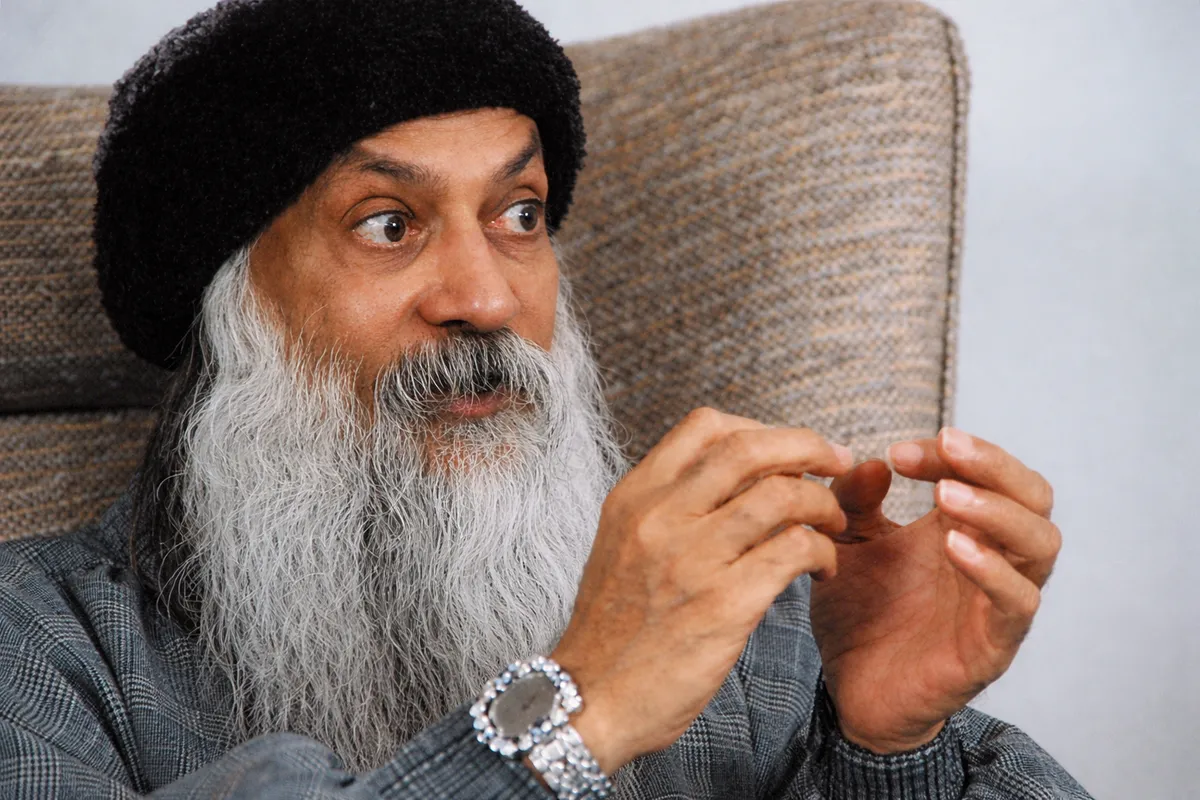
It means some think an enlightened one is God coming down, while others see a person waking up into God; Osho backs the second.
From the Discourses
Passages where Osho speaks to this question — each links to the complete discourse.
Beloved Osho, meher baba speaks about two different kinds of enlightened masters. One he calls "man becoming god," the other he calls "god becoming man." gautam buddha belongs to the first -- slowly, through many lives, he has flowered into the state of buddhahood. Meher baba asserts that he belongs to the second, "god becoming man." I have not really understood what he means. Can you say something about this?
I have been to many courts unnecessarily because whenever I would say anything about Rama, somebody's heart would start having attacks; their religious feelings would be hurt. Their religious feelings are not hurt by the act of Rama. Their religious feelings are hurt but in a wrong situation; I am simply saying what is written in their scriptures. I cannot believe that Rama is an incarnation of God. And the same is the case with other incarnations. Their life proves that they have nothing to do with God. Gautam Buddha, or Mahavira, or Bodhidharma, or Nagarjuna -- these are evolving consciousnesses. They don't believe there is a God. Their experience is that you have to create a god within you, you have to become a womb, and you have the potential to become a god. And looking at Gautam Buddha -- just the way he sits, just the way he…
Meher baba has talked about god descending in man (avatar, rasool, christ) and man rising to be god (the perfect master, sadguru, qutub, teerthankara). Would you please talk to us about the same?
God is. He neither ascends nor descends. Where can he ascend to and where can he descend to? God is all. There is nothing in to which God can ascend or descend. There is nobody else other than God. All that is is divine. So the first thing: there is no ascendence, no descendence. But when Meher Baba says it, there must be some meaning in it. The meaning is something quite different. Let me explain it to you. God is, remember. God is a pure isness, pure existence, and there is nowhere for God to go or come. The whole is full of him. He fills his existence, one thing. Second thing: but Meher Baba must be true. Then there must be some other meaning to it -- not God descending and ascending. What can be the meaning? The meaning is there are two ways of man approaching God.…
Osho, one view says that the Divine incarnates by taking a human body. Another view says that the ultimate flowering of the human being is into the Divine. Which of these is closer to the truth?
Jains and Buddhists gave man dignity—but created dangers. First: you must go alone, by your own hands. Hope dims. It is like trying to lift yourself by your own bootstraps. You must go by your own strength! And you know what your hands have achieved: you sought wealth—didn’t get it; status—didn’t get it; everywhere defeat and disappointment. And now to attain God? What you wanted most has never quite happened—and now this, which has neither clear address nor guarantee—will you seek it? Hard. And alone; with no support; Mahavira says: “asharana-bhava”—do not seek refuge, for there is none. Raise yourself—self-reliance. But do you have such trust in yourself? When the petty has not been fulfilled, how will you fulfill the vast? That is one danger. Second: if you happen to be one of the rare stubborn ones who persist—refining life and conduct until the fragrance of sainthood begins to arise—after…
Being beyond the limits of time he is the master of masters. He is known as aum.
REPEAT AND MEDITATE ON AUM. REPEATING AND MEDITATING ON AUM BRINGS ABOUT THE DISAPPEARANCE OF ALL OBSTACLES AND AN AWAKENING OF A NEW CONSCIOUSNESS. Remember this -- desire and need -- these two words. Desire is of the mind; need is of the body. Desire and need, then you are a clock with hands. Only need, no desire, then you are a clock without hands, and when need also drops, you have gone beyond time. This is eternity; beyond time is eternity. For example: if I don't look at the watch -- and I have to look continuously the whole day -- if I don't look at the watch, I don't know what is the time. Even if I have seen it five minutes before, again I have to look because I don't know exactly, because now -- no time inside -- only the body is ticking. Consciousness has no…
Why do masters need directions from master of masters? Are they not enough in themselves when they have reached enlightenment? Or are there stages of enlightenment too?
In a way it is difficult because I have to work more. In a way it is very beautiful because I have to work more and I have to look from every standpoint possible. I come to know many things which ready-made instructions cannot do. And when the Master of Masters in Patanjali's ideology -- a god -- gives instructions, he gives no explanations; he gives simply instructions. He simply says, "Do this; don't do that." Those who follow these instructions, they will also look like ready-made. It is bound to be so because they will say, "Do this." They will not have the explanation. And very coded instructions are given. Explanations are very difficult -- and there is no need also for them, because when it is given from a higher standpoint it is okay. Just one has to be obedient. The Master is obedient to the Master of…