
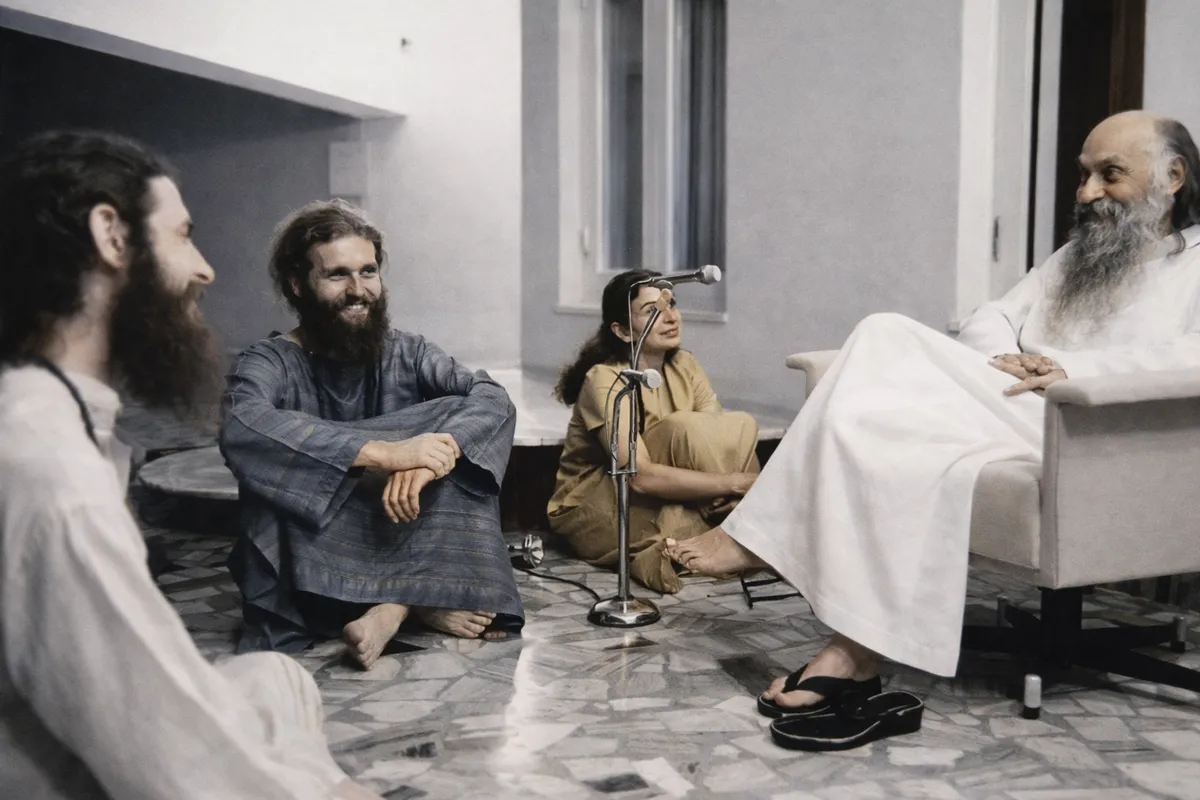
Don’t chase what others think; try things yourself and learn from what happens.
From the Discourses
Passages where Osho speaks to this question — each links to the complete discourse.
So, should one not seek anyone’s opinion?
If you ask me that, you have already started seeking opinions. You have not understood what I am saying. The moment you ask me, we are back to the same old thing. What I am saying is: know this—truth cannot be found by knowing opinions. Whether to ask or not to ask—why should I decide that for you? If you ask, still know that nothing will come of it; if you don’t ask, still know that nothing will come of it. What will happen will happen through living, through your own experience.
Question: BELOVED OSHO, SHOULD WE TAKE YOUR ADVICE NOT TO TAKE ANYONE'S ADVICE? Advice is the only thing in the world which everybody gives and nobody takes. You can ask me a question, but you cannot ask for advice; I am not that foolish. I will never give you any advice, because who am I to give you advice? You are unique, every individual is unique. My advice will be my experience. That may distract you from your own life, that may take you away from your own being. I have never advised anyone. Yes, you can ask a question. The answer that I give only has to be understood, it has not to be accepted on my authority. You have to be just a listener to it, without any prejudice.
Osho, you said... then you will find that the devotee is God. The question arises: if one devotee prefers to be God and another wants to remain only a devotee, then which of the two is superior?
The one who wants to be God will not be able to be. And the one who wants to remain a devotee will become God. The question of superior or inferior does not arise, because only one of the two will happen. The one who does not want to be will be. The one who wants to be will be deprived. That very wanting is of the ego. But the matter is a little delicate. Sometimes humility too belongs to the ego. Beware that your humility may not be of the ego. Perhaps you are saying, “No, I don’t want to be,” because you know that those who refuse are the ones who attain. Then you are clever. Then your humility is adulterous. Your humility is not pure, not sacred, not virginal—it is like a prostitute. The one who wants to be God, whose ego says, “I must become God,”…
Osho, yesterday you said one should not seek a master without first reading the scriptures. I have never studied the scriptures, and the very first time I heard you I accepted you as my master. So is my path wrong? Since yesterday I feel at sea; will I go on wandering forever?
In the depths, whatever happens happens only through your own experience. If your experience is ready and you meet a master, surrender, refuge arises. If your inner experience is not ready and you meet a master, influence arises. Influence comes in a moment and goes in a moment; it has little value. It is like going to see a picture—a film; you are moved for a while. But as soon as the lights come on and the bell rings, you remember it was only a film, a play of light and shadow; there was nothing to cry about, and you walk out laughing. Your eyes may still be wet, but it was all on the surface; it has no inner consequence. Listening to me can also be an influence. My words may feel pleasant, may seem logical. The poetry of my speech may capture your mind. But there is not…
You have heard a very beautiful discourse from Osho today; if you wish to ask a question, you may. Yes, yes—go ahead. A friend is asking: It is said that Arvind experienced shunya, the vacuum. Was that the quest for truth?
To ask about Arvind is futile, because whenever we ask in relation to another—“What was that emptiness that happened to him?”—at most we can only fill ourselves with words. Arvind will become just a word, and Arvind’s shunya will become just a word. And whether he attained or did not attain—these too will become words. No, with respect to the other we can never be free of words. In relation to the other, words are unavoidable. Only in relation to oneself can one be free of words. So do not worry about what happened or did not happen to Arvind. Worry about what can happen to you! And if I say that it did happen to Arvind, you will then ask someone else whether what I said about Arvind is right or wrong—you will still ask. Where will that end? This is an infinite regress, this endless questioning we go…