
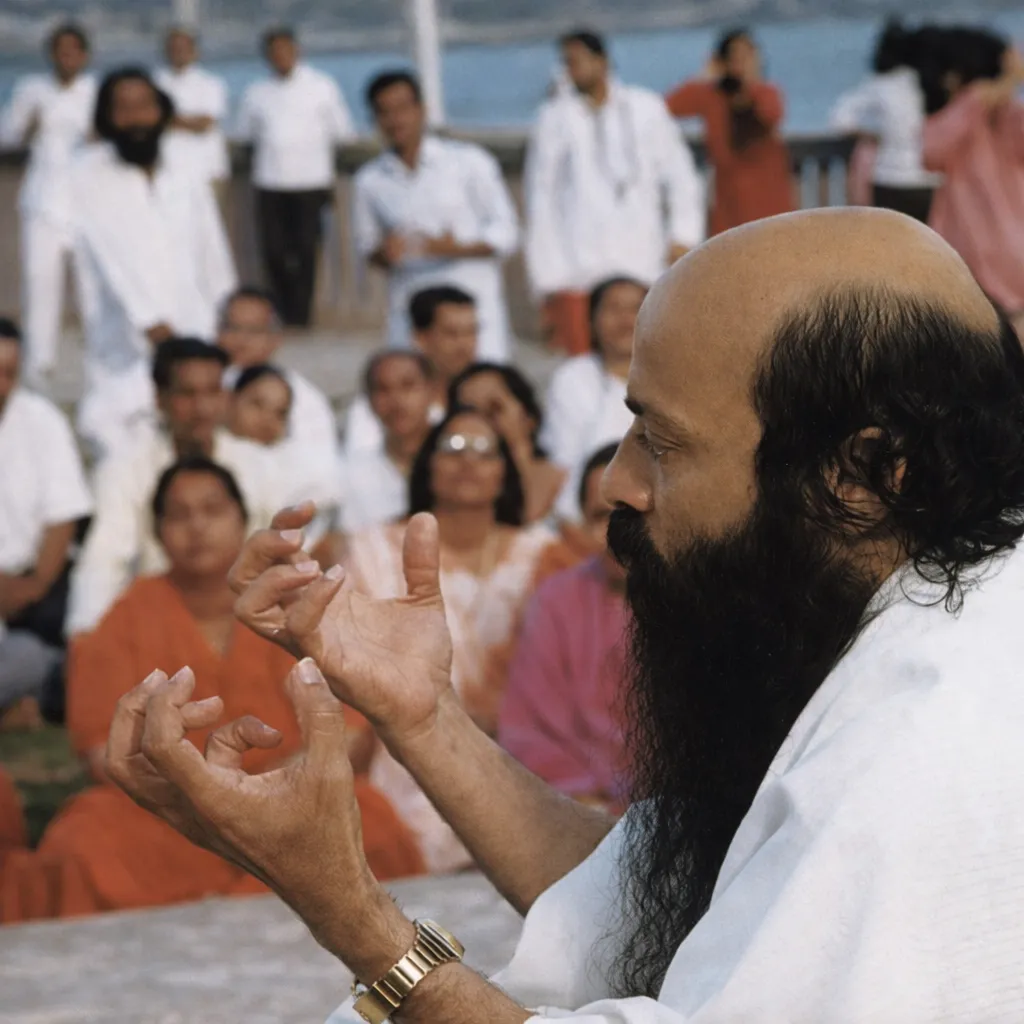
According to Osho, there is no easy, convenient shortcut to truth: you must pay the price of your very self. The egoic 'I' - the outer circumference - must dissolve through deep inward contemplation, allowing the universal inner center (God/Truth) to reveal itself. Losing the false 'I' is the sole way - arduous yet infinitely rewarding in peace, bliss, and awakened consciousness.
There’s no shortcut—let go of your ego by looking deeply within, and the real, peaceful you (truth) appears.
From the Discourses
Passages where Osho speaks to this question — each links to the complete discourse.
A monk asked, is there no easy and convenient way to attain the truth?
It is the law of life that we have to pay price of everything. Nothing is free. And the more valuable an object, the more we have to pay for it. The price for knowing the Truth is our own self -- yes, nothing less than our own self. Lose yourself and find the Truth. In other words, you find yourself when you lose yourself. If you do not lose yourself, you neither gain the Truth, nor yourself. All this may sound complicated, but it can be sorted out by deep contemplation. Haven't you, at times, felt, that whom you consider yourself is not your true self? No, if the 'I' we so often refer to in our daily life, were our true self, there was no question of searching for the Truth. Only because that 'I' is not true, there is the thirst for the Truth. Within ourselves, on…
First you have to become a little happier, you have to learn to be a little more love-full, joyful; your life has to have the color of a little happiness. Then go into the search for truth and you will be moving in the right direction, because then no lie can ever deceive you. You are no more interested in lies, because you are no more interested in consolation and comfort. Now you are ready to know the naked truth as it is. And to be a seeker of truth is the greatest thing in life. Satbodh One cannot find truth by mere thinking. Thinking is not the process that leads you to the truth. It leads only to inference. And inferences are just inferences, they are hypothetical. They may be true, they may not be true. They are just conjectures, not real conclusions.
truth cannot be achieved by human efforts because all human efforts are bound to originate in the mind and mind is the barrier between truth and consciousness the mind has to be put aside that's what man is capable of doing not using the mind, putting the mind aside by-passing the mind, transcending the mind and the moment the mind is not functioning consciousness immediately becomes connected with the truth the barrier is no more there hence the bridge happens and that is the greatest blessing in existence when truth showers on you only with the experience of truth life becomes meaningful, significant a celebration a man without truth is a beggar a man without truth is not yet really alive he is simply living in a kind of dream he is not awakened not awakened to the tremendous beauty of existence to the immense ecstasy of life not aware…
I am an idol-worshipper, but from your point of view there seems to be no need for an idol. Would you advise me to give it up?
Your body on the other hand extends to a point where others do have access. The limit of the world's entry into you is the boundary of your body. The world can enter it because it is a part of the world, of samsara. The senses are the doors through which the world enters. The mind is a hodgepodge of impressions that have entered you like this. That which is beyond the body, beyond the mind and the senses is the soul, atman. Without attaining that soul life is useless, because without knowing and attaining it all knowledge and achievements are worthless. I do not consider samsara and nirvana, the world and emancipation, as two different things. The distinction that exists between them has nothing to do with their natures. it is not an objective distinction. The distinction is not between them, it is in your way of looking at…
Question: Osho, Once there was a city with two parallel lanes. One day a dervish went from one lane to the other, and people saw tears in his eyes. Someone has died in the other lane!" a man shouted. And at once the nearby children took up his words and made a great fuss. In truth, what had happened was that the dervish had been peeling onions. Within a short while the children’s cries reached the first lane. And the elders of both lanes were so saddened and frightened that they did not even have the courage to find out the cause of the clamor. One sensible man tried to explain that the cause should be ascertained. But by then people were so panic-stricken and confused that they were no longer aware of what they were saying.