
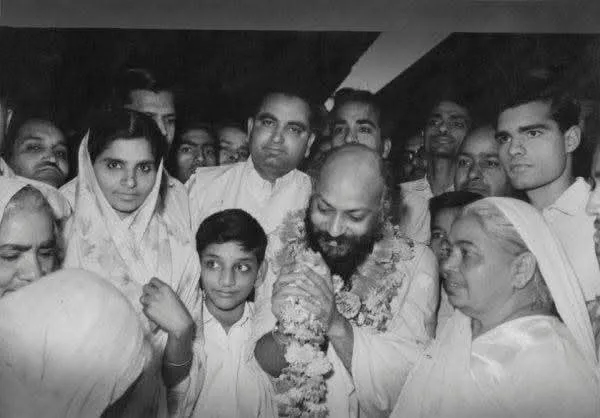
According to Osho, understanding is not separate from energy—it is energy turned inward and unoccupied. When energy chases objects (sex as object, money, power), it remains ignorance; when it falls back into your own source, it becomes awareness. By letting energy accumulate within—through love as giving, reverence, and non-occupation—a qualitative shift occurs, a quantum leap where energy turns luminous as understanding.
When you stop spending your energy chasing things and let it rest inside, it turns into clear seeing and understanding.
From the Discourses
Passages where Osho speaks to this question — each links to the complete discourse.
Is there any relationship between understanding and energy?
Yes, there is. It is energy that becomes understanding. So when you are depleted of energy, you start losing your understanding. When you are tired, your intelligence is less. You have observed it. In the mowing your intelligence is more fresh than in the evening. In the morning you are more understanding, more compassionate, more loving, than in the evening. Have you observed? -- beggars come in the morning to beg. They understand the psychology. In the evening, who is going to give to them? People are so angry by that time, so frustrated with life. In the mowing, they have rested the whole night, a deep sleep, the energy is fresh -- eight hours accumulation of energy. They have more understanding, more compassion, more love, more sympathy. It is possible to persuade them to give something to you. They have, so they can give. By the evening, they don't…
Sannyas is nothing but a name for becoming an individual seeker -- declaring that Buddha may have attained the truth, but that is not my truth; Mahavira may have attained the truth, but that is not my truth. If somebody else has eaten the food that does not mean that I am nourished; I am still hungry. Millions of people have found the truth, but truth is something which remains individual and cannot be given as a thing to somebody else; you have to find it on your own. I think it is one of the most significant gifts of existence that it has not made truth a commodity. Otherwise, there would have been shops in the market where you could purchase truth. You cannot purchase truth at any price. You will have to seek it.
Please say something about the relationship of consciousness and energy.
Hence my insistence on dancing and music, because it is only in dance that you will feel that your body, your mind and you are functioning together. And the joy is infinite when all these function together; the richness is great. Consciousness is the highest form of energy. And when all these three energies function together, the fourth arrives. The fourth is always present when these three function together. When these three function in an organic unity, the fourth is always there; the fourth is nothing but that organic unity. In the East, we have called that fourth simply "the fourth" -- turiya; we have not given it any name. The three have names, the fourth is nameless. To know the fourth is to know God. Let us say it in this way: God is when you are an organic orgasmic unity. God is not when you are a chaos,…
One of the key words to my and others' experiences here is 'energy'. I can feel it -- sometimes more, sometimes less -- and I also feel that opening myself more to experiencing it, is letting it do the job of change. Still it puzzles me as it is a totally new concept to me and I should like to know more about it. Is it an inner or an outer phenomenon, or both? Can one misuse it? Please explain.
The question is from Sucheta. She has stumbled upon one thing which is very significant -- energy. That's what we are producing here. To those who come as spectators, it remains unavailable. Those who come just to see what is happening will not be able to see it. And this is the real happening. But it is invisible. You have to become a participant, only then will you know about it. There are two ways of knowing a thing. One is that of the spectator. You go to the movie, you sit in your chair and you see whatsoever goes on moving on the screen. You are a spectator. This is one of the problems for the modern mind. The modern mind has become a spectator. Somebody is dancing -- you are watching. People are glued to their chairs before their TV sets for five, six, seven hours. The average…
Question: First question: Osho, “बलं वाव विज्ञानाद् भूयः; अपि ह शतं विज्ञानवतां एको बलवान आकंपयते। स यदा बली भवति, अथोत्थाता भवति, उत्तिष्ठन परिचारिता भवति, परिचरन उपसत्ता भवति, उपसीदन द्रष्टा भवति, श्रोता भवति, मन्ता भवति, बुद्धा भवति, कर्त्ता भवति, विज्ञाता भवति।।” Strength is superior to science, for a single strong man can terrify a hundred scholars. Only when a man is strong does he rise to stand; rising, he serves the master; by serving, he becomes worthy to sit near the master; by sitting near, he becomes a seer, a listener, a contemplative, a buddha, a doer, a knower. Osho, please compassionately explain in detail the intent of this seemingly strange sutra from the Chhandogya Upanishad. The youth left, but fell into great restlessness. The fakir was not mad. Fakirs are always a little illogical; if a fakir were logically neat, he wouldn’t be a fakir.