
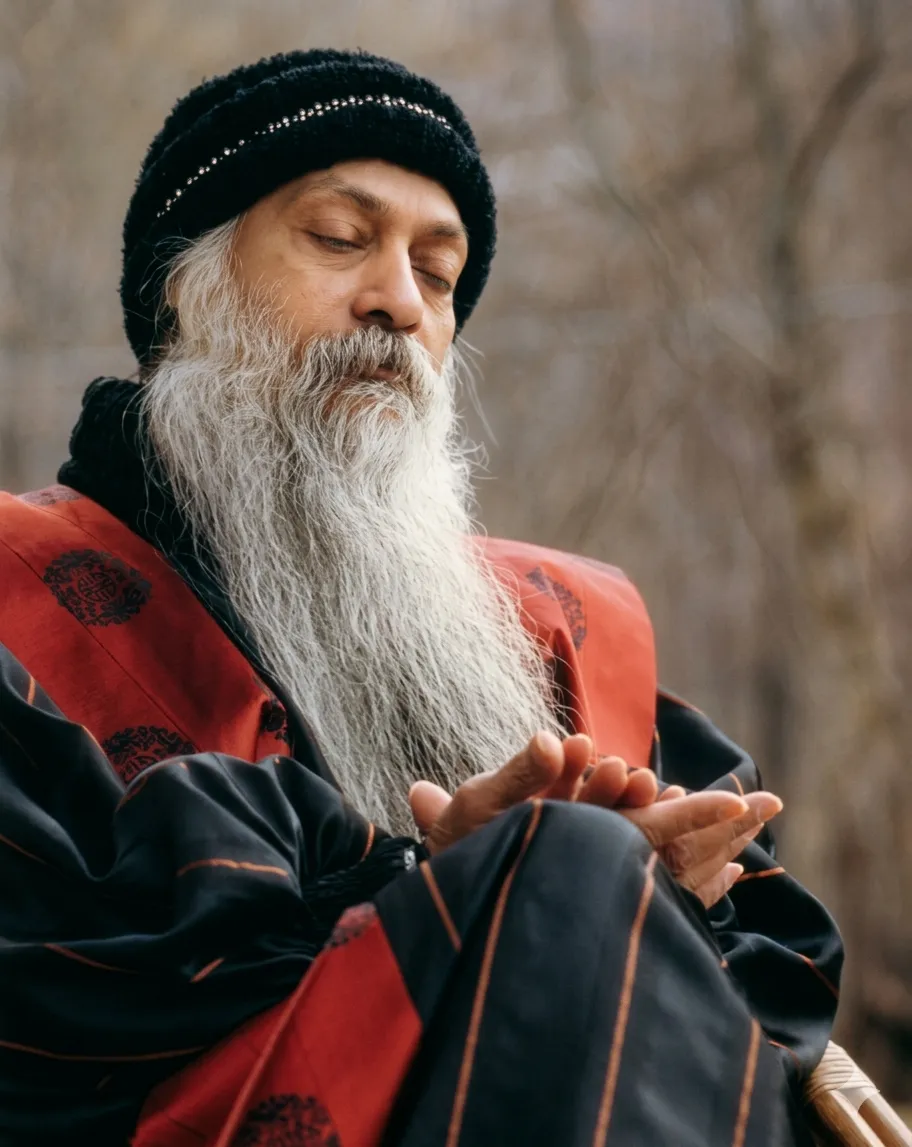
If you really know yourself from inside, you act kindly and responsibly, so you don’t need anyone to control you.
From the Discourses
Passages where Osho speaks to this question — each links to the complete discourse.
Question: BELOVED OSHO, IS THERE ANY RELATIONSHIP BETWEEN GNOSTICISM AND ANARCHY? The word `anarchism' has tremendous implications. It means that the people are so inwardly disciplined that they don't need any government. They are so deeply in order within themselves that no order outside is needed. Anarchism is basically the transformation of the individual in such a way that the government becomes superfluous. He lives in the light of his consciousness, fully aware of what he is doing, fully aware of its consequences, aware that it is not his right to interfere with any individual's life, or to trespass -- even in very subtle matters like conversion. Making an effort to convert somebody to your ideology is a trespass of that individual's consciousness. Unless he invites you, it is aggression.
Osho, the other day you said that some people are born buddhist. I must be one of them, because I always feel deeply in tune when you speak on buddha or ikkyu. This is my natural climate. But I remember that I also felt like that when you were speaking on jesus, yoga, tao, sufism... Please help me to find out which is my true nature.
SUGEETA, you are a natural Rajneesh freak. The last question I HEAR SO MANY STORIES ABOUT YOU, ALL CONTRADICTING EACH OTHER. EVEN ABOUT YOUR PHILOSOPHY, NO TWO DISCIPLES OF YOURS SEEM TO AGREE. WHY IS IT SO? I HAVE NO PHILOSOPHY AT ALL. So how can my disciples agree on anything? I have no dogma, no creed. My assertions are not philosophic, but poetic. My assertions are not about the truth, they are only devices to help you awake. For one disciple I create one device, for another another. How can they agree? They will agree only when both have become awakened; their awakening will be the agreement. But when two persons are awakened they have nothing to say. They may laugh -- their laughters may agree. Or they may cry out of joy -- their tears may agree. But statements can't agree. You must be new here. Don't be…
Osho, does Kropotkin’s anarchism contain some element of communism?
No. Kropotkin and the others have nothing to do with communism; in fact, they are its enemies. Because, in their view, communism cannot come without state power. To bring communism you need the apparatus of the state, a dictatorship—only then can you impose it. And they do not accept that any apparatus is needed. Hence there was opposition between them and communism. Anarchists and communists have been enemies; there is no common ground between them. Communism says that one day the state, developing further and further, will wither away. But anarchists say: the more the state develops, the stronger it becomes—how is it going to wither away? My position is very different. For me it is not very important whether there is a state or not, whether there is an external order or not. Man should become such that he can remain orderly even within disorder. Man should be like…
ओशो, क्रोपाटकिन के अनार्किज्म में कम्युनिज्म का कुछ तत्व है?
न, क्रोपाटकिन वगैरह को कम्युनिज्म से कोई मतलब नहीं है, बल्कि वे दुश्मन हैं। क्योंकि कम्युनिज्म मूलतः बिना राज्य-सत्ता के आ ही नहीं सकता, उनके खयाल से। क्योंकि कम्युनिज्म लाना पड़ेगा तो राज्य की व्यवस्था चाहिए, तानाशाही चाहिए, तब ला सकोगे। और वे तो मानते नहीं कि कोई व्यवस्था चाहिए। इसलिए वह तो कम्युनिज्म और उनके बीच विरोध था। अनार्किस्ट और कम्युनिस्ट तो दुश्मन रहे आपस में और उनके बीच कोई तालमेल नहीं है। क्योंकि कम्युनिज्म आएगा राज्य से और वे हैं राज्य के दुश्मन। कम्युनिज्म मानता है कि एक दिन ऐसा आएगा कि राज्य विकसित-विकसित होते हुए विलीन हो जाएगा। लेकिन अनार्किस्ट मानते हैं कि राज्य जितना विकसित होगा उतना ही मजबूत हो जाएगा, विलीन कैसे हो जाएगा? मेरी स्थिति बहुत और है। मेरे लिए यह सवाल बहुत महत्वपूर्ण नहीं है कि राज्य है या नहीं है, व्यवस्था है या नहीं है। आदमी ऐसा होना चाहिए जो अव्यवस्था में भी व्यवस्थित रह सके। आदमी ऐसा होना चाहिए! …
Beloved Osho, I have heard you say that you would like to sever our relationships with all "isms." does this include rajneeshism as well?
It would be easier to call it something totally new, but then nobody would understand what it is. So until we have enough people to understand, we will have to carry a wrong label on it. Once they have understood, the label will be removed. Once we have our own world around this earth, "ism" is not going to be part of our way of life. So if you think Rajneeshism is also an "ism," throw it away. You have not understood anything. Your approach is still intellectual; otherwise, such a question would not have arisen. You can see -- no dogma is preached, no belief system is given. You are not required to accept anything. The atheist can become part of my communes, the theist can become part, the communist can become part, the capitalist can become part. We don't discriminate against anybody. Our basic approach is such, that…
Beloved Osho, just a few days ago you spoke to us of three categories of belief: theist, atheist, and agnostic. What do you say about gnostic?
So people cling either to theism, or those who are a little stronger, intellectual, the intelligentsia -- they cling to atheism. But both are escapes from doubt. And to escape from doubt is to escape from inquiry -- because what is doubt? It is only a question mark. It is not your enemy. It is simply a question mark within you which prepares you to inquire. Doubt is your friend. And I had talked about the third category, the agnostic. The theist is the weakest of the three: less cultured, less educated, less intellectual -- just a mediocre person. The second category, the atheist, is more intellectual, more cultured, and tries hard not to be bothered by the question, and puts the question absolutely away as far as he is concerned, by arguing that there is no God. If an atheist and theist discuss and debate, the atheist is always…