
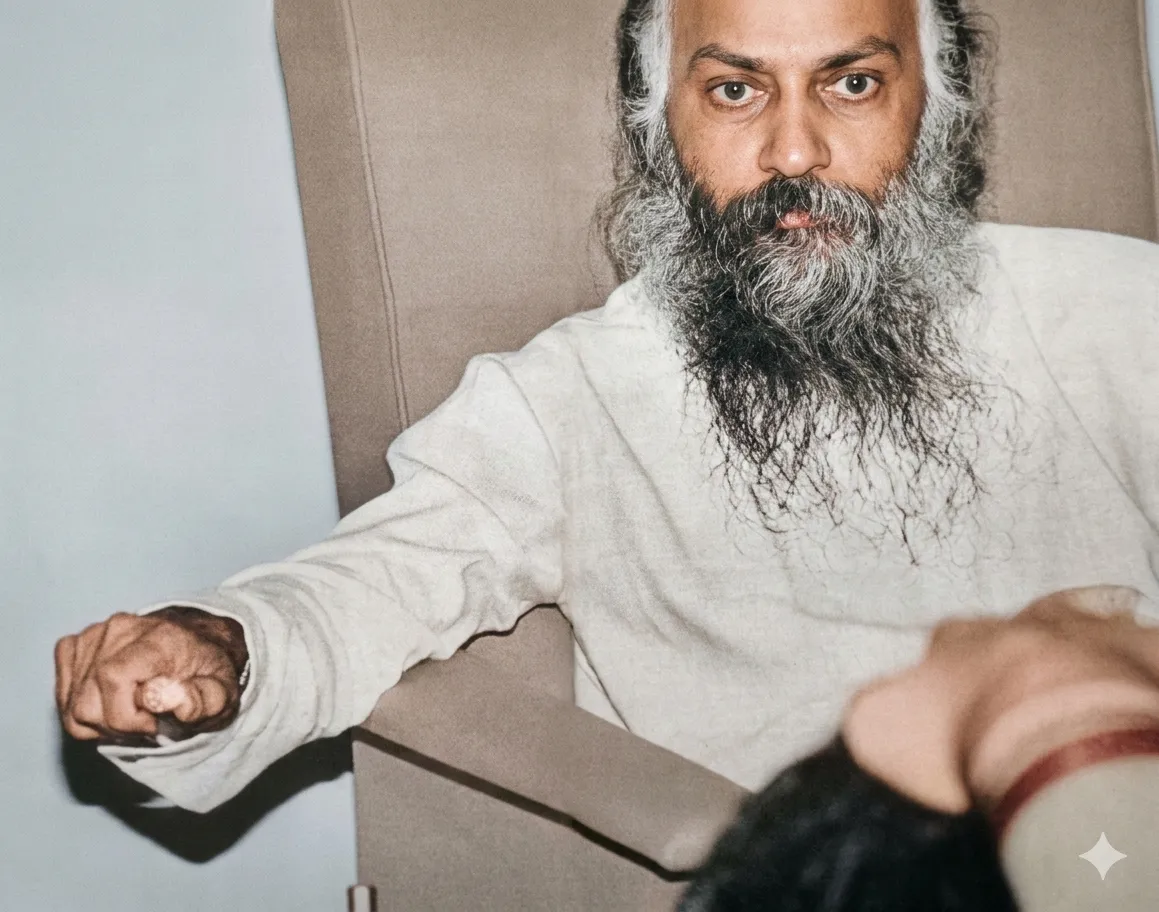
Not quite: first you watch (I and you), then you feel only “I am,” and finally, in tathata, everything—me, you, and the world—is one big “is,” simple being.
From the Discourses
Passages where Osho speaks to this question — each links to the complete discourse.
Is tathata the same as being just aware?
Actually, there is a slight difference between tathata and what you call "just awareness." Witnessing is also slightly different from it. You can say that being "just aware" makes up the link between witnessing and tathata. As you move from witnessing to tathata, you pass through the state of "just awareness." In the state of witnessing, there exists a firm feeling of "I am" and "you are." In the state where there is just awareness, only the feeling of "I am-ness" remains, the feeling of 'you' disappears. There is just the feeling of am-ness. In tathata, besides the feeling of am-ness, there is the feeling that my am-ness, my existence and your you-ness, your existence, constitute only one is-ness, one existence; that they are one and the same. As long as there exists just the awareness, just the feeling of am-ness, there will remain a world outside my state of…
Osho, are “just awareness,” mere alertness, and tathata the same?
In fact, when we say “just awareness,” mere alertness, there is a slight difference between that and tathata. And there is also a slight difference between that and the witness. Think of “just awareness” as the link between the witness and tathata—when you pass from witnessing to tathata, this will be the link in between: just awareness. In witnessing, the sense that “I am and you are” is firm. In just awareness there is only “am”; the sense of “you” has been forgotten—only the sense of being. In tathata, it is not only the sense of being; my being and your being are one being. Because as long as there is just awareness, as long as there is only the sense of being, there will be a boundary outside that sense of being—something I am not, from which I am separate. In tathata there is no boundary. There is only…
ओशो, जस्ट अवेयरनेस, केवल होश और तथाता एक ही बात है?
… और इसमें और साक्षी में भी थोड़ा-सा फर्क है। अगर ऐसा समझें कि साक्षी और तथाता के बीच की कड़ी--जब तुम साक्षी से गुजरोगे तथाता तक, तब यह बीच की एक कड़ी होगी--जस्ट अवेयरनेस। साक्षी होने में मैं हूं और तू है, इसका भाव पक्का है। जस्ट अवेयरनेस में सिर्फ हूं; तू का भाव भूल गया है। सिर्फ होने का भाव। तथाता में सिर्फ होने का भाव ही नहीं है। यह मेरा होना और तेरा होना एक ही होना है। क्योंकि जब तक जस्ट अवेयरनेस भी है, जब तक सिर्फ होने का भाव भी है, तब तक होने के भाव के बाहर एक सीमा होगी, जो कि मैं नहीं हूं, जहां से मैं अलग हूं। तथाता में कोई सीमा नहीं है। …
Osho, in the context of the practice of heedfulness (apramad), please explain the similarities and differences among the practices of witnessing, awareness, and tathata.
One more thought on tathata. A Zen fakir wrote a small song: “The geese fly across the sky. They have no desire that their reflections be formed in the still lake below. Yet the reflections form. The blue lake has no desire to catch the reflections of the geese. Yet the reflections are caught. Then the geese fly on and the reflections also fly away. The geese do not know they were caught in the lake; the lake does not know that the reflections aroused any curiosity, any stir, any disturbance in its bosom.” Tathata means such a being. Things happen. He is ready for all—wants to do nothing and has no complaint. That is why one of Buddha’s names is Tathagata. He loved that name. Even speaking of himself he would say, “The Tathagata passed through a certain village.” Tathagata means one who has attained tathata—thus come, thus gone.…
ओशो, अप्रमाद की साधना के संदर्भ में कृपया समझाइए कि साक्षी, सजगता और तथाता की साधना में क्या-क्या समानताएं व भिन्नताएं हैं।
तथाता का एक खयाल और मुझे आया वह आपसे कहूं। एक झेन फकीर ने एक छोटा सा गीत लिखा है। उस गीत में लिखा है कि आकाश में हंस उड़ते हैं। उनकी कोई इच्छा नहीं होती कि नीचे की शांत झील में उनका प्रतिबिंब बने। लेकिन प्रतिबिंब बन जाता है। नीचे की नीली झील पर से ऊपर जब हंस उड़ कर निकलते हैं, झील की कोई इच्छा नहीं होती कि हंसों का प्रतिबिंब पकड़े, लेकिन प्रतिबिंब पकड़ लिए जाते हैं। फिर हंस उड़ जाते हैं और प्रतिबिंब भी उड़ जाते हैं। न हंसों को पता चलता है कि झील में पकड़े गए थे, न झील को पता चलता है कि हंसों के प्रतिबिंबों ने झील की छाती में कुछ कुतूहल, कुछ हलचल, कुछ उपद्रव पैदा किया है। तथाता का अर्थ है ऐसा व्यक्तित्व। चीजें हो जाती हैं। सबके लिए राजी है। कुछ करना भी नहीं चाहता, कोई शिकायत भी नहीं है। इसलिए बुद्ध का एक नाम तथागत है। बुद्ध का एक नाम तथागत है। बुद्ध को बहुत प्रेम था उस नाम से। खुद भी वे कहते थे, तो वे कहते थे, तथागत एक गांव से गुजरे। तथागत का मतलब है: तथाता को उपलब्ध। …
When both the situations -- whether an empty boat bumps or a boat with a sailor bumps against your boat -- are one and the same to you. That is total acceptability. Even if there is the least amount of difference in your attitude you miss total acceptability. If one person throws flowers at you and another person throws stones at you, and if you accept both the situations, you make no distinction between the two, then there is total acceptability. Then you have no desire of having a different thing than that which is happening in this world. You are pleased with this entire, huge, endless universe where waves are moving in the ocean, tempests of wind are rising, flowers are growing on trees, stars are moving in the sky, someone is abusing and someone is singing songs. You accept the whole as it is.
Osho, what is the definition of God?
Words are very small. If you say God is light, then what of darkness? The scriptures have said that God is light. Suppose we accept this as a definition—then what about darkness? Where will darkness go? Darkness is too; in fact it is far more than light. Light sometimes is and sometimes is not; darkness is always, eternal. Where will you place darkness? If you say God is light, darkness is left out. If you say God is darkness, then light is left out. If you say God is both darkness and light, a contradiction arises: they cannot be together. Try to have both darkness and light in the same room. If you bring in light, darkness disappears; if you preserve darkness, you cannot have light. Then how can both be together? That becomes an impossibility. So you cannot say “both” either. Then the fourth device is to say: it…
पहला प्रश्न: ओशो, परमात्मा की परिभाषा क्या है?
शब्द तो बड़े छोटे-छोटे हैं। अगर कहो परमात्मा प्रकाश है, तो फिर अंधेरे का क्या होगा? ऐसा कहा है शास्त्रों में कि परमात्मा प्रकाश है। चलो मान लें इसे परिभाषा, फिर अंधेरे का क्या होगा? फिर अंधेरा कहां जायेगा? अंधेरा भी है, प्रकाश से कहीं ज्यादा है। प्रकाश तो कभी होता है कभी नहीं भी होता; अंधेरा सदा है, शाश्वत है। अंधेरे को कहां रखोगे? अगर कहा परमात्मा प्रकाश है, तो अंधेरा बाहर पड़ गया। अगर कहा परमात्मा अंधेरा है, तो प्रकाश बाहर पड़ गया। अगर कहो परमात्मा अंधेरा प्रकाश दोनों है, तो विरोधाभास होता है। दोनों एक साथ हो नहीं सकता। एक ही कमरे में अंधेरा और प्रकाश करके दिखाओ। प्रकाश करोगे, अंधेरा खो जायेगा; अंधेरा बचाओगे, प्रकाश न कर सकोगे। तो दोनों साथ कैसे होंगे? तब एक असंभव बात हो गई। तो यह भी नहीं कह सकते कि दोनों है।