
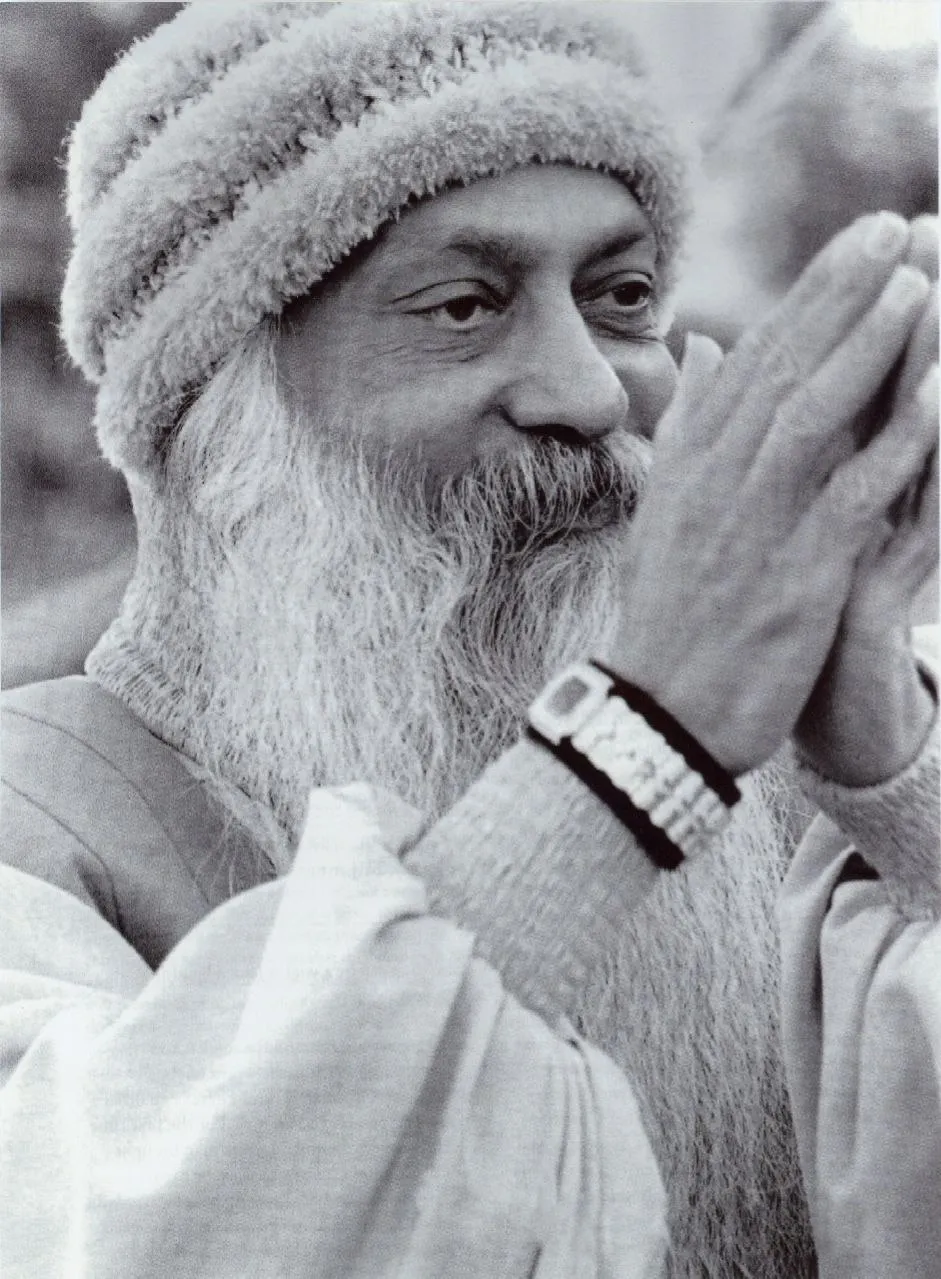
God is in everything, so don’t trap Him in a statue; see Him everywhere, and then even a statue is just part of the whole.
From the Discourses
Passages where Osho speaks to this question — each links to the complete discourse.
A friend has asked: Osho, if God is everywhere, then why would he not be in an idol?
Of course he will be. But the one who insists that he is only in the idol will never find him everywhere. And for the one who does not find him everywhere, he cannot be in the idol either. God is everywhere—certainly he is also in the idol. But the person who says, “He is only in the idol,” for that person he is not everywhere; and for the one for whom he is not everywhere, he cannot be in the idol either. And the one who says, “He is everywhere,” will not go searching for an idol; whatever he encounters will be God. He will not go searching for a temple, because all is his temple. Then he will not say, “This is my idol; I will worship it.” Whom to worship then? When all is that. Every breath is that, every particle is that—so whom to worship? I…
What my friend has asked is: Osho, if God is in everyone, then He must also be in an idol. So if we worship an idol, what objection do you have?
I object very much. My objection is strong. And the objection is precisely this: as long as you cling to the idol, He will not be seen in all. And once He is seen in all, then He will be in the idol too. But what need will there be for worship then? Who will worship? Whom will one worship—when He is seen in everyone? Eknath was returning from Kashi with all his friends. They were carrying water to offer at Rameshwaram. In between there was a desert, and a thirsty donkey lay there. Could God possibly be in a donkey? Never—how could God be in a donkey? In earlier primers for children, for the letter “ga” they used to write, “ga for Ganesh.” In some books people wrote, “ga for gadha (donkey).” The religious folk protested mightily: “This is very wrong. It should be ‘ga for Ganesh’—how can it…
Another friend has asked: Osho, if meditation can lead to samadhi and samadhi to knowing the Divine, then is going to today’s temples pointless? And should they be removed?
The husband was stunned. It was true. “But how did you know?” he asked. The wife said, “Last night, as you fell asleep, you said to me, ‘Tomorrow morning I must buy shoes. He’s quoting a high price; I’ve managed without shoes this long, but I must go in the morning.’ From experience, the last thought at night becomes the first in the morning. So I guessed you must be at the shoe shop just now.” The husband admitted, “I can’t deny it—this is the truth. I was chanting ‘Ram Ram’ loudly, but when she spoke, I saw I was at the shoemaker’s; he was demanding too much, I had grabbed him by the neck—an argument had started—and amid that inner quarrel I was chanting even louder. She is right; perhaps I have never been to the temple.” Entering the temple is not so easy as stepping within four walls.…
Osho, where is God? If we are to seek, where should we seek?
Is it a boat or the moon’s shadow upon the ocean’s waters? When will that boat of light touch the shore of night? Is that untouched lunar shade a frolicsome ripple, A fleeting kiss of light on parched, impatient lips? Dream, or ideal, or resolve—call it what you will— A jewel of a ray, a blossom on the body of dusk! Beyond the reach of clay—are all things false there? Are eyes, fixed on limits, chained to the horizon’s bar? How can literate eyes read what the heart hums within— What fragrance once inscribed as verse upon the gentle breeze! Let the unreachable become reachable—this is the abyss’s longing; Made vocal, written upon the deep heart of the ocean! What is that song of the Unseen the moon keeps writing— Boundless love on the boundless grief of the bounded! The quarters beat the drum, the sky is sound, Time sings,…
Osho, it is said, “bhaktya anuvritya.” Then devotion must be to a form. The sun is manifest with form in the sun realm; in the same way, why is God not with form?
Who said God is not with form? All forms are his. God has no form of his own. You are looking for God’s own form; that is why the question arises as to why God is not with form. In the tree, God is a tree; in the bird, a bird; in the waterfall, a waterfall; in a man, a man; in a stone, a stone; in a flower, a flower. If you look for God’s particular form, you will go on missing. The one to whom all forms belong cannot have a form of his own. Now this is quite a curious thing. It means: the one of whom all forms are, he himself can only be formless. It sounds a bit upside down: the one who has all forms is formless! How could the one of whom all names are, have a name of his own? The one…