
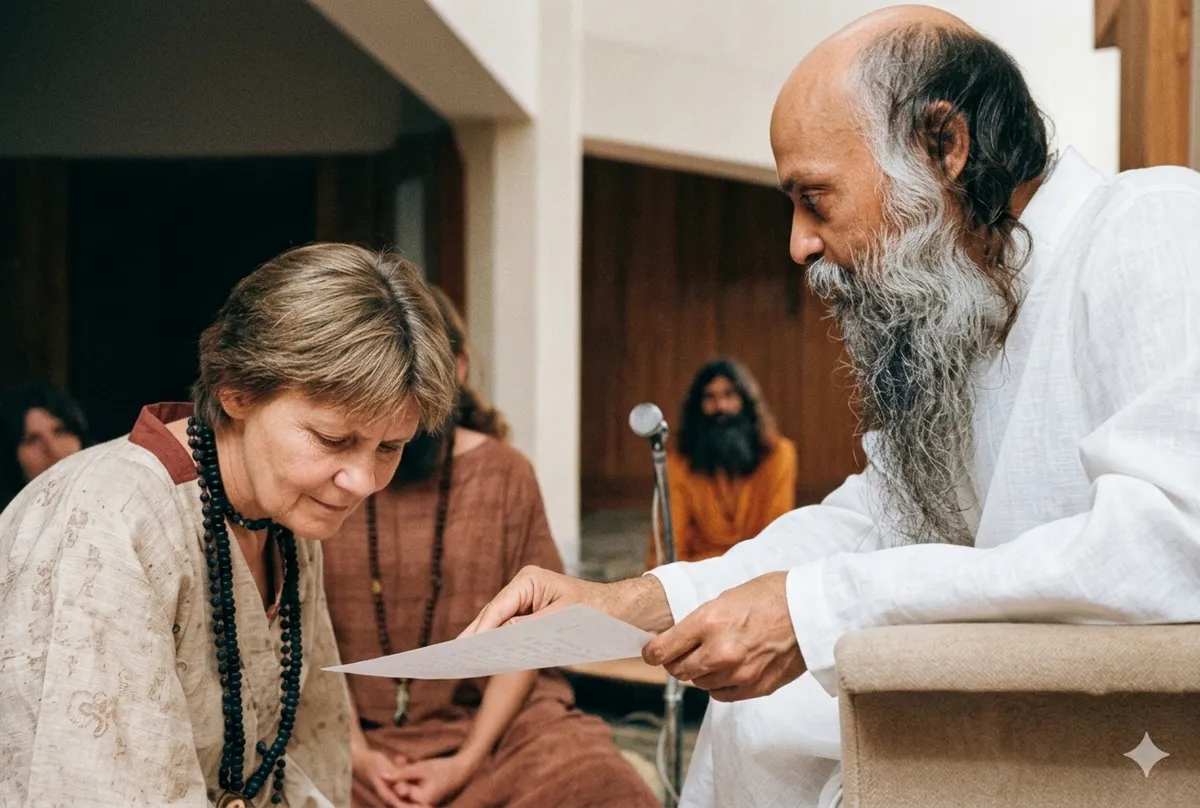
According to Osho, remembrance of the Divine begins not by forced thinking, but by satsang - being with one who is divinely intoxicated - and receiving a heart-stirring glimpse, even through their eyes or picture, like the moon reflected in a lake. Drop the ego that refuses to bow; then trust, longing, and authentic remembrance naturally arise, and the Sadguru finds you.
Be near a true knower of God and let go of your ego; their presence lights the real remembering in your heart.
From the Discourses
Passages where Osho speaks to this question — each links to the complete discourse.
Osho, how does the remembrance of the Divine begin? How am I to remember God? I have no clue to God at all.
Have you ever known any joy through the ego? The ego aches like a wound; the smallest things hurt. The greater the ego, the greater the pain in life. Remove the source of this pain. Then some true Master will knock at your door. Or, unawares, you will recognize a Master in one in whom you had never seen one before. Sometimes he was living right next door and you did not hear; you met daily on the road, exchanged greetings—and still you never saw. You need the eye to see; the ego does not allow such an eye to be born. Ego is a great curtain. One way is this. If this too feels hard—if letting the ego drop is not easy, if recognizing the Master is not easy—then there is another way: search in nature. In waterfalls, trees, winds, the moon and the stars. Do not search for…
Osho, what is the definition of God?
Words are very small. If you say God is light, then what of darkness? The scriptures have said that God is light. Suppose we accept this as a definition—then what about darkness? Where will darkness go? Darkness is too; in fact it is far more than light. Light sometimes is and sometimes is not; darkness is always, eternal. Where will you place darkness? If you say God is light, darkness is left out. If you say God is darkness, then light is left out. If you say God is both darkness and light, a contradiction arises: they cannot be together. Try to have both darkness and light in the same room. If you bring in light, darkness disappears; if you preserve darkness, you cannot have light. Then how can both be together? That becomes an impossibility. So you cannot say “both” either. Then the fourth device is to say: it…
Osho, I remember God so much, but a question arises in my mind: does God ever remember me, or not?
Teach a parrot “Ram-Ram” or teach it abuses—nothing goes deep; a parrot is a parrot. And most of your prayers are parrot-like—learnt by rote, taught by others. I am not asking for such prayers. At the very least, let your prayer be yours, your own. Don’t repeat borrowed words before the Divine. Don’t just chant the Gayatri. Sing your own song. Gayatri was someone’s own song once—then it was beautiful. When it arose from a living heart, it was filled with divinity. For the first singer, Gayatri’s glory is beyond telling. But Gayatri is not yours. You sit and mutter it—parrot-fashion. Your own Gayatri is waiting within you. Sing your own song. Even if it is halting, lisping, out of meter, without polished poetry—don’t worry. The Divine does not care for meter, or grammar, or language. The Divine cares for one thing only—your love, your loving call, exactly as it…
Only one condition: it must be done in love. Done in love, any means is strong enough. Name-repetition done with love—enough. But you may have repeated the Name; perhaps you did not do it with love. That is why it did not work. People repeat the Name out of fear. What is done from fear will be lost. People remember God when they are dying—the tongue falters, breath is failing, then they mutter. They are doing it out of fear of death, not the joy of life. People remember when they are defeated; when they are winning, they forget. Who remembers God in pleasure? In pain people remember. And so the remembrance does not reach God. Your remembrance itself is false. One who remembers in joy—his remembrance reaches. The sutra is: “For the love of the Divine.” In the love of the Lord. Shandilya’s vision is clear.
Osho, what is the relationship between meditation and patience?
If you sit to meditate to remove mental restlessness, you will keep looking back again and again: “Has it gone yet?” And the irony is that when you begin to meditate, restlessness will increase. Because what has been repressed will start surfacing; catharsis will begin. The rubbish you have kept hidden within and never allowed to express—meditation will break open those doors too. It will clean the house. Dust piled up for years, for births, will rise again; there will be gusts and storms. For a while even the little peace you had will be lost. Then you will panic: “I came for peace, and even what I had is gone.” Without patience, you could even become unhinged, because meditation brings such a great storm. The disease is not from a day or two; it’s from lifetimes. Meditation will break through all the layers to reach your innermost core. In…