
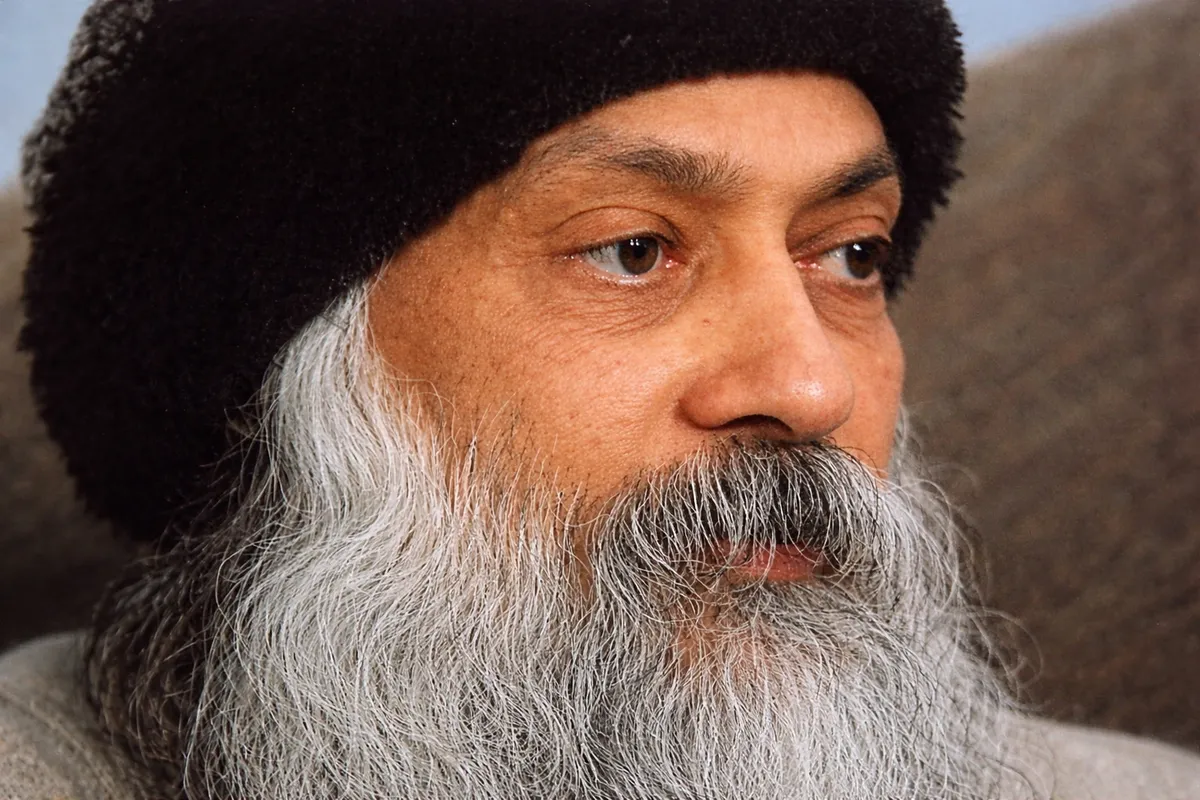
Osho says real spiritual help means talking to you, breaking your old beliefs, and fixing the world around you—not just sitting silently and telling you to grow inside.
From the Discourses
Passages where Osho speaks to this question — each links to the complete discourse.
Beloved Osho, many contemporaries and enlightened ones -- raman maharshi, meher baba, george gurdjieff and j. Krishnamurti -- have worked with people, but people get more offended by you than by anybody else. Osho, where does your technique differ from that of other enlightened ones?
The question is very fundamental. It arises in many people's minds, and it needs a very deep insight into the workings of different masters. We will take each of the masters named in the question separately. Raman Maharshi is a mystic of the highest quality, but a master of the lowest quality. And you have to understand that to be a mystic is one thing; to be a master is totally different. Out of a thousand mystics, perhaps one is a master. Nine hundred and ninety-nine decide to remain silent -- seeing the difficulty, that whatever they have realized is impossible to convey in any possible way to others; seeing that not only is it difficult to convey, it is bound to be misunderstood too. Naturally, one who has arrived to the ultimate peak of consciousness will most probably decide not to bother with the world anymore. He has suffered…
Beloved Osho, please throw light on the difference between a mystic and a master.
He gave Gandhi a blank check; whatever he wanted to spend, whatever he wanted to do with the money, he could do. He never asked, "Where does the money go? What happens to it?" And because Mahatma Gandhi was in Wardha, all the great freedom fighters in India, writers, poets, were going to see Gandhi, to meet Gandhi. And for them Jamnalal Bajaj had made a special guest house for five hundred people to stay together at one time. Chiranjilal was his manager, so he was the link between Mahatma Gandhi and Jamnalal Bajaj, Jawaharlal Nehru, Motilal Nehru, Madan Mohan Malaviya. All these people were respectful towards the old man. He was the man who invited me to Bombay. I had spoken at a Jaina conference, and as I came down from the stage -- it was a cold night, he was covering himself with a blanket -- he threw…
Osho, true masters are different, and a follower of one master cannot accept another. But we find ourselves bowing to Buddha, Mahavira, Lao Tzu, Jesus, Krishna—everyone. Perhaps it is because you yourself have oriented us toward them. Even on seeing the living master Krishnamurti, our hearts overflowed with joy, our feet began to dance. Why? And we cannot understand why Krishnamurti’s lovers cannot accept you?
True masters are certainly different. Broadly, three kinds can be seen. First is the kind of master like Krishnamurti; Mahavira and Buddha belong to the same line. Such a master has one central message: become utterly free, do not depend on anyone. Your liberation lies in your freedom. Liberation is not a final event waiting at the end; you must learn freedom from the very first step—only then will it flower at the last. Krishnamurti’s famous book is The First and the Last Freedom: the first freedom is the last freedom; the very first step of freedom is already the last step. So: do not go into anyone’s refuge, do not surrender anywhere, do not bind yourself to any ideology; avoid belief. Mahavira called this the state of ashraya-shunyata—no refuge. Take no shelter. Buddha’s last message at the time of his death—Ananda asked for a final word to treasure forever—was:…
पहला प्रश्न: ओशो, सदगुरु अलग-अलग होते हैं और किसी एक सदगुरु को मानने वाला दूसरे सदगुरु को स्वीकार नहीं कर सकता। लेकिन हम बुद्ध, महावीर, लाओत्से, जीसस, कृष्ण, सभी के प्रति झुक जाते हैं। इसकी वजह यह हो सकती है कि आपने ही हमें उनके उन्मुख किया। जीवित गुरु कृष्णमूर्ति को देखकर भी हमारा हृदय आनंदविभोर हो उठा है, पैर थिरक उठे हैं। क्यों? और समझ में नहीं आता कि कृष्णमूर्ति के प्रेमी आपको क्यों स्वीकार नहीं कर सकते?
सदगुरु निश्चित ही भिन्न-भिन्न हैं। विशेषकर तीन वर्ग किए जा सकते हैं। एक वर्ग है कृष्णमूर्ति जैसे सदगुरुओं का; महावीर, बुद्ध उसी पंक्ति में आते हैं। इस प्रकार के सदगुरु का एक ही उपदेश है कि तुम परिपूर्ण रूप से स्वतंत्र हो जाओ, निर्भर न रहो। तुम्हारी स्वतंत्रता में ही तुम्हारा मोक्ष है। मोक्ष कोई अंतिम घटना नहीं है। पहले कदम से ही मुक्त होना सीखना पड़ेगा, तो ही अंतिम कदम पर मुक्ति फलित होगी। कृष्णमूर्ति की प्रसिद्ध किताब है, दि फर्स्ट एंड दि लास्ट फ्रीडम--पहली और अंतिम मुक्ति। पहली मुक्ति ही अंतिम मुक्ति है और पहला कदम ही, स्वतंत्रता का, अंतिम कदम है। तो न तो किसी की शरण जाना, न कहीं समर्पण करना, न किसी विचार से बंधना, श्रद्धा से बचना। महावीर ने इसी बात को अशरण-भाव कहा है, किसी की शरण मत जाना।
Beloved Osho, when we reach a point where insanity can occur, at that state, a breakthrough in consciousness can also occur. Please tell us how to shift the gear from insanity to consciousness?
Radha, the question is very significant to every seeker on the path. There comes a moment where there are two possibilities: a breakdown or a breakthrough. Breakdown rarely happens because it needs certain conditions. For example: you don't have a master, you have been going on your own. You don't have anybody who knows the path. There is danger. Or, you may have a teacher, not a master, misunderstanding him as a master. Then there is more possibility of a breakdown. A teacher is without any experience. He himself has never traveled on the path, although he is knowledgeable. Perhaps he may be more knowledgeable than any master. And if you are impressed by knowledge, there is danger. Don't be impressed by knowledge, because knowledge can be accumulated from scriptures, from books, from thousands of other sources, but it is all borrowed, dead. How will you discriminate between a master…
Osho, Mahavira and Gautam Buddha were contemporaries. From your talks it becomes clear that the two were saying the same thing. Yet their disciples would argue and quarrel among themselves. After they were gone, there was even violence and war among their followers. But if Mahavira and Buddha had said that we are speaking of the same religion and the only difference is in method, then such hostility would not have grown and the harm that befell both religions would not have occurred. Kindly explain. Amrit Bodhidharma has asked:
If someone is enchanted by the design of the mosque, by its minarets, let him go to the mosque. But this has nothing to do with religion; it has to do with architecture, with aesthetic sense. You build your house one way, I build mine another—this creates no quarrel. I build my God’s house one way, you build yours another—why should that create quarrel? I build mine round, you build yours square—there is no quarrel. The purpose of a house is one: that I will live in this round house, you will live in that square one. We build houses to live in. There must be that much freedom—that whoever wishes should build as he likes; in old style or new; ancient design or an invented one; with a high roof or low; with a garden or without; with plants or with sand—a matter of taste! We do not quarrel…
पहला प्रश्न: ओशो, महावीर और गौतम बुद्ध समकालीन थे। आपके प्रवचनों से स्पष्ट हो रहा है कि दोनों बात भी एक ही कहते थे। लेकिन दोनों के शिष्य आपस में विवाद और झगड़े भी करते थे। उनके जाने के बाद उनके अनुयायियों के बीच हिंसा और युद्ध भी हुए। लेकिन यदि महावीर और बुद्ध ने कहा होता कि हम एक ही धर्म की बात करते हैं, भेद सिर्फ पद्धति का है, तो इतनी शत्रुता नहीं बढ़ती और दोनों धर्मों की जो क्षति हुई वह न होती। कृपापूर्वक समझाएं। पूछा है अमृत बोधिधर्म ने।
फिर धर्म की शैलियां अलग हो सकती हैं। किसी को रुचिकर लगता है प्रार्थना, तो रुचि से प्रार्थना करे, लेकिन इससे कुछ झगड़ा नहीं है। किसी को रुचिकर लगता है ध्यान, तो ध्यान करे। और किसी को मंदिर के स्थापत्य में लगाव है, तो मंदिर जाए। और किसी को मस्जिद की बनावट में रुचि है और मस्जिद के मीनार मन को मोहते हैं, तो मस्जिद जाए। लेकिन यह धर्म से इसका कोई संबंध नहीं है, स्थापत्य से संबंध है, सौंदर्य-बोध से संबंध है। तुम अपना मकान एक ढंग से बनाते हो, मैं अपना मकान एक ढंग से बनाता हूं, इससे कोई झगड़ा तो खड़ा नहीं होता। मैं अपने भगवान का मकान एक ढंग से बनाता हूं, तुम अपने भगवान का मकान एक ढंग से बनाते हो, इससे झगड़ा खड़ा क्यों हो? मैं अपना मकान बनाता हूं गोल, तुम चौकोन, इससे कोई झगड़ा खड़ा नहीं होता। झगड़े की जरूरत ही नहीं, तुम्हारी पसंद अलग, मेरी पसंद अलग; हम दोनों जानते हैं कि मकान का प्रयोजन एक कि मैं इस गोल मकान में रहूंगा, तुम उस चौकोन मकान में रहोगे। रहने के लिए मकान बनाते हैं। …