
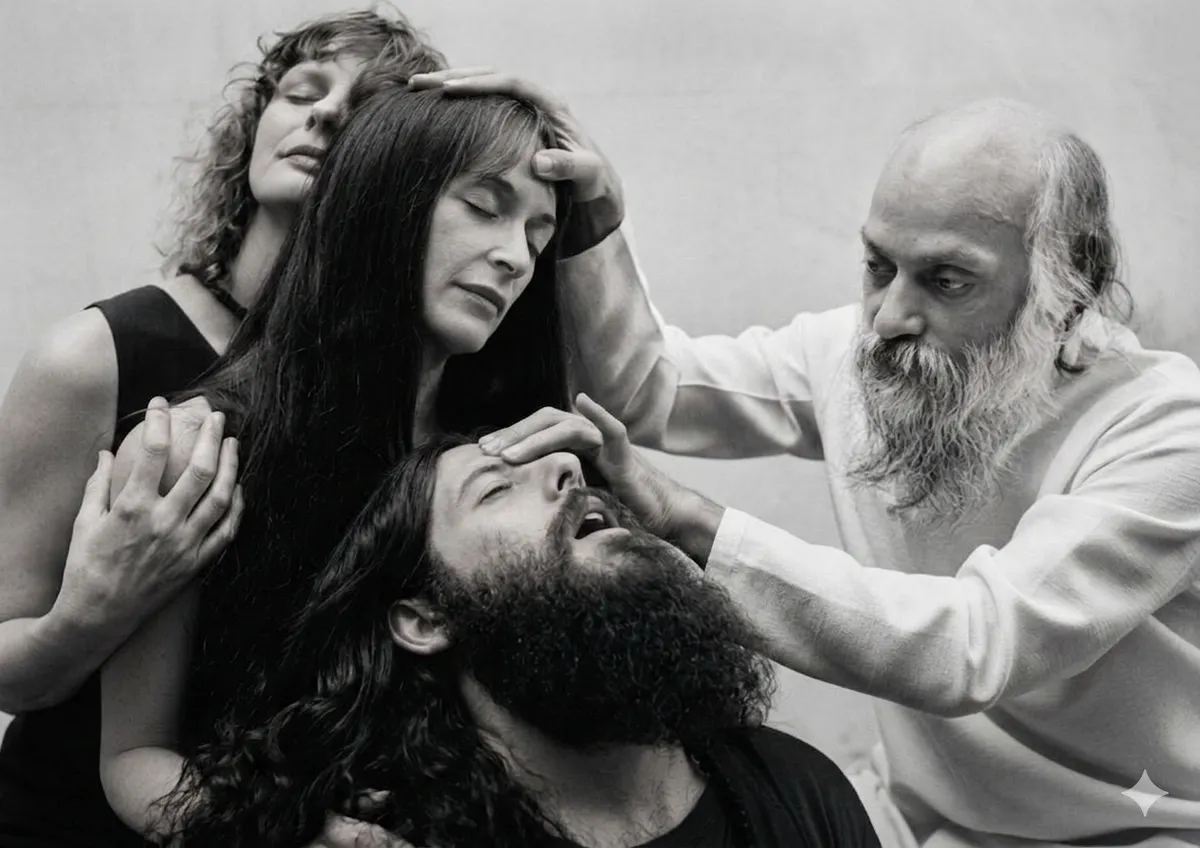
Just put all your attention on one thing until it fills you completely, and thoughts fall away on their own.
From the Discourses
Passages where Osho speaks to this question — each links to the complete discourse.
But that trance you speak of—by what process does one do it, and the process of becoming thoughtless...?
No, no, no. Nothing at all. You just have to be concentrated on that very thing; when it becomes total, a trance happens. You will have to concentrate, won’t you?
प्रश्न: पर वह मूर्च्छा जो कहते हैं आप, करने की वह किस प्रक्रिया से करते हैं और निर्विचार होने की प्रक्रिया...?
न, न, न। कुछ भी नहीं, उसी चीज में एकाग्र होना पड़ता है न पूरा तो मूर्च्छा हो जाती है। एकाग्र होना पड़ेगा न आपको।
Osho, is there any practical process for being in the realm of existence beyond thoughts, in the void?
The way to thin them out is non-cooperation. Right now we are their makers—that is, we are the ones maintaining them. When we sit idle, some thought or other is running, because without our cooperation they cannot run. Withdraw your cooperation from whatever thoughts are running, and do nothing else; regard just this as samayik, as meditation. If all thoughts dissolve, you will feel no ego and no person within. You will know only being—only being will be known, in which the distinction “I am an individual” or “I am the whole” will not be felt. Only pure being will remain—pure existence. In truth, because of the thoughts accumulated upon that pure existence, we appear to be a person. This sense that I am “A,” you are “B,” you are “C”—the A, B, C we have pasted on—is our thought-power. We commonly say, “I will become liberated”—this is not quite…
ओशो, क्या विचारों के पार अस्तित्व के जगत में, शून्य में होने की कोई व्यावहारिक प्रक्रिया है?
… जब खाली बैठते हैं तो कुछ न कुछ विचार चल रहे हैं। क्योंकि हमारे बिना सहयोग के वे चल नहीं सकते हैं। जो-जो विचार चल रहे हैं, उनसे सहयोग को खींच लें और कुछ न करें, बस इसी को सामायिक, इसी को ध्यान समझें। अगर सारे विचार विलीन हो जाएं तो आप में कोई ईगो, और कोई व्यक्ति नहीं मालूम होगा। आपको मालूम होगा केवल होना। केवल बीइंग मालूम होगा, जिसमें यह भेद मालूम नहीं होगा कि मैं व्यक्ति हूं या समष्टि हूं। केवल होना मात्र रह जाएगा। प्योर एक्झिस्टेंस मात्र होगा। वास्तव में उस प्योर एक्झिस्टेंस में जो विचार हमारे इकट्ठे हैं उन विचारों के कारण हम एक व्यक्ति मालूम होते हैं।
In 1969 followers of the Maharishi Mahesh Yogi invited Osho to talk to them. This was the first occasion on which Osho addressed a western audience, and the first time he talked publicly at length in English. The discourse has been published in OTI January 1 & 16, 1991; and February 1, 1991. Osho: Really, there can be no method as far as meditation is concerned. Meditation is not a method. Through technique, through method, you cannot go beyond mind. When you leave all methods, all techniques, you transcend mind. So meditation itself is not a method. Truth cannot be achieved through method. Method is our own invention. We, who are ignorant, have achieved knowledge through methods constructed, created, projected, in our ignorance. Through method you can achieve a sort of self-hypnosis, a sort of auto-hypnosis. Any method, whatsoever it's name, can only give you an illusory kind of peace.
Osho, please explain how I can meditate over something without using my mind.
Meditation has nothing to do with mind; meditation simply means a state of no-mind. The functioning of the mind is the only disturbance in meditation. If you are trying to achieve meditation THROUGH mind you are bound to fail, doomed to fail. You are trying to achieve the impossible. A Zen initiate was meditating for years and whenever he would come to his Master, whatsoever experience he would bring to the Master, the Master would simply reject: "It is all nonsense. You go back and meditate again." One day the Master came to the but of the disciple -- he was sitting in a Buddha posture. The Master shook him and told him, "What are you doing here? If we needed stone Buddhas we have many in the temple! Just by sitting like a stone Buddha you will not attain to meditation. Do what I have been telling you to…
Osho, I too have begun to feel that it is not valuable.
If you decide to do social service—uplift the “Harijan,” redistribute land, do this and that—and you think self-realization will result, you are mistaken. Self-realization will not come from that. You may become a good and popular person; you will taste a subtle pleasure of ego—and nothing more. You will enjoy the pleasure of being “a servant,” but you will not taste the joy of service. The pleasure of the role of “servant” is one thing; the joy of service is entirely another. But if you enter religious practice, which is utterly personal, then a day will come when that sadhana will transform your life into service. Now life is self-interest; then life will be service. In self-ignorance, life is self-centered; whatever you do, some form of self-interest is present. In self-knowledge, life is service; whatever you do, self-interest cannot remain. For me, religion is fundamental; its result will surely come.…
प्रश्न: ओशो, क्योंकि मुझे भी ऐसा लगने लगा है कि मूल्यवान नहीं है।
इसलिए अगर आपने सोचा कि समाज-सेवा करेंगे--कहीं हरिजन-उद्धार करेंगे, कहीं जमीन बंटवाएंगे, कहीं कुछ और करेंगे--अगर आपने यह सोचा और आपने सोचा इससे आत्मा की उपलब्धि होगी, तो आप बिलकुल गलती में हैं। इससे कुछ आत्मा की उपलब्धि नहीं होगी। इससे आप एक अच्छे आदमी, एक सज्जन आदमी बन जाएंगे। आप लोकप्रिय होंगे, आपमें एक सूक्ष्म अहंकार का रस और मजा होगा, और कुछ नहीं होगा। सेवक होने का सुख आप लेंगे, सेवा का सुख न ले पाएंगे। सेवक होने का सुख एक है, सेवा का सुख बिलकुल दूसरा है। लेकिन अगर आप धर्म-साधना में प्रविष्ट होते हैं, जो कि नितांत वैयक्तिक है, तो एक दिन ऐसा आएगा कि वह साधना आपके जीवन को सेवा में परिणत कर देगी। अभी वह जीवन स्वार्थ है, तब वह जीवन सेवा हो जाएगा। आत्म-अज्ञान में जीवन स्वार्थ होता है, आप जो भी करें वहां स्वार्थ किसी न किसी रूप में मौजूद रहेगा। और आत्म-ज्ञान में जीवन सेवा होता है, आप कुछ भी करें वहां स्वार्थ मौजूद नहीं रह सकता है।