
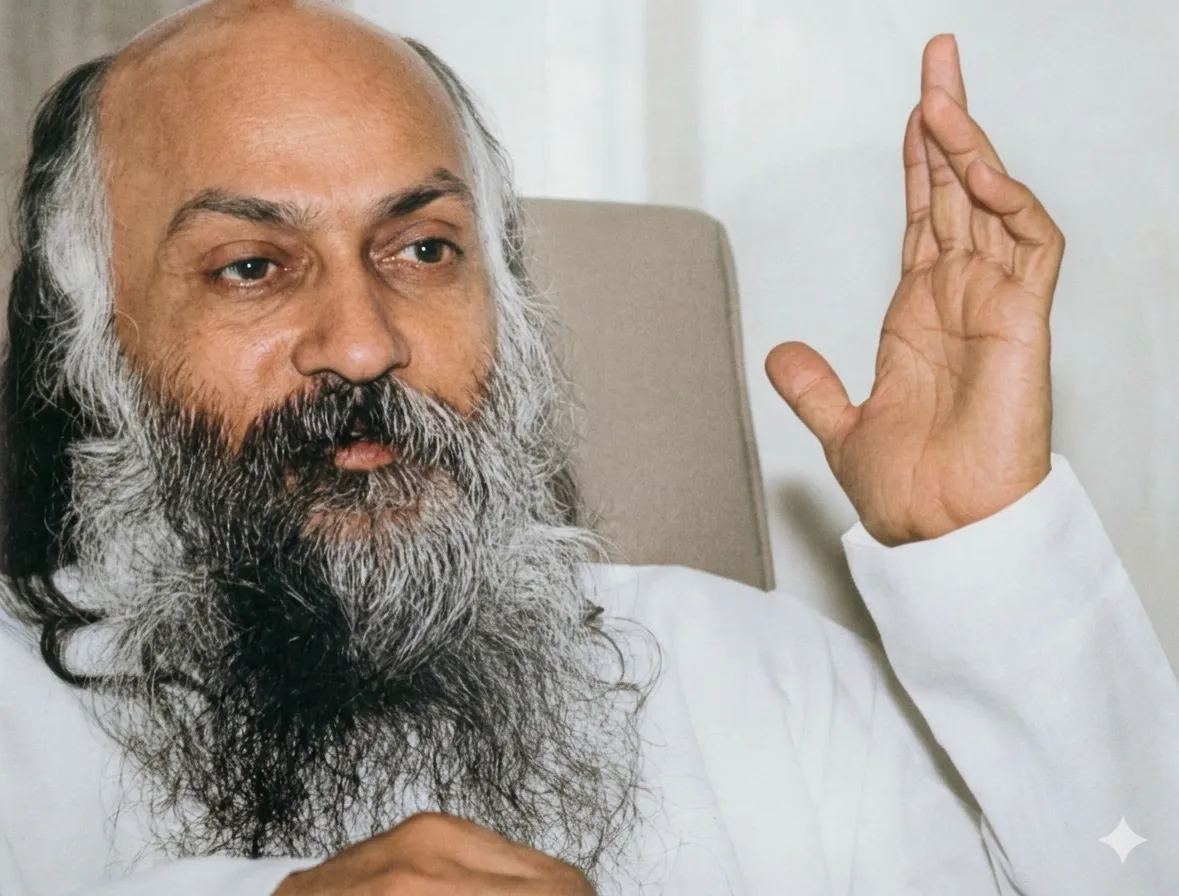
The best talk is almost no talk—feel the silence and what’s behind the words.
From the Discourses
Passages where Osho speaks to this question — each links to the complete discourse.
Osho, how do you define a good speech?
DIFFICULT TO SAY. I have never delivered a single speech in my life. You are asking a wrong person. But I have heard a definition that I liked and I would like you to know it: A good beginning and a good ending make a good speech -- if they come really close together, the beginning and the end. Of course, the best speech has no middle at all, and the very best is never delivered. And I have always been delivering the very best, the undelivered one. I have never delivered a single speech in my life, because I deal in silence, not in words. Even when you hear words, that was not the purpose. Even when I use the words, the words are used only as necessary evils -- because they have to be used, because you cannot understand silence yet. I am not talking to you. I…
Osho, you got as far as breakfast. To complete our religious historical records, could you tell us what goes beyond the juice?
So forgive me, I am going to remain the same way but you can always remind me that I have left something out in the middle. I can always complete it. I would love to complete it but what can I do? There is so much to say -- and nothing to say. You can understand my problem: so much to say that even if I go on for lives it will still be there -- and nothing to say, because that which I want to give to you is not something which can be said. I am living in this dilemma but trying for some middle way; and I have the feeling I have found the middle way. I have heard a story: when God created man of course He was an amateur. He baked the man too much -- a negro came out. God said,''Jesus! What happened to…
Osho, for forty years continuously Buddha gave discourses and sermons, and it is said that he did not speak a single word. Likewise, you too have been speaking and giving discourses for twenty years, and it could be said that you do not speak a single word. Is this true?
There is a sweet story about Mahavira. The Jains, in their rigidity, clung to the letter and missed the essence. The story is that Mahavira never spoke, and yet people heard. This is a difficult matter: Mahavira did not speak, yet people heard. Mahavira did not speak in any language that the ears can hear. The Jains say his speech is soundless—nishabd. There are no words in it. Yet people heard—those who could. If they too became wordless, sat near Mahavira in silence, they heard. Therefore there is another story in Mahavira’s life, important to note: wild animals heard him, gods of the sky came to listen, birds and beasts came, ghosts and spirits were present. The Jains have great difficulty explaining how birds and beasts can hear. Certainly, if Mahavira spoke in a language, then even among humans only those who knew that tongue could understand. If I am…
प्रश्न: ओशो, भगवान बुद्ध निरंतर चालीस वर्ष तक प्रवचन और उपदेश करते रहे, और कहा गया कि वे एक शब्द भी नहीं बोले। वैसे ही आप भी बीस वर्षों से निरंतर बोल रहे हैं, उपदेश कर रहे हैं, और कहा जा सकता है कि आप एक शब्द भी नहीं बोलते। क्या यह सच है?
महावीर के संबंध में बड़ी मीठी कथा है। जैन तो जड़ता से पकड़ लिए, इसलिए उसका सार नहीं निकाल पाए। कथा यह है कि महावीर बोले ही नहीं, फिर भी लोगों ने सुना। अब यह बड़ा मुश्किल मामला है। महावीर बोले नहीं, लोगों ने सुना। महावीर ऐसी किसी वाणी से नहीं बोले, जो कान सुन लें। तो महावीर की जो वाणी है, जैन कहते हैं, निःशब्द है। उसमें कोई शब्द नहीं है। फिर भी लोगों ने सुना--जो सुन सकते थे। अगर वे भी निःशब्द हो गए, महावीर के पास जाकर बैठ गए, तो उन्होंने सुना। इसलिए महावीर के जीवन में एक और कथा है, जो महत्वपूर्ण है, और वह यह कि महावीर को जंगली जानवरों ने भी सुना, आकाश के देवता भी सुनने आए, पशु-पक्षी भी सुनने आए, भूत-प्रेत भी मौजूद हुए। जैनों को बड़ी मुश्किल होती है समझाने में कि पशु-पक्षी कैसे सुनेंगे। निश्चित ही, अगर महावीर भाषा बोलते हों, तो पशु-पक्षी तो दूर, सारे मनुष्य भी नहीं समझ सकते। अब अगर मैं हिंदी बोल रहा हूं, तो जो हिंदी समझता है, वही समझ सकता है। जमीन पर हजारों भाषाएं हैं, वे लोग नहीं समझ सकते। …
Osho, every time after speaking I feel I have been dishonest; only when I remain silent do I feel honest—completely honest with myself. Why is this?
At Harvard University, psychologists ran an experiment. They split a class into two groups. To one half, in a separate room, they said: “The problem on the board is very difficult. There is hardly any hope that any of you can solve it. Even students in higher classes struggle with it. Only great mathematicians can solve it. We’re giving it just to see—by chance, perhaps—there is no assurance at all—maybe one of you might head a little in the right direction. Solving it completely is impossible, still try.” They tried. Out of fifteen students, only three solved it. To the other fifteen, in another room, they said—about the same problem—“It’s very simple. So simple that if any of you fail to solve it, it would be surprising. Students in lower classes have solved it.” Amazingly, twelve solved it; only three failed. What happened? Your confidence is borrowed—others hand it to…
पहला प्रश्न: ओशो, हर बार बोलने के बाद ऐसा अनुभव होता है कि मैंने बेईमानी की; चुप रहने पर ही अपने साथ ईमानदारी, पूरी ईमानदारी करती मालूम होती हूं। ऐसा क्यों है?
हार्वर्ड विश्वविद्यालय में मनोवैज्ञानिक एक प्रयोग कर रहे थे। उन्होंने एक कक्षा के विद्यार्थियों को दो हिस्सों में बांट दिया। आधे विद्यार्थियों को कहा अलग कमरे में, यह सवाल जो तख्ते पर लिखा जा रहा है, बहुत कठिन है; यह इतना कठिन है कि कोई आशा नहीं कि तुम में से कोई भी इसे हल कर पाएगा। तुमसे ऊपर की कक्षाओं के विद्यार्थी भी इसे हल करने में कठिनाई पाते हैं। यह तो बड़े गणितज्ञ ही इसे हल कर सकते हैं। लेकिन सिर्फ जानने के लिए दिया जा रहा है, हो सकता है संयोग से, शायद--इसका कोई जरा भी आश्वासन नहीं है--शायद तुम में से कोई थोड़ा-बहुत इसको हल करने की दिशा में ठीक चल पाए। पूरा हल कर पाए, यह तो हो नहीं सकता, फिर भी कोशिश करो।
Beloved Osho, lord buddha kept on discoursing and giving sermons continuously for forty years, yet it is said that he never spoke a single word. The same way you are discoursing and giving sermons continuously for the past twenty years and it can be said that you do not speak even a single word. Is it true?
Sometime visit a madhouse: the doctor there seems to be crazier than the patients. The patients are mad without worries, but this poor man has to suffer the madness of so many of them. In treating all these mad people, the psychologists themselves reach to the same stage of madness. The qualities travel through the words too. So an intelligent person will listen only to the words that are coming out of an inner emptiness, an inner peace, that are born in the inner depths. If the words are coming from an inner dis-ease, then close your ears -- it is better to be deaf to them. This will protect you. And likewise, don't look at the wrong -- because by looking at it, it is entering you. And don't touch the meaningless, because the very touch of it will affect you. But we are not aware of all this.…