
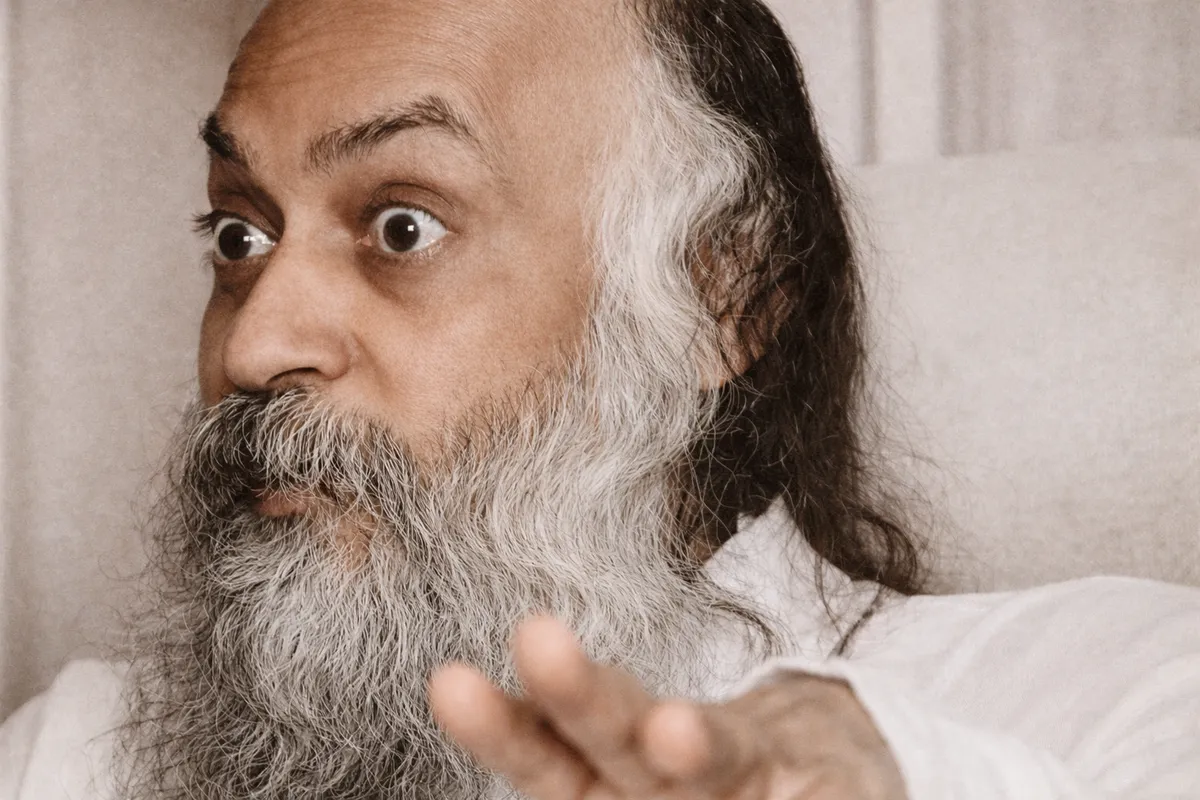
People copied saints’ fasting and harsh behavior without their inner joy, so sannyas started looking like dead, joyless renunciation instead of a living celebration.
From the Discourses
Passages where Osho speaks to this question — each links to the complete discourse.
Osho, once sannyas was crowned with the glory of life. Today it has become synonymous with death. How did sannyas become synonymous with death? Please explain.
Narendra! Sannyas has always been life, celebration—but the sannyas of Buddha, Krishna, Mahavira, Kabir. Followers, the crowd of the blind who trail behind, they turn everything upside down. There is a psychological reason behind that inversion; if you understand it, everything will become clear. Mahavira, for instance, fasted—he fasted a great deal. It is said that in the long twelve years of austerity he took food only three hundred and sixty-five days—meaning one year in all. On average he fasted eleven days, then ate on the twelfth: eleven days fast, one day food. Naturally people saw that by fasting and fasting and fasting, one day Mahavira attained the supreme light. People can only see the outside. Who has an eye to look into Mahavira’s within? Whoever can look into Mahavira’s within has himself become a Mahavira. He has no need then to peep into Mahavira; if he can look within…
Osho, sannyas was born in this land; it was granted the dignity of Gaurishankar (Everest). But today its honor has become merely superficial. Inside, the individual and society alike are afraid of it. Why have sannyas and the sannyasin lost their meaning? Please explain.
In my sannyas there is no prohibition—no “leave this, run from that.” Awakening is enough. Cowards run. Those who awaken remain where they are and are free there. My sannyas does not want to give you knowledge; it wants to give you meditation. Meditation means emptiness; it means: I do not know. Life is such an ultimate mystery that nothing definitive can be known about it. And I want to give sannyas a new posture—creativity. I will call him a sannyasin who sings a new song; who strikes a new music from the veena; who dances a new dance; who makes this world a little more beautiful, brings a little more blessedness to the earth. Then sannyas can regain its dignity. And I would have the sannyasin not imitate. Listen, understand, contemplate—but live from your own individuality. Therefore I give my sannyasins no codes of conduct—only processes to awaken the…
Osho, after sannyas it is as if everything has changed. I have changed, the world has changed. The birds’ voices have turned into music. The drops rising and falling in the fountain appear to dance. When I sit in Sufi meditation, it seems as if everything is happening to please me. Inside, an unprecedented bliss is felt. It seems the outer music is arising from within me. As if, become a goddess, I am seeing everything. Is this some new direction of madness, or tiny steps moving toward light? Please shed light!
Asha Satyarthi! When sannyas happens, of course everything changes. Sannyas is not just changing clothes. Sannyas is an inner transformation. It is a new way, a new method of seeing life. It is a new dimension of living. The old sannyas was anti-life. So it brought no benefit to the world. It harmed the world—certainly harmed it. Who knows how many homes were ruined, how many families destroyed. Who knows how many women became widows while their husbands were still alive. Who knows how many children became orphaned while their fathers still lived—fatherless. Surely, millions of children must have begged. And who knows how many women became prostitutes. The burden of all this lies on old sannyas. On the head of old sannyas is a large bundle of sins. And the irony is: in return for so much sin, what did old sannyas gain? Dry, shriveled people, devoid of the…
September 28, 1970 was a memorable day. At Manali in the Himalayas, Osho initiated His first group of sannyasins. This event was followed by this special evening discourse, on the significance of Neo Sannyas. To me, sannyas does not mean renunciation; it means a journey to joy bliss. To me, sannyas is not any kind of negation; it is a positive attainment. But up to now, the world over, sannyas has been seen in a very negative sense, in the sense of giving up, of renouncing. I, for one, see sannyas as something positive and affirmative, something to be achieved, to be treasured. It is true that when someone carrying base stones as his treasure comes upon a set of precious stones, he immediately drops the baser ones from his hands. He drops the baser stones only to make room for the newfound precious stones. It is not renunciation.
Beloved Osho, what is sannyas?
Sannyas is hope -- hope against all hope. People have lost all hope; they are living hopelessly. They are living simply because they are cowards and cannot commit suicide. The existentialist philosophers are right when they say that the most important philosophical problem is suicide: to live or not to live, to be or not to be. If this is life that ordinary people are living, then it does not seem to be worth living at all. What is the point of getting up every morning and going through the same empty gestures you have gone through thousands of times? The same breakfast, the same nagging wife, the same ugly husband; the same suspicions, the same possessiveness, the same jealousy, the same anger, the same ambition; rushing to the office, the same boss -- everything is the same, a constant repetition. And again coming back home and sitting in front…