
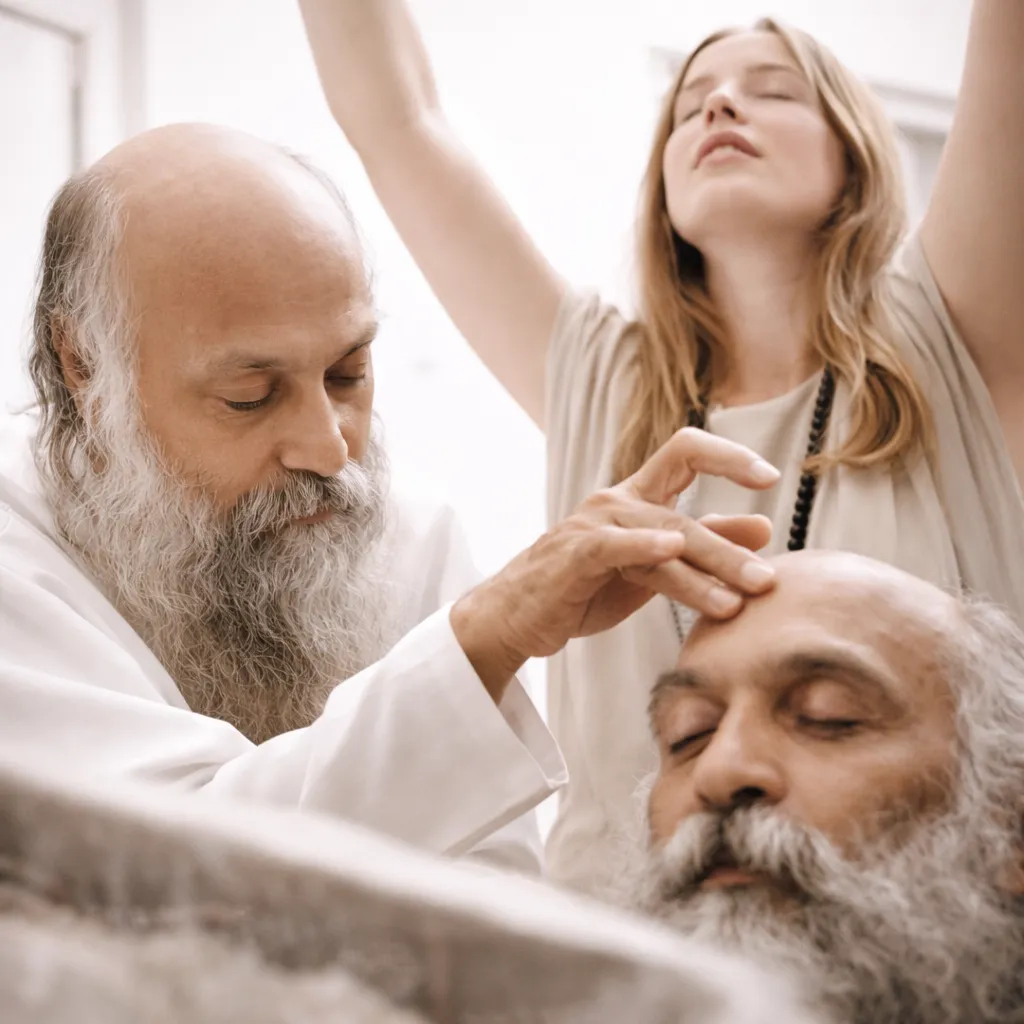
He played the role on the outside but stayed free inside, quietly helping people drop guilt instead of spreading it.
From the Discourses
Passages where Osho speaks to this question — each links to the complete discourse.
Osho, how was it possible for dionysius, as an enlightened being, to carry out his duties as bishop in a guilt-promoting organization? How could he present a facade to the world without creating division within himself without compromising himself -- for instance when he had to follow stupid orders from his archbishop?
A bunch of cowboys were sitting around a campfire about to eat dinner. The cook, a grimy, stubble-faced little man, was lecturing the boys, spoon in hand: "The first one of you guys to make a fuss about yer supper gits to do the cookin' tomorra night!" There was a careful silence as the slop was served and the eating began. "God, this tastes like shit!" exclaimed one of the cowboys. Immediately remembering the punishment for his complaint, he added enthusiastically, "But good shit, real good shit!" "Have you ever wavered from the party line?" a party-member was asked by an official. The man turned white with fear and protested vehemently, "No, no, no! I have always wavered WITH the party line!" An enlightened person becomes an actor. I don't think that Diogenes was in any difficulty; he must have enjoyed the whole show. Two East German guards were standing…
I am always feeling guilty as if I have committed great crimes. How can I drop this guilt? It is destroying me and all the possibilities to live my life joyously.
My approach is Dionysian, I am a disciple of Dionysius: Live and love life. Enjoy this occasion as deeply as possible, as totally as possible, and out of this living experience you will grow. A maturity will come to you; you will ripen and you will carry the fragrance with you. That fragrance is heaven. Nobody goes to heaven -- those who go to heaven, they have to carry their heaven in their heart. Nobody goes to hell -- those who go to hell, they have to carry their hell in their heart. I have heard: A man died -- a very rich man, a very politically powerful man, very cruel, very ambitious. The whole town went to give him the final send-off. People were feeling really happy that the calamity was gone, that this plague was gone -- the procession was big. And when the procession was moving slowly…
Osho, you say: live life as if it were acting. In that case, what more than acting would spiritual practice, religion, and the search for liberation be?
Someone laughs; you may also laugh. But you know there is nothing now truly to laugh at, and nothing now truly to weep about. The world goes on. For you it has become a dream, but that does not make it disappear. Trees will bloom, birds will sing, people will fall in love, deaths will occur, births will occur, bands will play, weddings will be celebrated, the shehnai will sound, someone will die and the chant “Ram naam satya hai” will be recited—this all will continue. For you it has ended. For you it ending means only this: you are no longer possessed by it. For you all has become acting. But everything continues. Where is there to run? What use is running? Because if you run, you again become the doer. That is why Krishna insists: do not run—otherwise running too is doership. And running also means that you…
Osho, the play-acting I have to do for security—should I keep doing it or drop it? And now even the acting itself seems to be abandoning me. Please guide me to the right path.
The whole of life is a play—of relationships, of the marketplace, of the household. Life is acting. Where will you leave it and go? Where can you run? Wherever you go, there again you will have to enact some drama. So I am not in favor of escapism. Become a skillful actor. Do not run away. Act knowingly, not in unconsciousness; act with awareness. Awareness has to be cultivated. A thousand tasks will have to be done—and perhaps they are necessary. But doing them with awareness is essential. Slowly you will find that life is no longer “life” as you knew it; it has become sheer play, and you have become an actor. To be an actor means that there is a great distance between you and what you do. For example, someone who plays Rama in the Ramleela performs the role completely—perhaps better than Rama himself, because Rama never…
We long exceedingly to dwell in this translucent darkness, and through not seeing and not knowing to see and to know him who is beyond both vision and knowledge -- by the very fact of neither seeing him nor knowing him. For this is truly to see and to know, and, through the abandonment of all things, to praise him who is beyond all above all. For this is not unlike the art of those who hew out a lifelike image (from stone), removing from around it all which impedes clear vision of the latent form, showing its true and hidden beauty solely by taking away.
FOR IT IS, AS I BELIEVE, MORE FITTING TO PRAISE HIM BY TAKING AWAY THAN BY ASCRIPTION, FOR WE ASCRIBE ATTRIBUTES TO HIM WHEN WE START FROM UNIVERSALS, AND COME DOWN THROUGH THE INTERMEDIATE TO PARTICULARS. BUT HERE WE TAKE AWAY ALL THINGS FROM HIM, GOING UP FROM PARTICULARS TO UNIVERSALS, THAT WE MAY KNOW OPENLY THE UNKNOWABLE, WHICH IS HIDDEN IN AND UNDER ALL THINGS THAT WE MAY BE KNOWN. AND WE BEHOLD THAT DARKNESS BEYOND BEING, CONCEALED UNDER ALL NATURAL LIGHT. WE HAVE PRAISED THOSE THINGS WHICH FITLY PERTAIN TO THE THEOLOGY OF AFFIRMATION; HOW THE DIVINE AND EXCELLENT NATURE MAY BE SPOKEN OF AS ONE, AND HOW AS THREE; HOW IN ACCORD THEREWITH THE FATHERHOOD OF GOD MAY BE EXPLAINED, HOW THE SONSHIP, AND IN WHAT MANNER THE TRUTH OF THE SPIRIT MAY BE REVEALED; HOW OUT OF THE INCORPOREAL AND UNDIVIDED EXCELLENCE THEY PUT FORTH THESE…