
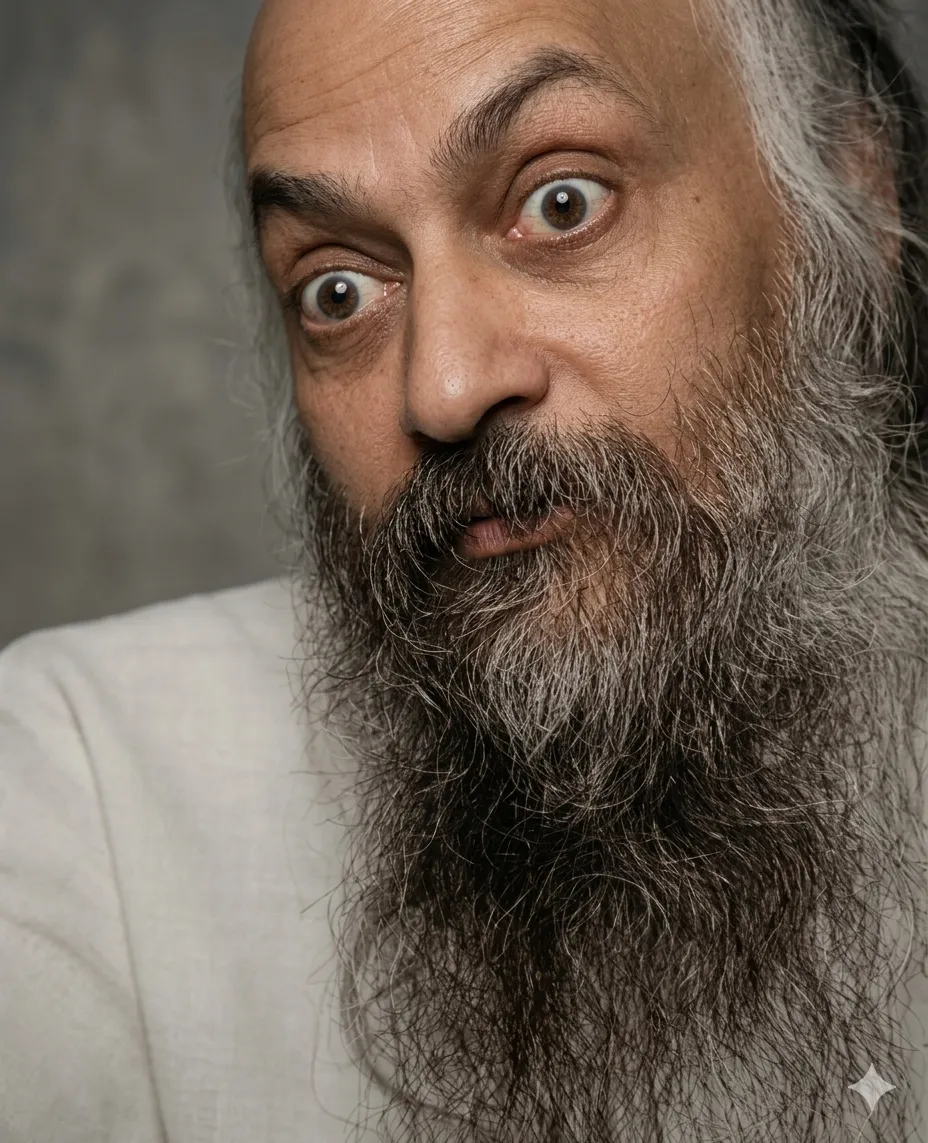
Meditate by lovingly watching the world with open eyes, and also close your eyes to discover the even more beautiful world inside—use both.
From the Discourses
Passages where Osho speaks to this question — each links to the complete discourse.
Beloved Osho, the saying goes: close your eyes, look inside, and see the beauty. But I love to keep my eyes open. I love to see the people, the places, the things, the lakes, the mountains, the rivers, the streams, the animals and the birds -- but most of all I love to see you, Osho. Is it possible to go inside and see the beauty with open eyes?
And one day things went too far. There was bloodshed. People brought their staffs and started hitting at each other's heads. The police came and the police took them all into custody and they locked the temple. Until the court decides, the lock cannot be opened. But, fearful that the other sect may break the lock, the first sect also brought another bigger lock. The second sect brought an even bigger lock. So three locks are on it, and the court has not been able to decide yet. Because how to decide whether Mahavira used to meditate with open eyes or closed eyes? I said to my chauffeur, "If you know the magistrate, you take me to him." He said, "But why are you getting unnecessarily involved? I always see you unnecessarily getting involved in things, unpopular causes... and you jump into them. We should go where we are going."…
Osho, Mahavira meditated with nasagra drishti—gazing at the tip of the nose. Is that itself the posture of meditation?
If someone lives with eyes completely open to the outer world, like Charvaka, he will say there is nothing within, soul and such are false notions: eat, drink, be merry. This is the experience of fully open eyes—that everything is outside: eat, drink, enjoy. There is nothing within; go within and you die—there is nothing there. There is nothing like a soul. If one lives by the experience of fully open eyes, only sensory pleasures remain; the soul dissolves. Then the world is true and the soul is false. And Mahavira says: the world is true and the soul is true. The world is not false, nor is the soul false. Mahavira says these are two ways of seeing. If someone experiences with closed eyes, the self will seem true and the world false. Another view is: someone never sits in meditation with closed eyes and lives only in the…
Question: OUR BELOVED MASTER, DAIKAKU SAID: THIS SCHOOL IS AN EXCEEDINGLY DEEP AND SUBTLE TEACHING; ONCE YOU HAVE HEARD IT, IT BECOMES AN EXCELLENT CAUSE FOR ENLIGHTENMENT FOR ALL TIME. AN ANCIENT SAID, "THOSE WHO HEAR THIS, EVEN IF THEY DON'T BELIEVE, HAVE BLESSINGS GREATER THAN HUMANS OR GODS; THOSE WHO STUDY, EVEN WITHOUT ATTAINMENT, EVENTUALLY REACH BUDDHAHOOD." A MONK ASKED DAIKAKU: "HOW SHOULD I REST MY MIND; HOW SHOULD I USE MY MIND?" DAIKAKU SAID: THE NO-MIND HAS NO ATTACHMENT TO APPEARANCES; DETACHMENT FROM APPEARANCES IS THE CHARACTER OF REALITY. AMONG THE FOUR MODES OF CONDUCT -- WALKING, STANDING, SITTING, AND LYING -- SITTING IS CONSIDERED TO BE STABLE AND TRANQUIL. THIS MEANS SITTING STRAIGHT AND CONTEMPLATING REALITY. SITTING STRAIGHT MEANS SITTING CROSS-LEGGED AS THE BUDDHAS DO. CONTEMPLATING REALITY MEANS SITTING MEDITATION.
What is the difference between gazing at an open clear sky, gazing at an enlightened master's photo, and gazing at the darkness?
The technique of gazing is not concerned really with the object; it is concerned with gazing itself. Because when you stare without blinking your eyes, you become focused, and the nature of the mind is to be constantly moving. If you are really gazing, not moving at all, the mind is bound to be in a difficulty. The nature of the mind is to move from one object to another, to move constantly. If you are gazing at darkness or at light or at something else, if you are really gazing, the movement of the mind stops. Because if the mind goes on moving, your gaze will not be there; you will go on missing the object. When the mind has moved somewhere else, you will forget, you will not be able to remember what you were looking at. The object will be there physically, but for you it will…
Osho, in this verse it would be good if you could clarify two small points. First, kusa, deer skin, and cloth—the order is given as one atop the other. And second, a “pure ground.” Please speak on this.
Kusa has been used extensively for meditation, for many reasons. First, in the days when the process of meditation was unfolding on this earth—those moments when meditation was being unveiled and discovered—kusa is very closely related to those moments. We still have a word from that time: kushal, or kusala—skillful. It comes from kusa itself. You may never have thought about it; we say of someone, “He’s a very skillful driver,” “She’s a very skillful teacher.” But do you know what kusala means? In its essence it simply means “one who can find the right kusa.” Not every grass is kusa. In the days when meditation was widespread on this earth, especially in this land, and when the preliminary stages of meditation were first uncovered, a kusala was one who, out of thousands of grasses, could find the particular grass that is supportive of meditation—the kusa. A special kind of…