
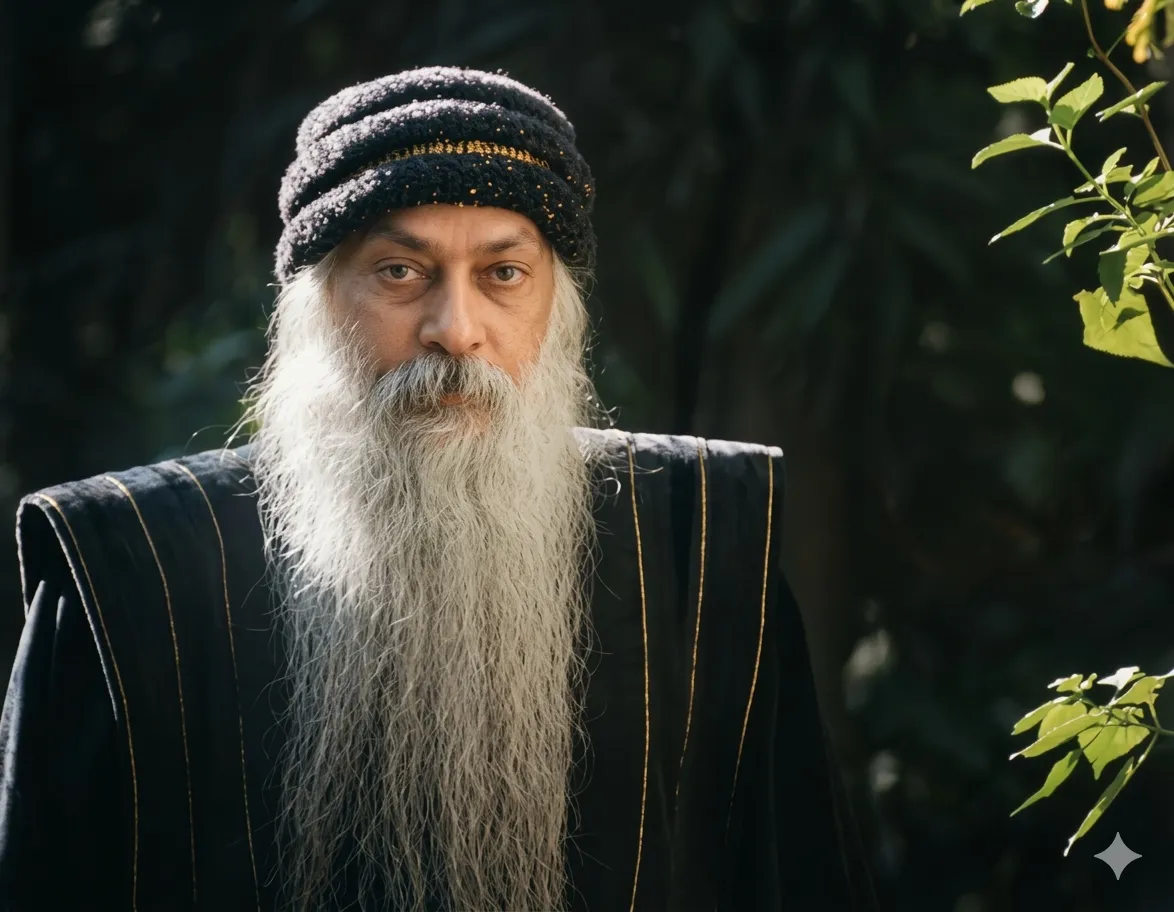
Stop trying to fight your thoughts; just watch them, and like a shadow in light, they lose power and fade.
From the Discourses
Passages where Osho speaks to this question — each links to the complete discourse.
Osho, for a few days my heart settles into meditation; then for a few days worship and bhajans flow. But I cannot concentrate anywhere. I am troubled by this state. Kindly guide and train me.
About three years later he was found in Paris learning painting. Reduced to a beggar’s state. His friends rushed there. “What have you done? You had everything—everything was fine.” He said, “That was the obstacle—everything was fine. But there was no exhilaration. Nowhere any surge. Everything ran fine, and I ran it fine—but no stream of rasa was flowing. “All my life I longed to be a painter. I never wanted to be a broker. That success was accidental. Now I am happy. I have nothing. I paint; if paintings sell, I manage food and clothes. I have not even a roof of my own. I live in a friend’s room. But I am not going back. I am happy.” And the friends saw that the man was filled with a strange energy, a strange aura. His body had thinned, but there was a light. He said, “Tell my wife…
For some moments Kach was speechless. Like a person who does not know what to do, he asked: "But how is the renunciation of the mind possible? Perhaps you too ask me the same question? Whoever is in search of peace, faces this basic problem. Whoever is engaged in search of truth and salvation has this curiosity. The mind itself is the obstruction. The mind itself is restlessness. What is this mind? Is not the desire to be something the mind itself? For a moment, kindly come out of sleep and see this truth. Is not the desire to be something, the race for being something, the thirst for being something, the mind itself? If there is no thirst for being something, where then is the mind?
Question: Third question: Osho, how can one control thoughts? What is the need for control? To become a controller is the ego itself. Thoughts are not yours; why do you want to be their master? Thoughts come and go. They pause in you for a moment and depart. You are an inn; thoughts are guests. You are the host. What is the need to grab your guests by the throat and control them? It is in the very effort to control that people go mad. You will never become the master of thought. Yes, a certain mastery does arise—but it is not mastery over thought. It arises from knowing this truth: what have I to do with thought? They come—they go. It’s a crowd passing on the road.
Osho, I have been listening to you for years. I have been with you a long time. From time to time I have heard many different statements from you, even mutually contradictory ones, yet no question has ever arisen in my mind about them. And in spite of them you have always remained one and indivisible in my vision and in my heart. Kindly shed some light on this.
You can be with me in two ways: through thought and intellect, or through the heart and feeling. If you are with me through the intellect and thought, there will be great difficulty. Day after day you will find contradictory statements. Every day you will have to sort them out, and still you will not succeed. The intellect never really resolves anything. Even where things are simple, the intellect tangles them up. And my words are very tangled. Even where everything is clear, the intellect creates problems. And I speak of paths filled with mist. Even if there were only one path, the intellect would find contradictions; here there are countless paths—contradictions upon contradictions. There is hardly a statement I have not refuted a thousand times. So if you are with me through the intellect, only two things are possible: either you will go mad and drop the intellect, or…
But Osho, as I understand it, there are certain subjects like chemistry, physics, or medicine where positive values are essential. What are your views about that?
Einstein was doing an experiment. He had failed seven hundred times, yet every morning he came into the laboratory laughing, ready to begin again. The young assistant with him was exhausted. “Is this old man mad? Seven hundred failures—and again he starts fresh!” The youth was tired; he said, “We should drop this now. How many times have we been defeated?” Einstein said, “Defeated? You’re crazy—each time we have won.” “Where have we won? Every experiment has failed.” Einstein answered, “In seven hundred directions we have searched, and we now know truth is not there. We have succeeded seven hundred times. Truth is being endlessly eliminated into nearness. Suppose truth will reveal itself on the seven hundred and fifteenth attempt; then fourteen more eliminations are needed. Then only that will remain; it cannot escape. Where will it go? We have searched seven hundred paths and found it absent. That much…