
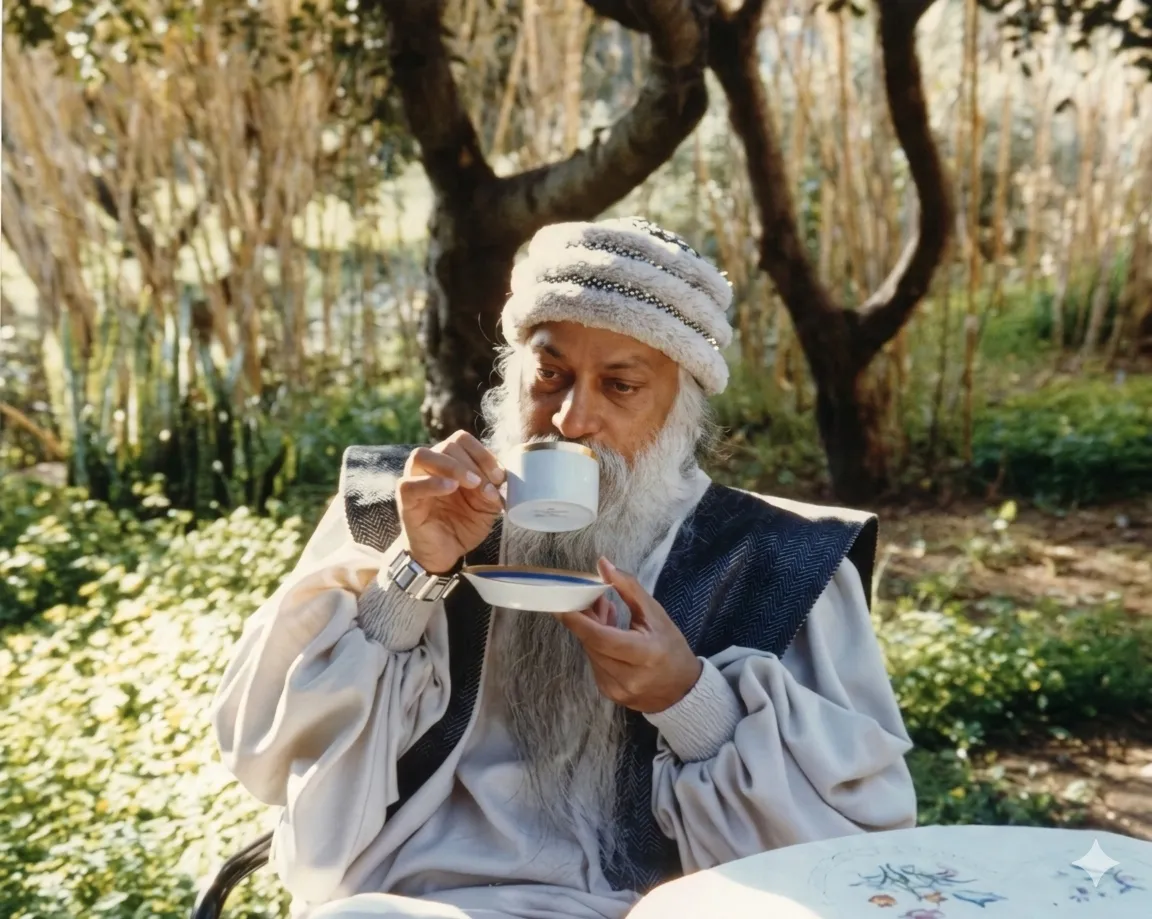
Pay full attention to what you’re doing; when you truly feel something is harmful, you stop naturally—no judging needed.
From the Discourses
Passages where Osho speaks to this question — each links to the complete discourse.
You say, "do not make the same mistake twice." how can I keep from doing that unless I bring the mind in -- to evaluate, compare, and judge? And then I have to say no.
When I say don't make a mistake twice, I am not saying to evaluate, to judge, to compare. I am saying to see -- when you are making a mistake see it so totally that you see that it is a mistake. In that very seeing it is dropped; you will never be able to repeat it. For example, if you put your hand in the fire and it is burned. Next time when you will be near fire, will you do an Aristotelean syllogism, that this too is a fire, all fires bum, therefore I have not to put my hand in it? Are you going to compare with the past eXperienCe? Are you going to evaluate? If you are doing that, then you cannot avoid committing the mistake again because then the mind will say, "Maybe this fire is different. And who knows, the fire may have changed…
Osho, I make many mistakes in life—the same mistakes again and again. I want to know why human beings don’t learn from their mistakes.
…I was a guest in Kolkata at the home of a friend, Sohanlal Dugar—one of the most prominent wealthy Jains in India. A courageous man—only then could he host me! Because inviting me home is not free of risk. He said it was fine despite all the Jains’ opposition. I told him at the airport, “You’re putting me up, but you’ll get into trouble.” He said, “You know I’m a gambler. All India knows I’m a bookie; betting is my business. I’ve placed all kinds of bets—this one too! Although I’ve been warned by Jain monks not to host you.” The whole house was air‑conditioned. Not a single fly or mosquito. But no night meal. They don’t even drink water at night. When Mahavira said don’t eat at night, there was no electricity. There weren’t even oil lamps in every home. People ate in the dark, as many villagers still…
Osho, how can we live so that there are no mistakes in life?
To walk as Mahavira’s shadow is one thing; to be a Mahavira is another. To repeat what Muhammad said, like parrots, is one thing; but to know as Muhammad knew—passing through all those mistakes, all those thorny paths, all those slippery roads, falling many times, skinning your knees, bleeding, losing your way in dark nights, despairing often, again and again losing the thread of dawn in your hand—until you pass through all that again, you will not have Muhammad’s strength, Mahavira’s capacity, Buddha’s depth. No, Haridas—do not ask how to live so that there are no mistakes. I say: live so that as many mistakes as can happen do happen; only do not repeat a mistake. Live fully! Drop the worry about wandering, about fear. Cowards remain stuck; they never rise. Just think: if little children decided, “We will walk only when there is no danger of falling,” then everyone…
Osho, your satsang is nothing less than heaven for me. It hurts deeply to be away from you. After this life I have not the slightest desire to be born again. But I make hundreds of mistakes. Please shower your compassion and guide me!
I don’t tell you, “If you smoke, stop.” I don’t—because that has been said to you so much and you still haven’t stopped. The sadhus and saints kept saying it till they died, and you did not stop. What is the point of my repeating it? Those who keep repeating it—I take them to be unintelligent. So many kept repeating and people didn’t listen; then there is a flaw in the very approach. Perhaps the root cause of smoking has never been understood; people just go on repeating empty words. Someone says, “Don’t smoke—you’ll get tuberculosis.” But he takes it for granted that you are afraid of TB. Who is afraid! People say, “When it happens, we’ll see. There is medicine, treatment.” And if you look into a book, you will read that if a man smokes twelve cigarettes a day for twenty years, then he may get TB. Who…
Question: Third question: Beloved Osho, have you ever made any mistake in your life? As long as I was, there was nothing but mistake. Since I am not, there is no possibility for mistake. There is only one mistake: the being of the ‘I’. From that ‘I’ a thousand mistakes arise. As long as I was, all was mistake. How could it be right? Even what appeared right was not right; it was only an appearance, a seeming, an assumption, a contrivance. Then it was mistake upon mistake. Since I am no more, the doer is no more. If the doer is not, how can there be a mistake? Since then everything is simply right—because since then it is only God, only the Divine. So long as you are, there is mistake. You disappear, and the mistake goes too.