
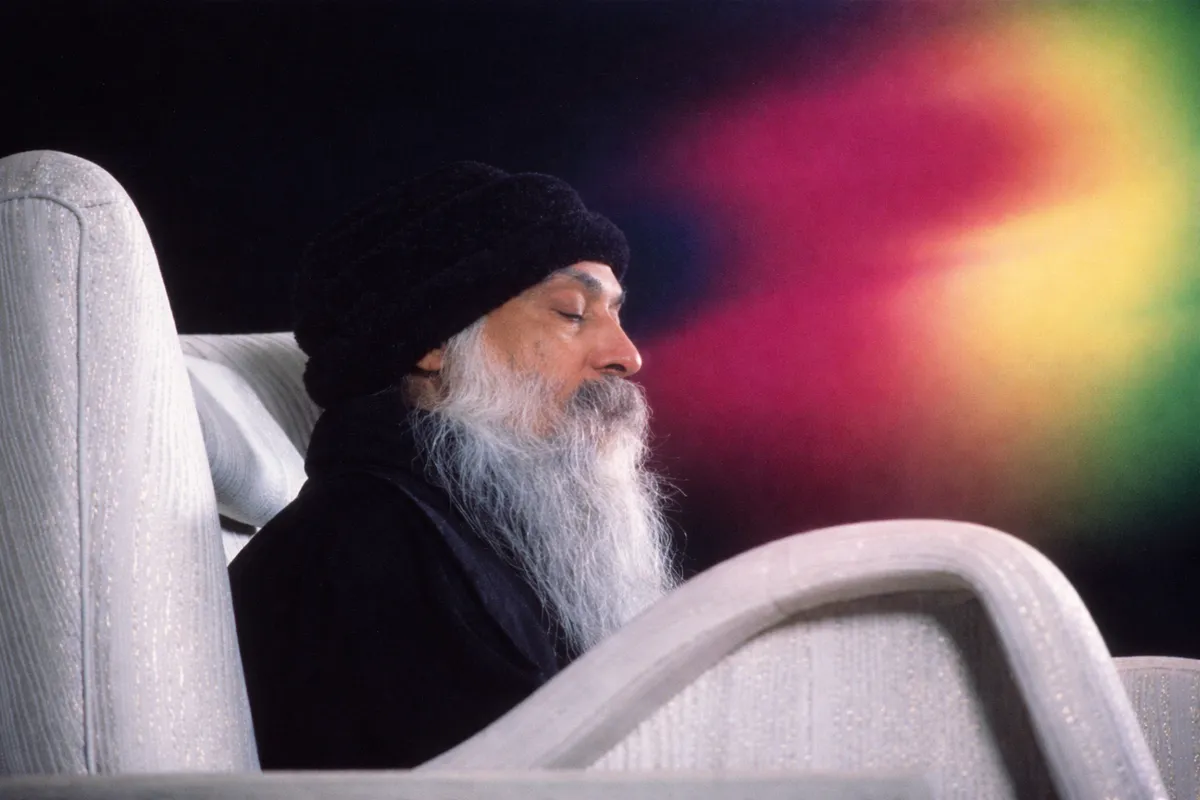
Don’t force inner sounds by chanting; let them come naturally and quietly watch them until they fade into silence.
From the Discourses
Passages where Osho speaks to this question — each links to the complete discourse.
You have said that the practice of chanting aum also brings about the nada, the inner sound. Does it come about spontaneously also? Which is the proper nada?
If it comes spontaneously it is more valuable. If it comes with the repetition of aum it can be imaginary. That which comes of its own accord is authentic, valuable. If the nada begins you should become a witness. Do not be merged into it, because that is the state of the seventh plane. If you tend to get lost in the nada before reaching the seventh you will halt there; it will act as a brake. As these inner sounds become more and more subtle, our witnessing too will have to become more and more subtle. We will have to go on observing to the end, when the sound is completely lost.
You said that through the practice of Om, nada arise. Do the nada also arise automatically?
If they arise automatically, they are more precious; if they arise of their own accord, they are more precious. If they arise through the use of Om, they may be imagined. They should arise by themselves. Those alone are precious; those alone are true.
प्रश्न: आपने कहा कि ओम् की साधना से नाद उपस्थित होते हैं। क्या ऑटोमैटिक भी नाद उपस्थित होते हैं?
ऑटोमैटिक उपस्थित हों, वे ज्यादा कीमती हैं; अपने आप उपस्थित हों, वे ज्यादा कीमती हैं। ओम् के प्रयोग से उपस्थित हों तो वे कल्पित भी हो सकते हैं। अपने आप ही होने चाहिए। वही कीमती हैं, वही सच्चे हैं।
Thus there are two ways to say it: either call it the soundless Word—the tone that is not born of collision, not born of the impact of two—or the saints have chosen another precious term: Anahata Nada. Anahata means: not produced by striking, not produced by collision. Is there such a sound that is Anahata? Is there a sound born without striking? If there is such a sound, that alone is the fundamental note of life. Several points need to be understood. Whatever is produced by collision will perish. For collision generates a quantity of energy, but how long will that energy last? I clap my hands; the impact of my hands releases a limited force. How long will it resound? Whatever has been produced will be destroyed. Whatever is made will be unmade. Buddha said: that which is compounded cannot be eternal, cannot be Sanatana. How could it be?
तो दो बातें हैं--या तो हम कहें नाद-रहित वाणी, नाद-रहित स्वर, ऐसा स्वर जो टक्कर से पैदा नहीं होता, जो दो चीजों के आघात से पैदा नहीं होता। और या फिर संतों ने एक और शब्द चुना है, वह भी बहुत कीमती है--अनाहत नाद। अनाहत का मतलब भी यही होता है कि जो आहत से नहीं, टक्कर से पैदा नहीं हुआ--अनाहत। क्या ऐसा कोई नाद है, जो अनाहत है? क्या ऐसा भी कोई नाद है, जो बिना टक्कर के पैदा होता है? ऐसा अगर कोई नाद है तो वही जीवन का मूल-स्वर है। इसमें कई बातें समझ लेने जैसी हैं। क्योंकि जो चीज टकराहट से पैदा होती है, वह नष्ट हो जाएगी। क्योंकि टकराहट से एक शक्ति की मात्रा उपलब्ध होती है। लेकिन वह एक शक्ति की मात्रा कितनी देर चलेगी? मैं ताली बजाता हूं, तो मेरे दोनों हाथों की टक्कर से जितनी शक्ति पैदा होती है, वह शक्ति सीमित है। कितनी देर वह स्वर गूंजेगा? जो पैदा हुआ है, वह नष्ट हो जाएगा। जो बना है, वह मिट जाएगा।
In doing sadhana on aum, is it better to repeat it like a mantra or to try to hear it as an inner sound?
And the third step is when the mind feels saturated. And you will come to know it when this happens; there is no need to ask how one will feel it. It is just like eating: you feel, "Now, enough" The mind will feel when it is enough. Then you start the third step. The third is: neither body has to be used nor mind has to be used. As you lock the body, now you lock the mind. And it is easy. When you have been doing the chanting for three, four months, it is very easy: you simply lock the body, you simply lock the mind. Just listen, and you will hear a sound coming to you from your own heart of hearts. The Aum will be there as if somebody else is chanting; you are just the listener. This is the third step, and this third step…
Question: MANDUKYOPANISHAD SANTI-PATHAH OM BHADRAM KARNEBHIH SRNUYAMA DEVAH STHIRAIR ANGAIS TUSTUVAMSAS TANUBHIR VYASEMA DEVA-HITAM YAD AYUH SVASTI NA INDRO VRIDDHASRAVAH SVASTI NAH PUSA VISVAVEDAH SVASTI NASTAKRSYO ARISTANEMIH SVASTI NO VRHASPATIRDADHATU OM SANTIH SANTIH SANTIH OM ITYETAD AKSARAM, IDAM SARVAM TASYOPAVYAKHYANAM, BHUTAM BHAVAD BHAVISYAD ITI, SARVAM ONKARA EVA. YAC CANYAT TRIKALATITAM TAD APYOMKARA EVA. SARVAM HYETAD BRAHMA, AYAM ATMA BRAHMA AUM, THE IMPERISHABLE SOUND, IS THE SEED OF ALL THAT EXISTS. THE PAST, THE PRESENT, THE FUTURE, -- ALL ARE BUT THE UNFOLDING OF AUM. AND WHATEVER TRANSCENDS THE THREE REALMS OF TIME, THAT INDEED IS THE FLOWING OF AUM. THIS WHOLE CREATION IS ULTIMATELY BRAHMAN. AND THE SELF, THIS ALSO IS BRAHMAN. AUM PURNAMADAH PURNAMIDAM PURNAT PURNAMUDACHYATE PURNASYA PURNAMADAYA PURNAMEVA VASHISYATE. ... All the Upanishads begin with AUM; AUM means the primordial sound.