
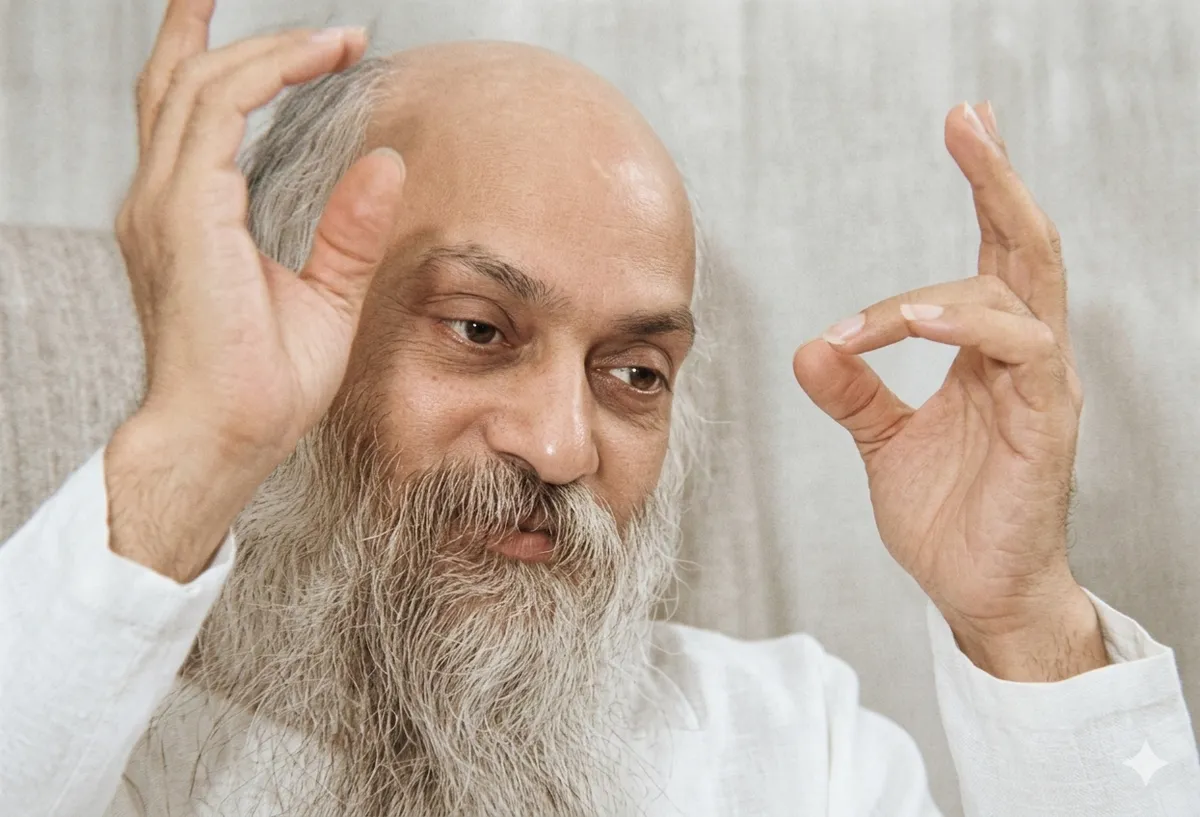
According to Osho, no—the mind’s stopping is not a negative process; what matters is whether it is a lived experience, not a mere notion. A concept about spontaneity is still mind, hence not spontaneous. When stopping is experienced directly, spontaneity flowers by itself; when it’s only an idea, it remains a mental construction.
When your thoughts pause, it’s good—just make sure it’s something you truly feel, not something you only think about.
From the Discourses
Passages where Osho speaks to this question — each links to the complete discourse.
No—Isn’t the idea that whatever the mind keeps doing—the very doing, its action—has to come to a stop? Does that mean it is a negative process?
No. What I am saying is this: firstly, if it is only our notion that the self is in its spontaneous state—already so—if it is a notion, then that notion is never spontaneous. A notion is always of the mind and cannot be spontaneous. If it is an experience, then it can be spontaneous. And there is a great difference between a notion and an experience.
I have been thinking all day of a way to ask the question: how to stop thinking?
Mind is making almost no noise; goes on working silently. And such a servant! -- for seventy, eighty years. And then, too, when you are dying your body may be old but your mind remains young. Its capacity remains yet the same. Sometimes, if you have used it rightly, it even increases with your age! -- because the more you know, the more you understand, the more you have experienced and lived, the more capable your mind becomes. When you die, everything in your body is ready to die -- except the mind. That's why in the East we say mind leaves the body and enters another womb, because it is not yet ready to die. The rebirth is of the mind. Once you have attained the state of samadhi, no-mind, then there will be no rebirth. Then you will simply die. And with your dying, everything will be dissolved…
Beloved Osho, I have come to a dead end. I see the impotence of the mind and feel all action useless. Does the mind totally die only in samadhi? Please say something about mind and action in witnessing.
Vinod Bharti, you say, "I have come to a dead end" -- but I don't feel it so. Not yet, because when you really come to a dead end, a transformation immediately happens. You are coming closer to it, of that much I am certain. The dead end is not far away, but you have not come to it yet. Your whole question proves it. You are coming closer, you are feeling intuitively that it is not far away -- but it has not been reached yet. Still, there is hope. Still, deep down, you are dreaming that this is not going to be the dead end; hence the question arises. You say, "I see the impotence of the mind...." You have not seen it yet, you only think you have. Seeing and thinking are totally different, but one can get mixed up very easily. Thinking can pretend to be…
Osho: To think is the nature of the mind. And if you don't think then there is no mind. A state of no-mind comes, then you know. That is nature, this too is nature; that is not against this nature which creates ignorance, creates unknowing, creates conflict. We have not known the total mind, we have known only the mind which thinks. If you transcend it then you know the total mind -- which knows. Thinking is one thing, knowing is quite another. QUESTION: THE NATURE OF THE MIND IS TO THINK, AND THEN IT CEASES TO THINK. WHAT DO YOU DO IN ORDER TO CAUSE IT NOT TO THINK? DOES IT NATURALLY NOT THINK? Osho: If you become aware of your thinking process, then the process by and by is dissolved.
Osho, I too have begun to feel that it is not valuable.
If you decide to do social service—uplift the “Harijan,” redistribute land, do this and that—and you think self-realization will result, you are mistaken. Self-realization will not come from that. You may become a good and popular person; you will taste a subtle pleasure of ego—and nothing more. You will enjoy the pleasure of being “a servant,” but you will not taste the joy of service. The pleasure of the role of “servant” is one thing; the joy of service is entirely another. But if you enter religious practice, which is utterly personal, then a day will come when that sadhana will transform your life into service. Now life is self-interest; then life will be service. In self-ignorance, life is self-centered; whatever you do, some form of self-interest is present. In self-knowledge, life is service; whatever you do, self-interest cannot remain. For me, religion is fundamental; its result will surely come.…