
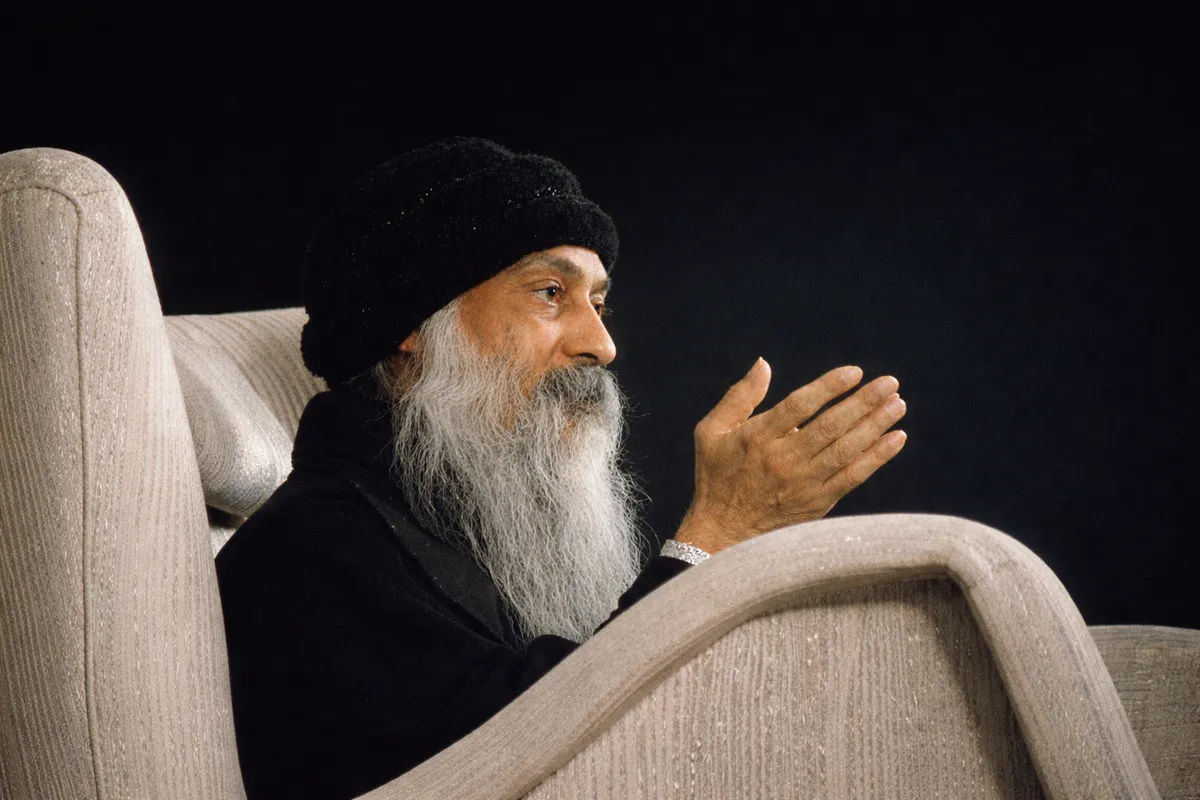
Therapy can tidy your thoughts, but only meditation lets you step outside them and be truly free.
From the Discourses
Passages where Osho speaks to this question — each links to the complete discourse.
Question: BELOVED OSHO, DOES PSYCHOLOGICAL THERAPY HELP TO GO BEYOND THE MIND? Vijen, psychological therapy can help you to understand the mind, but it cannot lead you beyond the mind. Only one thing leads you beyond the mind and that is meditation. Meditation has nothing to do with psychotherapy, but psychotherapy can create a ground by giving you a better understanding of your mind to go into meditation. It cannot lead you directly into the transcendental, but it can be a help, just the way you prepare a garden. First, you prepare the soil, but that is not the garden. And just preparing the ground, removing the weeds, the grass, any wild growth, stones, roots, still it is not the garden -- this much psychotherapy can do. Now you will have to put seeds, give nourishment to those seeds, care and love and protection.
Question: BELOVED MASTER, WHAT IS BEYOND PSYCHOTHERAPY? The being can see through the mind with great clarity, perception. Before the being's arrival it was always a question of either/or -- to do this or to do that, what is right, what is wrong -- and the mind was never able to decide. And, whatever it decided, it was always half-hearted; hence, repentance was always bound to happen. You were thinking to marry this woman or that woman... finally the mind has to decide. Wavering, it comes to a decision. By marrying one woman you come to know the woman in her totality, and a great repentance settles in: you have chosen the wrong woman. Nobody in the whole world has chosen the right woman, neither has any woman chosen the right man. It is very strange....
Beloved master, you speak on the psychology of the buddhas, the psychology of transcendence, as the essence of the work happening here in the buddhafield. What is the uniqueness of this third psychology? Is there a psychotherapy of transcendence?
Meditation, awareness, watchfulness, witnessing -- that is the uniqueness. No psychoanalyst is needed. You can do it on your own; in fact, you have to do it on your own. No guidelines are needed, it is such a simple process -- simple if you do it; if you don't do it, it looks very complicated. Even the word 'meditation' scares many people. They think it something very difficult, arduous. Yes, if you don't do it it is difficult and arduous. It is like swimming. It is very difficult if you don't know how to swim, but if you know, you know it is so simple a process. Nothing can be more simple than swimming. It is not an art at all; it is so spontaneous and so natural. Be more aware of your mind. And in being aware of your mind you will become aware of the fact that you…
In a different garb, different terminology, again the same game starts. And there are many people in the West whose whole lives are being wasted in therapy. Therapy can be very helpful but one needs to know its limits. If you know the limits you can be very helpful. If you forget the limits you can be very de'structive. Then psychotherapy itself becomes like an occupation for the patient he starts depending on it. It becomes an escape so he can avoid life, because he says that he is under therapy and he is not yet healed and there are a thousand and one problems yet to be solved. Unless they are solved, how can he participate in life? And that can become a disease in itself. Sometimes medicines can create a greater disease than what they were meant to cure.
Beloved Osho, is taking the role of a therapist dangerous to my own spiritual growth? Is it possible to help people and still let my own ego dissolve at the same time? I feel that a subtle fight goes on inside me between one part that is clear and another part that wants nothing to do with clarity. Under your guidance I have learned not to dominate others when I use my capacity to see, but am I still dominating myself?
But these people have not gone inside; they have looked from outside. And this is the problem: from the outside you can only see objects, and love is not an object, bliss is not an object, enlightenment is not an object, understanding is not an object, wisdom is not an object. All that is great in human existence and life is subjective, not objective. But from the outside you can see only objects. That gives a tremendous urgency to fill your hollow inside with any rubbish. There are people who are filling it with borrowed knowledge; there are people who are filling it with self-imposed torture -- they become saints. There are people who are beggars to become the prime minister, to become the president. Everywhere the hollow people are in tremendous need to dominate others. That gives them the feeling that they are not hollow. A sannyasin begins by…