
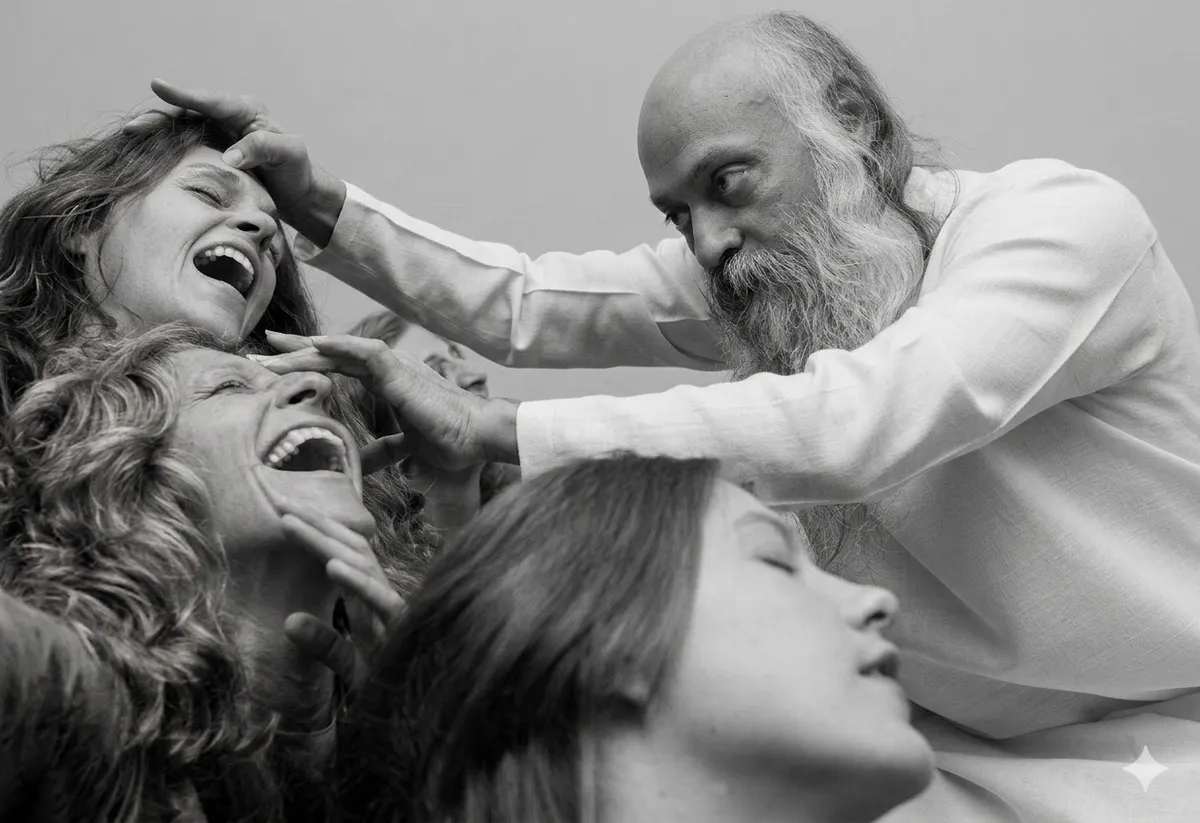
Even if your body sleeps or faints, a quiet watcher inside can still be there—especially if you practice awareness.
From the Discourses
Passages where Osho speaks to this question — each links to the complete discourse.
Osho, if witnessing is possible through the knowledge-senses, is it also possible through the action-senses, or not?
One can be a witness to the body, because inside, consciousness is separate and distinct. I raise this hand—at that moment an action is occurring: I have raised the hand. Ordinarily we only know that I am the doer of the hand’s raising. But look within: while I am raising the hand there is a consciousness inside that is seeing the hand being raised. When you are walking on the road there is someone within who is seeing that you are walking. When you are doing anything there is someone within who is seeing that you are doing something. Twenty-four hours a day there is a seeing point within you. But you are not aware of it. Witnessing means: we gradually come to remember that point; its remembrance keeps returning; its awareness dawns. As awareness of that point grows, as awakening happens there, the coverings fall away; you will find…
Beloved Osho, in the sixties and seventies neurologists became very interested in an area of the brain stem called the "reticular formation." it is said that this is the area that filters input into the brain while we are asleep. Thus, a mother sleeps through all sorts of noises, but wakes the instant her child cries -- this function was said to be achieved by the reticular formation. It seems that during sleep there is one element within us which remains awake. Does witnessing have any relationship to this phenomenon? Does witnessing belong to a part of the brain?
It is recorded that Buddha never changed his posture in sleep; he would sleep in the same posture the whole night. His disciple, Ananda, was puzzled. Many times he would wake up and look, and he could not believe how Buddha managed. In sleep you cannot manage to keep the same posture. People cannot even manage the same posture while they are awake; there is so much restlessness that they have to turn this way and that. But in sleep you are unconscious... One day Ananda finally asked, "How do you manage the same posture the whole night long?" Buddha said, "You will understand one day when you become enlightened. I will give you the answer but it will be difficult for you to grasp it. I simply rest, I don't sleep. Since the day I became awakened, sleep has disappeared." Other things may be disturbed in the bodies of…
Osho, before discussing the process of entering a conscious death, I would like to ask: what is the difference between stupor and awakening? What do we call the state of unconsciousness? In other words, in wakefulness and in unconsciousness, what is the state of the jivatma’s consciousness?
Religion is a search for attention; so, in their own way, are gambling, battle, hunting. The man who enters the forest to hunt a lion is also seeking attention; so is the yogi in a cave striving at the ajna chakra. The search may be noble or ignoble, desirable or undesirable, successful or futile—but the underlying hunger is one. Attention means: the knowing power within me becomes fully manifest—no part left potential or dormant. Whatever capacity to know I carry turns from potential into actual. In the moment a person is fully awake, in that very moment he fully is. Awakening and being happen together. Think of a seed: the tree is hidden in the seed, but only potentially. The seed can die without becoming a tree; the tree is not a necessity, only a possibility. When the tree manifests, it is the seed in its expressed form. Sleep is…
It is also asked: Osho, in the second stage the body feels completely separate, yet whenever something happens to the body I become aware of it immediately.
It is separate, yes—but that does not mean you will not know. Even when it is separate, you will know. Even when there is a sense of oneness, you still know. What changes is how the knowing appears; the knowing is there in any case. When the body is felt as separate and hunger arises, it will seem that the body is hungry. And when the body is felt as one with you, it will seem that I am hungry. That is the only difference; there will be no other difference. If there is pain in the body, then when the body is separate it will feel as though somewhere at a distance the body is in pain and I am aware of it. And if you take yourself to be one with the body, it will feel as if I am in pain. In the illusion of unity, in…
Osho, please say something about this news item: the indian express of 18th august reports that the rajneesh film won't reflect the real image of india. The union information minister, l.k. Advani said in the parliament, 'foreign television and film units have been refused permission to document the activities of the rajneesh ashram, as it is felt that a film on the activities of the ashram would not reflect favourably on india's image abroad.'
If this country is going to be destroyed one day, the reason will be these people who are in power today. India cannot have one language. And if it can have one language, that language has to be neutral; either it will be English or Esperanto, but not Hindi, not Gujarati, not Marathi, not Bengali, not Tamil. It will have to be a neutral language. English is neutral; it is nobody's mother tongue in India. And English is international too, so it is perfectly good. I support a two-language formula: English as the national language, because it is also international and as the second language, the mother tongue. Each child should be taught two languages. Forget all about Hindi, and forget all about creating one monolith in this country of variety, of multiplicity. And they are trying to do the same thing with religion too, in the same way. They…