
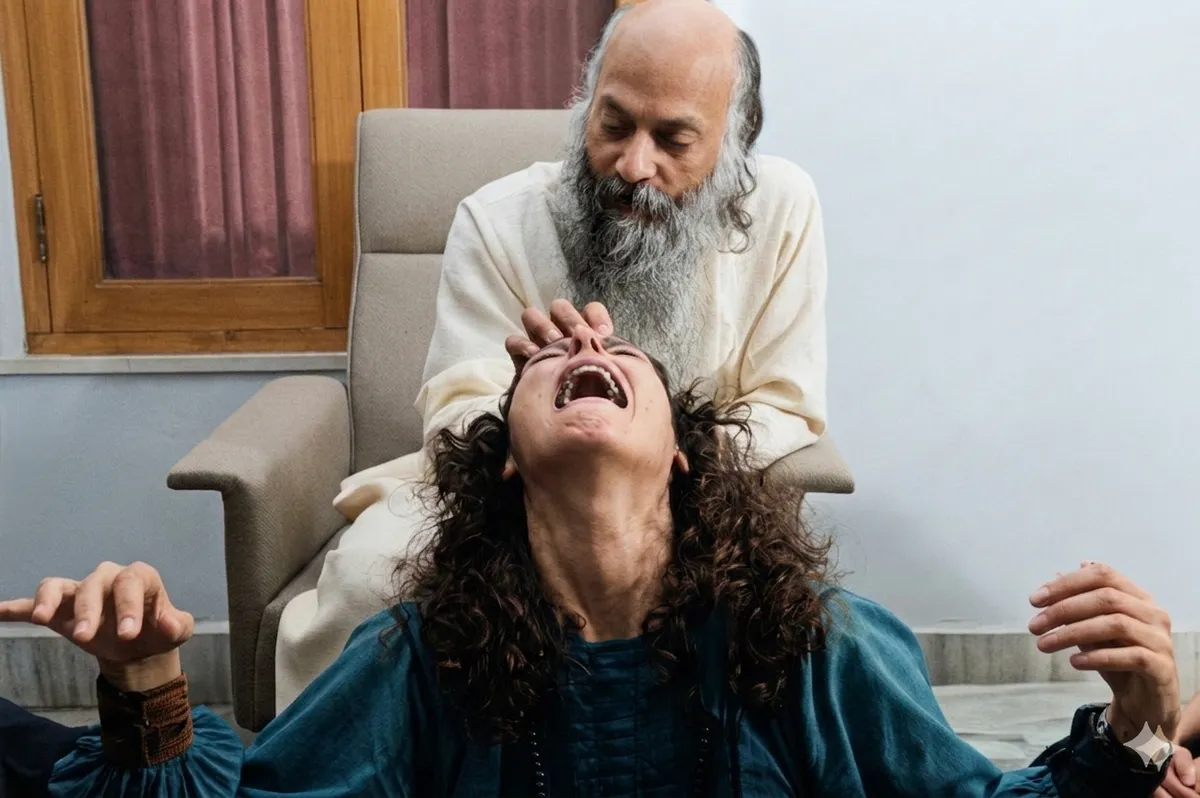
Yes; when you give your all, the practice sometimes runs on its own—just watch it without fear, knowing you can stop anytime.
From the Discourses
Passages where Osho speaks to this question — each links to the complete discourse.
Beloved Osho, can there be moments of effortlessness while a seeker is engaged in the first three stages? Is effort completely lacking in the second four stages? Does there come a point at which both effort and effortlessness must cease?
So don't go on suppressing, because a quantity can be tolerated but there comes a moment when the quantity reaches the climax, the evaporating point -- one hundred degrees. Then you start boiling and evaporating. Many persons who were just like you a day before are in madhouses now. You can be there any day. If you don't allow catharsis you are all prone to go mad, because civilization is such, the situation is such, that everybody accumulates madness. You have to throw it every day to remain clean and pure, to retain the clarity of mind and vision. But if you know the law that if you start a thing you can stop it, then you can start anything and you can stop. Be the master in the starting, you will be the master in the end also. But if a thing starts by itself then you cannot stop…
In this second stage, many people may feel to throw away their clothes. If the thought arises, throw them away. Do not worry about anyone; do not take any concern. Here there will be no onlooker—everyone will be with eyes closed in his own work; no one has anything to do with anyone else. Many friends will feel that when the body is becoming very light, even a slight garment will suddenly feel like a mountain, like a rock. Mahavira was not mad that he became naked. There was a reason. And hundreds who practiced this meditation became naked—their nakedness had a reason. It is not that nakedness will become compulsory for you. Once the mind becomes light, you will return to the world, and can be simple and straight. This catharsis does not continue forever. At most for three months; at least three weeks.
इस दूसरे चरण में अनेक लोगों को ऐसा अहसास हो सकता है कि वे कपड़े फेंक दें। अगर उन्हें खयाल हो तो उन्हें फेंक देना है, उन्हें किसी की फिकर नहीं लेनी है, कोई चिंता नहीं लेनी है। यहां कोई देखने वाला भी नहीं होगा, क्योंकि सब आंख बंद किए हुए अपने काम में लगे होंगे, किसी से किसी को प्रयोजन नहीं है। कोई किसी को देखता होगा नहीं। किसी को देखने से मतलब नहीं है। बहुत से मित्रों को ऐसा अनुभव होगा कि जब बहुत तीव्रता से शरीर हलका हो रहा होगा तो थोड़ा सा वस्त्र भी एकदम पहाड़ की तरह, पत्थर की तरह भारी हो जाएगा। महावीर पागल नहीं थे कि नग्न हुए। नग्न होने का कारण था। और सैकड़ों लोग उस ध्यान का प्रयोग करके नग्न हुए, उसका कारण था। ऐसा नहीं है कि वह नग्नता आपके लिए अनिवार्य बन जाएगी। एक दफा चित्त हलका हो जाए, मन हलका हो जाए, तो आप वापस लौट आएंगे इस दुनिया में और सीधे और साफ हो सकेंगे।
Beloved Osho, are there really discrete stages on the way to the ultimate happening, as this upanishad seems to suggest, or does this happening occur suddenly and unexpectedly? Is it a matter of long conscious effort, or of a sudden total surrender to existence?
So this Upanishad is dividing, not because divisions are there, but because you will not be able to understand the whole. The whole will be too much, too complex. The whole will be incomprehensible, and understanding will not be possible. That's why the division into seven stages, and that's why there are so many divisions. You can divide in fourteen, you can divide in seventeen -- you can divide into as many as you like. And theologicians go on fighting about these divisions. They are workable, utilitarian -- not existential. Just feel your body, close your eyes and feel. Where are the divisions? It is one. But if your eyes are not functioning well you will go to the eye specialist. And you know that eyes are not separate, they are one with the body, so then why go to the eye specialist? You can go to any doctor. The…
To my mind the real sanity is that which comes after the transcendence of madness. Then there is neither the question nor the answer. The mind becomes calm and quiet. Then the fourth stage is reached. It comes only when you have come to the peak, to the height of tension. Then comes Relaxation. Having gone through the previous three stages each for ten minutes, for the next ten minutes or more just relax, and remain just as you are, without doing anything, because you are tired completely--The policy of 'LET GO' is achieved as an automatic process. The fourth step is the moment of doing nothing. That I call dhyana, meditation. The first three stages are steps only, the fourth is the door. Then you are there without breathing or movement. Just silence! This fourth step comes of its own accord and in these moments comes Grace.
Beloved Osho, as you know, the old zen custom was that a monk should stay with his master for ten years before he went out on his own teaching. There is a zen story about a monk who had completed his ten years in the monastery. One rainy day the monk visited his master, nan-in. After nan-in had greeted him, he said to the monk, "no doubt you have left your shoes in the vestibule. On which side of your umbrella did you leave your shoes?" for a moment the monk hesitated, and through that hesitation realized that he was not in every-minute zen.
YOU HAVE TOLD US THAT LIFE HAS A PULSATION -- IN AND OUT, YIN AND YANG. DO WE HAVE TO KEEP TRYING FOR EVERY-MINUTE AWARENESS, OR CAN WE TOO PULSATE WITH LIFE, AND AT TIMES LET GO OUR TRYING? ... You can rest with restlessness inside you. You can lie down on the ground, but the restlessness goes on inside. So you are simply lying down, but it is not a rest. You may sit like a buddha and inside the child is running -- the mind is working and functioning. Inside you are going mad: outside you are sitting in a buddha posture. You can be totally static outside, not moving, no activity, and inside, the turmoil goes on. This won't help. Finish the turmoil in effort. ... Run as fast as you can. ... Be exhausted! ... Hence, my emphasis on Dynamic Meditation. It is both effort and effortlessness. ... It is both