
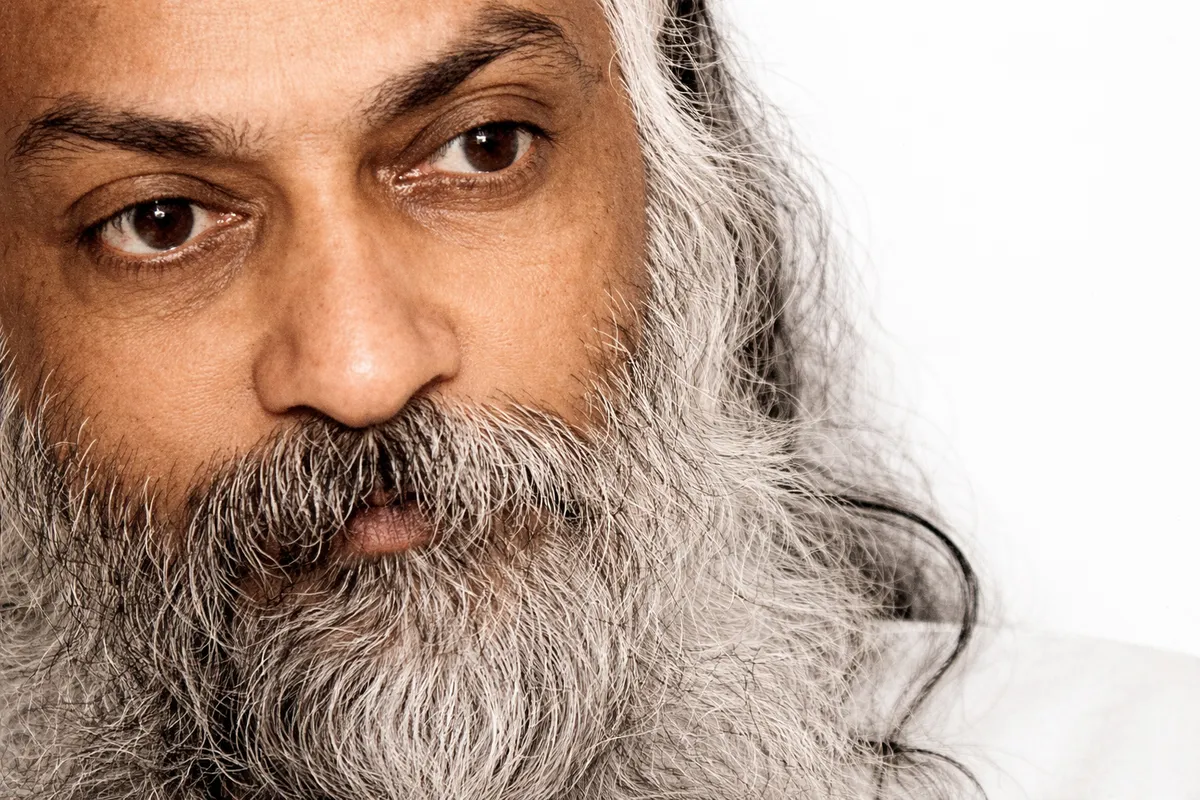
According to Osho, true God-experience needs no self-declaration; your very being proclaims it. If a declaration happens, it is God speaking through you—spontaneous, unchosen. If you decide to announce it, it's the ego’s subtlest madness. Surrender the chooser; let existence act. Sometimes it shouts, sometimes stays silent—both are His will.
If you truly meet God, you won’t need to say it—God will speak through you; if you feel like boasting, it’s just your ego.
From the Discourses
Passages where Osho speaks to this question — each links to the complete discourse.
Question: OSHO, CANNOT ONE DECLARE THAT ONE HAS EXPERIENCED GOD? If you have experienced, your very existence will be the declaration, you need not declare. At least you need not ask. If the declaration comes it comes, what can you do? One who has experienced God will not decide anything, not even this -- whether he has to declare or not. One who has experienced God has dropped the mind. Now whatsoever happens he will be into it, he will be totally into it. If declaration comes it comes. It came to Mansoor. He declared, "ANA'L-HAQ, I am God." His master, Junnaid, told him, "Mansoor, this is not right. You will get into trouble. I also know but I have never declared because you know these Mohammedans who are all around -- they will kill you." But Mansoor said, "What can I do? When he declares what can I do?
You say not to convert anyone or say you have found it. But what about you, Osho? What about wanting my beloved to become a sannyasin?
But the wife listened to me and stopped saying to the man.... It was hard for her, because she had also been, for thirty years, in the old habit of nagging. The husband was puzzled. He could not believe that the wife was bringing alcohol for him, serving it. He came to me after one week. He said, "What have you done to my wife? It is strange, but suddenly I am feeling that now the time has come to drop it." The male ego.... You are against smoking and your husband will smoke. You are against this and he will do that. He has to protect himself. He's so afraid of you -- that if he does not protect, you will eat him, you will absorb him. He's afraid because he knows you have the capacity to absorb him. Once, he had lived in a woman's womb, and he's…
Osho, can't one believe in god without seeing him?
Surendra Mohan, WHO IS TELLING YOU TO BELIEVE IN GOD? I am against all belief. You must be a very new comer here. Belief is irreligious, as much as disbelief is. Belief means you don't know yet you have accepted something. It is cowardly -- you have not inquired. You are pretending, you are a hypocrite. All believers are hypocrites -- Catholic and communist, Jainas and Jews -- all. Believers are hypocrites. They don't know and yet they pretend AS IF they know. What is belief? It is playing the game of "as if." And the same is true about disbelief. The communist knows NOT that there is no God, just as the Hindu knows not that there is a God. The Hindu believes there is a God, the communist believes there is no God. Disbelief is also a kind of belief -- a negative kind of belief. And that's…
Osho, is the experience of the Divine different for each person?
Think of it like this: you go home from this garden, and your children say, “Tell us—what was the garden like?” A painter might tell you by making a painting: “It was like this.” A poet will write a poem—of the trees, of the winds passing through them, of the sun filtering between their leaves. Now a poem and a painting differ greatly. Or perhaps someone is a musician; he will not even write a poem—he will lift his vina. Why write? The winds passed through the trees and there was sound and resonance—he will reproduce that resonance on the vina. The colors in the trees he will translate into tones. The sun and shade he will pour into music. He will play the garden on his vina. Another will write a poem; another will render it on paper. The three expressions will differ. And if you look only at…
Osho, by discussing the “aha-experience” and the “peak-experience,” the psychologist Viktor E. Frankl has given psychology a new dimension. Would you kindly explain this to us in the context of Ashtavakra and Janaka’s sense of wonder?
So “aah” can occur even to an atheist. “Aah” can happen to a scientist as well. When a scientist makes a new discovery, he is stunned; he cannot believe it; “aah” escapes him. “Aah” can happen to a mathematician too. When a problem has entangled him for years, and at last it is solved, the long tension collapses and a great peace is felt. This has nothing to do with religion yet. “Aah” can happen to the nonreligious. When Hillary reached Everest, “aah” burst forth. It has nothing to do with God. No one had ever reached there; an unprecedented event occurred. It does not make Hillary a theist. When man first walked on the moon, “aah” must have arisen: “I am walking on the moon!” For centuries man has dreamt of it—every child is born lifting his hands to catch the moon. “For the first time I have reached…