
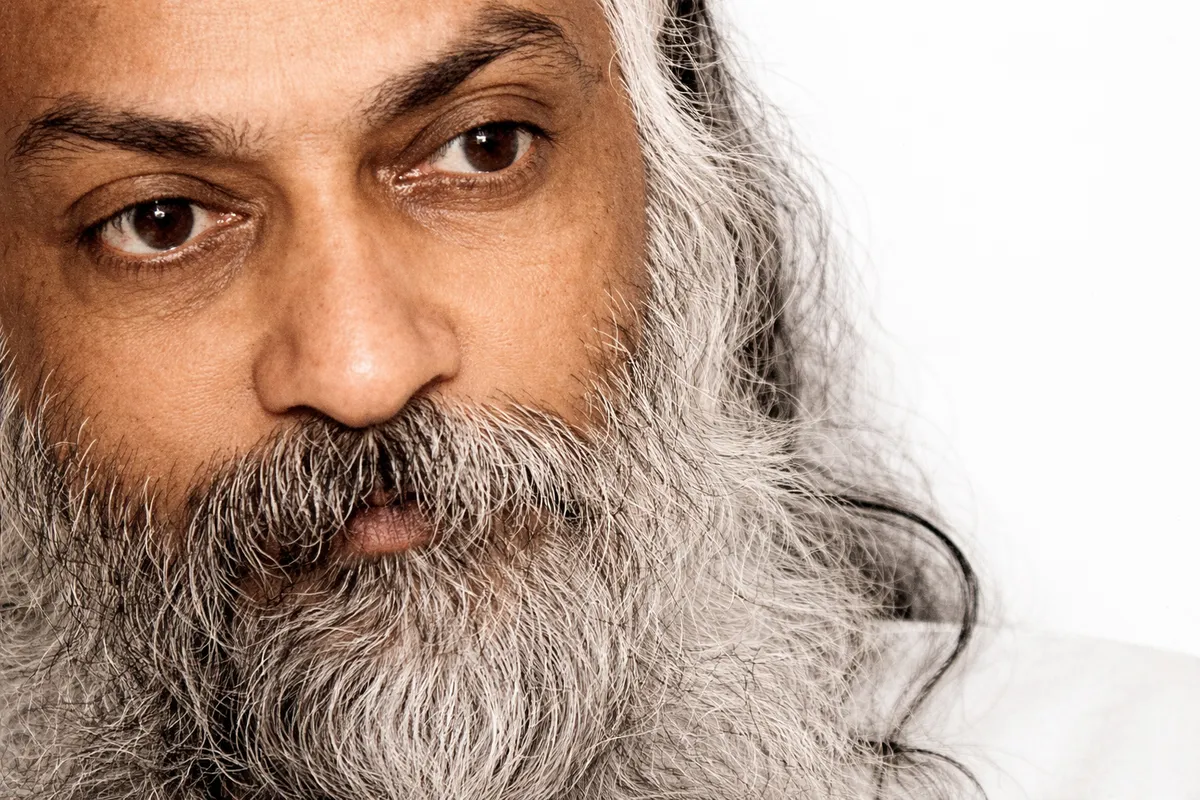
According to Osho, head and heart need not stay divorced, nor be fused; both are mere instruments. You are the witnessing consciousness beyond them. Let awareness be the master, and coordinate them: use the heart for love and value, the head for skill and expression. If compelled to choose, let the heart lead and the head serve; truth arises in silent witnessing, not in logic or emotion.
You’re not your head or your heart—be the calm boss who uses feelings to care and the mind to get things done.
From the Discourses
Passages where Osho speaks to this question — each links to the complete discourse.
Beloved Osho, your way is the way of the heart, and the outside world is the way of the head. Will it ever be possible that man can function from a blend of both head and heart, or must the two always remain totally divorced? Will it always be essential to make a conscious choice for one way or the other?
If you are talking to your wife, you must know it is impossible to talk, it is impossible to argue, it is impossible to come to a fair decision, because the woman functions through the heart. She jumps from one thing to another without bothering whether there is any relationship between the two. She cannot argue, but she can cry. She cannot be rational, but she can scream. She cannot be cooperative in coming to a conclusion. The heart cannot understand the language of the head. The difference is not much as far as physiology is concerned, the heart and the head are just a few inches apart from each other. But as far as their existential qualities are concerned, they are poles apart. My way has been described as that of the heart, but it is not true. The heart will give you all kinds of imaginings, hallucinations, illusions,…
Osho, you often tell us to listen to the heart rather than the mind. But how is one to know which voice is the mind’s and which is the heart’s? Please explain with compassion.
Renuka! The matter is absolutely straightforward. There is not the slightest confusion. The mind always points you outward; the heart always points you inward. When something within says, “Go out—earn money, gain position, prestige, ambition,” know it is the mind speaking, because these are not the heart’s longings. When something says, “Sit silently, close your eyes, dive within yourself, take a plunge into your own being, listen to your life-breath, step into the inner sound that is rising,” then know the heart has spoken. The inner journey is the heart’s message; the outer journey is the mind’s. There is no reason for mistake here. When hatred arises, know the mind has spoken; when love arises, know the heart has spoken. When thoughts surround you, know the mind has seized you; when waves of feeling rise, know you are in the heart. When negation arises—an urge to say “no,” when doubt…
[NOTE: This is an unedited tape transcript of an unpublished darshan diary, which has been scanned and cleaned up. It is for reference purposes only.] Man can function in two ways -- either ss a head or as a heart. And both are polar opposites to each other; their languages are different, their rhythm is different, their dimension is different, their whole world is different. Head consists of logic, calculation, cleverness, cunningness; it is a prose style of life, mundane and superficial, but efficient, very useful to the society, because man functions through the head almost like a machine -- and that's what the society needs. The society is not in need of men, it needs machines. That's why it goes on replacing man by more and more machines. Sooner or later man will become absolutely irrelevant.
In fact, love has such a magical quality that you may fail in the eyes of the world but you are never a failure as far as you are concerned -- and that is the only thing to be considered. Logic may succeed in the eyes of the world -- it is cunning. It succeeds politically; it succeeds as far as prestige, power, money is concerned. But inside you know that you have failed. Your life is empty, there is no meaning in it. And doubt goes on creating darkness. Doubt is another name for darkness, and trust another name for light. And these are the two alternatives available for every person: the head and the heart. The whole humanity can be divided in two categories, the heads and the hearts. But we don't divine humanity that way, we divide humanity into hand& and heads.
Jesus says, 'What does a man gain if he gains the whole world and loses his soul?' Nothing is gained. Alexander dies a poor man, utterly poor, like a beggar. Buddha is a beggar and dies like an emperor. It is so paradoxical. Yes, I see that that is the problem but there are two ways to go beyond it: either do something so it becomes a breakthrough, or go on solving it. But if you go on trying to solve it you will again be supporting the head, because that very effort will be of the head; it will be strengthening the head. This is what sannyas is all about: it is a breakthrough. You simply put the head aside and jump. It is a mad decision; it is deciding by the heart, not listening to the head.