
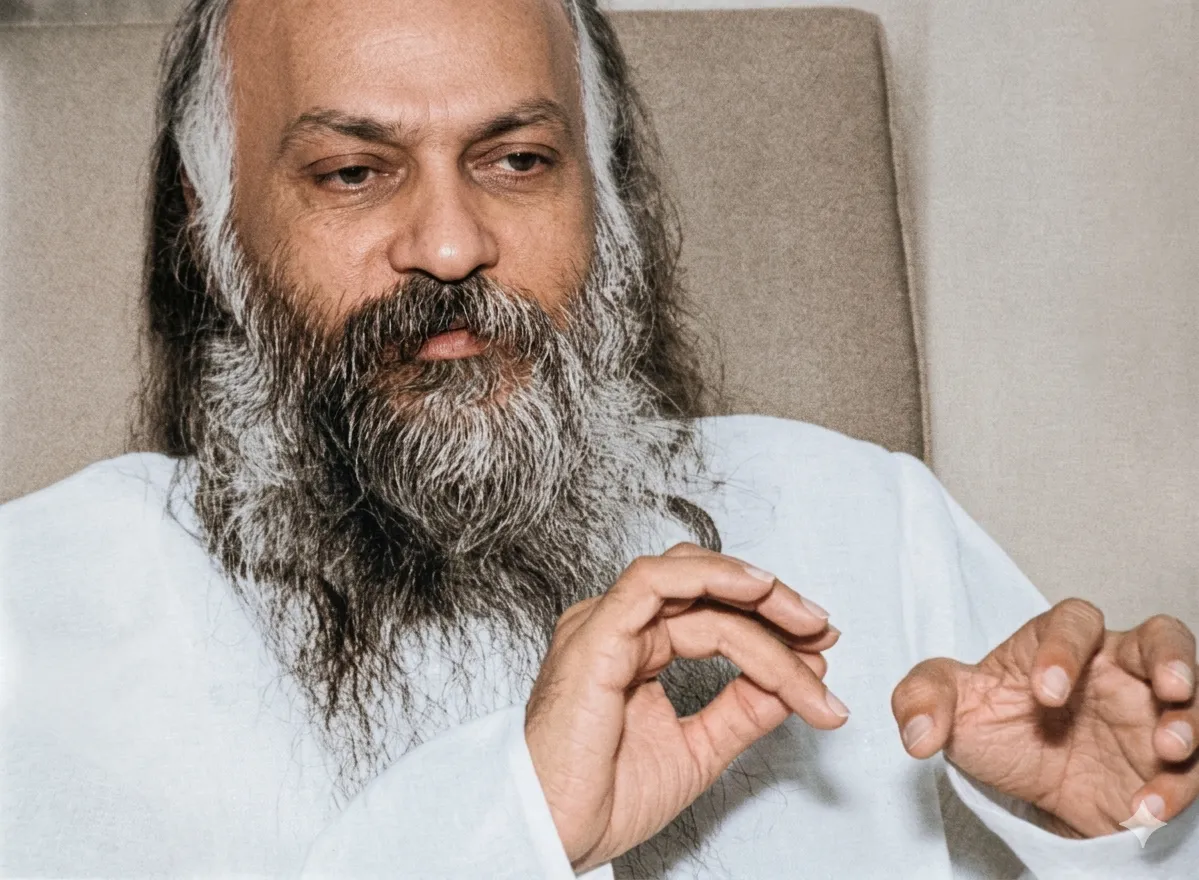
Other people’s ideas can point the way, but only what you experience yourself becomes real—so don’t just believe, check.
From the Discourses
Passages where Osho speaks to this question — each links to the complete discourse.
Osho, can information about someone else’s work not be useful?
By “use,” I mean this: from another’s work you can have information; it cannot become your own knowing. And it should never become belief. Do you see the difference? My knowing can never become your knowledge; it can at most become your information—information, yes. But it should never turn into belief.
प्रश्न: ओशो, क्या किसी के काम की जानकारी काम नहीं आ सकती?
काम में मेरा मतलब यह है, काम में आपकी जानकारी हो सकती है, आपका ज्ञान नहीं बन सकता। और विश्वास कभी नहीं बनना चाहिए। मेरा फर्क समझीं न आप? आपका ज्ञान तो कभी बन नहीं सकता मेरा जानना, आपकी जानकारी बन सकती है, इनफर्मेशन बन सकती है। लेकिन विश्वास कभी नहीं बनना चाहिए।
Question: OSHO, IS KNOWLEDGE ABSOLUTELY USELESS? ... Borrowed knowledge is always going to create that kind of state in you. You can repeat Jesus, you can repeat Krishna, you can repeat Moses, Zarathustra, Lao Tzu, but repetitions won't help; you have to learn on your own. Yes, imbibe the spirit of the Masters, of the awakened ones, but remember it is not knowledge that is going to help you but wisdom. And wisdom comes when all knowledge has been put aside. Call it knowledge or call it mind, it is the same thing. Mind is knowledge. When you have put aside all knowledge you have put aside the mind itself; you are in a state of not-knowing. And to be in a state of not-knowing is the most beautiful experience because it is innocence. You will be full of wonder and awe. You will be a child again.
When yamaoka was a brash student he visited the master dokuon. Wanting to impress the master he said: 'there is no mind, there is no body, there is no buddha. There is no better, there is no worse. There is no master, there is no student. There is no giving, there is no receiving. What we think we see and feel is not real. None of these seeming things really exists.' dokuon had been sitting quietly smoking his pipe, and saying nothing. Suddenly he picked up his staff and gave yamaoka a terrible whack. Yamaoka jumped up in anger. Dokuon said: 'since none of these things really exists, and all i
<q>THERE IS NO BETTER, THERE IS NO WORSE. THERE IS NO MASTER, THERE IS NO STUDENT. THERE IS NO GIVING, THERE IS NO RECEIVING. WHAT WE THINK WE SEE AND FEEL IS NOT REAL. NONE OF THESE SEEMING THINGS REALLY EXISTS.</q> This is the most profound teaching of Buddha, so one thing has to be remembered: you can repeat the most profound words ever uttered, and you can still be a stupid man. This Yamaoka IS stupid. He's repeating exactly the same words as Buddha. Words carry your being. When Buddha says the same words, they have a different significance, a different fragrance. The words carry something of the Buddha, something of his being: the aroma, the taste, of his inner being. The music of his inner harmony is carried by those words. When Yamaoka repeats them they are dead, stale, they don't carry any fragrance. They will carry something:…
It is asked: Osho, if we drop acquired knowledge—if we let go of what we have learned—won’t it create dullness and inactivity?
I have heard: In a school a teacher was teaching his students mathematics. He asked the children: “In a small pen, in a little garden, eleven sheep are penned. Five of them jump out—how many sheep are left inside?” A child waved his hand, a very small child waved his hand first. The teacher asked: “What is the answer?” The child said: “Not a single sheep will be left.” The teacher said: “You are absolutely crazy! Five sheep went out and eleven were inside—none will be left inside?” The child said: “You may know mathematics; I know sheep. We have sheep at home. If even one sheep jumps out, none will remain behind. You may know mathematics, but I know sheep—there are sheep in my house.” Can we not say the same about man—that he has behaved like sheep? Can we say we are thoughtful like humans, or do we…
Why, Osho, isn't knowledge of the scriptures helpful in finding the truth?
Maneeshi, KNOWLEDGE IS NOT YOURS, THAT'S WHY. It is borrowed. And can you borrow truth? Truth is untransferable; nobody can give it to you. Not even an alive Master can transmit it to you. You can learn, but it cannot be taught. So what to say about dead scriptures, howsoever holy they may be? They must have come from some original source; some Master, someone awakened must have been at the very source of them -- but now they are only words. They are only words about truth, information about truth. To be with Krishna is a totally different matter from reading the Bhagavad Gita. To be with Mohammed, attuned, in deep harmony, overlapping with his being, allowing his being to stir and move your heart, is one thing. And just to read the Koran is a far, faraway cry; it is an echo in the mountains. It is not…