
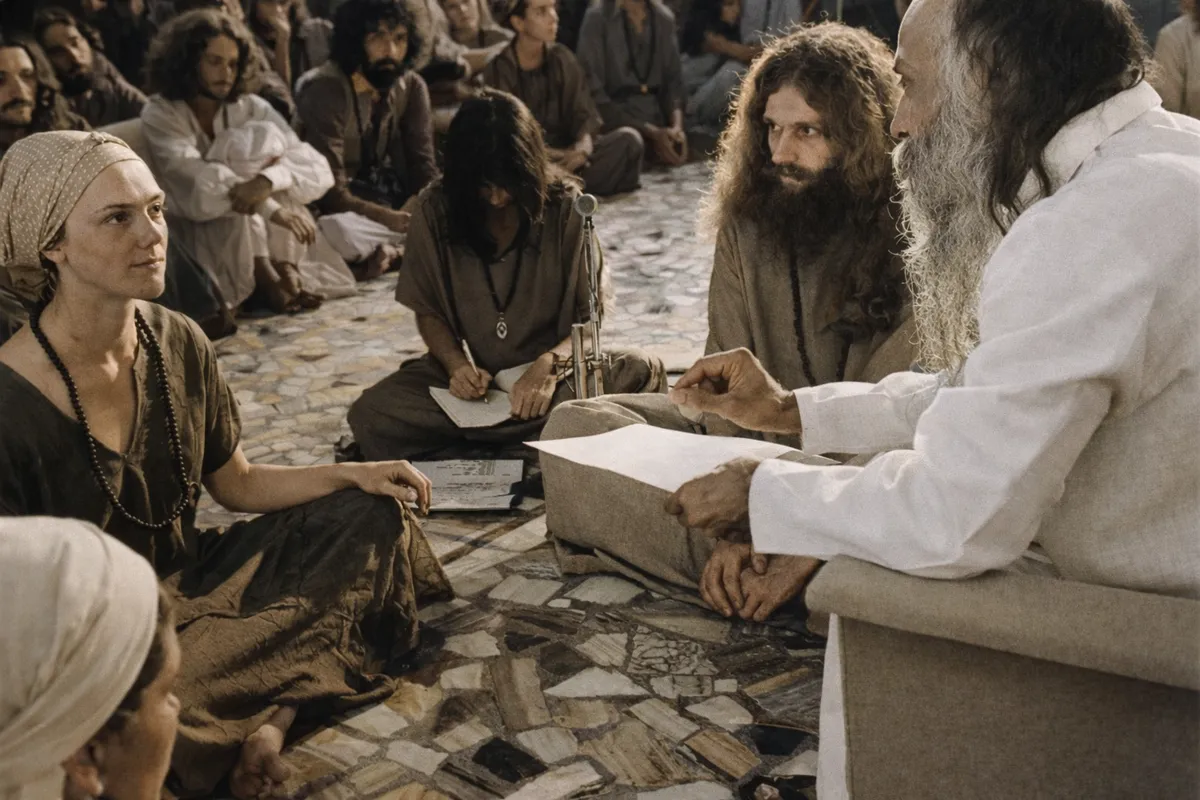
If you listen so quietly that your “me” fades, a flute, a bird, or any sound can give you the same God-experience Sufis seek.
From the Discourses
Passages where Osho speaks to this question — each links to the complete discourse.
If I can truly experience the music of the fluteplayer, can that be on the same level as the experience you wish to occur with you? I am thinking of the sufis: I see, but I do not see. I am behind a glass wall.
The object is irrelevant. Only the subjectivity is relevant. Whether listening to me, or listening to a fluteplayer, or listening to the birds in the morning, or sitting by the side of the waterfall and listening to it, the same experience can happen. It happens not from what you listen to, it happens because you listen. Just listening gives you total silence; in deep listening you disappear. The whole art is how to listen. Once you know how to listen, in deep receptivity, sensitivity, you are not there. The listener is not there, only listening. And when the listener is not there, there is no ego: there is no one who listens, only listening. And then it penetrates to the very core of your being. If you listen to me with mind, you will miss. If you listen to the waterfall without mind, you will get. It is not a…
Osho, the other day while listening to your discourse, a strange kind of vibration arose in the heart and along the auditory nerves; since then even ordinary sounds set off odd ripples and waves of bliss. Please tell me: is there something in the voice of enlightened ones that produces a special effect? Also, in your presence there is a particular, delightful fragrance; at times it is felt in the ashram and sometimes during meditation as well. In this regard, please say whether certain moments in time have their own special fragrance too.
I speak with the same purpose with which a musician plays the vina. He does not play to explain anything. Remember me as a vina player. My speaking is my vina. What I am saying to you—less am I speaking, more am I singing. If you understand its purpose, that is enough: listening to this instrument—as one sometimes, listening to a vina, falls into a trance—one begins to sway; something within begins to vibrate; something like a stone inside begins to melt and flow. For a moment a window, an opening, is there—sky is glimpsed. Like a flash of lightning—the darkness is gone—even if only for a moment; but then you know that light is, and you also know there is a path. It was revealed for a moment in the lightning’s flare, but revealed it was. Now no one can tell you there is no path; no one can…
चौथा प्रश्न: ओशो, पिछले दिन आपका प्रवचन सुनते हुए आपकी आवाज से हृदय और कर्ण-तंतुओं पर एक अजीब तरह का कंपन हुआ और तब से साधारण ध्वनियां भी अजीब कंपन और आनंद की लहर पैदा कर रही हैं। कृपया बताएं कि क्या बुद्धपुरुषों के स्वर में कुछ है, जो विशेष प्रभाव पैदा करता है? साथ ही आपकी उपस्थिति में एक विशेष आनंददायक गंध मिलती है; और वह कभी आश्रम में और कभी ध्यान के समय भी मिलती है। इस संदर्भ में भी बताएं कि क्या काल या समय-विशेष की विशेष गंध भी होती है?
… यह बोलना मेरी वीणा है। यह जो मैं तुमसे कह रहा हूं, कह कम रहा हूं, गा ज्यादा रहा हूं। इसका प्रयोजन तुम्हारी समझ में आ जाए, तो बस काफी है। वह प्रयोजन इतना ही है, इस वाद्य को सुनते-सुनते.जैसे वीणा को सुनते-सुनते कभी-कभी ‘तारी’ लग जाती है। डोलने लगता है आदमी। कुछ भीतर कंपने लगता है। कोई पत्थर जैसी चीज भीतर पिघलने लगती है, बहने लगती है। एक क्षण को एक झरोखा खुलता, एक वातायन खुलता, आकाश दिखायी पड़ जाता है। जैसे बिजली कौंध गयी। अंधेरा खो गया--एक क्षण को सही--लेकिन फिर तुम जानते हो कि प्रकाश है, और तुम यह भी जानते हो कि राह है। …
Osho, when I read your discourses I am filled with wonder. But when I listen to them, only sound keeps reverberating. In the end, only emptiness remains, and a soft, delicate bliss. Is this your taste, Osho?
Certainly. I am not saying anything to convince your intellect. My effort here is not to placate your mind. Sometimes I speak on devotion—then the effort is that your heart be stirred. Sometimes I speak on knowledge—then the effort is that you transcend both heart and intellect and become a witness. But I never speak for the intellect. The intellect is like an itch: the more you scratch… While scratching it feels pleasant; afterward a great soreness comes. I am not speaking for your intellect, not for your head. Either I speak for the heart, or I speak for that which is beyond both—beyond heart and intellect. Either for the witness, or for your feeling. Either for your love, or for the awakening of truth within you. And the greatest benefit will be for those who listen by putting the intellect aside. Heard through the intellect, nothing much is heard.…
दूसरा प्रश्न: ओशो, जब आपका प्रवचन पढ़ता हूं तो आश्चर्य होता है। लेकिन उसे ही जब सुनता हूं तब सिर्फ ध्वनि ही ध्वनि गूंजती रह जाती है। अंत में रह जाती है केवल शून्यता और भीनी-भीनी मस्ती। क्या यही आपका स्वाद है ओशो?
निश्चित ही। तुम्हारी बुद्धि को समझाने को मैं कुछ भी नहीं कह रहा हूं। यहां मेरा प्रयास तुम्हारी बुद्धि को राजी करने के लिए नहीं है। या तो कभी बोलता हूं भक्ति पर, तब प्रयास होता है कि तुम्हारा हृदय तरंगित हो; या कभी बोलता हूं ज्ञान पर, तब प्रयास होता है कि तुम हृदय, बुद्धि दोनों का अतिक्रमण करके साक्षी बनो। लेकिन बुद्धि के लिए तो बोलता ही नहीं। बुद्धि तो खाज जैसी है, जितना खुजलाओ...। खुजलाते वक्त लगता है सुख, पीछे बड़ी पीड़ा आती है। तुम्हारी बुद्धि के लिए नहीं बोल रहा हूं, तुम्हारे सिर के लिए नहीं बोल रहा हूं। या तो बोलता हूं हृदय के लिए कभी, या बोलता हूं उसके लिए जो सब के पार है--हृदय, बुद्धि दोनों के। या तो साक्षी के लिए या तुम्हारे भाव के लिए। या तुम्हारे प्रेम के लिए या सत्य का तुम्हारे भीतर जागरण हो, उसके लिए। और अधिकतम लाभ उन्हीं को होगा, जो बुद्धि को छोड़ कर सुनेंगे। बुद्धि से सुना कुछ खास सुना नहीं। शब्दों का सुन लेना कुछ सुनना नहीं है। …
In the East we say that all music is an effort to bring that cosmic sound to be. That's why there is spirituality in indian music... a new sensitivity which is nowhere to be found. In the western music there is too much sexuality, it is too sensuous. In the indian music there is too much spirituality -- it is not sensuous at all. It silences you, calms you down, cools you, and brings a breeze from the eternal... the breath of the eternal. It is an effort to give you an indication of the cosmic sound. It is just as when I am talking to you. My whole effort in talking is to bring you something that cannot be talked about... to say something that cannot be said... to bring to words something which is wordless... to define something which cannot be defined and is immeasurable.
Beloved Osho, when I'm not near you physically, music seems to be the easiest way to feel your love. Sometimes, listening to classical music, it touches me so deeply that there comes a moment when I feel I cannot take in more joy. Suddenly I remember you, and all the excitement falls into a greater depth, more calm, silent, soothing. Now there is no more boundary to joy... And so much gratitude.
"You have beautiful instruments and you have beautiful art, but your heart is not in the music; it is in defeating somebody. And unless you drop that idea you will never be equal to Tansen. He has no idea to defeat anybody, that's why he goes on winning." It was very difficult for Baiju Bawara to get rid of the desire, because that was the desire through which he had devoted his whole life to music. But if the master said so, then it was better to wait. He forgot all about Tansen, slowly slowly. And once, when Haridas became very old, be became sick; and he had a kind of paralysis of the legs, so he could not go from his small cottage to the nearby Krishna temple. And without seeing Krishna, he would not eat anything. Many physicians tried to treat him. They could not do anything. Baiju…