
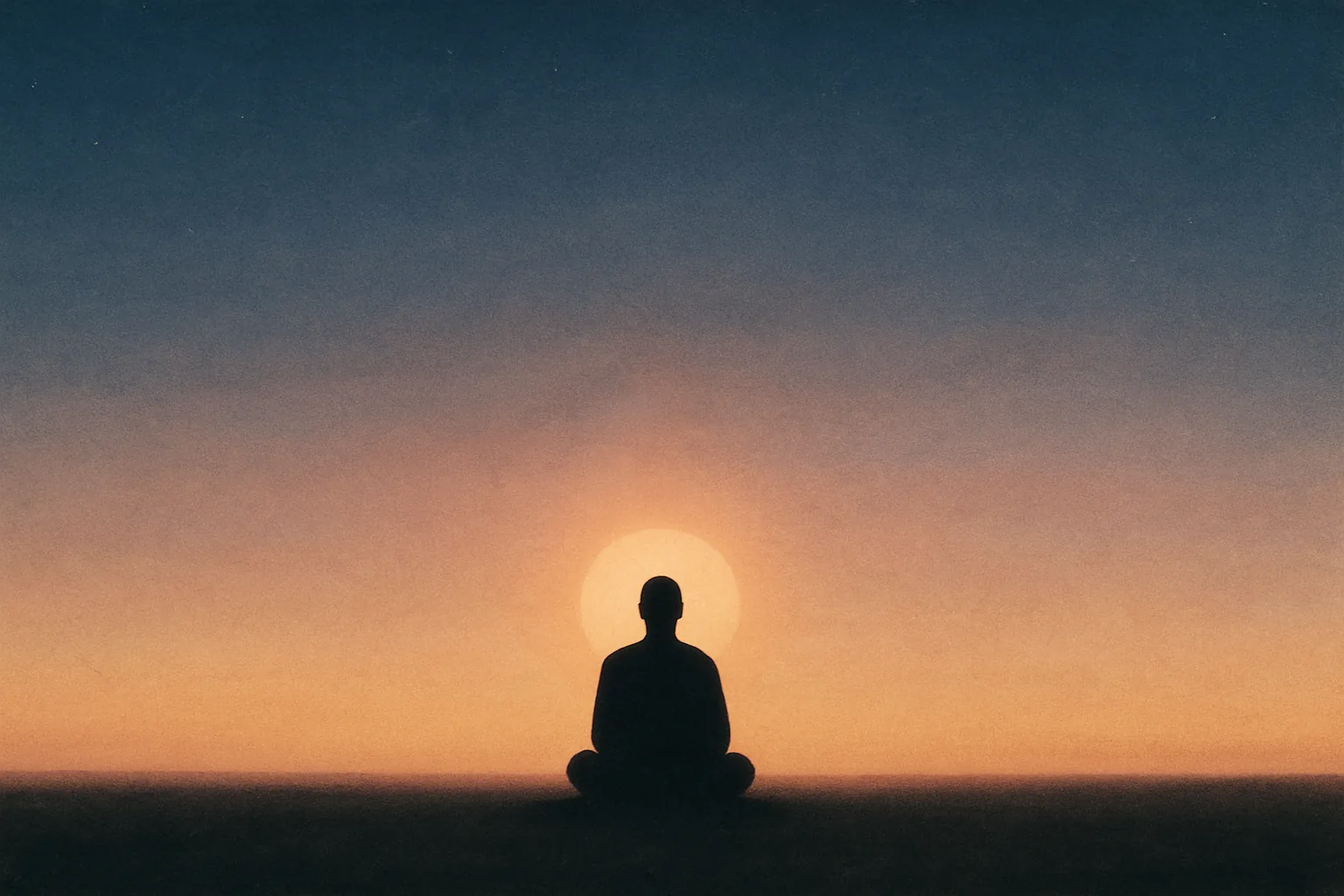
Swaying Meditation is an Osho method that begins in stillness and ripens into spontaneous dance. The practice starts simply—eyes closed, seated, body gently arcing from side to side—then uses a sharp, grounded sound to unlock deeper currents. As the movement gathers its own life, technique falls away and the dance becomes prayer: the dancer dissolves, only the dance remains.
Rooted in the Tantra spirit of totality and surrender, this meditation transforms ordinary motion into a gateway to egoless ecstasy. You are invited to lose the manipulative doer, to let the body flow as if moved by a larger love—“as if you are deep in love with the universe, as if you are dancing with your lover; let God be your lover.” In this way, movement becomes meditation, and prayer becomes a living, breathing dance.
Phase Instructions
First Stage: Swaying with the 'hoo' release (20 minutes)
Sit cross‑legged with eyes closed. Let the hands rest comfortably. Begin to sway gently—first to the left, then to the right—allowing the torso to arc like a pendulum. The swaying need not involve the whole body; simply bend as far as feels comfortable and natural. At the furthest point on each side, sharply release the sound 'hoo' with a small, decisive jerk through the body. Do this at the end of the sway on both sides, each time you reach the edge. Keep the rhythm unforced and continuous: left… edge… 'hoo'; right… edge… 'hoo'. Let breath remain natural, letting gravity guide the bowing arc. Continue for the full 20 minutes, letting the sound and the brief jerk punctuate and deepen the sway.
Second Stage: Let movement become dance
As swaying gathers energy, allow it to overflow into free, ecstatic movement—when the movement becomes so total that there is no manipulator, it is dance. Drop techniques and any idea of how it should look. Allow the body to flow spontaneously, as if moved from beyond you; let the dancer be lost and only the dance remain. If the mind tries to steer, soften and surrender again to the current. Dance as a prayer: as if you are deep in love with the universe, as if you are dancing with your lover—let God be your lover. Continue as long as the ecstasy is authentic and the dance carries itself.
Ongoing Practice: Daily prayerful free dance (optional deepening)
Outside the formal session, cultivate this doorway daily: for at least one hour every day, forget all technique and simply dance to the Divine like a small child—innocently, wholeheartedly, as a living prayer. Trust steps you have never taken before; allow unfamiliar ground to reveal itself. As you tune with the unknown, techniques disappear; when dance is pure and simple, it is perfect.
Core Benefits
- Facilitates deep emotional release
- Encourages spontaneous self-expression
- Transforms movement into a meditative state
- Fosters a sense of surrender and letting go
- Cultivates a feeling of unity with the universe
What Osho Said About This Technique
ABOUT THE AFTERNOON MEDITATION. KIRTAN, singing and dancing, is one of the secret doors, one of the deepest doors. The approach is very basic. The first thing to be understood is: don't take religion seriously. You can sing and dance in it; long faces are not needed. We have lived with long faces too long. If you see the old face of God it is sad. It creates boredom. Now -- and not only now, it has always been so, but more so today -- now. we need a dancing and laughing God. Seriousness has killed religion. Irreligious people have not killed religion. atheists have not destroyed religion -- seriousness has killed relig ion. The serious faces of the priests and prophets. Seriousness is a disease. Because of the serious face of religion.
What is dynamic meditation?
In the second step so many things are possible -- something different will happen to each individual. One person will begin to dance, another person will begin to cry. One will become naked, another will begin to jump and yet another will begin to laugh. Anything is possible. Move from within, move totally, and then you can proceed to the third stage. The third stage is reached as a result of an inherent sequence. In the first stage, the body electricity, or you can call it Kundalini, is awakened. It begins to revolve and move. Only then can the body be in a total letgo, not before. Only when the inner movement has begun are outer movements possible. When the catharsis of the second stage is brought to a peak, to a climax, the third ten-minute stage begins. Begin to repeat vigorously the Sufi mantra: Hoo! Hoo! Hoo! The energy…
The meditative process of inner transformation: the source of Yoga-vidya It may surprise you to know, but you must know it: all the yogasanas have been discovered only as spontaneous postures in meditative states. No one sat down and invented them by thinking. No one prepared them at a desk. In meditation the body assumed those postures, and then it was found that such postures exist. Then gradually the associations were discovered: when the mind goes into a certain state, the body goes into a certain stance. Then it occurred to us that if the body is taken into that stance, the mind will go into that state. We know that when inner weeping fills us, tears come to the eyes. If tears come to the eyes, inner weeping will be filled. These are two ends of the same phenomenon. When anger comes, our hand rises to strike someone’s head.
आंतरिक रूपांतरण की ध्यान-प्रक्रिया: योगविद्या का स्रोत यह जानकर आपको आश्चर्य होगा, लेकिन जान लेना जरूरी है कि जितने भी योगासन हैं, वे सब ध्यान की स्थितियों में आकस्मिक रूप से ही उपलब्ध हुए हैं। उन्हें किसी ने बैठकर, सोचकर निर्मित नहीं किया। उन्हें किसी ने बैठकर तैयार नहीं किया है। वह तो ध्यान की स्थिति में शरीर ने वैसी स्थितियां ले ली हैं और तब पता चला कि ये स्थितियां हैं। और तब धीरे-धीरे एसोसिएशन भी पता चला कि जब मन एक दशा में जाता है तो शरीर इस दशा में चला जाता है। तब फिर यह खयाल में आ गया कि अगर शरीर को इस दशा में ले जाया जाए तो मन उस दशा में चला जाएगा। जैसे हमें पता है कि अगर भीतर रोना भर जाए तो आंख से आंसू आ जाते हैं। अगर आंख से आंसू आ जाएं तो भीतर रोना भर जाएगा। ये एक ही चीज के दो छोर हो गए। जैसे हमें क्रोध आता है तो किसी के सिर के ऊपर हमारा हाथ उसे मारने को उठ जाता है। …
Relax into the body, rest into the body. Next time when you are making love and the body starts moving on its own, be thrilled that your body is alive. You have not been able to kill it yet! Participate in it. Rather than trying to control it, become part of it. If the body is shaking, you go into the shaking; be the shaking! The english word 'shaking' comes from a sanskrit root, you will be surprised to know. The sanskrit word is 'shakti'; it means power, energy. The english word shaking comes from shakti. When you are shaken, it is energy -- it is shakti. Go into it, allow it and cherish it! Cherish the dance! And the second thing: never try to impose any sexuality on the body; that is violence.
Dance is a rhythmic movement. Dance represents god more than anything else. In my observation, dance is the most prayerful activity possible. When your body is in a dance and you are utterly lost in the rhythm of it, you start coming closer to god. The indian story is beautiful... in India the story of creation starts with a dance. God started dancing and out of his rhythm and movement the world arose. The Christian idea, that god said 'Let there be light,' looks very intellectual... a kind of commandment, an order. The Hindu idea looks more in tune with existence: god wanted to create so he started dancing. His first step is the beginning of creation, his first movement... he started moving. He must have remained stagnant, he must have remained dormant, he must have been fast asleep, unmoving until then. He started moving.
Common Questions
The practice starts seated with eyes closed and the body gently arcing from side to side.
Yes, it begins with a grounded sound to help unlock deeper currents.
Yes, it is suitable for anyone willing to experience movement as meditation and to surrender to the flow.
This method transforms ordinary motion into a gateway to egoless ecstasy, unlike traditional seated meditations focused on stillness.