
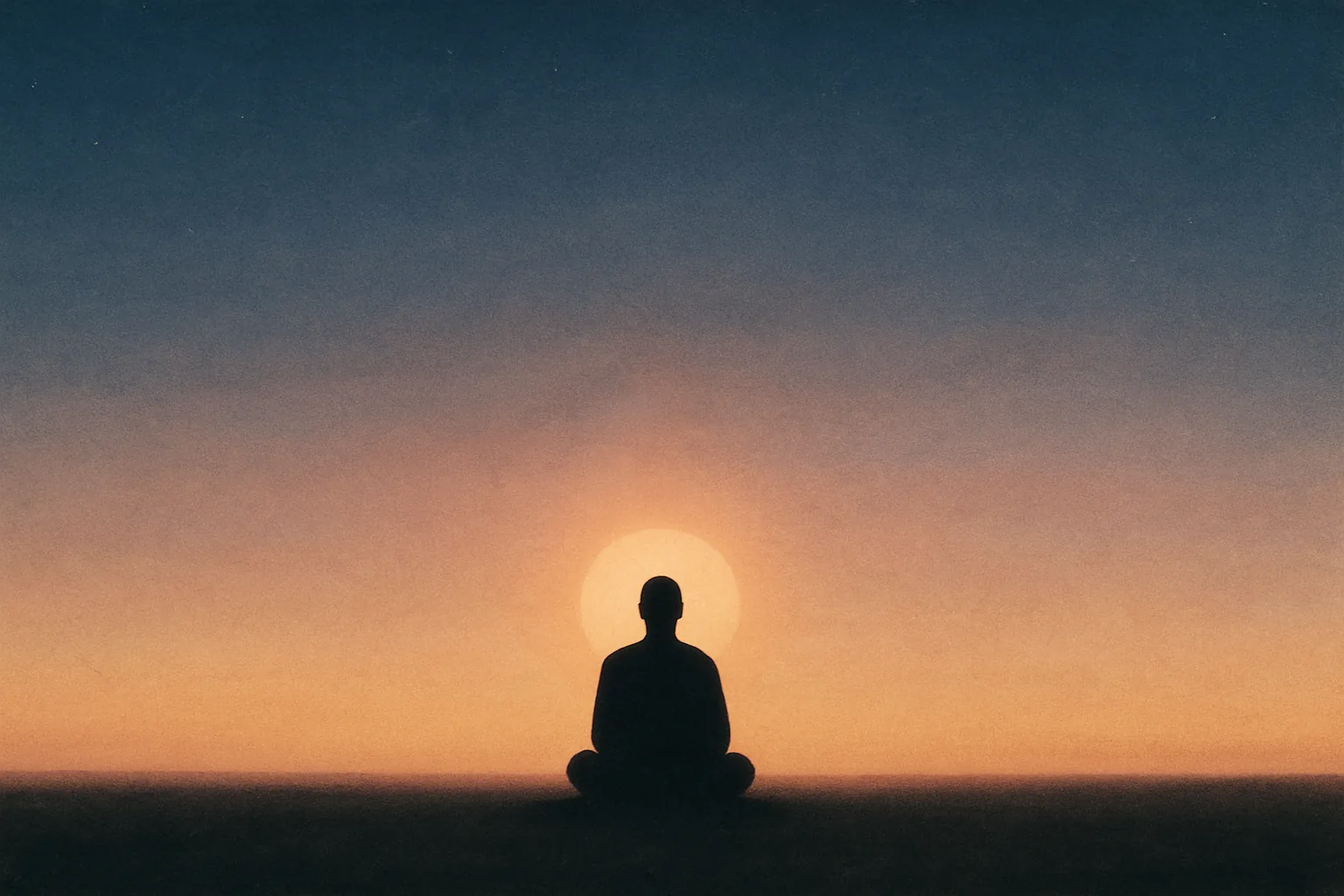
This meditation distills a core Tantric insight spoken of in Osho’s way: love is the circumference, freedom is the center, and meditation is the balance that lets both wings fly together. Rather than choosing between worldly intimacy and ascetic detachment, you cultivate a warm heart that does not possess, and a clear center that is never cold. In this method you examine and investigate the subtle movements of clinging and escape, then unify them through breath, awareness, and embodied imagery—so love and freedom grow hand in hand.
Rooted in the message echoed by Atisha and the Buddhas—"find freedom by means of both examination and investigation"—this practice moves from grounding in your inner center, to radiating love without bondage, to seeing the traps of “freedom from” and “freedom for,” and finally resting in simple freedom beyond both. It is poetic and practical: a dance of wings where the heart embraces and the being remains unbound.
Phase Instructions
First Stage: Center as Freedom
Sit upright, relaxed, eyes closed. Feel your sitting bones rooted and your spine spacious. Place one hand lightly below the navel (hara) and one on the heart. Breathe through the nose: slow, even breaths. On each inhalation, sense a quiet axis forming from pelvic floor to crown; on each exhalation, let the body soften around that axis. Do not try to fix anything—simply witness. If thoughts of past or future arise, label them gently “past” or “future” and return to the living sensation of breath at the hara. Let the feeling-tone of this stage be cool, clear, and unpossessive—freedom as your center.
Second Stage: Circumference as Love
Keep the inner axis. Shift your attention to the heart. With each out-breath, imagine a warm, luminous circle expanding from the chest in all directions—the circumference of love. Let it include people, places, and beings without choosing or excluding. If possessiveness appears (images, strings, contracts, demands), notice where it tightens your body. Breathe directly into that spot and soften with the inner whisper: “You are free, and I am free.” Maintain the witnessing center while allowing warmth to spread. Feel tenderness without grasping, care without control.
Third Stage: Examination — Freedom From and Freedom For
Bring to mind one real relationship or situation. Inquire in three movements: (1) Freedom from: What in this do I want to escape—memory, role, fear, obligation? Where does that land in the body? Feel it exactly as sensation; breathe and let the contraction loosen by 5–10%. (2) Freedom for: What future do I chase here—recognition, safety, perfection? Where does that lean forward in the body? Feel and soften by 5–10%. (3) Just freedom: For a few breaths, drop both the push (from) and the pull (for). Rest as simple presence at the center while love continues to glow at the circumference. Let the three be seen without judgment. Clarity, not suppression, is the key.
Fourth Stage: Investigation — Label, Bow, Release
Now watch the mind–heart field moment to moment. Each time an impulse surfaces, name it once—“cling,” “fear,” “need,” “avoid,” “possess,” “escape.” Bow to it inwardly (acknowledge), feel its energy in the body, then let the breath move it through on the next exhale. Do not analyze the story; sense the energy, keep the center cool and the circumference warm. Check your balance every few minutes: (a) If you feel warm but entangled, re-emphasize the cool center (two deeper breaths at the hara). (b) If you feel clear but cold, re-emphasize the warm circumference (two heart-breaths radiating kindness). Continue until labeling becomes sparse and presence becomes simple.
Fifth Stage: Two Wings in One Flight
Coordinate breath and image. Inhale: draw awareness to the center (hara–spine), silently feel “free.” Exhale: let warmth expand from the heart, silently feel “love.” Optionally, add subtle movement: with the inhale, forearms rotate inward slightly (wings gather); with the exhale, forearms open slightly (wings unfold). Move minimally so stillness remains primary. Let center and circumference be simultaneous—no gap between them. If emotion arises, include it in the warm field while remaining unbound at the center.
Sixth Stage: Silent Rest in Just Freedom
Drop all techniques. No labels, no imagery. Sit as you are: the center effortless, the warmth effortless. Allow breath to breathe itself. Sense the feeling of being that is neither from nor for—just freedom—while love remains available as a gentle glow. End by placing both hands over the heart, then the hara, bowing slightly. Before opening your eyes, resolve to carry this balance into action today: be loving and nonpossessive, be free and warm.
Core Benefits
- Cultivates a warm heart that does not possess and a clear center that is never cold.
- Unifies movements of clinging and escape through breath, awareness, and embodied imagery.
- Grows love and freedom hand in hand.
- Grounds in the inner center while radiating love without bondage.
- Helps in resting in simple freedom beyond traps of 'freedom from' and 'freedom for'.
What Osho Said About This Technique
Meditation fulfils something, love fulfils something else. It is like telling a person 'Either you can eat or you can drink. If you eat, then you cannot be allowed to drink anything; if you want to drink anything then you cannot eat. Choose one -- whatsoever you want.' Now, you will drive that man crazy! He needs both. You tell somebody 'Either you can remain awake or you can go to sleep -- choose.' These are opposite activities, and you cannot choose opposite things because that will create troubles for you, so either be awake or be asleep.' Now, nobody can choose one. You will need a certain rhythm between waking and sleeping; you will have to move from one to the other. Waking you will create the necessity for sleep, sleep will create the necessity for waking.
It is ridiculous. It is ridiculous because we don't want it -- still we go on creating it. It is ridiculous because it is our own creation and we don't want it. Nobody wants it and everybody goes on creating it. And we desire bliss, but we don't prepare the ground for it. That too is ridiculous. All that we do creates misery and all that we long for is bliss. This is the ridiculousness of it: we are longing for bliss and creating misery. This is the contradiction, the dilemma that man lives in. But it can be transformed. The moment you become aware, withdraw from all those things that have been creating misery; don't pour your energy into them any more. Start pouring your energy into things which prepare you for bliss. Two things, love and meditation, are enough to prepare the ground, and bliss comes!
These are three concentric circles around the center. Of course the heart is closer to being, so it is better to be in the heart than to be in the mind. The mind is closer than the body; it is better to be in the mind than in the body. But the ultimate goal is to be just your being -- no action, no thought, no feeling, just pure witnessing. And then the satori happens and one becomes full of light, full of truth. Then to live is a blessing. Before it, it is just a drag; after it, it is a dance. (Really, meditation is a journey, Osho told Bhavan, from your head to your heart to your being.) Meditation is not-knowing, it is not like knowledge, It is far closer to feeling. It is not like logic, it is far more like love.
Question: ONCE UPON A TIME THERE WAS A MAN STANDING ON A HIGH HILL. THREE TRAVELLERS, PASSING IN THE DISTANCE, NOTICED HIM AND BEGAN TO ARGUE ABOUT HIM. ONE SAID, 'HE HAS PROBABLY LOST HIS FAVOURITE ANIMAL.' ANOTHER SAID, 'NO, HE IS PROBABLY LOOKING FOR HIS FRIEND.' THE THIRD SAID, 'HE IS UP THERE ONLY IN ORDER TO ENJOY THE FRESH AIR.' THE THREE TRAVELLERS COULD NOT AGREE AND CONTINUED TO ARGUE RIGHT UP TO THE MOMENT WHEN THEY ARRIVED AT THE TOP OF THE HILL. ONE OF THEM ASKED: 'O FRIEND, STANDING ON THIS HILL, HAVE YOU NOT LOST YOUR FAVOURITE ANIMAL?' 'NO, SIR, I HAVE NOT LOST HIM.' THE OTHER ASKED: 'HAVE YOU NOT LOST YOUR FRIEND?' 'NO, SIR, I HAVE NOT LOST MY FRIEND EITHER.' THE THIRD TRAVELLER ASKED: 'ARE YOU NOT HERE IN ORDER TO ENJOY THE FRESH AIR?' 'NO, SIR.
In the cavity of the heart, which is situated in the body, dwells the unborn who is eternal.
THE EARTH IS ITS BODY. IT DWELLS IN THE EARTH, BUT THE EARTH DOES NOT KNOW IT. WATER IS ITS BODY. IT DWELLS IN WATER,BUT WATER DOES NOT KNOW IT. FIRE IS ITS BODY. IT DWELLS IN FIRE BUTFIRE DOES NOT KNOW IT. AIR IS ITS BODY. IT DWELLS IN THE AIR, BUT THE AIR DOES NOT KNOW IT. THE SKY IS ITS BODY. IT DWELLS IN IT,BUT THE SKY DOES NOT KNOW IT. THE MIND IS ITS BODY. IT DWELLS IN THE MIND, BUT THE MIND DOES NOT KNOW IT. THE INTELLECT IS ITS BODY. IT LIVES IN THE INTELLECT, BUT THE INTELLECT DOES NOT KNOW IT. THE EGO IS ITS BODY. IT DWELLS IN THE EGO,BUT THE EGO DOES NOT KNOW IT. THE CONSCIOUSNESS IS ITS BODY. IT DWELLS IN THE CONSCIOUSNESS, BUT THE CONSCIOUSNESS DOES NOT KNOW IT. THE UNMANIFEST IS ITS BODY. IT DWELLS IN THE…
Common Questions
It focuses on unifying love and freedom through embodied imagery, rather than just observing thoughts and sensations.
Yes, it promotes cultivating a warm heart that does not possess, potentially aiding in healthier relationship dynamics.
Yes, the practice is both poetic and practical, making it accessible for beginners while also offering depth for advanced practitioners.
Breath is used to unify the movements of clinging and escape, allowing love and freedom to grow together.
Meditation balances love and freedom, allowing both to coexist without conflict, akin to wings flying together.