
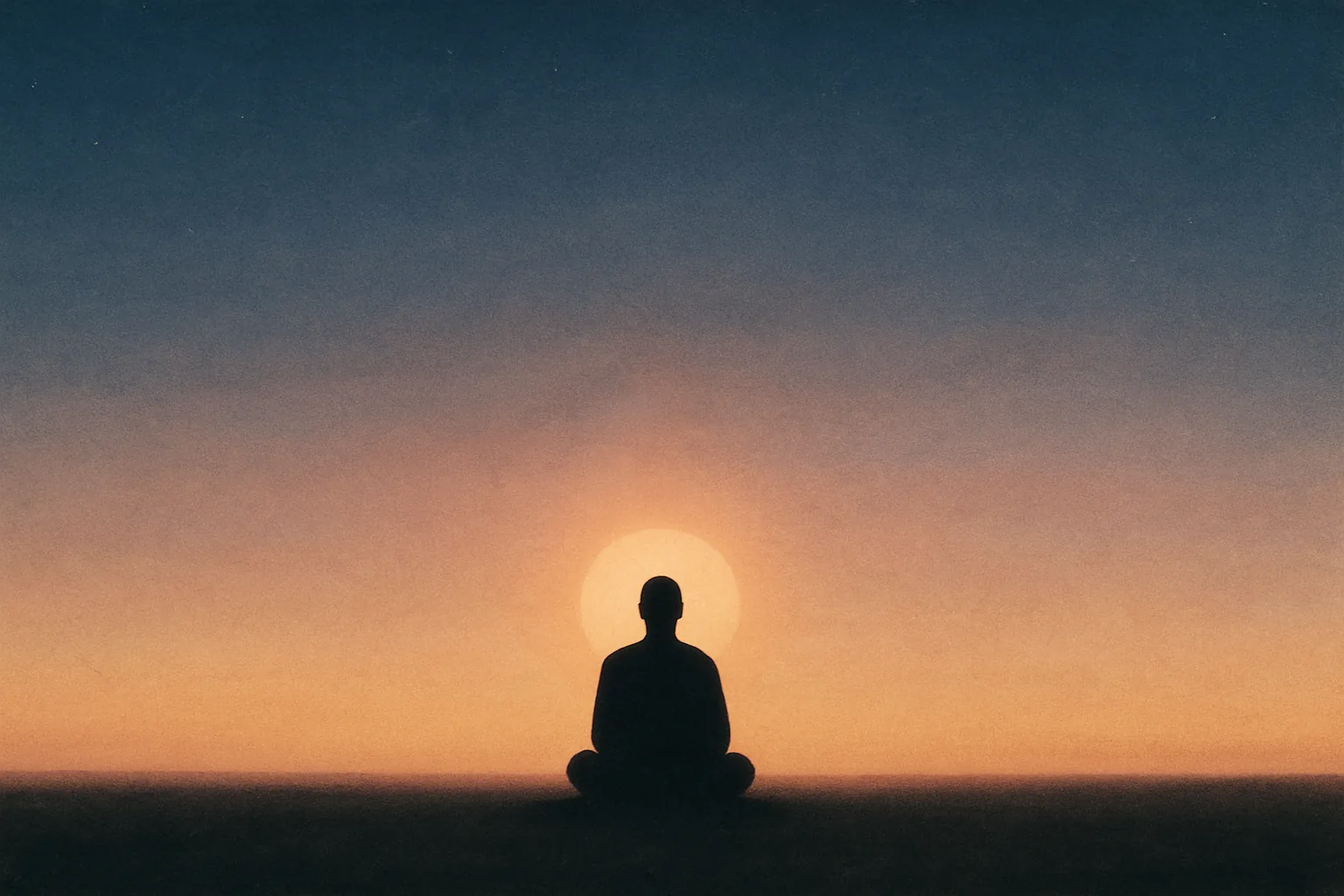
Dynamic Meditation is Osho’s powerful, cathartic method for modern seekers—an alchemical process that turns stored tension, sadness, anger, and numbness into vitality, clarity, and presence. Rooted in the radical spirit of Tantra, it moves through breath, emotional release, primal sound, utter stillness, and joyous celebration. Rather than suppressing what has been repressed, it invites full-bodied expression so that heaviness dissolves and a fresh, innocent awareness can appear.
This practice is designed for times when energy feels stuck or life seems like a breakdown waiting to happen. It prepares the ground for breakthrough: first shaking loose old patterns, then opening a silent space within which witnessing naturally flowers. Best done at sunrise on an empty stomach with eyes closed or a blindfold, it uses music or a timer to mark five distinct stages. Give yourself totally to each phase—and let the meditation do the work.
Phase Instructions
First Stage: Chaotic Breathing (10 minutes)
Stand with feet shoulder-width apart, knees soft, spine free. Close your eyes or wear a blindfold. Breathe rapidly and deeply through the nose only. Let the inhalation happen; emphasize a forceful, complete exhalation. Allow the breath to become chaotic—irregular, powerful, alive—so it unhooks your usual control. Let the body move as it wishes: shake, sway, ripple. Keep your attention on the exhalation and steadily increase intensity. Use music or a timer; build energy without strain, keeping the jaw relaxed and shoulders loose.
Second Stage: Catharsis (10 minutes)
Explode into expression. Give the body and emotions total permission to discharge: shout, cry, laugh, growl, stamp, kick cushions, shake out the limbs, beat the chest—whatever is true for you. Do not act or perform; allow. If tears come, cry; if laughter comes, laugh; if rage rises, let it move safely. Keep eyes closed; stay aware while expressing. Use the whole space but remain injury-aware—protect your body and others. Let everything repressed surface and empty out.
Third Stage: Jumping with the Mantra “Hoo” (10 minutes)
Raise both arms straight overhead, hands relaxed. Jump up and down, landing firmly on the flats of your feet. With each landing, sound a strong, single "Hoo!" from deep in the belly, letting the shock wave strike the pelvic floor/sex center. Keep the arms up, the body vertical, and the mantra total. Let the sound drill down and break inner locks. If you tire, keep going lightly but do not drop the arms; stay wholehearted.
Fourth Stage: Stop and Witness (15 minutes)
On the cue—"Stop!"—freeze immediately in whatever position you are in. Do not adjust. Become utterly still: no movement, no cough, no scratch, no fidget. Eyes remain closed. Let breath settle on its own. Simply watch—sensations, heartbeat, tingling, thoughts—without involvement. If you fall or move unintentionally, freeze again at once and continue witnessing. This is the pivot of the meditation: be a silent, alert awareness inside a motionless body.
Fifth Stage: Celebration and Integration (15 minutes)
Let the body move into free dance and celebration. Smile, spin, sway, or leap—whatever joy wants. Allow gratitude to flood the system while keeping the witnessing flame inside. Let movement be prayerful and playful. As the music ends, stand or sit quietly for a few breaths, feeling the freshness, spaciousness, and grounded energy that remain.
Core Benefits
- Transforms stored tension into vitality.
- Converts sadness into clarity.
- Expresses anger as presence.
- Dissolves numbness into awareness.
- Prepares for energetic and mental breakthroughs.
What Osho Said About This Technique
What is dynamic meditation?
The first thing to be understood about Dynamic Meditation is that it is a method of creating a situation through tension in which meditation can happen. If your total being is completely tense, the only possibility that remains is relaxation. Ordinarily one cannot go directly into relaxation, but if your whole being is at a peak of total tension then the second step comes automatically, spontaneously: silence is created. The first three stages of the technique are done in order to achieve this climax of tension throughout all the layers of your being. The first layer is the physical body. Beyond that is the prana sharir, the vital body: this is your second body, the etheric body. Beyond it is the third body, the astral body. Your vital body takes in breath as its food. If the normal intake of oxygen is changed, the vital body is bound to change.…
Question: in hatha yoga there is an exercise in which one tenses every muscle in the body and then releases the tension and becomes relaxed. Is this similar to what happens in dynamic meditation?
You are not aware of the spiritual because you have so much tension in the body, so much tension in the mind. But if you are not tense in the physical and mental realms, you will automatically know the bliss of the spiritual, the relaxation of the spiritual. It comes to you; it has been waiting for you. Your whole attention is so absorbed by the physical and the mental that there is no attention left to divert to the spiritual. Only if the body and the mind are not tense can you delve into the spiritual, can you know the bliss of it. The spiritual is never tense; it cannot be. There is no spiritual tension, only bodily tension, only mental tension. Bodily tension has been created by those who, in the name of religion, have been preaching anti-body attitudes. In the West, Christianity has been emphatically antagonistic toward…
Question: dynamic meditation is very active, very strenuous.can one not go into meditation just by sitting silently?
You can go into meditation just by sitting, but then be just sitting; do not do anything else. If you can be just sitting, it becomes meditation. Be completely in the sitting; nonmovement should be your only movement. In fact, the word zen comes from the word zazen, which means, just sitting, doing nothing. If you can just sit, doing nothing with your body and nothing with your mind, it becomes meditation; but it is difficult. You can sit very easily when you are doing something else but the moment you are just sitting and doing nothing, it becomes a problem. Every fiber of the body begins to move inside; every vein, every muscle, begins to move. You will begin to feel a subtle trembling; you will be aware of many points in the body of which you have never been aware before. And the more you try to just…
The state in which the soul, with the help of the energies of the sun and other gods, and through the instrumentality of these fourteen: mind, intellect, mind stuff, ego, and the ten sense organs -- becomes sensitive to sound, touch and such other gross objects, is called the waking state. When the living being, on account of the unfulfilled desires of the waking state, becomes sensitive to sound, touch and such other gross objects -- even in the absence of the latter -- it is called the dreaming state of the self or soul.
This state of dreaming, the rishi says, means without the instrumentality of your senses. The senses are closed -- they are not aware of the world beyond you; now you are within your cells, within your body, but still you can create you own worlds. This creation of your own worlds in dreams becomes possible because your mind is a conditioning of everything you have known, you have felt; everything has been accumulated in it. It is an accumulation, not only of this life, but of all the lives one has lived; and not only of human lives, of animal lives also; and not only of animal lives, but of vegetable lives also. So in a dream you can become a tree; in a dream you can become a lion. Sometime you have been a tree: that memory is still there -- it can unfold. This unfolding of past memories,…
SECOND STAGE Now we have to enter the second stage. Continue deep breathing, and let go of the body. Leave the body to do what it wishes to do. Let go of it. Let it take whatever asanas or postures it wants to take; let it form whatever mudras or gestures it likes. Leave it free to move and shake and whirl as it likes. If it wants to weep let it. Let go of the body completely. Continue deep breathing and let go of the body. Let the body fall down if it wants to fall down. And let it rise again if it wants to rise. And if it wants to dance allow it wholly. Let go of the body absolutely. Let it do whatever it wants to do. Leave it free. Don't impede it even in the least. Cooperate with the body. If it spins, let it.
Common Questions
It is best practiced at sunrise on an empty stomach.
Keep your eyes closed or wear a blindfold.
Use music or a timer to mark the distinct stages.
The meditation invites full-bodied expression to dissolve heaviness.
To release old patterns and open a silent space where witnessing naturally occurs.