
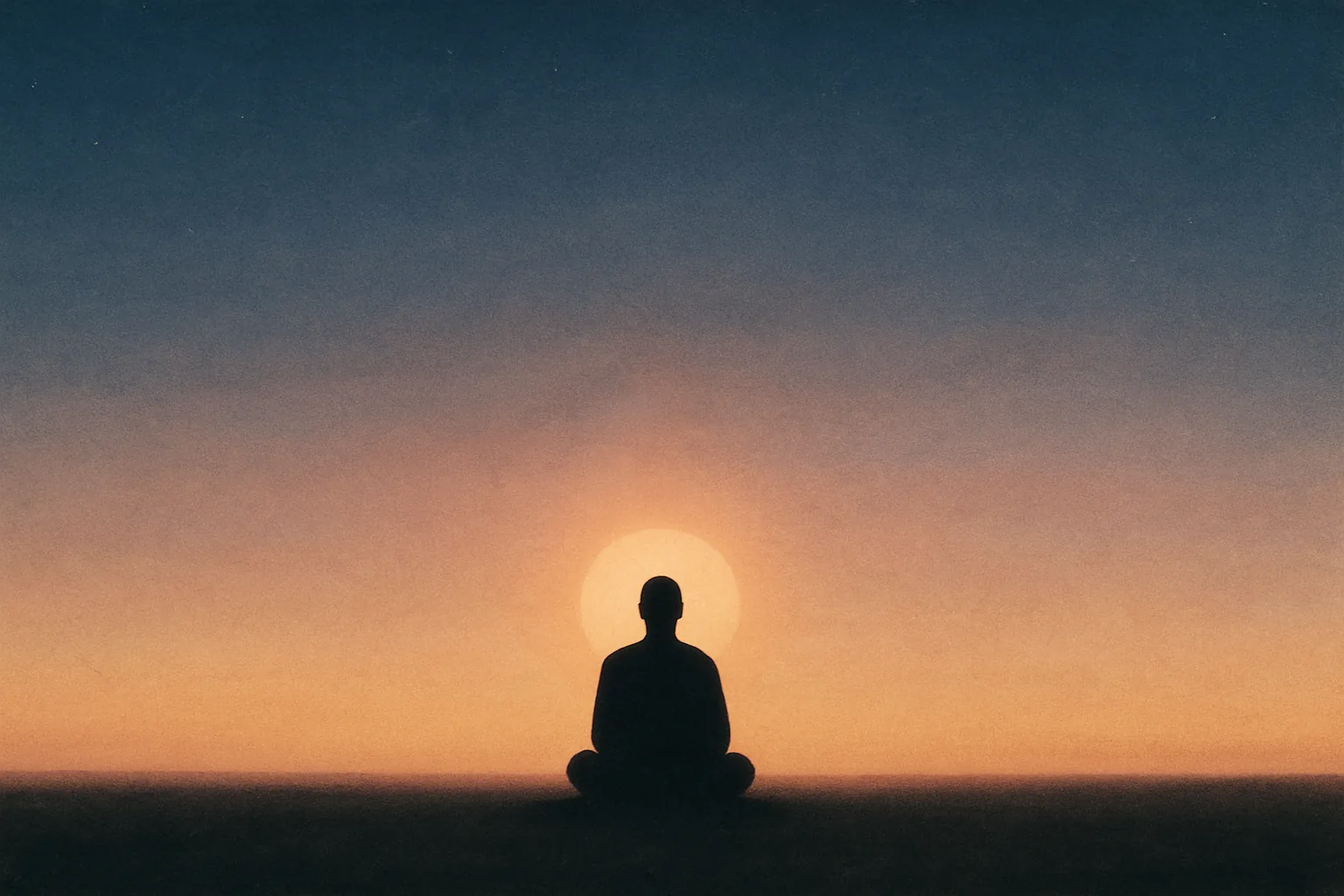
Meditation is the beginning—listening is only the invitation, the appetizer. This method turns the sweetness of understanding into the fire of practice, shifting you from being entertained by ideas to being transformed by experience. It honors the simple truth: words can point, but only your own meditative journey lets you taste the Himalayas for yourself.
Drawn from Osho’s discourse in Tao: The Pathless Path (Chapter: Tao Tantra), this practice follows a distinctly tantric arc: first, do the work yourself with totality; only when nothing more remains to be done does prayer flower on its own. In that ripeness, you don’t beg or bargain—you become available. Effort ripens into surrender, and surrender invites grace.
Phase Instructions
First Stage: Turn from Talk to Practice (5 minutes)
Find a quiet space. Sit with an alert, comfortable spine; let the hands rest on the thighs, eyes gently closed. Feel the simple fact of being here—breath moving, body present. Acknowledge any tendency to use teachings as mere comfort or entertainment, then set a clear inner resolve: Today I move from listening to living. Let this resolve be steady, warm, and uncompromising.
Second Stage: Do Your Uttermost (35 minutes)
Choose one simple anchor and stay with it: feel the breath at the nostrils or the rise and fall of the belly. Keep the spine poised; let the whole body participate in awareness. Do not fight the mind and do not follow it—see each thought, image, or feeling as a cloud passing. Each time you notice you’ve wandered, return immediately to the anchor, without blame and without delay. If drowsy, open the eyes slightly and brighten the posture; if restless, allow the energy and feel it fully while staying with the anchor. Practice as if nothing else exists. You are doing the work yourself—total, sincere, moment to moment.
Third Stage: The Threshold of Prayer (15 minutes)
When you feel you have done absolutely all you can, shift from effort to openness. Let the chin lift slightly, as if meeting the vast sky; rest the hands with palms open. From the heart, say inwardly: I have done all I can. If there is more, show me. Now help me. Then fall silent. Do not push, do not demand—simply be available. Receive the silence, the space, the unknown. Allow gratitude to arise naturally if it comes; let tears come if they come. Remain alert and receptive, like a clear sky.
Fourth Stage: Grounding and Continuity (5 minutes)
Bring your attention back to the breath and the body. Feel the contact of the seat, the floor, the room. Bow inwardly to the effort you made and to the grace of receptivity. Open the eyes softly. Carry this fragrance into your next actions—walk, speak, and listen from the same awareness. If you engage with talks or texts later, let them refine your practice rather than replace it. Return daily to this arc of total effort ripening into prayerful openness.
Core Benefits
- Transforms understanding into experiential practice
- Transitions from entertainment by ideas to transformation by experience
- Allows personal tasting of profound truths
- Effort leads to surrender and invites grace
- Encourages self-work in preparation for spiritual ripeness
What Osho Said About This Technique
What is meditation?
One has to begin somewhere. Every beginning is bound to be a false beginning, but one has to begin. Through the false, through the groping, the door is found. One who thinks that he will begin only when the right beginning is there will never begin at all. Even a false step is a step in the right direction because it is a step, a beginning. You begin to grope in the dark and, through groping, the door is found. That is why I said to be aware of the linguistic process -- the process of words -- and to seek an awareness of the gaps, the intervals. There will be moments when there will be no conscious effort on your part and you will become aware of the gaps. That is the encounter with the divine, the encounter with the existential. Whenever there is an encounter, do not escape…
In 1969 followers of the Maharishi Mahesh Yogi invited Osho to talk to them. This was the first occasion on which Osho addressed a western audience, and the first time he talked publicly at length in English. The discourse has been published in OTI January 1 & 16, 1991; and February 1, 1991. Osho: Really, there can be no method as far as meditation is concerned. Meditation is not a method. Through technique, through method, you cannot go beyond mind. When you leave all methods, all techniques, you transcend mind. So meditation itself is not a method. Truth cannot be achieved through method. Method is our own invention. We, who are ignorant, have achieved knowledge through methods constructed, created, projected, in our ignorance. Through method you can achieve a sort of self-hypnosis, a sort of auto-hypnosis. Any method, whatsoever it's name, can only give you an illusory kind of peace.
In the beginning you will find only darkness or absurd, irrelevant thoughts, dreams floating here and there. It will look like a chaos but go on watching, go on looking. We are not worried about what you are seeing. Our whole effort is to see. Remember, the emphasis is on seeing, not on the seen, so it does not matter what you see. Thoughts, desires, memories, dreams -- it doesn't matter what you are seeing. Everything is just an opportunity to make the inner eye function. So remember the emphasis otherwise people become tired; they think 'What is the point? We don't see any light, we don't see god, we don't see the soul we don't see this, we don't see that. Just ordinary thoughts are there so what is the point? They have missed the whole message.
Think of a torch. A torch is not meditation; it is concentration. You switch it on and the beam focuses on one spot. Light a lamp—that lamp is meditation. It does not concentrate on one thing; it illumines whatever is around. With a torch, one thing is seen and the rest remains in darkness. With a lamp, all is gently lit. And meditation is such a lamp that it has no base for darkness to gather beneath—no wick, no oil! Only pure flame, pure awakening—so there is no “dark under the lamp.” Understand “meditation” as the flavor of witnessing. For example, you are listening to me. You can listen in two ways. Newcomers listen with concentration—eager not to miss a word, excluding everything else, tensing around my speech. Those who have been here awhile are listening in meditation. The difference is great.
ऐसा समझो कि टार्च होती है। टार्च तो ध्यान नहीं है, एकाग्रता है। जब तुम टार्च जलाते हो तो प्रकाश एक जगह जाकर केंद्रित हो जाता है। लेकिन जब तुम दीया जलाते हो तो दीया जलाना ध्यान है। वह एक चीज पर जाकर एकाग्र नहीं होता; जो भी आस-पास होता है, सभी को प्रकाशित कर देता है। एकाग्रता में, अगर तुम टार्च लेकर चल रहे हो तो एक चीज तो दिखाई पड़ती है, शेष सब अंधेरे में होता है। अगर दीया तुम्हारे हाथ में है तो सब प्रकाशित होता है। और ध्यान तो ऐसा दीया है कि उसमें कोई तलहटी भी नहीं है कि दीया तले अंधेरा हो सके। ध्यान तो सिर्फ ज्योति ही ज्योति है, जागरण ही जागरण है--और बिन बाती बिन तेल! इसलिए दीया तले अंधेरा होने की भी संभावना नहीं है। ध्यान शब्द को तुम समझो साक्षी-भाव। जैसे मुझे तुम सुन रहे हो, दो ढंग से सुन सकते हो। जो नया-नया यहां आया है, वह एकाग्रता से सुनेगा। स्वभावतः, दूर से आया है, कष्ट उठा कर आया है, यात्रा की है। कोई शब्द चूक न जाए! तो सब तरफ से एकाग्र होकर सुनेगा। सब तरफ से चित्त को हटा लेगा। …
So those who think that meditation will happen just by sitting for ten minutes, fifteen minutes in the morning, fifteen minutes in the evening... and you will know what transcendental meditation is - are simply fools. All that you can learn from those fifteen minutes is a certain technique of falling asleep. Nothing is wrong with falling asleep. If you enjoy it, it is perfectly good, but don't mistake it for meditation. All kinds of chanting, all kinds of mantras are nothing but lullabies; they create a deep, auto-hypnotic state. Repeating a certain word constantly - you fall into a certain state of trance which is not meditation. Meditation means awareness. Meditation is not a trance. It is not auto-hypnosis; it is just the opposite of it. It means silence, but fully alert. It means a state of no-mind. There is no chanting, no chanter.
Common Questions
The first step is to do the work yourself with totality before anything else.
Unlike other practices, this meditation emphasizes personal experiential transformation rather than passive listening to ideas.
Effort ripens into surrender, and then surrender invites grace.
Yes, but prayer flowers naturally on its own when nothing more remains to be done.
The ultimate goal is to become available and receptive to transcendental experiences.