
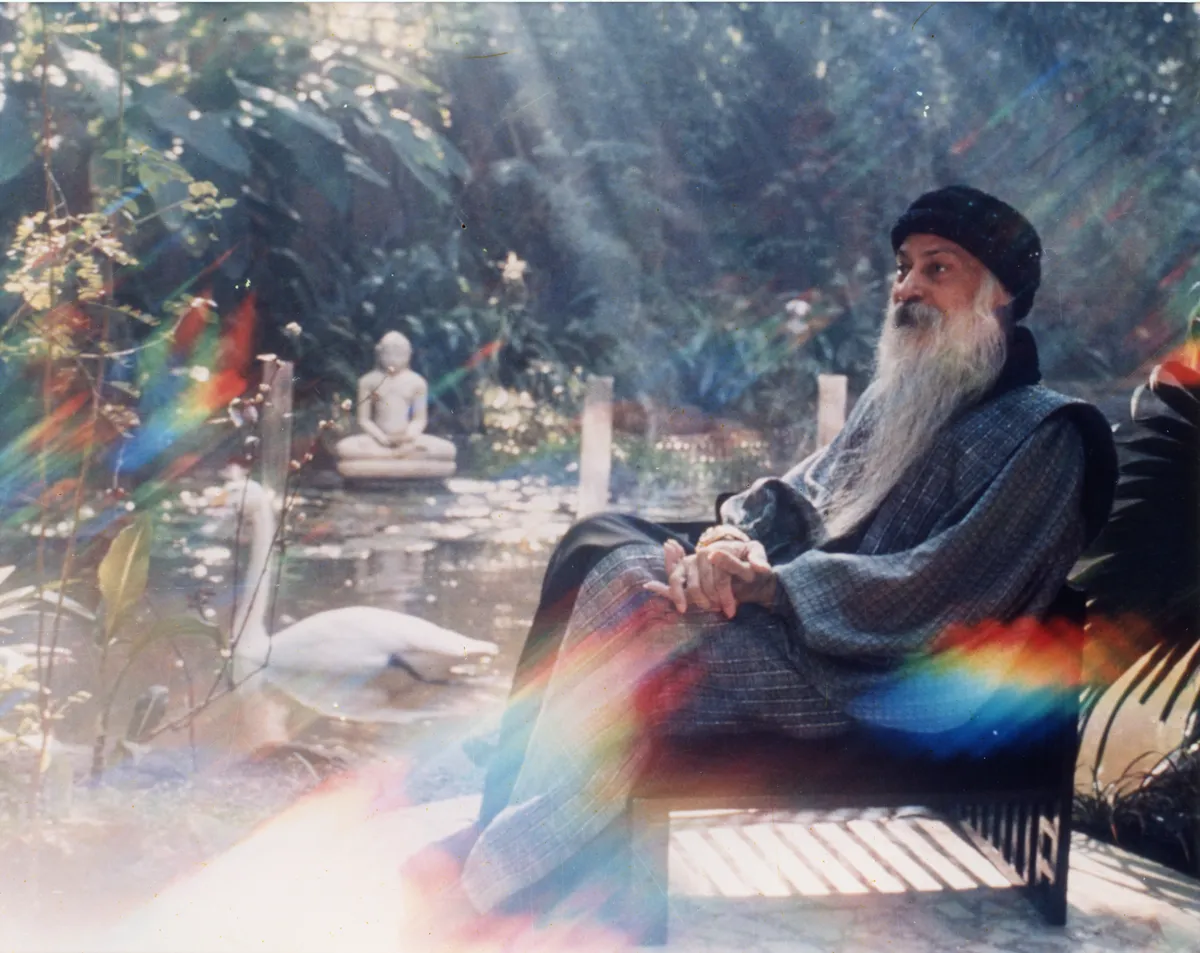
Osho's original Hindi beside Osho Live's English translation, matched passage by passage.
तमसा का पूर
अगम औ’ अकूल
गलबल अपार
डूबे आर-पार
बह गए अधार
ढह गए कगार
शिखर औ’ कछार
सभी एक सार
खोए सांझ भोर
मिटे ओर-छोर
दिग्भ्रम रव घोर
कहां, रे, किस ओर?
सघन अंधकार
A flood of darkness unfathomable, shoreless commotion without end both banks drowned foundations swept away ledges collapsed peaks and sandbanks all leveled into one lost were dusk and dawn edges and ends erased a grave, confused clangor of directions Where, oh where, which way?
गहन अहंकार
लहर फनाकार
अतुलित विस्तार
भय का संचार
नाश की कतार
उझ का संहार
आई मझधार!
compact night dense ego wave, hooded like a serpent immeasurable expanse the spread of fear a queue of ruin upheaval annihilated caught midstream!
वक्र भंवरजाल
नक्र की उछाल
करो, रे, सम्हाल
असमय अकाल
टूट रही ताल
ओ, रे, महाकाल!
crooked meshes of whirlpools a crocodile’s leap Hold, O hold! untimely famine the rhythm breaking O, Mahakal!
मनुष्य एक अमावस की रात है। एक गहन अंधकार! और जो मनुष्य रह कर ही समाप्त हो जाता है, उसे ज्योति के दर्शन ही नहीं हो पाते। और ऐसा नहीं था कि अंधकार में ज्योति के बीज नहीं थे--बीज थे! बीज साथ लेकर ही आए थे, लेकिन बीज कभी फूटे नहीं, अंकुरित नहीं हुए। ज्योति जलनी थी, जली नहीं। यही मनुष्य का संताप है।
Man is a night of the new moon. A dense darkness! And the one who ends while remaining merely a man never beholds the vision of light. It was not that there were no seeds of light in the darkness—there were! You arrived carrying the seed, but it never sprouted, never germinated. The lamp was to be lit, it did not light. This is man’s anguish.
संताप का एक ही अर्थ होता है: तुम जो होने को पैदा हुए हो अगर न हो पाए, तो संताप होगा। और तुम जो होने को पैदा हुए हो अगर हो पाए, तो जीवन में संगीत होगा, उत्सव होगा। और उत्सव हो जीवन में तो ही संतुष्टि है। उत्सव हो जीवन में तो ही प्रार्थना की संभावना है, तो ही धन्यवाद दे सकोगे!
Anguish has only one meaning: if you cannot become that for which you were born, there will be anguish. And if you do become that for which you were born, life will be music, a festival. Only when life becomes a festival does contentment dawn. Only when life becomes a festival is prayer possible—only then will you be able to give thanks!
सुंदरदास के वचन आरती पर पूरे हो रहे हैं। जीवन में ही आरती पूरी हो, तभी वचनों में भी आरती पूरी हो सकती है, अन्यथा वचन झूठे होंगे, पाखंड होंगे। प्रार्थना तो बहुत लोग करते हैं, लेकिन सच्ची प्रार्थना कभी ही होती है, मुश्किल से होती है। लोगों की प्रार्थना तो मांगना है, भीख है; धन्यवाद नहीं! और जब तक प्रार्थना धन्यवाद न हो, अनुग्रह का उदघोष न हो, तब तक प्रार्थना झूठी है। पर अनुग्रह का उदघोष कैसे हो? दीया तो जला नहीं, फूल तो खिला नहीं, अमावस तो अमावस ही रही, पूर्णिमा तो आई नहीं! पूर्णिमा तो दूर, दूज का चांद भी नहीं उगा जीवन में। धन्यवाद कैसे हो? धन्यवाद किसको हो? और धन्यवाद दो भी तो सच्चा कैसे होगा?
Sundardas’ words are culminating in arati. Only when the arati is consummated in life itself can the words of arati be fulfilled; otherwise the words will be false, hypocrisy. Many people pray, but true prayer is rare, difficult. People’s prayer is asking, begging; not thanksgiving! And until prayer becomes thanksgiving, an outcry of grace, it remains false. But how is the outcry of grace to arise? The lamp has not been lit, the flower has not bloomed, the new moon remained a new moon, the full moon has not arrived! Far from the full moon, even the second day’s crescent has not risen in life. How to give thanks? To whom to give thanks? And even if you give thanks, how will it be true?
प्रार्थना तो परितृप्ति का उदघोष है। इसलिए मंदिर-मस्जिदों में जाकर व्यर्थ समय खराब मत करो! भीतर जाओ! एक दिन उठेगी प्रार्थना, दुर्निवार उठेगी! रोकना भी चाहोगे तो रुकेगी नहीं। एक दिन उठेगी सुगंध भीतर से, दिगदिगंत व्याप्त होगा। एक दिन ज्योति जलेगी। उस जलती ज्योति का ही नाम प्रार्थना है।
Prayer is the proclamation of fulfillment. Therefore do not waste time going to temples and mosques! Go within! One day prayer will arise—irresistibly! Even if you try to stop it, it will not stop. One day a fragrance will rise from within and pervade all horizons. One day a flame will be lit. That kindled flame is what we call prayer.
अंधेरी आत्मा प्रार्थना करेगी कैसे? इसलिए शुभ है कि आज के वचन इक्कीस दिनों की इस यात्रा के बाद पूजा पर हो रहे हैं: ‘आरती कैसैं करौं गुसाईं, तुमही व्यापि रहै सब ठाईं।’ कहां उतारूं आरती? किस दिशा की करूं आरती? किस मूर्ति की, किस रूप की? सभी मूर्तियां तुम्हारी हैं। सभी दिशाएं तुम्हारी हैं। सभी रूप तुम्हारे हैं। तुम्हारे अतिरिक्त और कुछ है नहीं। तब व्यक्ति की श्वास-श्वास आरती हो जाती है। आरती करनी नहीं पड़ती फिर, जीवन आरती हो जाता है। हृदय की धड़कन-धड़कन उसकी ही पूजा में लीन हो जाती है। जागो कि सोओ, प्रार्थना के स्वर उठते ही रहते हैं।
How will a darkened soul pray? Thus it is auspicious that today’s words, after this twenty-one day journey, conclude in worship: ‘How shall I perform arati, O Master, when you pervade all places?’ Where shall I wave the arati? In which direction shall I offer it? To which image, which form? All images are yours. All directions are yours. All forms are yours. There is nothing other than you. Then one’s very breath becomes arati. Then you do not have to perform arati—life becomes arati. Every heartbeat dissolves in his worship. Awake or asleep, the tones of prayer keep rising.
ऐसा ही तुम्हारे जीवन में भी हो। ऐसा हो सकता है। अगर नहीं हुआ तो स्वयं के अतिरिक्त किसी और को जिम्मेवार मत ठहराना। तुम्हारे अतिरिक्त कोई और इसे होने से नहीं रोक सकता है। तुम्हारे शरीर पर जंजीरें डाली जा सकती हैं, बाहर से; लेकिन तुम्हारी आत्मा पर जंजीरें कोई बाहर से नहीं डाल सकता! तुम्हें कारागृह में फेंका जा सकता है; लेकिन देह ही कारागृह में होगी, तुम सदा मुक्त हो। मुक्ति तुम्हारा स्वभाव है। तुम कारागृह की दीवालों में जंजीरों और बेड़ियों में पड़े हुए भी मुक्त आकाश में ही विचरण करोगे। तुम्हारी बाहर की आंखें फोड़ी जा सकती हैं, लेकिन तुम्हारी भीतर की आंखों को फोड़ने का कोई उपाय नहीं। लेकिन तुम ही न खोलो तो बात और है। और तुम ही डैने न फैलाओ, और न उड़ो, तो बात और। तुम ही गुलाम रह कर मर जाना चाहो तो बात और।
May it be so in your life as well. It can be so. If it does not happen, do not hold anyone other than yourself responsible. No one but you can prevent it from happening. Chains can be cast upon your body from the outside; but no one can chain your soul from the outside! You can be thrown into a prison; but only the body will be in prison, you are forever free. Freedom is your nature. Even lying chained and shackled within prison walls, you will roam the open sky. Your outer eyes can be gouged out, but there is no way to gouge out your inner eyes. Only if you yourself do not open them, that is another matter. If you yourself do not spread your wings and fly, that is another matter. If you choose to live and die a slave, that is another matter.
स्मरण करो इस बात का कि तुम्हारे अतिरिक्त तुम्हारे महोत्सव में और कोई बाधा नहीं है। और तुमने जितने कारण खोज रखे हैं, वे सब भुलावे हैं। कोई कहता है इस कारण नहीं पहुंच पा रहा हूं, कोई कहता है उस कारण नहीं पहुंच पा रहा हूं! मैं तुम्हें बार-बार यह याद दिलाना चाहता हूं कि सब कारण वंचनाएं हैं, मन की तरकीबें हैं। कारण खोज कर तुम निश्चिंत हो जाते हो। दूसरे पर दोष डाल दिया, छुटकारा हो गया! लेकिन जिन्होंने भी इस जगत में जाग कर पाया है, जिन्होंने भी इस जगत में परमात्मा का अनुभव किया है, उन सबकी गवाही एक है कि तुम्हारे अतिरिक्त और कोई रुकावट नहीं डाल रहा है। इसलिए हटा दो सब कारण। छोड़ो सब झूठे तर्क, और एक ही बात पर सारी जीवन-ऊर्जा को निछावर कर दो कि जाग कर ही जाना है, जीवन को ज्वलंत प्रकाश बना कर जाना है।
Remember this: in your great celebration, there is no obstacle other than you. And all the reasons you have collected are all deceptions. One says, for this reason I cannot arrive; another says, for that reason I cannot arrive! I want to remind you again and again: all reasons are pretenses, strategies of the mind. By finding reasons you feel at ease. You put the blame on others and feel released! But all those who have awakened and realized in this world, all who have experienced Paramatma here, their testimony is one: other than you, no one is preventing you. So drop all reasons. Abandon all false arguments, and pour all your life-energy into one resolve: to know by awakening, to turn life into a blazing light before you go.
लेकिन लोग गैर-जरूरी में उलझे हैं।
But people are entangled in the nonessential.
जो काम जरूरी थे,
उन्हें एहतियात से
अलगाता गया--
कभी शांतचित्त से,
एकाग्र मन से,
समय से,
The tasks that were essential, I carefully set aside— Someday, in tranquility, with a concentrated mind, with time, with convenience, I will accomplish them.
सुविधा से
उन्हें अंजाम दूंगा।
जो गैर-जरूरी थे
उन्हें चटपट निपटाता गया।
अब देखता हूं
कि जीवन
गैर-जरूरी कामों में ही बीत गया है
और सब जरूरी काम
What was nonessential I hurried to finish. Now I look and see life has passed in the nonessential, and all that was essential waits for my next birth.
मेरे दूसरे जन्म की
प्रतीक्षा कर रहे हैं।
ऐसा न हो कि मरते घड़ी तुम्हें ये वचन बोलने पड़ें। ऐसा ही अक्सर होता है। करोड़ में एक को छोड़ कर शेष के साथ यही होता है।
Do not let it be that on your deathbed you have to utter these words. This is exactly what happens—save but one in millions.
जीवन पर पुनर्विचार करो। तुम गैर-जरूरी चटपट निपटा लेते हो। तुम गैर-जरूरी को कल पर नहीं टालते। जरूरी को तुम कहते हो, कल कर लेंगे, परसों कर लेंगे, जल्दी क्या पड़ी है? धन अभी खोज लें, ध्यान फिर कभी खोज लेंगे! पद अभी पा लें, परमात्मा को पाने की जल्दी क्या है? शाश्वत है, समय चुका नहीं जा रहा है। इस जन्म में नहीं, अगले जन्म में होगा। आज नहीं कल, जवानी में नहीं बुढ़ापे में होगा! सब व्यर्थ को निपटा लेंगे, फिर सार्थक को करेंगे।
Reconsider life. You quickly settle the nonessential. You do not postpone the nonessential for tomorrow. For the essential you say, we will do it tomorrow, the day after—what is the hurry? Let us acquire wealth now, meditation later! Let us acquire position now—what is the hurry to attain Paramatma? The eternal is not expiring. If not in this life, then in the next. If not today, then tomorrow; if not in youth, then in old age! We will finish the trivial, and then do the meaningful.
और ध्यान रखना, व्यर्थ निपटता नहीं, एक व्यर्थ से दस व्यर्थ कामों के जाल पैदा हो जाते हैं। व्यर्थ चुकता ही नहीं। व्यर्थ की श्रृंखला अनंत है। इस दुनिया में व्यर्थ में उलझा आदमी कभी ऐसा अवसर नहीं पाता, जब कह सके कि अब सब व्यर्थ काम पूरे हो गए, अब मैं सार्थक करूं! वह भ्रांत दिशा है।
But remember, the trivial is never finished. From one triviality, ten more snares of triviality arise. The trivial is never settled. Its chain is endless. A man entangled in triviality never finds such a moment when he can say: now all trivial tasks are done, now I shall do the essential! That path is delusion.
सार्थक करना हो तो अभी करना! अभी या कभी नहीं! टालना ही हो तो व्यर्थ को टालो। क्रोध आता है, तत्क्षण करते हो। प्रेम उठता है, कल पर छोड़ देते हो। कहते हो अभी तो धन कमाना है, अभी तो प्रतिष्ठा बनानी है। प्रेम प्रतीक्षा करे। होगा धन जब पास तो प्रेम भी करेंगे। होगा धन जब पास, मित्रों से भी मिलेंगे; अभी समय नहीं। लेकिन क्रोध उठता है तो तुम टालते नहीं। घृणा उठती है तो तुम छुरे पर धार अभी रखने लगते हो। हां, पूजा का भाव उठे तो आरती का थाल अभी नहीं सजाते, दीये अभी नहीं जलाते, टाले ही चले जाते हो।
If the essential is to be done, do it now! Now—or never! If you must postpone, postpone the trivial. Anger comes—you act at once. Love arises—you leave it for tomorrow. You say, first I must earn money, first I must build prestige. Let love wait. When there is wealth, we will love too. When there is wealth, we will also meet friends; for now there is no time. But when anger arises, you do not postpone. Hatred arises—you at once sharpen the blade. Yes, if worship arises in the heart, you do not arrange the arati platter now, you do not light the lamps now—you keep postponing.
‘कल’ मनुष्य का सबसे बड़ा दुश्मन है। कल ने मनुष्य को डुबाया है। कल ने मनुष्य को मारा है। आज की भाषा सीखो। इस क्षण के अतिरिक्त और कोई क्षण तुम्हारे पास नहीं है। दूसरा क्षण भी होगा, इसका कुछ पक्का नहीं है। दूसरे क्षण के भरोसे मत रहना। उसके भरोसे रहने वाले धोखा खाते गए हैं, सदा धोखा खाते गए हैं। और हम सब उसी के भरोसे बैठे हैं।
‘Tomorrow’ is man’s greatest enemy. Tomorrow has drowned man. Tomorrow has killed man. Learn the language of today. Beyond this moment, no other moment is yours. Whether there will be a next moment—there is no certainty. Do not rely on the next moment. Those who relied on it have been deceived—always deceived. And we all are sitting relying on that.
सूत्र:
A sutra:
संत चले दिस ब्रह्म की, तजि जगव्यवहारा।
The saint moves toward the direction of Brahman, abandoning worldly dealings.
संत वही है जो ब्रह्म की दिशा में चल पड़ा जगत के व्यवहार को छोड़ कर। वचन सीधा-साफ है, अर्थ गहरा है। और अक्सर ऐसा होता है, सीधे-साफ वचन, जो एकदम सुनते ही समझ में आ जाते हैं, इतना गहरा अर्थ लिए रहते हैं उसका हमें स्मरण ही नहीं होता। कठिन वचन को तो हम सोचते-विचारते हैं; कठिन है, इसलिए। सरल वचन को तो हम सोचते हैं समझ ही लिया। अब यह इतना सरल वचन है; इसमें डुबकी लगाओगे तो प्रशांत महासागर की गहराई तुम पाओगे।
The words are simple and straight; the meaning is deep. Often it so happens that the words which seem immediately comprehensible carry such depth that we do not even remember to dive. Difficult words we think over—because they are difficult. Simple words we think we have understood. These words are so simple; if you dive into them, you will find the depth of the pacific ocean.
The saint moves toward the direction of Brahman…
संत चले दिस ब्रह्म की,.
ब्रह्म की दिशा क्या है? दस दिशाएं हैं आकाश की। इन दस में से कोई भी ब्रह्म की दिशा नहीं। पूरब जाओ, पश्चिम जाओ, काशी या काबा--ब्रह्म की दिशा नहीं है। उत्तर जाओ, दक्षिण जाओ, कैलाश कि रामेश्वरम--ब्रह्म की दिशा नहीं है। ऊपर जाओ कि नीचे--ब्रह्म की दिशा नहीं है। ब्रह्म की दिशा ग्यारहवीं दिशा है। और ग्यारहवीं दिशा का कोई उल्लेख भूगोल में नहीं है। भूगोल का ग्यारहवीं दिशा अंग नहीं है। ग्यारहवीं दिशा है: भीतर जाओ, अपने में जाओ। आकाश दस दिशाओं से बना है, तुम ग्यारहवीं दिशा हो!
What is the direction of Brahman? The sky has ten directions. None of these ten is the direction of Brahman. Go east, go west, Kashi or Kaba—none is the direction of Brahman. Go north, go south, Kailash or Rameshwaram—none is the direction of Brahman. Up or down—none is the direction of Brahman. The direction of Brahman is the eleventh direction. And the eleventh direction finds no mention in geography. It is not part of geography. The eleventh direction is: go within, go into yourself. Space is made of ten directions—you are the eleventh direction!
मो़जे़ज के प्रसिद्ध नियम हैं: दस आज्ञाएं। जैसे एक-एक दिशा को एक-एक आज्ञा पूरा करती है।
Moses’ famous injunctions are the Ten Commandments—as if each commandment fulfills a direction.
जीसस ने अपने शिष्यों को कहा: मैं तुम्हें ग्यारहवीं आज्ञा देता हूं! वही ग्यारहवीं आज्ञा ग्यारहवीं दिशा में ले जाने वाली है। वह आज्ञा भी बड़ी अनूठी है। शिष्यों ने पूछा कि ग्यारहवीं आज्ञा? हमने तो सुना है कि दस आज्ञाओं में सारा धर्म आ गया। लेकिन जीसस ने कहा: जब तक तुम ग्यारहवीं आज्ञा पूरी न करो, दस तो पूरी होंगी ही नहीं। जिसने दस पूरी कीं और ग्यारहवीं छोड़ दी, उसका कुछ भी पूरा नहीं होगा। और जिसने ग्यारहवीं पूरी कर ली, उसकी दस अपने आप पूरी हो जाती हैं। कौन सी है ग्यारहवीं आज्ञा? और जीसस ने कहा: प्रेम है ग्यारहवीं आज्ञा! अंतिम रात्रि भी विदा होते समय भी उन्होंने यही कहा कि मैं जाता हूं, लेकिन मैंने तुम्हें जो कहा है उसे भूल मत जाना।
Jesus said to his disciples: I give you an eleventh commandment! It is the one that takes you into the eleventh direction. That commandment is unique. The disciples asked: An eleventh commandment? We have heard that all religion is encompassed in ten. Jesus said: Until you fulfill the eleventh, the ten cannot be fulfilled. He who fulfills the ten but leaves the eleventh—nothing will be fulfilled. And he who fulfills the eleventh, the ten are fulfilled by themselves. What is the eleventh commandment? Jesus said: Love is the eleventh commandment! Even on the final night, while departing, he said the same: I go, but do not forget what I have told you.
एक शिष्य ने पूछा: आपने बहुत बातें कही हैं, कौन सी बात को आप याद दिलाना चाहते हैं?
A disciple asked: You have said many things, which one do you want to remind us of?
जीसस ने कहा: वही ग्यारहवीं आज्ञा। मैंने तुम्हें जिस तरह प्रेम किया, उसी तरह तुम प्रेम करना! ठीक. ‘प्रेम करना’ उचित नहीं है कहना--‘प्रेम हो जाना!’
Jesus said: That very eleventh commandment. As I have loved you, so you must love! Rather, do not say ‘love as a doing’—say ‘become love!’
जो भीतर जाता है, वह प्रेम हो जाता है। जो भीतर जाता है, वह प्रार्थना हो जाता है। प्रार्थना प्रेम का ही निचोड़ है। जैसे हजारों फूलों से इत्र निचोड़ते हैं, ऐसे हजारों प्रेम के अनुभव से प्रार्थना का इत्र निचुड़ता है। और जिसने प्रेम ही नहीं किया, वह प्रार्थना तो क्या खाक करेगा? और अक्सर ऐसा होता है, जो लोग प्रेम करने में असमर्थ हैं, मंदिर चले जाते हैं। और कहते हैं हम प्रार्थना करेंगे। प्रेम अभी किया नहीं, अभी प्रेम का क ख ग भी नहीं सीखा, प्रार्थना करने चल पड़े! जिन्हें जमीन पर चलना नहीं आता, वे आकाश में उड़ने का विचार करने लगे। गिरेंगे, बुरी तरह गिरेंगे! हड्डी-पसलियां तोड़ लेंगे। पहले जमीन पर चलना तो सीखो!
He who goes within becomes love. He who goes within becomes prayer. Prayer is the very distillation of love. As fragrances are distilled from a thousand flowers, so from a thousand experiences of love the attar of prayer is pressed. And the one who has not loved—what on earth will he have to do with prayer? Often those who are incapable of love run to the temple and say they will pray. They have not yet loved; they have not learned even the ABC of love—and they set off to pray! Those who cannot walk on the ground are thinking of flying in the sky. They will fall—fall badly! They will break their bones. First learn to walk the earth!
इस पृथ्वी को प्रेम करो! जिस दिन इस पृथ्वी के प्रति प्रेम तुम्हारा बेशर्त हो जाएगा, उस दिन तुम पाओगे तुम्हें पंख लग गए, अब तुम आकाश में उड़ने में समर्थ हो गए। पृथ्वी उनको ही पंख देती है भेंट, जो अपना सारा प्रेम पृथ्वी पर निछावर कर देते हैं। और उन पंखों का नाम प्रार्थना है। यह पृथ्वी उस परमात्मा की है। इस पृथ्वी को भर दो अपने प्रेम से--और तुम पाओगे: वही प्रेम तुम्हें उठाने लगा आकाश में! चले तुम अनंत की यात्रा पर!
Love this earth! The day your love for this earth becomes unconditional, you will find wings have grown; now you are capable of flying in the sky. Earth gifts wings only to those who pour all their love upon her. And the name of those wings is prayer. This earth belongs to Paramatma. Fill it with your love—and you will find: that very love begins to lift you into the sky! You set off on the journey to the Infinite!
लेकिन प्रेम वही कर सकता है जो भीतर जाए। तुम तो प्रेम जब करते हो तो बाहर जाते हो। तुम्हारा प्रेम भी झूठा प्रेम है। तुम सदा किसी और से प्रेम करते हो। और, और से जो प्रेम किया जाता है वह सिर्फ प्रेम का बहाना है। उस प्रेम में कुछ और ही छिपा है--वासना छिपी होगी, एषणा छिपी होगी, तृष्णा छिपी होगी, मोह छिपा होगा, लोभ छिपा होगा, महत्वाकांक्षा छिपी होगी, दूसरे के मालिक बनने का अहंकार छिपा होगा, हजार-हजार चीजें छिपी होंगी; प्रेम भर उसमें नहीं होगा।
But only he can love who goes within. You, when you love, go outward. Your love too is false love. You always love another. And the love that is done with another is only a pretext for love. Something else is hidden in it—lust is hidden, ambition is hidden, craving is hidden, attachment is hidden, greed is hidden, the ego of becoming the other’s master is hidden—thousands of things are hidden; only love is not in it.
प्रेम का दूसरे से कुछ भी संबंध नहीं है। प्रेम तो अपने अंतःस्तल में डुबकी लगाने का परिणाम है। तुमने जो प्रेम किया है, उसकी कहानी तो बड़ी छोटी सी है।
Love has nothing to do with the other. Love is the outcome of a dive into one’s own innermost core. The love you have done—its story is very small:
किसी के प्यार की इतनी कहानी!
गगन में चांद आया खिल रहा है
उदधि में ज्वार आया मिल रहा है
अभी तो चांदनी में लहर थिरकी
अभी फिर हो गई जानी-अजानी
किसी के प्यार की इतनी कहानी!
Only so much is the story of someone’s love— The moon rose in the sky, blossoming the ocean’s tide came in, merging just now the wave shimmered in moonlight and suddenly again—known-unknown— only so much is the story of someone’s love.
तिमिर के घूंट अनगिन पी रहा है
अजिर में एक दीपक जी रहा है
सुबह की किरण को सर्वस्व देकर
रही जो शेष--काजल की निशानी
किसी के प्यार की इतनी कहानी!
झलकते पल्लवों पर ओसकन हैं
Countless draughts of darkness he keeps drinking in the courtyard a single lamp keeps living giving all to the morning ray what remained—a trace of kohl— only so much is the story of someone’s love.
छलकते लोचनों से अश्रुगन हैं
तुम्हारे साथ सुख-दुख झेल पाए
मिला कर कुल यही अपनी-बिगानी
किसी के प्यार की इतनी कहानी!
अभी फिर हो गई जानी-अजानी
किसी के प्यार की इतनी कहानी!
On quivering leaves are beads of dew from brimming eyes are beads of tears with you I could share joy and sorrow— this sum of ours, the rest not ours— only so much is the story of someone’s love.
रही जो शेष--काजल की निशानी
किसी के प्यार की इतनी कहानी!
मिला कर कुल यही अपनी-बिगानी
किसी के प्यार की इतनी कहानी!
प्यार तुम्हारा, जिसे तुमने प्रेम कहा है, वही प्रेम नहीं है जिसे मीरा ने प्रेम कहा, कबीर ने प्रेम कहा, सुंदरदास ने प्रेम कहा। तुम्हारा प्रेम तो नाममात्र है। उसके पीछे कुछ और है, जो प्रेम कतई नहीं--ईर्ष्या है, जलन है। प्रेम में और ईर्ष्या? यह तो अमृत में जहर हो गया! यह तो फूल में दुर्गंध हो गई! यह तो दीये से अंधेरा झरने लगा, रोशनी नहीं!
Your love, which you have called love, is not the love that Meera called love, that Kabir called love, that Sundardas called love. Your love is only in name. Behind it is something else, which is not love at all—jealousy, envy. Love and jealousy? Poison in nectar! A stench in a flower! Darkness dripping from a lamp instead of light!
नहीं; एक और प्रेम है, जो अंतर्यात्रा में जितनी गहराई बढ़ती है तब मिलता है। वह प्रेम की दशा है, संबंध नहीं! तब तुम प्रेम होते हो, प्रेम करते नहीं। तब तुमसे प्रेम बहता है, दसों दिशाओं में प्रेम बहने लगता है। ग्यारहवीं दिशा में बीज टूट जाए, दसों दिशाओं में सुगंध बहने लगती है।
No—there is another love, found as the inner journey deepens. That is a state of love—not a relation. Then you are love, you do not love. Love flows from you; in the ten directions it begins to flow. When the seed breaks in the eleventh direction, fragrance streams into the ten.
संत चले दिस ब्रह्म की, तजि जगव्यवहारा।
ब्रह्म की दिशा में जो चले वह संत! प्रेम ब्रह्म की दिशा है। और प्रेम अंतःस्तल में पड़ा है। वह अमोलक हीरा--सुंदरदास ने कहा--तुम्हारे भीतर पड़ा है। उस दिशा में चलो!
The saint moves toward the direction of Brahman, abandoning worldly dealings.
Love is the direction of Brahman. And love lies within the heart’s core. That priceless diamond—Sundardas said—lies within you. Walk in that direction!
और भी एक बड़ी महत्वपूर्ण बात कही है: जगत को छोड़ने को नहीं कहा है, जगत-व्यवहार को छोड़ने को कहा है। दोनों में बड़ा फर्क है। जगत को तो छोड़ कर जाओगे कहां? जहां जाओगे वहीं जगत है। हिमालय पर जाओगे, वहां जगत है। गुफा में बैठ जाओगे--वहां जगत है। यही हवा, यही सूरज, यही चांद-तारे वहां भी होंगे। और अगर तुम यहां से चले भी गए हिमालय, तो तुम तो कम से कम वही होओगे जो यहां थे। और जो तुम्हारे भीतर यहां था, वही वहां भी तरंगें लेगा। यहां अगर तुमने अपने मकान से मोह बांध लिया था तो वहां किसी वृक्ष के नीचे बैठ कर उसी वृक्ष से मोह बांध लोगे। झगड़े हो जाते हैं जंगल में। एक साधु एक वृक्ष के नीचे दो-चार साल रह गया, वह उसकी बपौती हो गई। दूसरा साधु आकर वहां डेरा रखने लगे, वह कहेगा: उठाओ! चलते बनो! यह वृक्ष मेरा है! यह गुफा मेरी है।
He has said something further of great import: he has not told you to leave the world, he has told you to leave worldly dealings. There is a great difference. Where will you go by leaving the world? Wherever you go, the world is. Go to the Himalayas—there is the world. Sit in a cave—there is the world. The same air, the same sun, the same moon and stars will be there. And if you go from here to the Himalayas, you will at least be the same one who was here. What was within you here will ripple there as well. If here you were attached to your house, there you will become attached to a tree under which you sit. Quarrels happen in the forest too. A sadhu lives under a tree for two or four years—he claims it as his property. If another sadhu comes to camp there, he will say: Move! Go on! This tree is mine! This cave is mine!
मैं वर्षों तक जबलपुर रहा! वहां एक स्थान है पहाड़ियों में गुप्तेश्वर। गुप्तेश्वर के पीछे एक गुफा में एक साधु वर्षों से रहता था। गुफा प्यारी थी! एक दिन मैं भी जाकर वहां बैठ रहा। साधु कहीं बाहर गया था, स्नान करने गया था, लौट कर आया, उसने कहा: आप यहां कैसे बैठे हैं? यह गुफा मेरी है!
I lived for years in Jabalpur. There is a place in the hills, Gupteshwar. Behind Gupteshwar in a cave a sadhu had lived for years. The cave was dear! One day I too went and sat there. The sadhu had gone out to bathe; when he returned he said, How are you sitting here? This cave is mine!
मैंने उससे पूछा: घर किसलिए छोड़ा, अगर गुफा तुम्हारी हो गई? घर मेरा था, उसे छोड़ कर आ गए हो; अब कहते हो गुफा मेरी!
I asked him: Why did you leave home if the cave has become ‘mine’? The house was mine—you left it and came; now you say the cave is mine!
महल छूट जाते हैं, इससे फर्क नहीं पड़ता; लंगोटियों पर मोह लग जाता है कि लंगोटी मेरी है!
Palaces can be left—no difference; attachment binds to a loincloth: This loincloth is mine!
समझदार आदमी था; उसकी आंख में आंसू आ गए। उसने कहा: मुझे क्षमा कर दें! यह ‘मेरा’ शब्द जाता ही नहीं। आप ठीक ही कहते हैं। सब छोड़ कर आ गया हूं, लेकिन यह ‘मेरा’ शब्द नहीं जाता।
He was an intelligent man; his eyes filled with tears. He said: Forgive me! This word ‘mine’ will not go. You are right. I have left all, but this ‘mine’ does not go.
जगत छोड़ने से जाएगा भी नहीं। जगत व्यवहार छोड़ने से जाएगा! और वह बड़ी अनूठी बात है--जगत-व्यवहार छोड़ना! मेरा-तेरा जगत-व्यवहार है। कामचलाऊ है। यहां कौन किसका है! कौन अपना है कौन पराया है! चार दिन का मेला है, मेले में मिलना हो गया है। दोस्तियां बन गई हैं, दुश्मनियां बन गई हैं। कोई अपना हो गया है, कोई पराया हो गया है। यह सब व्यवहार है। इसे व्यवहार की तरह जान लेना, इससे मुक्त हो जाना है। इसको जिसने सत्य मान लिया, वह इसमें उलझ जाता है। इसे व्यवहार ही समझो। व्यवहार है तो कोई अड़चन नहीं है।
It will not go by leaving the world. It will go by dropping worldly dealings! That is a very unique thing—to drop worldly dealings. ‘Mine-yours’ is worldly dealing. It is makeshift. Here who belongs to whom? Who is one’s own, who the other? It is a fair of four days; in the fair we have met. Friendships are made, enmities are made. Someone has become own, someone other. All this is dealing. Recognize it as dealing and be free of it. He who takes it as truth gets entangled. Take it as dealing only. If it is dealing, there is no problem.
रास्ते पर नियम है बाएं चलो, वह व्यवहार है। कोई बाएं चलने में धर्म नहीं है कि बाएं चलते रहे तो स्वर्ग पहुंच जाओगे। अमरीका में व्यवहार है दाएं चलो!
On the road there is a rule: keep left—that is dealing. There is no religion in keeping left, that by keeping left you will reach heaven. In America the dealing is: keep right!
मुल्ला नसरुद्दीन अमरीका जाना चाहता था। बड़ा उत्सुक था, बड़ा आतुर था। कौन नहीं होता आतुर! चूड़ीदार पाजामा वगैरह सब बनवा रखा था! अचकन, गांधी टोपी. बिलकुल तैयार था। फिर एक दिन आया, बड़ा उदास था। कहने लगा कि नहीं जाऊंगा।
Mulla Nasruddin wanted to go to America—very eager. Who wouldn’t be eager! He had a churidar pajama stitched, and all! Achkan and Gandhi cap—quite ready. Then one day he came, very depressed. He said he would not go.
मैंने कहा: बात क्या हो गई? सब तैयारी पूरी हो गई है, अब जाते क्यों नहीं? उसने कहा कि नहीं, नहीं जाऊंगा। एक बड़ी झंझट की बात है। अमरीका में दाएं गाड़ी चलानी पड़ती है। मैंने पूना में जाकर दाएं गाड़ी चला कर देखी, बड़ी झंझट में पड़ गया। मैं ऐसी झंझट में नहीं पड़ना चाहता।
I asked: What happened? All preparations complete—why not go now? He said: No, I will not. There is a big hassle. In America one has to drive on the right. I went to Poona and tried driving on the right—got into great trouble. I do not want such trouble.
पूना में दाएं गाड़ी चलाओगे तो झंझट में पड़ोगे। उसने कहा कि एक आधे ही घंटे में ऐसी मुसीबतें आईं कि जान की मुसीबत हो गई। मैं तो सोच रहा था कि दो-तीन महीने अमरीका में गुजारूंगा, तो दो-तीन महीने में जिंदा नहीं लौटूंगा।
In Poona, if you drive on the right you will get into trouble. He said: In half an hour I got into such fixes that it became a danger to life. I was thinking to spend two or three months in America; I would not return alive in two or three months.
अब बाएं चलना या दाएं चलना व्यवहार की बात है। दोनों से काम चल जाता है। इसमें कुछ सिद्धांत नहीं है--व्यवहार है। पत्नी है, पति है, बेटे हैं, मां है, पिता है, भाई हैं, बंधु हैं--सब व्यवहार हैं। इसको जब तुम सिद्धांत मान लेते हो, जैसे इसका कोई पारमार्थिक मूल्य है, तब तुम झंझट में पड़ जाते हो।
Now left or right are matters of dealing. Both work. There is no principle in it—only dealing. Wife, husband, sons, mother, father, brothers, kin—all are dealings. When you take them as principles, as if they have a transcendental value, then you get into trouble.
धन व्यवहार है। ऐसे तो कागज के नोट हैं; उनमें कुछ भी नहीं, सिर्फ एक समझौता है कि हमने उनमें मूल्य माना हुआ है। अभी देखे न, हजार के नोट एक क्षण में व्यर्थ हो गए! जब हजार के हो गए तो पांच-दस रुपये की क्या बिसात है!
Money is dealing. Those paper notes—there is nothing in them, only an agreement that we have given them value. Overnight you saw thousand-rupee notes become worthless! When that happens to the thousand, what to say of five and ten!
एक समझौता था, तोड़ दिया सरकार ने कि अब हम इस पर राजी नहीं हैं। बस समझौते की बात थी कि नोट कागज हो गए कि लोगों ने सड़कों पर फेंक दिए, कि कुछ लोगों ने सिगरेट बना कर पी ली, कुछ लोगों ने नोट बिछा कर उन पर नाश्ता कर लिया। और क्या करना है! कल तक यही नोट बड़े बहुमूल्य थे। बांट दिए लोगों ने, बच्चों के खेल-खिलौने हो गए।
It was an agreement; the government broke it: we are no longer willing. Being only an agreement, the notes turned into paper; people threw them on the streets; some rolled cigarettes; some spread them as mats and ate snacks. What else to do! Until yesterday they were valuable; they were distributed, became children’s toys.
जिन चीजों को हम मूल्य दे रहे हैं जगत में, वे मूल्य सिर्फ समझौते के मूल्य हैं। हमने तय किया है कि मूल्य हैं, इसलिए मूल्य है। हम तय कर लें कि मूल्य नहीं है तो मूल्य समाप्त हो गए। तो हमारे तय करने में मूल्य है। हमारे मानने में मूल्य है। मान्यता ही मूल्य है।
The values we give to things in the world are only values of agreement. We determined they have value; so they have value. We can determine they do not; the values end. The value lies in our determining. The value lies in our believing. Belief itself is value.
जगत-व्यवहार को छोड़ने का अर्थ होता है: जगत में सारी चीजें व्यवहार-मात्र हैं। यहां कुछ भी पारमार्थिक नहीं है। जगत को छोड़ कर कहीं जाना नहीं है। जहां हो वहीं रहो; सिर्फ व्यवहार को व्यवहार समझो और व्यवहार की तरह पूरा कर दो। और तुम चकित हो जाओगे, व्यवहार पूरा होता रहता है और तुम व्यवहार के बाहर हो गए। जैसे कोई अभिनेता अभिनय करता हो, तो राम बन जाता है, धनुषबाण ले लेता है; कोई लक्ष्मण बन जाता है, कोई सीता बन जाता है। पर सब व्यवहार की बात है। जितनी देर को राम राम हैं, उतनी देर को राम राम हैं। पर्दा गिरेगा, बात खत्म हो गई। पर्दा उठा था, राम और रावण में बड़ा युद्ध चल रहा था। पर्दा गिर गया, दोनों पीछे बैठ कर चाय पी रहे हैं। बस इतनी ही बात है। पर्दा उठने और पर्दा गिरने की बात है।
To abandon worldly dealings means: everything here is mere dealing. Nothing here is ultimate. You need not go anywhere leaving the world. Wherever you are, remain there; only see dealing as dealing and fulfill it as dealing. You will be amazed: dealings keep being fulfilled, and you remain outside them. As an actor acts: someone becomes Rama and takes bow and arrow; someone becomes Lakshman, someone Sita. But it is all dealing. For the time Rama is Rama. The curtain will fall; the thing is over. The curtain rose—Rama and Ravana fought mightily. The curtain fell—both sit behind and sip tea. That is all. It is a matter of the curtain rising and falling.
अब अगर कोई रामचंद्र जी को यह वहम सवार हो जाए कि वे रामचंद्र जी हो गए, पर्दा गिर गया है, मगर वे अपना धनुष-बाण लिए ही चले जा रहे हैं--तो अड़चन होगी, तो उनको पागलखाने में रखना पड़ेगा, उनका इलाज करवाना पड़ेगा। नाटक महंगा पड़ गया।
If Lord Rama is seized by the delusion that he has become Rama—though the curtain has fallen—if he walks about carrying bow and arrow, there will be trouble; he will have to be kept in a madhouse; he will need treatment. The play became expensive.
और यही हालत हो गई है तुम्हारी--नाटक में हो लेकिन नाटक महंगा पड़ गया है।
This is your condition—you are in a play, but the play has become expensive.
एक रामलीला हुई एक गांव में। लक्ष्मण बेहोश पड़े हैं। हनुमान संजीवनी बूटी लेने गए हैं। लेकर आए। नाटक का मामला। रस्सी के सहारे कागज का पहाड़ उठाए हुए चले आ रहे थे कि घिर्री में रस्सी अटक गई। अब जनता ताली बजा रही है और सीटियां बजा रही है और हनुमान जी लटके हैं। घिर्री अटक गई। वह चले न, रस्सी उतरे न। अब यह बात बिगड़ने लगी। और रामचंद्र जी कह रहे हैं: हे हनुमान, तुम कहां हो? वे अपनी दोहराएं जा रहे हैं, क्योंकि उनको जो पाठ सिखाया गया है वे उसमें से कैसे.। हनुमान आएं नहीं, तब तक वे आकाश की तरफ देख कर कहते हैं कि हे हनुमान, तुम कहां हो? और हनुमान सामने हैं। कहां चले गए, बड़ी देर लगा दी, लक्ष्मण का जीवन खतरे में पड़ा हुआ है, हनुमान जल्दी आओ, संजीवनी लाओ।
In a village a Ramleela was being performed. Lakshman is lying unconscious. Hanuman has gone to fetch the sanjeevani herb. He returns—stage mechanics. Suspended by a rope, bearing a paper mountain, he is coming in when the pulley jams. The audience is clapping and whistling and Hanuman is hanging. The pulley stuck. He neither moves nor descends. Now things are going awry. Rama keeps saying: O Hanuman, where are you? He keeps repeating his lines; what else can he do! Until Hanuman comes, he looks to the sky and says: O Hanuman, where are you? And Hanuman is right there in front. Where have you gone? You are late; Lakshman’s life is in danger—Hanuman, come quickly, bring the herb!
और जनता ताली पीट रही है। हनुमान तो सामने हैं, पहाड़ी लिए खड़े हैं। हनुमान भी बड़ी मुश्किल में हैं कि अब करें क्या? कुछ सूझ-बूझ नहीं आई। मैनेजर चढ़ा ऊपर और उसने रस्सी खोलने की कोशिश की, नहीं खुली, तो उसने काट दी। हनुमान जी धड़ाम से मय पहाड़ी के नीचे गिरे। अब जब कोई ऐसी अचानक हो जाए घटना तो किसको याद रहती है कि हम हनुमान हैं। रामचंद्र जी ने कहा कि भले आ गए, जड़ी-बूटी कहां है? हनुमान जी ने कहा: ऐसी की तैसी जड़ी-बूटी की! पहले यह बताओ रस्सी किसने काटी?
The audience is clapping. Hanuman is in a fix—what to do now? The manager climbed up, tried to release the rope; it would not. So he cut it. Hanuman crashed down with the mountain. When such a sudden thing happens, who remembers he is Hanuman! Rama said: Good that you came—but where is the herb? Hanuman said: To hell with the herb! First tell me—who cut the rope?
बस इतना ही व्यवहार है ऊपर-ऊपर; नीचे तो तुम्हें पता है कि तुम हनुमान जी नहीं हो; कहां के हनुमान जी, कहां की जड़ी-बूटी! उनके घुटने में चोट लग गई।. रस्सी किसने काटी, यह बताओ! पहली बात, मतलब की बात, असली बात पहले तय हो जानी चाहिए।
This much is dealing on the surface; underneath, you know you are not Hanuman; what Hanuman, what herb! His knee is hurt. Tell me first—who cut the rope! First the essential, the real matter should be settled.
तुम्हारा जीवन ऊपर-ऊपर जैसा चल रहा है उसे छोड़ कर भाग जाने की कोई भी जरूरत नहीं। लेकिन जगत व्यवहार-मात्र है, इतनी प्रतीति सघन हो जाए कि बस छूट गया। छोड़ने में कुछ और है नहीं। यहां पकड़ने को कुछ है नहीं तो छोड़ोगे क्या? पकड़ने को कुछ होता तो छोड़ भी देते। पकड़ने को ही कुछ नहीं है! इस बात की प्रतीति और बोध का नाम संन्यास है।
You need not run away from how life is moving on the surface. Only let the conviction become dense that worldly affairs are only dealings—and they drop. There is nothing to leave. If there is nothing to hold, what will you drop? If there were something to hold, you could drop it. There is nothing to hold! Recognizing this is sannyas.
इसलिए मैं अपने संन्यासी को नहीं कहता कि तुम कहीं छोड़ कर भाग जाना। पत्नी है, बच्चा है, नौकरी है, बाजार है, दुकान है--सब व्यवहार है। तुम अछूते रहना। तुम दूर-दूर रहना। निपटाए जाना सब। मजे से निपटा देना। परमात्मा ने जो दिया है, उसे पूरा कर देना। भगोड़े मत बनना। भगोड़े ने तो परमात्मा की भेंट को अस्वीकार कर दिया। भगोड़े ने तो जिद की। उसने तो कहा कि मैं अपनी चलाऊंगा। उसने तो परमात्मा की भेंट की निंदा की।
Therefore I do not tell my sannyasins to run away leaving anything. Wife, child, job, market, shop—all are dealings. Remain untouched. Remain aloof. Keep settling all. Settle it joyfully. What Paramatma has given, fulfill it. Do not be a deserter. The deserter rejects the gift of Paramatma. The deserter insists on having his way. He maligns the gift of Paramatma.
भगोड़े संत नहीं होते। संत होना इतना सस्ता काम नहीं है जितना भगोड़ा कर लेता है। संत होना बड़ी आंतरिक क्रांति है। और आंतरिक क्रांति का अर्थ है: बाहर जो हो रहा है, सब लोक-व्यवहार है। भीतर मैं अलिप्त हूं, अलग हूं, पृथक हूं, साक्षीमात्र हूं, द्रष्टामात्र हूं। जो द्रष्टा हो गया उससे जगत छूट गया--बिना छोड़े! और जो कर्ता रहा, वह छोड़ कर भी भाग जाए तो जगत उससे छूटता नहीं, वह कर्ता ही बना रहता है।
संत चले दिस ब्रह्म की, तजि जगव्यवहारा।
सीधै मारग चालतैं, निंदै संसारा।।
Deserters are not saints. Sainthood is not as cheap as a deserter makes it. Sainthood is a great inner revolution. And inner revolution means: whatever is happening on the outside is all worldly dealing; within I am unattached, separate, apart, only a witness, only a seer. He who becomes the seer—without leaving—the world drops from him. And he who remains the doer, even if he flees, the world does not drop; he remains the doer.
और बड़े आश्चर्य की बात यह है कि जब भी कोई सीधा-सीधा चलेगा इस संसार में, सारा जगत उसकी निंदा करेगा। संत सीधे चलते हैं, जगत उनकी निंदा करता है। यह दुर्घटना क्यों घटती है? इसके पीछे कारण साफ है। जगत में लोग इरछे-तिरछे चल रहे हैं। जो आदमी सीधा चलता है, उस आदमी के सीधे चलने के कारण ही लोगों को अड़चन होने लगती है। अगर यह आदमी ठीक है तो हम सब गलत हैं। और कोई यह मानने को राजी नहीं होता कि मैं गलत हूं। तिरछे से तिरछा चलने वाला आदमी भी यही सोचता है कि मेरी चाल सीधी-साफ है। झूठ बोलने वाला आदमी सोचता है कि मुझसे ज्यादा सच्चा आदमी कौन है! झूठ बोलने वालों के बीच में तुम सच बोलोगे तो मुश्किल में पड़ जाओगे। वे तुम्हें बरदाश्त नहीं कर सकेंगे। इसका तुम्हें जीवन में रोज-रोज अनुभव होगा! इसके लिए कोई महासंत होने की जरूरत नहीं है। थोड़े से जिंदगी में अनुभव करो। दफ्तर में तुम काम करते हो, वहां कोई काम नहीं करता। हिंदुस्तान के किसी दफ्तर में कोई काम नहीं करता। काम करने वाले दफ्तर में बच नहीं सकते। लोग बैठे रहते हैं, पैर पसारे रहते हैं। फाइल यहां से वहां रखते रहते हैं।
The saint moves toward the direction of Brahman, abandoning worldly dealings.
He walks a straight path, and the world condemns him.
Astonishingly, whenever someone walks straight in this world, the whole world condemns him. Why does this mishap occur? The reason is clear. People in the world walk crookedly. The one who walks straight creates a problem for them. If this man is right, then we are all wrong. And no one is willing to accept that he is wrong. The most crooked walker thinks his gait is straight. The liar thinks there is no one more truthful than he! If you speak truth among liars, you will be in trouble. They will not tolerate you. You experience this daily; you need not be a great saint. In an office, if you work where no one works—no one works in any Indian office—those who work cannot survive. People lounge with feet stretched, shuffle files from here to there.
एक दफ्तर में एक आदमी की टेबल फाइलों से बिलकुल खाली रहती थी। सारे लोग हैरान थे: सारा काम निपटा लेता है, दूसरों की तो फाइलें बढ़ती जाती हैं। असल में जितनी ज्यादा फाइलें जिसकी टेबल पर होती हैं वह आदमी उतना ही बड़ा अपने को अनुभव करता है। इतना काम उसके पास! फाइल को निपटाना ही नहीं चाहते लोग, फाइलों को इकट्ठा करते हैं। उससे किसी ने पूछा कि भाई, तुम काम निपटा कैसे लेते हो? हम तो दपतर का काम घर ले जाते हैं तो भी निपटता नहीं; आधी-आधी रात तक काम करते हैं तो भी निपटता नहीं; तुम कैसे निपटा लेते हो? दफ्तर में तुम्हारी टेबल हमेशा साफ, कोई फाइल रुकी नहीं होती है।
In one office a man’s table was always free of files. Everyone was amazed: he finishes all the work; on others’ tables the files only pile up. The more files on one’s table, the more important he feels: so much work! They do not want to finish files; they collect them. Someone asked him: Brother, how do you get everything done? We even take work home, and still it is not finished; we work till midnight, yet not finished—how do you finish? Your table is always clean; no file remains.
उसने कहा कि इसकी एक तरकीब है। अब यहां कोई. सचिवालय में समझो कि हजारों लोग काम कर रहे हैं. तो मैं तो सदा लिख देता हूं: भाईदास भाई को भेजो। अब इतने हजार आदमी बंबई में काम कर रहे हों दफ्तर में तो भाईदास भाई एकाध तो होगा ही। बंबई और भाईदास भाई न हो, यह हो ही नहीं सकता। भाईदास भाई की टेबल पर भेजो, बस इतना लिख कर भेज देता हूं। फिर फाइल मुझ तक लौटती ही नहीं, फिर कहां जाती है भगवान जाने! कोई भाईदास भाई होगा।
He said: There is a trick. Imagine in the secretariat thousands are working. I always write: send to Bhai Das Bhai. In a city like Bombay, with thousands working, there must be at least one Bhai Das Bhai. It cannot be that Bombay has no Bhai Das Bhai. Send it to Bhai Das Bhai’s table—write only that—and send. The file never returns—where it goes, God knows! There must be some Bhai Das Bhai.
संयोग की बात, वह आदमी बोला कि महाराज, मैं ही भाईदास भाई हूं! जब ही तो मैं सोच रहा हूं कि मेरे पास फाइलों पर फाइलें इकट्ठी होती जा रही हैं। यह कौन है जो भेज देता है, भाईदास भाई को भेजो!
By coincidence the man said: Sir, I am Bhai Das Bhai! That is why I wondered why files keep piling on my table. Who is it who keeps sending: Send to Bhai Das Bhai!
दफ्तर में कोई काम थोड़े ही करता है। एक टेबल से दूसरी टेबल पर फाइलें सरकती रहती हैं, यहां से वहां घूमती रहती हैं। बस घूमती ही रहती हैं। अगर कोई काम करने वाला आदमी आए दफ्तर में तो सारे लोग उसके खिलाफ हो जाते हैं, क्योंकि उसके काम करने की वजह से यह बात जाहिर होने लगती है कि वे सब निकम्मे बैठे हैं। और यह कोई बरदाश्त नहीं करता।
In offices no one works. A file goes from one table to another, circling from here to there—just circling. If a worker arrives, everyone turns against him; because his working exposes them as idlers. And no one tolerates that.
मुल्ला नसरुद्दीन एक दफ्तर में काम करता था। मैंने पूछा, कभी छुट्टी नहीं लेते? उसने कहा कि नहीं, मैं छुट्टी ले ही नहीं सकता कभी।
Mulla Nasruddin worked in an office. I asked: Don’t you ever take a day off? He said: No, I cannot ever take a day off.
‘बात क्या है?’ उसने कहा कि छुट्टी अगर मैं लूं तो वहां बात पता चल जाए कि मेरे बिना काम चल सकता है। मेरी वहां कोई जरूरत ही नहीं है असल में। तो मैं छुट्टी तो ले ही नहीं सकता, क्योंकि छुट्टी लिया कि पता चला। अभी तो मैं बैठा रहता हूं पैर पसारे और ऐसा रूप बनाए रखता हूं कि भारी काम है, माथे पर शिकनें डाले रखता हूं। कोई भी आता है तो अपने को व्यस्त दिखलाता हूं। कुछ न हो तो कागज पर ही गूंथता रहता हूं। दस्तखत अपने ही करता रहता हूं। कोई काम नहीं है, मगर अगर मैं छुट्टी लूं तो कितनी देर लगेगी, लोगों को पता चल ही जाएगा कि हां, इस आदमी के पास कोई काम है ही नहीं।
Why? He said: If I took a day off, they would discover that the work goes on without me. In truth, I am not needed there. So I cannot take leave; because if I took leave, they would know. For now I sit with legs stretched, wear a heavy look, keep a furrowed brow. If anyone comes, I look busy. If nothing else, I twist papers. I sign my own name repeatedly. There is no work; but if I take leave, how long will it take for them to know that this man has no work at all?
जहां कोई काम न कर रहा हो वहां अगर तुम काम करो, तो लोग नाराज हो जाएंगे। जहां सारे लोग झूठ बोलने पर जी रहे हों वहां तुम सच बोलो, तो तुम उन सबके पाखंड का भंडा फोड़ कर दोगे। अंधों के बीच अपनी आंख की घोषणा मत करना, नहीं तो अंधे पकड़ कर तुम्हारी आंख फोड़ डालेंगे। बहरों के बीच मत कहना कि मुझे संगीत सुनाई पड़ता है।
Where no one works, if you work, people get angry. Where all live by lying, if you speak truth, you will explode their hypocrisy. Among the blind, do not announce your eye; otherwise the blind will catch you and gouge it out. Among the deaf do not say you hear music.
संत की तकलीफ यही है, इक्के-दुक्के मामलों में नहीं, जीवन की सारी प्रक्रिया में वह सीधा-सीधा चलने लगता है। और यहां सब तिरछे-तिरछे चलने वाले लोग हैं। यहां कोई सीधा चल ही नहीं रहा है। यहां चलने की प्रक्रिया ही हमें तिरछी समझाई गई है।
This is the saint’s difficulty—not in odd instances; in the entire process of life he begins to walk straight. And here almost everyone is walking crooked. No one here walks straight. The very way we have been taught to walk is crooked.
जैसे उदाहरण के लिए, बच्चा पैदा नहीं हुआ कि हम उसे समझाते हैं कि तू बुद्ध जैसा हो जा, कृष्ण जैसा हो जा; राम जैसा हो जा, बस तिरछा हमने करना शुरू कर दिया इस बच्चे को। इसका मतलब यह हुआ कि इसको हम कभी भी वही नहीं होने देंगे जो होने को यह पैदा हुआ है। बस तिरछापन शुरू हो गया।
For example, as soon as a child is born we tell him: become like Buddha, become like Krishna, become like Rama—the crookedness begins. Meaning: we will never allow this child to be what he was born to be. The crookedness begins.
और दुनिया में कोई आदमी किसी दूसरे जैसा नहीं हो सकता; होने की कोशिश में तिरछा हो जाएगा। होने की कोशिश में पाखंड हो जाएगा। तुम कैसे राम हो सकते हो? राम एक बार ही हुए, दुबारा नहीं होते। दुबारा वैसी परिस्थिति भी नहीं होती! अब तुम जरा सोचो, राम होने के लिए पहले रावण चाहिए, सीता चाहिए, बूढ़ा दशरथ चाहिए। बुढ़ापे में शादी करे किसी से, यह भी चाहिए। कारों इत्यादि में नहीं, रथों पर चले। रथ का पहिया निकलने लगे, उसकी जवान स्त्री रथ के पहिए को गिरता देख कर कील की जगह अंगुली डाले--यह सब उपद्रव जब हो, तब रामचंद्र जी फिर से हों। अब यह उपद्रव हो नहीं सकता!
No person in the world can be like another; in trying, he will become crooked. In the effort he becomes a hypocrite. How will you be Rama? Rama happened once; he does not happen again. The circumstances do not recur. Think: to be Rama you need a Ravana, a Sita, an old Dasharatha who marries in old age. Travel by chariots, not cars. The wheel of the chariot comes off, his young wife, seeing it fall, inserts her finger as a pin—when all this uproar is, then Rama will be again. Such uproar cannot be!
तुम समझते हो, कोई व्यक्ति अचानक आकाश से कूद पड़ता है? उसका संदर्भ होता है। अब एक दिन अचानक तुम उठो और अपना धनुषबाण लेकर निकल जाओ, तो लोग समझेंगे कि गणतंत्र-दिवस पर कोई आदिवासी दिल्ली जा रहा है। वे भी गणतंत्र-दिवस पर ही तैयारी करके जाते हैं, वैसे वे भी आदिवासी नहीं रहते। तुम इस भूल में मत रहना। वैसे वे भी फिल्म देखते हैं और सिगरेट पीते हैं। मगर जब गणतंत्र-दिवस पर जाते हैं तो लंगोटी लगा कर धनुषबाण लेकर पहुंच जाते हैं।
Do you think a person falls suddenly from the sky? He has a context. One day you suddenly pick up your bow and arrows, people will think some tribal is going to the Republic Day parade in Delhi. Even they are not tribal then. They watch films and smoke cigarettes. But for the parade they don loincloths and carry bows and arrows.
जिंदगी में सभी चीजें संदर्भ में पैदा होती हैं। संदर्भ के बाहर तो एक पत्ती भी नहीं पैदा होती, एक फूल भी नहीं खिलता। और राम जैसा फूल खिले, इसके लिए राम का पूरा का पूरा जगत चाहिए, वैसा का वैसा जगत चाहिए। तुम कैसे राम हो सकते हो? तुम कैसे बुद्ध हो सकते हो? बुद्ध कुछ ऐसा थोड़े ही है--संदर्भहीन टपक गए आकाश से। पृथ्वी में उगते हैं बुद्ध और पृथ्वी की पूरी की पूरी व्यवस्था वैसी की वैसी दुबारा कभी नहीं होगी। अब शुद्धोधन कभी नहीं होंगे, यशोधरा कभी नहीं होगी। अब राज्य बचे नहीं। अब लोकतंत्र के दिन आ गए। अब राजा कभी नहीं होंगे। अब बुद्ध के होने का कोई उपाय नहीं रहा!
Everything in life arises in context. Outside context, not even a leaf is born, not even a flower blooms. And for a flower like Rama to bloom, the whole world of Rama must reappear. How will you be Rama? How will you be Buddha? Buddha did not drop from the sky without context. Buddhas grow in the earth, and the earth’s arrangement never repeats exactly. Shuddhodana will never be again; Yashodhara will not be again. Kingdoms are gone; democracies have come. Kings will not be. There is no way for a Buddha like that now!
इसलिए इस जगत में कोई भी व्यक्ति पुनरुक्त नहीं होता! और अच्छा है कि पुनरुक्त नहीं होता, नहीं तो कार्बनकॉपियां, कार्बनकॉपियां घूमती हुई मालूम पड़ेंगी। झूठे लोग होंगे! तुम तुम ही होने को पैदा हुए हो। लेकिन पैदा भी नहीं हो पाते कि मां-बाप पड़े पीछे कि बन जाओ कुछ और; स्कूल के शिक्षक पड़े पीछे कि बन जाओ कुछ और; पंडित और गुरु पड़े पीछे तुम्हारे कि बन जाओ कुछ और। तुम तिरछे होने लगते हो। जीवन की सरलता तभी बच सकती है, जब तुम वही होना चाहो जो तुम होने को पैदा हुए हो। जब तुम अपनी निजता से जरा भी न डिगो, तब तुम सरल होओगे। अगर तुम निजता से जरा भी डिगे कि तुम कपटी हो जाओगे, पाखंडी हो जाओगे, ऊपर कुछ भीतर कुछ हो जाओगे। तुम्हारे भीतर द्वंद्व हो जाएगा। बोलोगे कुछ, करोगे कुछ। तुम्हारे भीतर सब चीजें उलझ जाएंगी। तुम्हारा सुलझाव समाप्त हो जाएगा।
Thus, no person in this world is a repetition! And good that it is so, otherwise carbon copies would be roaming. People would be false. You were born to be you. But hardly are you born before parents begin: become something else; teachers begin; priests and gurus begin. You become crooked. Simplicity can remain only if you want to be what you were born to be. When you do not budge an inch from your ownness, then you are simple. If you budge, you become crafty, hypocritical—one thing on the surface, another within. Conflict arises inside. You will speak one thing, do another. Everything inside will tangle. Your clarity will end.
संतत्व का जन्म होता है: जब कोई व्यक्ति अपनी निजता को स्वीकार कर लेता है।
Sainthood is born when a person accepts his ownness.
यहूदी फकीर झुसिया मर रहा था। गांव के किसी बूढ़े ने उससे कहा: झुसिया जिंदगी भर तू उलटा-सीधा काम करता रहा--दुनिया को लगता था कि उलटे-सीधे काम कर रहा है। अपनी तरफ से तो वह बिलकुल साफ-सीधा आदमी था। मुश्किल से इतना साफ-सीधा आदमी होता है।--अब तो तू परमात्मा से क्षमा मांग ले। और अब मो़जे़ज का स्मरण कर क्योंकि वही तुझे बचाने वाले होंगे। हमने तुझे कभी मो़जे़ज की प्रार्थना करते नहीं देखा! अब तो प्रार्थना कर ले। अब तो उनसे कह दे कि मैं आ रहा हूं, मेरा खयाल करना। परमात्मा से मेरे लिए सिफारिश करना, मुझे बचाना। तुम ही मेरे रक्षक हो!
A Jewish fakir, Zusya, was dying. An elder of the village said to him: Zusya, your whole life you did topsy-turvy things—people thought so. In himself he was utterly straight; such straightness is rare. Now at least ask God for forgiveness. Now remember Moses because he will save you. We have never seen you pray to Moses—now pray. Tell him: I am coming, take care of me. Intercede for me with God; save me. You are my protector!
झुसिया मर रहा था, उसने आंख खोली। उसने कहा: बात बंद करो। जब मैं परमात्मा के सामने जाऊंगा तो वह मुझसे यह नहीं पूछेगा कि झुसिया, तू मो़जे़ज क्यों नहीं बना? वह मुझसे इतना ही पूछेगा, झुसिया, तू झुसिया क्यों नहीं बना? मो़जे़ज से मुझे क्या लेना-देना? उसने मुझे मेरे जैसा ही बना कर भेजा है। बस मैं वही होकर उसके सामने पहुंच जाऊं। उसकी मर्जी पूरी हो जाए। मैं सहजता और सरलता से घास का फूल हूं तो घास का फूल सही, मगर खिल कर उसके सामने पहुंच जाऊं। गुलाब का फूल उसने मुझे बनाया नहीं, बनाया होता तो मैं गुलाब का फूल हो जाता। कमल का फूल उसने मुझे बनाया नहीं, बनाया होता तो मैं कमल का फूल हो जाता। मैं जो हूं, खिल कर पहुंच जाऊं; घास का फूल तो घास का फूल। उसके चरणों में खिल कर गिर जाऊं।
Zusya opened his eyes and said: Stop this talk. When I go before God he will not ask me: Zusya, why were you not Moses? He will ask only: Zusya, why were you not Zusya? What have I to do with Moses? He made me as myself. Let me reach him as that. Let his will be fulfilled. If I am a simple blade of grass, then let me be that and bloom before him. He did not make me a rose; had he made me, I would have been one. He did not make me a lotus; had he made me, I would have been one. Let me reach him as I am, in full bloom. A blade of grass—then a blade of grass—let me blossom at his feet.
क्या तुम सोचते हो कि घास के फूल से परमात्मा पूछेगा कि तुम गुलाब के फूल क्यों न हुए? या गुलाब के फूल से पूछेगा कि तुम कमल के फूल क्यों न हुए? ये क्या पागलपन की बातें हैं। लेकिन इससे आदमी तिरछा होता है। इससे आदमी धोखेबाज हो जाता है। इससे आदमी मुखौटे ओढ़ लेता है। इससे आदमी जिंदगी में सरल नहीं रह जाता, सीधा नहीं रह जाता। कैसे रहेगा? अपने को दबाता है और जो नहीं है उसको ओढ़ता है।
Do you think God will ask a grass-flower why he did not become a rose? Or ask a rose why he did not become a lotus? What madness! But this is what makes man crooked. It makes him deceitful. He puts on masks. He becomes not simple, not straight. How can he? He suppresses himself and dons what he is not.
संत चले दिस ब्रह्म की, तजि जगव्यवहारा।
सीधै मारग चालतैं, निंदै संसारा।।
The saint moves toward the direction of Brahman, abandoning worldly dealings.
He walks a straight path, and the world condemns him.
लेकिन संसार निंदा करता है उनकी। संतों की सदा संसार ने निंदा की है। हां, मर जाते हैं तब पूजा करता है; जीते हैं जब तक, निंदा करता है। क्योंकि जीते हैं तो संत अड़चन में डालते हैं। उनका व्यवहार, उनके जीवन की शैली तुम सबको झूठा सिद्ध करने लगती है। उनकी प्रार्थना, उनकी पूजा तुम्हारे सारे पूजागृहों को पाखंड सिद्ध कर देती है। उनका परमात्मा से सीधा-सीधा संबंध, उनकी सरल वाणी, उनका निश्छल व्यवहार, उनके जीवन से उठती हुई सोंधी सुगंध, तुम सब की दुर्गंध साफ कर देती है।
But the world condemns them. Always the world has condemned the saints. Yes, once they die, the world worships them; while living, it condemns them. Because while alive, saints create trouble. Their way, their style of life exposes your falsity. Their prayer, their worship turns your temples into hypocrisy. Their direct relation with God, their simple speech, their guileless conduct, the earthy fragrance rising from their life—exposes the stench in all of you.
तुम अपने से भले लोग अपने बीच नहीं चाहते। उससे अहंकार को चोट लगती है। कहते हैं ऊंट पहाड़ों के पास नहीं जाता। शायद इसीलिए रेगिस्तानों में रहता है। न जाएगा पहाड़ के पास न कभी पता चलेगा कि मैं छोटा हूं। मनुष्य के मनोविज्ञान का एक अनिवार्य अंग है कि हर आदमी अपने से छोटे आदमियों के साथ रहना चाहता है, जीना चाहता है, क्योंकि छोटों के पास बड़ा मालूम होता है, हर आदमी अपने आस-पास समूह इकट्ठा कर लेता है क्षुद्र लोगों का। उन क्षुद्रों के बीच वह महान दिखाई पड़ने लगता है। यह कोई महान होने का ढंग है?
You do not want people better than yourselves around you. It hurts the ego. They say the camel does not go near the mountains; perhaps that is why it remains in the desert. If it does not go near, it will never know it is small. A fundamental trait of the human mind is that each wants to live among those smaller than himself; among the small he appears great. Each collects around himself a circle of petty people. Among them he appears great. Is this a way to be great?
महान होना हो तो महानों से दोस्ती जोड़ो। ऊंचे उठना हो तो उनके पास जाओ जो ऊंचे उठे हैं। अगर पहाड़ों जैसी ऊंचाई पानी हो तो पहाड़ों का सत्संग करो। लेकिन आदमी पहाड़ों का सत्संग करने में भयभीत होता है। वहां जाकर पता चलता है कि मैं कितना छोटा हूं! यह बात दिल को चोट करती है। कोई अपने को छोटा नहीं मानना चाहता। अहंकार अपने को बड़ा मान कर जीता है।
If you want to be great, befriend the great. If you want to rise, go to those who have risen. If you want the height of the mountains, keep the company of mountains. But people fear the company of mountains. There they discover how small they are. This wounds the heart. No one wants to accept smallness. Ego lives by thinking itself big.
संतों की निंदा इसीलिए होती है, क्योंकि अचानक वे पहाड़ की भांति तुम्हारे बीच खड़े हो जाते हैं; गौरी शंकर के शिखर की भांति, हिमाच्छादित, वे आकाश में उठ जाते हैं। सूर्य की किरणों में चमकता है उनका रूप, उनका सौंदर्य उनकी सरलता, उनकी सहजता। तुम सब नाराज हो जाते हो। भीड़ पहाड़ को गिराने को तत्पर हो जाती है।
Hence the saints are slandered—because suddenly they stand among you like a mountain; like Gauri Shankar’s peak, snow-clad, they rise into the sky. In the sun’s rays their form shines—their beauty, their simplicity, their ease. You all are annoyed. The crowd becomes ready to bring the mountain down.
साक्रेटीज को इसीलिए जहर दिया गया, क्योंकि साक्रेटीज की मौजूदगी एथेंस के लोगों को अखरने लगी; क्योंकि साक्रेटीज ने पूरे एथेंस के लोगों को एक बात का अहसास करवा दिया कि तुम सब झूठे हो। साक्रेटीज जिससे बात करता उसी को पता चल जाता कि मैं झूठा हूं। साक्रेटीज की प्रक्रिया ऐसी थी। उसके प्रश्न ऐसे थे कि वह जल्दी ही तुम्हारे झूठ को तुम्हारे सामने प्रकट करवा देता। तुमसे पूछेगा कि ईश्वर को मानते हो? अब आमतौर से आदमी कहेगा कि हां, मैं ईश्वर को मानता हूं, पूजा भी करता हूं।
Socrates was given poison for this reason: his mere presence began to irk the Athenians. Socrates made the entire city aware that you all are false. Anyone who spoke to Socrates immediately felt: I am false. Such was his process. His questions were such that he would quickly reveal your lie to you. He would ask: Do you believe in God? Generally a man says: Yes, I believe, I also worship.
वह कहेगा, ‘तुमने देखा?’
He would ask: Have you seen?
अड़चन शुरू हुई।
Trouble begins.
तुम कहते हो: नहीं मेरे पिता ने मुझे बताया।
You say: No, my father told me.
‘तुम्हारे पिता ने देखा?’
Did your father see?
तुम कहते हो: उनके पिता ने उन्हें बताया!
You say: His father told him.
‘उन्होंने देखा था?’
Did he see?
और उसने तुम्हारे पैर के नीचे की जमीन खींचनी शुरू कर दी! कौन जाने उनमें कोई झूठ बोल रहा हो, फिर? किसी ने न देखा हो, फिर? अफवाह हो, फिर? चिंदी के सांप बन जाते हैं। तुमने कैसे अपने जीवन को आधारित कर लिया है एक परमात्मा पर, जिसका तुम्हें कोई अनुभव नहीं है? तुम्हारी पूजा झूठी। अब भूल कर मंदिर मत जाना! नहीं तो तुम पाखंडी हो।
He begins to pull the ground from under your feet. Who knows if someone there lied? If none ever saw? If it is only a rumor? How have you based your life on a God you have never experienced? Your prayer is false. Now do not go to the temple, otherwise you are a hypocrite.
अब तुम डरे, अब दूसरे दिन मंदिर जाओगे तो बच कर निकलोगे कि कहीं साक्रेटीज रास्ते में न मिल जाए, नहीं तो वह कहेगा: तुम पाखंडी हो। तुम्हारे पास कोई उपाय भी नहीं सिद्ध करने का कि तुम पाखंडी नहीं हो। अदालत ने साक्रेटीज से कहा था कि हम तुझे क्षमा कर सकते हैं। एक बात का वचन दे दे कि चुप रहेगा, बोलेगा नहीं, लोगों को परेशान नहीं करोगे, सड़कों, रास्तों और गलियों पर खड़े होकर लोगों को छेड़-छाड़ नहीं करोगे! यह सत्य बोलने की बात अगर तुम छोड़ दो तो अदालत तुम्हें मुक्त कर सकती है, तुम अभी जी सकते हो।
You are afraid. Next day you will avoid the temple lest Socrates meets you on the way and says: You are a hypocrite. And you have no means to prove you are not. The court said to Socrates: We can pardon you. Give us your word that you will be quiet—that you will not trouble people, will not stand in streets and lanes and prick them. If you leave off this speaking of truth, the court can free you; you can live.
लेकिन साक्रेटीज ने कहा कि अगर सत्य ही नहीं बोलूंगा तो मेरे जीने का प्रयोजन क्या? यही तो मेरा धंधा है। लोग नाराज होते हों तो यह उनकी गलती है। वे भी सत्य की तलाश में लगें। मैं उन्हें सत्य की तलाश में ही लगाना चाहता हूं!
Socrates said: If I do not speak truth, what is the point of living? That is my very work. If people are angered, that is their mistake. Let them also seek truth. I want only to set them on the quest for truth!
ऐसे आदमी बरदाश्त नहीं किए जा सकते। साक्रेटीज को जहर देकर मार ही डालना पड़ा। हमने सभी सच्चे लोगों के साथ यही व्यवहार किया है। महावीर नग्न खड़े हो गए थे। नग्नता का अपना आनंद है, अपनी सहजता है, अपना सौंदर्य है। मनुष्य को छोड़ कर कोई पशु-पक्षी कपड़ों में अपने को छिपाए नहीं है। लेकिन तुमने कभी खयाल किया कि किसी पशु-पक्षी को देख कर तुम्हें यह खयाल आता है कि वह नंगा है? तुम्हें खयाल आता है कि कुछ अशोभन हो रहा है? तुम्हें खयाल आता है कि कुछ अश्लील हो रहा है? आदमी नग्न होता है तो क्यों खयाल आता है कि अश्लील हो रहा है, अशोभन हो रहा है? आदमी ने अपने को इतना छिपाया है कि अब वस्त्र तक उतारने में कुछ गलत हो रहा है, ऐसा मालूम पड़ता है।
Such a man cannot be tolerated. Socrates had to be killed by poison. We have done this to all the true ones. Mahavira stood naked. Nakedness has its own bliss, its ease, its beauty. Except man, no creature hides itself in clothes. Have you ever felt that looking at animals you think: they are naked? Do you feel something unseemly, obscene? When a man is naked, why do you feel obscenity and shame? Man has hidden himself so much that now even removing clothes feels wrong.
अब तुम मजा देखते हो, एक तरफ आदमी वस्त्रों में अपने को छिपाए चला जाता है और फिर प्ले-बॉय जैसी पत्रिकाएं निकलती हैं, जिनमें नग्न स्त्रियों की तस्वीरें देखने के लिए खरीदता है; या फिल्मों में जाता है कि नग्न तस्वीरें देख सके। आदमी का उलटापन देख रहे हो? पहले छिपाता है, फिर जब छिपा लेता है अपने को तो फिर देखने की उत्सुकता पैदा होती है कि पता नहीं कपड़ों के भीतर क्या छिपा हुआ है! और जो चीज जितनी ही छिपी होती है उतना ही उघाड़ने को मन होता है।
See the fun: one side, man keeps hiding in clothes; then he buys magazines like Playboy to look at naked women, or goes to the movies to see naked scenes. See the inversion! First he hides; then having hidden, curiosity arises: what is concealed beneath the clothes? The more hidden a thing is, the more the urge to uncover.
आदिवासी हैं अब भी जमीन पर कुछ, जो नग्न रहते हैं। उनको तुम प्ले-बॉय पत्रिका दिखाओ वे बड़े हंसेंगे, कहेंगे--मामला क्या है? इसमें बात ही क्या है? इतना छिपाया ही नहीं है तो प्रकट होने का कोई सवाल नहीं है। अब तुम चकित होओगे यह बात जान कर कि तुम्हारे पंडित-पुजारियों का हाथ है जो प्ले-बॉय जैसी पत्रिकाएं दुनिया में चलती हैं। और तुम्हारे पंडित-पुजारियों का हाथ है कि दुनिया में नग्न तस्वीरें बिकती हैं, नग्न फिल्में बनती हैं। और ये उसके विपरीत हैं। बड़ा मजा यह है, ऊपर से देखने में ऐसा लगता है सब पंडित-पुजारी इनके विरोध में हैं कि यह नहीं होना चाहिए। इनके विरोध के कारण ही इन बातों में रस है। निषेध से रस पैदा होता है।
There are still some tribals on earth who live naked. Show them a Playboy—they will laugh: What is the matter? What is there in this? If nothing is hidden, what is there to reveal! You will be surprised to know that your priests have a hand in the existence of magazines like Playboy. They are responsible for the sale of nude pictures and films. And they are, on the surface, opposed to them. The great fun is: apparently the priests oppose these, saying such things should not be. Because of their prohibition there is juice in these things. From prohibition arises allure.
मैं रायपुर में कुछ दिनों तक रहा। मेरे पास में एक वकील रहते थे। वकील आदमी, सोचने का ढंग वकील का। रायपुर अब भी थोड़ा सा असभ्य है। लोग कहीं भी पेशाब करते हैं, लोग कहीं भी पाखाने के लिए बैठ जाते हैं। तो उनकी दीवाल के पास लोग पेशाब करते हैं। तो वे वकील थे तो उन्होंने बड़े-बड़े अक्षरों में दीवाल पर लिखवा दिया कि यहां पेशाब करना मना है। जब से उन्होंने यह लिखवा दिया, तब से तो वह अड्डा ही हो गया लोगों का पेशाब करने का। मैं एक दिन उनके पास बैठा था। वे कहने लगे: हम बड़े परेशान हुए जा रहे हैं, अब और क्या करें? लिखवा भी दिया कि यहां पेशाब करना मना है, तब से हालत और बिगड़ गई है।
I lived for a time in Raipur. A lawyer lived near me. Raipur is still somewhat rustic. People urinate anywhere, defecate anywhere. People were urinating on his wall. Being a lawyer, he had on his wall painted in big letters: Urinating here is prohibited. Since he wrote it, the place became a urinal. I sat with him one day. He said: We are greatly troubled—what to do now? We even wrote that it is prohibited, and the situation got worse.
मैंने उनसे कहा कि तुम वहां लिखो कि यहां पेशाब करना अनिवार्य है।
I said: Write there: Urinating here is compulsory.
उन्होंने कहा: उससे क्या होगा?
He said: What will happen?
मैंने कहा: तुम लिखो तो।
I said: Just write.
‘तो और-और लोग करने लगेंगे, अगर अनिवार्य है?’
He said: Then more will do it if it is compulsory?
मैंने कहा: कोई नहीं करेगा, तुम लिखो तो। जैसे ही लोगों को लगेगा कि अनिवार्य है, वे कहेंगे हम किसी के नौकर हैं या किसी के गुलाम हैं? तुमने लिखा यहां पेशाब करना मना है। जो आदमी अपने काम से चला जा रहा है, उसको भी पढ़ कर एकदम खयाल आ जाता है कि अरे, तो कर ही लो! और यहां लोग करते होंगे, तभी तो लिखा है कि मना है। नहीं तो कोई काहे के लिए लिखेगा?
I said: No one will—write it. As soon as people feel it is compulsory, they will say: Are we someone’s servants or slaves? You wrote ‘prohibited’. A man passing on his business, on reading it, suddenly thinks: then let me! People must be urinating here; otherwise why would anyone write it!
भोपाल में मैं एक घर में बैठा था, घर के भीतर, बैठकखाने में लिखा है--यहां पान थूकना मना है। मैंने कहा: तुम पागल हो गए हो? इसका मतलब ही यह हुआ कि यहां लोग थूकते हैं। उसने कहा: थूकते हैं, तभी तो लिखा है। मगर इसको भी कोई पढ़ता नहीं। लोग थूकते ही हैं। भोपाल का अलग ही रिवाज है। वहां लोग बस मुंह में पान चबाएंगे, पिचकारी वहीं चला देंगे।
In Bhopal I was sitting in a house; inside the drawing room was written: Spitting paan here is prohibited. I said: Are you mad? It means that here people spit. He said: They do—hence we wrote. But no one reads this either. People still spit. Bhopal has its own custom. People chew paan and spit right there.
सहज. तख्ती लगाओ, उससे क्या फर्क पड़ता है? तख्ती से सिर्फ इतना ही सिद्ध होता है कि ऐसे काम यहां किए जाते हैं। तुमने जितने निषेध लगाए हैं, उतनी ही मुश्किल हो गई है।
Put up a sign—what difference does it make? It only proves such acts are done there. The more prohibitions you impose, the greater the problem.
फिल्म आ जाती है गांव में कि ‘सिर्फ व्यस्कों के लिए’ और छोटे-छोटे बच्चे भी चले, दो आने की मूंछ खरीद कर लगा लेते हैं। मगर देखना तो पड़ेगा ही। सिर्फ व्यस्कों के लिए है तो बच्चों की उत्सुकता जग जाती है, बहुत जग जाती है--जरूर कुछ मजा होगा! कुछ बात देखने जैसी है!
A film arrives in the town: Adults only. Little kids go, buy two-anna mustaches, stick them on—but they must see! If for adults only, children’s curiosity is piqued—there must be some fun! Something worth seeing!
जहां निषेध है वहां निमंत्रण है।
Where there is prohibition, there is invitation.
संतों की मौजूदगी तुम्हें अड़चन में डाल देती है। महावीर नग्न खड़े हो गए, तुम बड़ी अड़चन में पड़ गए। महावीर अत्यंत निर्दोष व्यक्ति थे। छोटे बच्चे की भांति थे। छोटे बच्चे की भांति ही खड़े हो गए थे, लेकिन उन्होंने सब कपड़े पहने लोगों को मुश्किल में डाल दिया। उनको खदेड़ा, गांव से निकाला, भगाया, मारा। लोग जितना दुर्व्यवहार कर सकते थे किया और अब पूजा कर रहे हैं! यह पूजा भी तुम समझ लेना, अपराध-भाव के कारण पैदा होती है। जब तुम किसी व्यक्ति के साथ बहुत ज्यादा दुर्व्यवहार कर लेते हो, अंततः उसे मार ही डालते हो; फिर तुम्हारे मन में बड़ा अपराध पैदा होता है कि यह हमने क्या किया! यह तो करना उचित नहीं था। तो अब अपराध-भाव से बचने के लिए उसका मंदिर बनाओ। उसकी मूर्ति बनाओ, पूजा करो।
The presence of saints puts you in difficulty. Mahavira stood naked—you were troubled. He was utterly innocent—like a child—stood like a child. But he troubled all who wore clothes. He was driven away, expelled from towns, beaten. People did all possible misbehavior—and now they worship! Know this: such worship arises from a sense of guilt. When you have misbehaved with someone too much—ultimately killed him—then a great guilt arises in you: What have we done! This was not right. To evade guilt you build a temple, make a statue, and worship.
एक सज्जन के पिता मर गए। मैं उन्हें जानता हूं वर्षों से। पिता जब तक जिंदा थे तब तक उन्होंने सिवाय दुर्व्यवहार के पिता के साथ कुछ भी नहीं किया। मार-पीट भी करते थे पिता की। अब मर गए तो उन्होंने पिता की मूर्ति बनवाई है। और जब मुझे खबर भेजी कि मैंने पिता की मूर्ति बनवाई है, आप आकर उदघाटन कर दें। मैंने कहा: मैं तुम्हें भलीभांति जानता, तुम इन्हीं की पिटाई करते रहे। पिता को आमतौर से नहीं पीटते लोग। पीटना चाहें तो भी नहीं पीटते। अब तुमने मूर्ति बनाई है, किसलिए मूर्ति बनाई है? अब पश्चात्ताप पड़ रहा है मन में कि यह मैंने ठीक नहीं किया। अब इस पश्चात्ताप को कैसे भरें, तो मूर्ति बना कर रख दी!
A gentleman’s father died. I had known them for years. While the father lived he did nothing but misbehave with him—even beat him. Now the father died; he had a statue made. He sent word: I have had a statue made of my father—please come inaugurate it. I said: I know you well—you used to beat him. People do not usually beat fathers. Even if they feel like, they refrain. Now you have made a statue—why? Now repentance pricks: I did not do right. How to fill this? Make a statue!
बंबई में मेरे एक मित्र हैं। उनकी पत्नी मर गई। पत्नी मरी ही जहर खाकर। और मरी ही इसलिए कि जब तक वह जिंदा रही तब तक वे कभी इस स्त्री कभी उस स्त्री. पैसे वाले हैं, सुविधा है। जब मर गई तो उन्होंने उसकी तस्वीरें पूरे कमरे में टांग लीं और एकदम वियोगी होकर बैठ गए। उनकी बहन मेरे पास आई, उसने कहा कि भाई तो कहते हैं कि मैं विवाह तो कभी करूंगा ही नहीं, कभी नहीं करूंगा! बस एक को प्रेम किया। बस आंसू चढ़ाते हैं। फूल चढ़ाते हैं पत्नी की फोटो को।
In Bombay a friend’s wife died. She died by drinking poison—because while she lived he went from one woman to another. He is a rich man; has the means. When she died he hung her pictures all over and sat like a renunciate. His sister came to me and said: My brother says he will never marry; never! He brings flowers to the photo with tears.
मैं उनसे मिलने गया। मैंने कहा कि बंद करो यह बकवास! जब वह जिंदा थी.! वह मरी कैसे, यह तो तुम मुझे बताओ। वह मरी क्यों? अब तुम फूल चढ़ा रहे हो! अब यह तुम क्या ढोंग कर रहे हो? अब तुम्हें पश्चात्ताप हो रहा है!
I went to meet him. I said: Stop this nonsense! How did she die? Tell me. Why did she die? Now you place flowers! What are you pretending? Now you feel guilty.
आदमी ऐसा ही पागल है। अब तुम सम्मान दे रहे हो! अब तुम कहते हो मैं कभी विवाह न करूंगा! तुम किसको धोखा देने चले हो?
Man is like this. Now you give respect; now you say you will never marry. Whom are you deceiving?
मगर ऐसा ही हमने सदियों-सदियों में किया है। ऐसी मनुष्य की आदत है।
This is how we have done for centuries. Such is man’s habit.
सीधै मारग चालतैं, निंदै संसारा।
संत तो सीधा-सीधा चलने लगता है और संसार उसकी निंदा करने लगता है। निंदा इसलिए करने लगता है कि उसकी वजह से तुम्हारी चाल तिरछी मालूम पड़ती है। जहां सब शराब पी कर चल रहे हों और डगमगाते हों, वहां एक आदमी बिना डगमगाता चले, सब शराबी नाराज हो जाएंगे कि तुम भी डगमगाओ; जैसे सब चलते हैं वैसे चलो!
He walks a straight path, and the world condemns him.
The saint walks straight, and the world condemns him. Because his straight walking makes your gait look crooked. Where all walk drunk and stagger, if someone walks without staggering, all the drunk will be offended: you too stagger—walk as all do!
तुमने देखा, छोटी-छोटी बातों में लोग नाराज हो जाते हैं। अगर सब लोग एक तरह के कपड़े पहनते हों और तुम उस तरह के कपड़े न पहनो, तो लोग नाराज हो जाते हैं। वे कहते हैं, जैसे सब रहते हैं वैसे तुम भी रहो। सब इस तरह के बाल कटाते हैं, तुम भी ऐसे ही कटाओ। सब इस तरह से उठते-बैठते हैं, तुम भी इसी तरह से उठो-बैठो!
You have seen: people get annoyed at small things. If everyone dresses one way and you do not, people get annoyed. They say: Be as everyone is. All cut hair this way—so should you. All sit and stand in this way—so should you!
लोग बरदाश्त नहीं करते भिन्न आदमी को, क्योंकि भिन्न आदमी उनके भीतर संदेह पैदा करता है कि कहीं हम गलत तो नहीं हैं! लोग चाहते हैं सब हमारे जैसे हों, तो यह विश्वास बना रहता है कि जब इतने लोग हमारे जैसे हैं तो हम ठीक ही होंगे--इतने लोगों का संग-साथ है, गलत कैसे हो सकते हैं? इतने लोग गलत कैसे हो सकते हैं?
People do not tolerate a different man, because his difference creates doubt in them: perhaps we are wrong! People want all to be like them; then the belief remains: when so many are like us, we must be right—so much company—how can we be wrong? How can so many be wrong?
जॉर्ज बर्नार्ड शॉ ने एक बहुत अदभुत बात कही है। उसने कहा है: जिस बात को बहुत लोग मानते हों, सोच ही लेना कि वह बात ठीक नहीं हो सकती, इतने लोग सही कैसे हो सकते हैं?
George Bernard Shaw said something wonderful: Whatever many people believe, assume it cannot be right; how can so many be right?
आम आदमी की धारणा है, इतने लोग गलत कैसे हो सकते हैं? इसलिए हम भीड़ के साथ राजी हो जाते हैं। हम सदा भीड़ के साथ राजी हो जाते हैं। भीड़ जहां जाती है वहीं हम चल पड़ते हैं। संत भीड़ का रास्ता छोड़ देता है, अकेला चल पड़ता है। उसके अकेले चल पड़ने से ही हमें अड़चन शुरू होती है। उसकी मौजूदगी अखरने लगती है। हम उसकी हजार बहानों से निंदा करते हैं। और स्वभावतः, जिसको निंदा करनी है वह बड़े तर्कयुक्त बहाने खोज लेता है। और ऐसी तो कोई भी बात नहीं है जो तर्क से सिद्ध न की जा सकती हो। हर चीज तर्क से सिद्ध की जा सकती है। तर्काभास होते हैं वे, रेशनेलाइजेशन होते हैं; लेकिन तर्क जैसे मालूम पड़ते हैं।
The common man’s notion is: how can so many be wrong? Therefore we consent to the crowd. We always go with the crowd. Wherever the crowd goes, we proceed. The saint leaves the crowd’s path and walks alone. His walking alone begins to trouble us. His presence begins to irk. We find a thousand rationalizations to condemn him. And there is nothing that cannot be rationalized. Everything can be made to look logical—pseudo-logic—rationalizations; they look like logic.
तुम तर्काभास से सावधान रहना! पहले इस बात को खोज लेना कि ऐसा मैं क्यों सिद्ध करना चाहता हूं। क्या कारण है? किस वजह से मेरे भीतर चोट पड़ रही है? मैं क्यों तिलमिला गया हूं? मेरी बेचैनी कहां है? कहीं ऐसा तो नहीं है कि इस आदमी की मौजूदगी ने मेरे अहंकार को चोट पहुंचा दी है, मेरी धारणाओं को डगमगा दिया है। और मैं अपने को फिर से सम्हालने की कोशिश में ये सारे तर्क खोज रहा हूं।
Beware of rationalizations! First look into why you want to prove thus. What is the cause? Where is the hurt? Why are you agitated? Where is the unease? Might it be that this man’s presence wounded my ego, shook my beliefs, and I am now trying to regain balance by gathering these arguments?
यहां लोग आते नहीं। मेरी निंदा में हजार तरह की बातें करते हैं। उनको अगर कहो कि आते क्यों नहीं, तो वे कहते हैं, वहां हम आएंगे नहीं क्योंकि वहां सम्मोहित कर लिए जाते हैं। अब यह बड़ा मजा है! यहां आएंगे नहीं, उसके लिए एक तरकीब खोज ली है कि वहां गए तो सम्मोहित हो जाते हैं। क्योंकि वहां जो गया वह उन्हीं के पक्ष में बात करने लगता है। इसलिए यहां तो आ ही नहीं सकते। वह तो बात ही खत्म हो गई। अब बाहर से ही निंदा करेंगे, बिना जाने निंदा करेंगे, बिना समझे निंदा करेंगे। किसी बात को समझ तो लो। इसके पहले कि कुछ निर्णय करो, ठीक से परख तो लो! कुछ प्रयोग करके तो देख लो! क्या यहां घट रहा है, उसमें थोड़ा प्रवेश तो करो! थोड़ा रस तो लो!
People do not come here. They speak all kinds of slander. If you say: Why don’t you come? they say: If we go there we will be hypnotized. A great fun! They will not come, and they have found a trick: if we go there we are hypnotized. Whoever goes there begins to speak in his favor. Therefore we cannot come there. Case closed. From outside they will condemn, without knowing, without understanding. First understand something. Before concluding, examine properly! Try some experiment! What is happening here? Enter a little. Taste a little!
मगर वे कहते हैं कि अगर रस लिया तो फिर सम्मोहित हो जाएंगे! रस ले लिया तो फिर हम भी दीवाने हो जाएंगे! हम तो बाहर ही से रह कर निंदा करेंगे?
But they say: If we taste, we too will be hypnotized! If we savor, we too will go mad! We will remain outside and condemn!
मगर यह तो बात बड़ी बेईमानी की हो गई। अगर मेरे गैरिक संन्यासी उनको कुछ कहते हैं तो वे कहते हैं: तुम तो उनके पक्ष में हो गए, तुम्हारी बात हम न मानेंगे। निष्पक्ष आदमी चाहिए। निष्पक्ष कौन है?--जो यहां आया ही नहीं! जिसने यहां पर नहीं मारा वह निष्पक्ष है! जो यहां आया, वह पक्षपात का हो गया!
This is great dishonesty. If my ochre-robed sannyasins say something to them, they say: You are already on his side; we will not accept your word. We need an impartial man. Who is impartial?—the one who has never come here! He who has not set foot here is impartial! He who has come becomes partisan!
यह तो बड़ा अजीब तर्क हुआ। इसका तो अर्थ हुआ, चश्मदीद गवाह गवाह नहीं है; जो मौजूद ही न रहा हो, वही गवाह है, उसी की गवाही मानी जाएगी, क्योंकि वह मौजूद नहीं था वहां। कौन अदालत इस बात को मानेगी? लेकिन लोगों के मन में इसी तरह की बातें चलती हैं।
What a strange logic! It means an eyewitness is not a witness; the one who was not present—his testimony will be accepted because he was not there. What court accepts this? But such things run in people’s minds.
संत कहै सांची कथा, मिथ्या नहिं बौलें।
The saint speaks the true tale, speaks no falsehood.
संत तो वैसा का वैसा कह देता है जैसा है।
The saint simply says it as it is.
संत कहै सांची कथा, मिथ्या नहिं बौलें।
The saint speaks the true tale, speaks no falsehood.
जगत डिगावैं आइकैं, तो कबहूं ना डोलैं।।
Though the world comes to unsteady him, he never wavers.
और जगत बहुत कोशिश करता है कि तुम भी हमारे जैसे डोलो; तुम भी हमारे जैसे बोलो; तुम भी हमारे जैसे उठो, हमारे जैसे बैठो; तुम हम से भिन्न होने की चेष्टा न करो। तुम्हारी भिन्नता हमें बेचैन करती है। तुम्हारी भिन्नता से हमारी सुरक्षा छिनती है। तुम्हारी भिन्नता से हमारे पैर के नीचे की जमीन डगमगाती है। तुम भी हम जैसे रहो।
The world tries hard to make you sway as it sways; speak as it speaks; sit and rise as it sits and rises; do not attempt to be different. Your difference unseats us. Your difference robs us of our security. Your difference makes our ground tremble. Be like us.
लेकिन जिसको सच का रस लग गया, वह अपना जीवन भला दे दे, लेकिन झूठ बोलने को राजी न होगा!
But one who has tasted truth may give up his life, but will not consent to lie.
जे-जे कृत संसार कै, ते-ते संतनि छांड़े।
वे जो-जो संसार के कृत्य हैं, सांसारिक, उनकी संत चिंता नहीं करता, उनकी चिंता ही छोड़ देता है। संसार के कृत्य क्या हैं? महत्वाकांक्षा से भरे कृत्य हैं। संत महत्वाकांक्षा छोड़ देता है।
Whatever are the doings of the world, those the saint drops.
He drops all acts born of worldliness. What are worldly acts? Those filled with ambition. The saint leaves ambition.
संसार की दौड़ क्या है? दूसरे से आगे हो जाना! संत कहता है: हम सबसे पीछे भले हैं।
What is the race of the world? To get ahead of the other! The saint says: We are happy to be behind.
जीसस ने कहा है: जो पीछे हैं वे ही प्रभु के राज्य में आगे हो जाएंगे! और जो यहां आगे हैं, सावधान, प्रभु के राज्य में पीछे पड़ जाएंगे।
Jesus said: Those who are behind shall be foremost in the kingdom of God; and those here who are foremost—beware—will be behind in the kingdom.
संत कहता है: हम पीछे भले, हम सबसे पीछे खड़े हैं, हम दौड़ेंगे नहीं। हम स्पर्धा न करेंगे। हम किसी से प्रतियोगिता न लेंगे! क्योंकि तुम तुम हो, मैं मैं हूं, प्रतियोगिता का कारण कहां है? तुम ऐसे हो, मैं ऐसा हूं, प्रतियोगिता का कारण कहां है?
The saint says: We are happy behind; we will not run. We will not compete. We will not enter any contest. Because you are you and I am I—where is the reason to compete? You are such, I am such—where is the reason to compete?
संत स्वीकार कर लेता है, अपनी जैसी स्थिति है उसको वैसा ही। और जहां प्रतियोगिता नहीं, वहां प्रतिहिंसा नहीं पैदा होती। संत राजनीति के बिलकुल बाहर हो जाता है। राजनीति का जगत महत्वाकांक्षा का जगत है, प्रतिस्पर्धा का; दूसरे को पीछे करना है, स्वयं को आगे करना है। चाहे फिर किसी भांति हो, किसी तरह दूसरे के पैर खींचना है और उसे कुर्सी से नीचे उतार देना है। और कुर्सी पर खुद चढ़ जाना है।
The saint accepts his situation as it is. Where there is no competition, there is no vengeance. The saint stands outside politics. Politics is the world of ambition, of rivalry—drag the other down and seat oneself upon the chair, by any means.
Politics is the race to climb the chair. The saint is he who says: Wherever I sit, there is my throne.
राजनीति कुर्सी पर चढ़ने की दौड़ है। संत वही है जो कहता है: हम जहां बैठे हैं वहीं हमारा सिंहासन है।
एक फकीर एक सभा में गया! वहां एक पंडित बोल रहा था। फकीर पीछे बैठ गया, जैसी फकीरों की आदत, पीछे बैठ गया! जहां लोगों ने जूते उतारे थे वहीं बैठ गया। लेकिन फकीर की मौजूदगी, उसकी तरंग, उसका आभामंडल. जो लोग उसके पास बैठे थे, वे मुड़ कर उसकी तरफ बैठ गए। उसकी तरफ पीठ करना उन्हें अड़चनदायी मालूम पड़ा! उन्होंने उसकी तरफ मुंह कर लिया! जब देखा उसका प्यारा रूप, उससे झरते हुए संगीत और सुवास को, तो और लोग भी मुड़ गए। धीरे-धीरे हालत यह हो गई कि पंडित की तरफ सबकी पीठ हो गई, फकीर की तरफ सब का मुंह हो गया। तब पंडित घबड़ाया। पंडित ने फकीर को कहा कि आप यहीं आ जाइए। यहां आइए, गद्दी पर बैठिए! फकीर ने कहा: हम जहां बैठते हैं वहीं गद्दी है। हम गद्दी पर नहीं बैठते। हम जहां बैठते हैं वहीं गद्दी है!
A fakir went to an assembly. A pundit was speaking. The fakir sat at the back, as fakirs do—at the place where people had left their shoes. But his presence, his aura—those near him turned to face him. They found it awkward to have their backs to him; they turned their faces. Seeing his dear form, the music and fragrance dripping from him, others also turned. Little by little, all backs turned to the pundit, all faces to the fakir. The pundit became nervous. He said to the fakir: Please come here, to the seat! The fakir said: Wherever we sit, that is the seat. We do not sit on seats; wherever we sit becomes the seat.
एक जीवन की ऐसी दशा भी है कि तुम जहां होते हो वहीं सम्राट होते हो! भीख मांगता हुआ संत भी सम्राटों से ज्यादा गरिमावान होता है। सम्राट सिंहासनों पर बैठे हुए भी भिखमंगे होते हैं, क्योंकि अभी और मिल जाए और मिल जाए, और मिल जाए.।
There is such a state of life—that wherever you are, you are sovereign. A saint begging is more majestic than emperors. Emperors sitting on thrones are beggars—still asking: more, more, more…
सूफी फकीर बायजीद के पास एक सम्राट आया। उसने हजारों स्वर्ण-मुद्राएं चढ़ाईं। बायजीद ने कहा: एक बात पूछूं? यह किसी गरीब को दे दो तो ठीक। सम्राट ने कहा: आप बिलकुल गरीब हैं। मैंने तो सुना है, कई दिन आपको फाकामस्ती करनी पड़ती है। खाना भी नहीं मिलता! इसीलिए तो ले आया कि यह पड़ा रहेगा यहां, जब आपको जरूरत होगी तो भूखा तो नहीं मरना पड़ेगा। मेरे मन में आपके प्रति बड़ी श्रद्धा है।
A Sufi, Bayazid, was visited by an emperor who offered thousands of gold coins. Bayazid said: May I ask one thing? Give this to some poor man. The emperor said: You are utterly poor. I have heard that for days you fast, have no food. I brought this so that when needed you will not starve. I have great reverence for you.
नहीं; फकीर ने कहा: तुम किसी गरीब को दे दो! मैं कहता हूं, सुनो मेरी, किसी गरीब को दे दो। सम्राट ने कहा: तो किस गरीब को दे दूं, आप ही बता दें? जैसी आपकी आज्ञा! फकीर ने कहा कि बेहतर तो यह है कि तुम ही रख लो! क्योंकि तुमसे बड़ा गरीब इस गांव में दूसरा नहीं है। तुम्हारे पास इतना है, फिर भी अभी और की दौड़ नहीं मिटी, यही तो गरीबी है।
No, said the fakir: Give it to some poor man. I say, listen to me—give it to the poor. The emperor said: Then to which poor man shall I give it? You tell me. As you wish! The fakir said: Better you keep it—because there is no one in this village poorer than you. You have so much, yet the race for more has not ended—this is poverty.
स्वामी रामतीर्थ कहा करते थे। एक गांव में एक फकीर था। लोग पैसे चढ़ा जाते थे। ऐसे पैसे इकट्ठे होते रहे, होते रहे, होते रहे, जब वह मरने के करीब आया तो काफी इकट्ठा हो गया था धन। उसने कहा: भई मरने के पहले इसका कुछ निपटारा कर देना चाहिए। लोग डालते ही गए हैं, डालते ही गए हैं, काफी इकट्ठा हो गया है। यह किसी गरीब को दे देना चाहिए। बहुत गरीब आए। दावेदार आए कि हम गरीब हैं। हम से ज्यादा गरीब कोई भी नहीं, हमको दे दें! पर उसने कहा कि रुको, आने दो सबसे बड़े गरीब को। और एक दिन सम्राट की सवारी निकली और उसने कहा कि रुक, यह सारा धन उठा कर ले जा! सम्राट ने कहा: मैंने तो सुना था कि आप किसी गरीब को देना चाहते हैं।
Swami Ramtirtha used to tell: There was a fakir in a village. People offered money; it kept collecting. When he was near death, a lot had amassed. He said: Before dying, this must be settled. People kept dropping; now it is much. It should be given to some poor man. Many poor came, claiming: we are poor, none poorer—give to us. He said: Wait—let the greatest poor come. One day the emperor’s procession passed. He said: Stop! Take all this money. The emperor said: I heard you wanted to give to some poor man.
उस फकीर ने कहा कि गरीब की प्रतीक्षा करता था। तेरी सवारी की राह थी। इस गांव में और गरीब हैं, लेकिन तुझसे बड़ा गरीब कोई भी नहीं। तेरे पास इतना है, फिर भी चैन नहीं; फिर भी तू बेचैन है--और मिल जाए! अभी भी तेरी फौजें लड़ रही हैं और राज्य बढ़ाने के लिए। तेरी गरीबी कभी न मिटेगी। तू ले जा। शायद थोड़ा-बहुत इससे तुझे राहत मिले। शायद एकाध रात तू आराम से सो सके। ले जा! क्योंकि मैंने तो सुना है तू रात-रात भर सोता भी नहीं!
The fakir said: I was waiting for the poor. I awaited your path. There are other poor in this village—but none poorer than you. You have so much, yet no peace; still you are restless—more! Your poverty will never end. Take it! Perhaps you will get some relief, perhaps a night or two you might sleep in ease. Take it! I have heard you do not sleep nights.
तो फकीर संसार की जो मौलिक आधारशिला है, महत्वाकांक्षा, उसे छोड़ देता है।
जे-जे कृत संसार कै, ते-ते संतनि छांड़े।
Thus the fakir drops the world’s very foundation—ambition.
पाखंड छोड़ देता है। मिथ्या आचरण छोड़ देता है। जैसा है, वैसा ही, वैसा ही अपने को प्रकट कर देता है। संत अपने और परमात्मा के बीच किसी तरह के आवरण नहीं रखता। बुरा है तो बुरा, भला है तो भला। सब उसका है। छुपाता नहीं!
Whatever are the doings of the world, those the saint drops.
He drops pretense. He drops false conduct. As he is, so he reveals himself. The saint keeps no veils between himself and Paramatma. If he is bad, he is bad; if good, he is good—both are his. He hides nothing.
ताकौ जगत कहा करै, पग आगै मांड़े।
और जगत बड़ी मुश्किल में पड़ जाता है। ऐसे आदमी के रास्ते में हर तरह के अड़ंगे डालता है।
What can the world say? It sets obstacles before his feet.
जे मरजादा बेद की, ते संतनि भेंटी।
वेद की मर्यादा, वेदों की, शास्त्रों की जो मर्यादा है, वह भी संत छोड़ देते हैं। वेद कहते हैं: ऐसा करो, यज्ञ करो, हवन करो। संत कहता है: सब पागलपन है। शास्त्र कहते हैं: ऐसा व्यवहार करो। संत कहता है, मैं तो व्यवहार भीतर से करूंगा, किसी शास्त्र के अनुसार नहीं। मेरा शास्त्र मेरे भीतर है। मेरा वेद मेरे भीतर है। मेरी किताब मेरी आत्मा है। मैं वहीं कुरान पढ़ लूंगा, वहीं उपनिषद जन्मा लूंगा। मैं तो अपने भीतर जाऊंगा! मैं तो परमात्मा की आवाज सीधी ही सुन लूंगा! अगर ऋषियों ने परमात्मा की आवाज सुनी थी, कहां से सुनी थी? भीतर गए, वहीं सुनी थी। अगर ऋषि भीतर गए और ऋचाओं का जन्म हुआ, तो मैं भी हड्डी-मांस-मज्जा का वैसा ही बना हूं जैसे ऋषि बने थे; मैं भी अपने भीतर जाऊंगा, आवाज सुनूंगा। अगर परमात्मा उनसे बोला, मुझसे भी बोलेगा। उसकी करुणा अपार है। वह उनसे ही बोल कर चुप नहीं हो गया है। उसे मेरी भी उतनी ही चिंता है जितनी उनकी थी। अगर परमात्मा मोहम्मद पर उतरा कुरान की तरह, मुझ पर भी उतरेगा।
Even the dignity of the Vedas, the saint forsakes.
The injunctions of the Vedas, the shastras—the saint leaves them. The Vedas say: Do thus—perform yajna, perform havan. The saint says: All madness. The scriptures say: Behave thus. The saint says: I will act from within, not according to any shastra. My scripture is within. My Veda is within. My book is my soul. I will read the Quran there; I will birth the Upanishad there. I will go within! I will hear God’s voice directly! If the rishis heard God’s voice—where did they hear? They went within and heard there. If rishis went within and verses were born—I too am made of bone and flesh as they were; I too will go within and hear the voice. If God spoke to them, he will speak to me. His compassion is boundless. He did not speak and then fall silent. He cares for me as much as for them. If God descended upon Muhammad as the Quran, he will descend upon me too.
इस श्रद्धा का नाम धर्म है कि परमात्मा ने आदमी को त्याग नहीं दिया है, कि परमात्मा ने आदमी के प्रति आशा नहीं खो दी है, कि तुम बेसहारे नहीं हो, कि मालिक तुम्हारे पीछे अभी भी उतने ही काम में रत है। जैसे मोहम्मद को गढ़ा था वैसे तुम्हें भी गढ़ेगा। एक बार श्रद्धापूर्वक, निष्ठापूर्वक अपने भीतर तलाशो। इसलिए संत तो भीतर के वेद से जीता, भीतर के कुरान से जीता, भीतर की बाइबिल से जीता है।
The name of this trust is religion: that God has not abandoned man; that God has not lost hope in man; that you are not without support; that the Master is still as much at work behind you as ever. As he shaped Muhammad, so will he shape you. Search within—faithfully, steadfastly. The saint lives by the inner Veda, the inner Quran, the inner Bible.
Even the dignity of the Vedas, the saint forsakes—
जे मरजादा बेद की, ते संतनि भेंटी।
वह तो सब छोड़ देता है।
जैसे गोपी कृष्ण कौं, सब तजिकरि भेंटी।
as the gopis forsook all and surrendered to Krishna.
जैसे गोपियों ने सब छोड़ दिया था--वेद, शास्त्र, कुरान, पुराण--सब छोड़ दिए थे, एक कृष्ण के आस-पास नाचने लगी थीं--ऐसे ही भीतर तुम्हारे कृष्ण बैठा है। तुम्हारे भीतर परमात्मा का वास है, तुम उसी के आस-पास नाचो। गोपियों जैसे सर्वस्व उसी पर निछावर कर दो!
As the gopis left all—Vedas, shastras, Qurans, Puranas—and danced around Krishna—so within you sits Krishna. Within you dwells Paramatma—dance around him. Like the gopis, pour your all at his feet.
एक भरोसे राम कै, कछु शंक न आनै।
Trusting only in Rama, entertaining no doubt.
संत को तो एक ही भरोसा है--न शास्त्र का, न समाज का--एक ही भरोसा है राम का।
The saint has only one trust—not in scripture, not in society—only in Rama.
एक भरोसे राम कै, कछु शंक न आनै।
Trusting only in Rama, entertaining no doubt.
उसके जीवन में शंकाएं नहीं हैं। उसके जीवन में श्रद्धा है।
In his life there is no doubt; there is trust.
Says Sundar with a true mind, he does not heed the world.
जन सुंदर सांचै मतै, जग की नहिं मानैं।
वह जग की नहीं मानता; अपने भीतर जो बैठा है उसकी मानता है। किसी और की नहीं मानता, अपनी मानता है। संत घोषणा है व्यक्तित्व की। संत विद्रोह है, बगावत है। संत इस जगत में सबसे ज्यादा दुस्साहसी आदमी है। लेकिन उतना जिनका साहस है, वे ही परमात्मा को पाने के हकदार भी हैं। सब दांव पर लगा देता है।
He does not heed the world; he heeds the one who sits within. He obeys no other—he obeys himself. The saint is a declaration of individuality. The saint is rebellion. The saint is the most audacious man in the world. But only those who have such courage are worthy of attaining Paramatma. He stakes everything.
तुम तो परमात्मा को याद भी करते हो तो बस यूं ही।
You remember God too—but casually.
जब कोई ताजा मुसीबत टूटती है ऐ हफीज
एक आदत है, खुदा को याद कर लेता हूं मैं
When some fresh calamity befalls, O Hafiz, a habit I have: I remember God.
आदत की तरह। निष्ठा नहीं है, श्रद्धा नहीं है, अनुभव नहीं है, स्वाद नहीं है--बस एक आदत है। आदत--और परमात्मा की? तो तुम चूकते रहोगे। आदत की तरह तुम मंदिर भी हो आते हो। आदत की तरह तुम झुक भी जाते हो। यहां मुझे यह रोज अनुभव होता है, क्योंकि दोनों के ढंग में भेद होता है। मेरे पास ऐसे भी लोग आकर झुक जाते हैं जो प्रेम से झुके; और ऐसे लोग भी मैं पाता हूं झुकते हुए जो सिर्फ आदत से झुक रहे हैं। जब कोई प्रेम से झुकता है तो उसकी पुलक, उसका उल्लास, उसका आनंद, उसका अहोभाव.। और जब कोई आदत से झुकता है तो उसके चेहरे पर न कोई भाव होता है, न उसकी आंखों में कोई रस होता; उसे पता ही नहीं वह क्या कर रहा है। एक तरह की कवायद. उसको आदत हो गई है। कोई साधु-संत हो, झुक जाना है। कोई भी हो, झुक जाना है। झुकना यांत्रिक है। न उसमें समर्पण है, न चैतन्य है, न होश है।
A habit—no devotion, no trust, no experience, no taste—just a habit. A habit—and for Paramatma? You will miss. Out of habit you go to the temple. Out of habit you bow. I see it daily here—the two are different. Some bow in love; others only out of habit. When one bows in love, there is his thrill, his delight, his joy, his ah!—and when one bows from habit, there is no expression on his face, no juice in his eyes; he does not know what he does. A kind of drill. He is habituated. If any sadhu stands, bow down. Whoever it is—bow down. The bow is mechanical—no surrender, no consciousness, no awareness.
मुझि बेगि मिलहु किन आइ मेरा लाल रे।
Come swiftly to me, my Beloved!
जो साहस करेंगे भीतर की आवाज सुनने का, उनके जीवन में धीरे-धीरे जैसे-जैसे रस बढ़ेगा, बूंद-बूंद, वैसे-वैसे बड़ी प्यास उठेगी, ज्वलंत प्यास उठेगी।
Those who dare to listen to the inner voice—gradually, as the savor grows, drop by drop—within them a great thirst flames up.
मुझि बेगि मिलहुं किन आइ मेरा लाल रे।
तब तो एक ही आकांक्षा जगती है भीतर, एक ही अभीप्सा--लपटों की तरह--कि मेरा प्यारा मुझे कब मिल जाए!
Come swiftly to me, my Beloved!
Then only one longing arises within—fiery—When will my beloved meet me!
अब ये जाना, कि इसे कहते हैं आना दिल का
हम हंसी-खेल समझते थे लगाना दिल का
Now I have learned what it means for the heart to be entered; we had thought love was play and laughter.
लोग सोचते हैं: परमात्मा को खोजना हंसी-खेल है, हंसी-खेल नहीं, दिल में आग लगती है।
People think: to seek God is play—it is not; the heart catches fire.
अब ये जाना कि इसे कहते हैं आना दिल का
हम हंसी-खेल समझते थे लगाना दिल का
Now I have learned what it means for the heart to be entered; we had thought love was play and laughter.
हालांकि दिल लग जाए तो सब हो जाता है।
मोहब्बत रंग दे जाती है जब दिल से दिल मिलता है
मगर मुश्किल तो ये है दिल बड़ी मुश्किल से मिलता है।
Yet when heart meets heart, love colors all. The difficulty is only that the heart is so hard to find.
हम तो बाहर के ही व्यापार में इतने उलझे हैं कि पता भी नहीं चलता कि भीतर दिल जैसी कोई चीज भी है। डॉक्टरों से मत पूछना दिल के संबंध में। वे जिसको दिल का दौरा कहते हैं वह दिल का दौरा नहीं है। फेफड़े-फुफ्फुस में कुछ गड़बड़ हुई होगी। दिल का दौरा तो सिर्फ भक्त को ही पड़ता है। वह तो सौभाग्यशालियों को पड़ता है दिल का दौरा। जिसको तुम दिल का दौरा कहते हो, हार्ट-अटैक, वह हार्ट-अटैक नहीं है। हार्ट का तो तुम्हें पता ही नहीं है। तुम तो यह जो श्वास को चलाने वाला पंप है, यह जो धुकधुकी है, इसी को तुम समझते हो। यह जो धौंकनी है लुहार की, जिससे देह चल रही है, श्वास आती-जाती है, खून साफ होता है--इसी को तुम दिल समझते हो? यह दिल नहीं है। दिल तो कभी सौभाग्यशाली को होता है। दिल तो जिनके पास होता है उनको परमात्मा से मिलने में देर नहीं लगती। दिल का दौरा तो ऐसा ही समझो कि परमात्मा का ही दौरा है। वही आता है तब पड़ता है। इस भौतिक दिल के पीछे एक आध्यात्मिक दिल भी छिपा है। इस धक्-धक् की आवाज के पीछे एक और आवाज छिपी है।
We are so entangled in outer trades we do not even know there is such a thing as a heart within. Do not ask doctors about the heart. What they call a heart attack is not an attack of the heart. Something happens to the lungs. An attack of the heart befalls only a devotee. Only the fortunate get a heart attack. What you call a heart attack is not of the heart. You know only the pump that drives breath, this throb you take as heart—the bellows that keeps the body going, breath in and out, purifying blood—you take this as heart? This is not heart. The heart belongs to the fortunate. Those who have a heart do not take long to meet God. The heart’s attack—understand it as God’s attack. He comes—then it occurs. Behind the physical heart there is a spiritual heart. Behind this dhak-dhak, another sound is hidden.
नहीं मालूम कि वो खुद हैं कि मोहब्बत उनकी
पास ही से कोई बेताब सदा आती है।
I do not know if it is he himself or his love— from very near, from within, a restless call keeps coming.
जब सुनना शुरू करोगे तो पता चलेगा कि भीतर से ही, बहुत करीब से अपने ही दिल के भीतर से उसकी आवाज आती है। और जिस दिन इस दिल का पता चल जाता है उसी दिन भक्त के जीवन में समर्पण की शुरुआत है।
When you begin to listen, you will know: from within, very near, from the heart itself, his call comes. The day this heart is discovered—that day surrender begins.
अब तेरा ऐ दिले-बेताब खुदा हाफिज
कर चुके हम तो मोहब्बत में हिफाजत तेरी
Now then, O restless heart, God be your guardian; we have done all we could in love to protect you.
बस उस समय तक तुम्हें हिफाजत करनी होती है.। और जिस दिन पता चल गया दिल का, फिर तो तुम कह सकते हो कि अब खुदा हाफिज!
Until then you had to protect it; the day the heart is found, you can say: Now God be your guard.
अब तेरा ऐ दिले-बेताब खुदा हाफिज
हे व्याकुल हृदय! अब परमात्मा तेरी सम्हाल करे। हम तो जहां तक कर सकते थे कर चुके।
Now then, O restless heart, God be your guardian— we have done what we could.
तुम श्रद्धा जगाओ, शेष सब परमात्मा कर लेता है।
Stir trust and the rest God accomplishes.
मोहब्ब्त क्या है? तासीरे-मोहब्बत किसको कहते हैं?
What is love? What is the effect of love?
तेरा मजबूर कर देना, मेरा मजबूर हो जाना!
Your making me helpless, my becoming helpless!
तुम जरा झुको तो, तुम जरा भीतर तलाशो तो!
Bow just a little; search a little within!
मोहब्बत क्या है? तासीरे-मोहब्बत किसको कहते हैं?
What is love? What is the effect of love?
तेरा मजबूर कर देना, मेरा मजबूर हो जाना!
Your making me helpless, my becoming helpless!
Come swiftly to me, my Beloved!
मुझि बेगि मिलहु किन आइ मेरा लाल रे।
मैं तेरै बिरह बिवोग फिरौं बेहाल रे।।
मैं तेरे विरह में, वियोग में बेहाल फिरता हूं!
I wander distraught in the pain of your separation!
हौं निसदिन रहौं उदास तेरै कारनै।
तेरे कारण उदास हूं। जब तक तू न मिले तब तक कैसी खुशी, तब तक कैसी हंसी, तब तक कैसे गीत?
Day and night I remain sad—for your sake.
मुझे बिरह-कसाई, आइ लगा मारनै।
और यह विरह तो मुझे ऐसे काट रहा है जैसे कसाई किसी पशु को काटता हो।
Butcher-like this separation comes to slaughter me.
इस पंजर मांहैं पैठि बिरह मरोरई।
और मेरे भीतर हृदय को ऐसा मरोड़ रहा है.
जैसे बस्तर धोबी ऐंठि नीर निचोरई।
जैसे कि कपड़े को धोकर धोबी पानी को निचोड़ता है।
Within this cage it twists my heart— like a washerman wringing water from cloth.
हम तेरे इश्क से वाकिफ नहीं हैं लेकिन।
सीने में जैसे कोई दिल को मला करे है।।
एक चौबीस घंटे के लिए जैसे कोई हृदय को मथ रहा हो, मल रहा हो!
We are not acquainted with love, but— it feels as if someone is kneading the heart.
मैं कासनि करौं पुकार तुम बिन पीव रे।
Whom shall I call to? Without you, my Love—
What passes upon the heart in love, do not ask, friend; it is the intimate secret of love—let it remain a secret!
और अब मैं कहूं तो किससे कहूं, कौन मेरी समझेगा? तुम्हारे सिवाय और कोई समझेगा भी नहीं!
गुजरती है जो दिले-इश्क पर कुछ न पूछ जिगर
ये खास राजे-मोहब्बत है राज रहने दे!
यह किसी से कहा ही नहीं जा सकता। यह तो उसी से निवेदन किया जा सकता है क्योंकि यहां किससे कहो? यहां किसी ने मोहब्बत की नहीं। यहां किसी ने आशिकी जानी नहीं। यहां तो लोग रुपये-पैसे से प्रेम करते हैं, या बहुत हुआ तो शरीरों से प्रेम करते हैं। यहां आत्मा की झलक तो लोगों को मिलती नहीं। यहां अंधों से प्रकाश की बात कैसे करें? जिनने रोशनी देखी हो उन्हीं से बात हो सकती है। इसलिए संत-समागम का अर्थ होता है, जहां तुम अपने दिल की बातें कह सको; जहां कोई अपने दिल की बातें तुमसे कह सके; जहां दिल दिल से मिलें, बात कर सकें, संवाद हो सके; जहां सत्संग हो सके। पियक्कड़ बैठें जहां, तो ही मदहोशी की बात हो सकती है। बीच बाजार में तुम अपने प्रेम की बात मत करना, अपनी प्रार्थना की बात मत करना। लोग समझेंगे तो हैं ही नहीं, लोग तुम्हें पागल समझेंगे! जो उनका अनुभव नहीं है उसे समझने का उनके पास कोई उपाय भी नहीं है।
This cannot be said to anyone. It can be submitted only to Him—for to whom else to say? None here have loved. None here have known passion. People here love money—or at most bodies. They have not glimpsed the soul. How to speak of light to the blind? Only to those who have seen can it be said. Hence the meaning of satsang: where you can speak the heart’s matters; where someone tells you his heart’s tale; where heart meets heart and a dialogue happens; where communion is possible. Among drinkers one can speak of intoxication. Do not speak of your love, your prayer, in the marketplace. People will not understand; they will call you mad. What is not their experience, they have no way to understand.
मोहब्बत में एक ऐसा वक्त भी आता है इंसा पर।
सितारों की चमक से चोट पड़ती है रगे जां पर।।
In love there comes a time upon a man— the sparkle of stars hurts the veins of life.
और जब हृदय तैयार होने लगता है तो फिर हर तरफ से चोट पड़ती है। सितारों की रोशनी बहुत दूर है, मगर वह भी चोट करती है। पपीहा बुलाता है पी-कहां--और भक्त के भीतर अपने पिया की रटन शुरू हो जाती है। फूल खिलते हैं और भक्त रोने लगता है, क्योंकि उसका फूल कब खिलेगा!
When the heart becomes ready, wounds come from all sides. The starlight is far, but it too wounds. The pied cuckoo calls ‘pi’—and within the devotee the mantra of his beloved repeats. Flowers bloom and the devotee weeps—for when will his flower bloom!
मैं कासनि करौं पुकार तुम बिन पीव रे।
Whom shall I call to? Without you, my Love—
यहु बिरहा मेरी लार दुखी अति जीव रे।।
मेरा एक ही संगी-साथी है अब--यह विरह!
This separation is my only companion; my life is greatly pained.
आशिकी सब्र-तलब, और तमन्ना बेताब।
दिल का क्या रंग करूं खूने-जिगर होने तक।।
प्रेम कहता है: धीरज रखो। ‘आशिकी सब्र-तलब।’ प्रेम कहता है: धीरज रखो, प्रतीक्षा करो। ‘और तमन्ना बेताब।’ और अभीप्सा कहती है: अभी मिलो, इसी क्षण मिलो!
Love demands patience; desire is impatient.
What shall I do to my heart until the liver bleeds?
Love says: Be patient, wait. Desire says: Meet now, this very moment!
दिल का क्या रंग करूं खूने-जिगर होने तक।
What shall I do to my heart until the liver bleeds?
इसके पहले कि तू मार ही डाले मुझे अपने प्रेम में और डुबा ही ले मुझे अपने में, मैं अपने दिल का क्या रंग करूं? किससे कहूं? कौन समझेगा? यह मेरा दुख कोई भी नहीं समझ सकता। यह मेरा सुख भी कोई नहीं समझ सकता। यह दुख भी है और सुख भी। यह बड़ी मीठी पीड़ा है।
Before you kill me, drown me in your love— what shall I make of my heart? To whom to tell? Who will understand? None can understand this sorrow—none this joy. It is both sorrow and joy—a very sweet pain.
अब काहे न करहु सहाइ सुंदरदास की।
Now why not come to the aid of Sundardas?
अब और कितनी देर करोगे? अब और कितना असहाय करोगे? अब और कितना रुलाओगे?
बाल्हा, तुमसौं मेरी आइ लगी है आसकी।
How much longer will you delay? How much longer make me helpless? How much longer will you make me weep?
अब तो सब छोड़ कर सारा प्रेम तुम्हारी तरफ गतिमान हुआ है। अब तो तुमसे ही आशिकी लग गई है। तुम्हीं से इश्क लगा है। अब कब तक और मुझे प्रतीक्षा करनी पड़ेगी?
Beloved, I have fallen in love only with you.
Now I have left all—the whole flow of love moves toward you. Now I love only you. How long must I still wait?
यह तेरा बैत मुकद्दस तेरी रफअत का मजार
किसकी मनहूस निगाहों का बना आज शिकार
This sacred house of yours, the tomb of your glory— whose ill-omened glance made it prey today?
क्या हुए वह मेरे मनसूबे वह ख्वाबे-फरदा
जल गया मेरा चमन लुट गई मेरी सब बहार
Where are my cherished plans, the dreams of tomorrow? My garden burned; all my spring was plundered.
मेरी बरबत में कोई तार नहीं अब साबित
मेरी चीखों में कोई दर्द नहीं अब बाकी
In my barbat not a single string remains unbroken; in my cries no pain remains.
अब और क्या करूं?
What more shall I do?
मेरी बरबत में कोई तार नहीं अब साबित
मेरी वीणा के सब तार टूट गए।
In my barbat not a single string remains unbroken; all the strings of my vina are snapped.
मेरी चीखों में कोई दर्द नहीं अब बाकी
अब मैं रो चुका जितना रो सकता था। पुकार चुका, जितना पुकार सकता था।
In my cries no pain remains— I have wept as much as I could; I have called as much as I could.
अब काहे न करहु सहाइ सुंदरदास की।
Now why not come to the aid of Sundardas?
बाल्हा, तुमसौं मेरी आइ लगी है आसकी।।
Beloved, I have fallen in love only with you.
मगर इतना प्रेम हो, इतनी पुकार हो तो मेघ आते हैं उसके और वर्षा होती है। इतना जिसने पुकारा है उसने जरूर पाया है। पुकार जब पूर्ण होती है तो मिलन होता ही है। यह इतना ही स्पष्ट है जैसे दो और दो चार होते हैं। निरपवाद रूप से ऐसा हुआ है।
But when there is such love, such a call—the clouds come and it rains. Whoever has called so has surely received. When the call is complete, union happens. It is as clear as two and two are four. Without exception it has been so.
इसलिए इसके बाद का पद प्रार्थना का पद है, पूजा का पद है। घटना घट गई। प्यारा आ मिला! पुकारा खूब, बहुत रूपों में पुकारा!
Therefore the next pada is prayer, worship. The happening has happened. The Beloved has come! He was called in many ways, with many cries.
तुम्हारी याद के जब जख्म भरने लगते हैं
किसी बहाने तुम्हें याद करने लगते हैं।
When the wounds of your memory begin to heal, by some pretext we begin to remember you again.
ऐसी हालतें भी आ जाती हैं।
Such states too arrive.
उठते नहीं हैं अब तो दुआ के लिए भी हाथ।
इस दर्जा नाउमीद है परवरदिगार से।।
Now even hands do not rise for prayer; so hopeless I am with the Provider!
कभी तो इतना थक जाता है भक्त कि हाथ भी नहीं उठते। इतना रोता है कि आंसू सूख जाते हैं।
At times the devotee is so tired that even hands do not rise. He has wept so much that tears have dried.
उठते नहीं हैं अब तो दुआ के लिए भी हाथ।
इस दर्जा नाउमीद है परवरदिगार से।।
Now even hands do not rise for prayer; so hopeless I am with the Provider!
ऐसी हताशा हो जाती है--पुकार, पुकार और पुकार और मिलन के कोई आसार नहीं! सब आशा टूट जाती है। मगर क्रांति घटती है तभी, जब सब आशा टूट जाती है। जब तक आशा है तब तक तुम्हारा मन है। जब तक तुम्हारा मन है तब तक अहंकार है। जब आशा गई, मन भी गया, अहंकार भी गया। तुम गिर पड़े, जैसे मिट्टी में मिट्टी गिर जाए।
Such despair comes—cry upon cry—and no sign of union! All hope breaks. But revolution happens exactly then—when all hope breaks. As long as there is hope, there is mind. As long as there is mind, there is ego. When hope goes, mind goes, ego goes. You collapse—like dust falling into dust.
मेरी बरबत में कोई तार नहीं अब साबित
मेरी चीखों में कोई दर्द नहीं अब बाकी
In my barbat not a single string remains unbroken; in my cries no pain remains.
उस घड़ी में, बस उसी घड़ी में तत्क्षण उतर आता है अनंत, असीम!
In that moment—just then—the Infinite descends.
आरती कैसैं करौं गुसाईं।
How shall I perform arati, O Master?
उतर आया!. उसकी बात ही नहीं की। अपनी पुकार तक की बात की। अपनी चीख तक की बात की। अपने प्राणों की पूरी लपटें उठा दीं! हो गई वर्षा।
He descended! Of him there was no talk. He only spoke of his own calling, his own cry, his whole life’s flame. The rain came.
आरती कैसैं करौं गुसाईं।
How shall I perform arati, O Master?
अब तुम सामने खड़े हो। अब तुम सब तरफ खड़े हो! अब मैं आरती भी उतारूं तो कैसे उतारूं? पहले नहीं उतार सकता था कि पता नहीं था तुम कहां हो! अब कैसे उतारूं क्योंकि तुम सब कहीं हो!
आरती कैसैं करौं गुसाईं। तुमही व्यापि रहै सब ठांईं।।
तुमही कुंभ नीर तुम देवा, तुमही कहियत अलख अभेवा।
Now you stand before me. Now you stand everywhere! Even if I perform arati—how? Earlier I could not, for I did not know where you are. Now how can I? For you are everywhere!
तुम ही तो हो आरती। तुम ही हो आराध्य। तुम ही मेरे भीतर, तुम ही मेरे बाहर! तुम्हीं हो भक्त, तुम्हीं हो भगवान।
How shall I perform arati, O Master? You pervade all places.
You are the vessel, the water, you are the Deva—you are named the Unseen, the Unknowable.
You yourself are the arati. You are the worshiped. You are within me; you are outside me. You are the devotee; you are the God.
You are the vessel, the water, you are the Deva—you are named the Unseen, the Unknowable.
तुमही कुंभ नीर तुम देवा, तुमही कहियत अलख अभेवा।
तुमही दीपक धूप अनूपं, तुमही घंटा नाद स्वरूपं।।
You are the lamp, the incense, the incomparable; you are the bell—the very form of sound.
तुमही पाती पुहुप प्रकासा,.
तुम्हीं फूल, तुम्हीं फूल की पत्ती, तुम्हीं प्रकाश, तुम्हीं दीया, तुम्हीं सब-कुछ!
You are the leaf, the flower, the light;
you are the flower, you the petal, you the radiance, you the lamp—you are everything.
You are the Lord; you are the servant.
You are water and earth, fire and wind;
Sundar holds his mouth closed in silence.
.तुमही ठाकुर तुमही दासा।
अब बड़ी मुश्किल हुई! पहले मुश्किल थी कि तुम दिखाई न पड़ते थे, आरती तैयार थी। अब मुश्किल है कि तुम दिखाई पड़ गए, लेकिन अब तो आरती भी तुम हो। अब तो मैं भी तुम हो। अब तो मैं-तू में कोई फासला न रहा! अब कौन किस की आरती उतारे, अब कैसे आरती हो!
Now a great difficulty! Before, the difficulty was you were not seen; the arati was ready. Now the difficulty is: you are seen; but now you are the arati as well. Now I too am you. Now there is no distance between I and you. Who shall perform whose arati—how can there be arati now!
You are the Lord; you are the servant.
.तुमही ठाकुर तुमही दासा।
तुम ही मालिक, तुम ही गुलाम।
You are the Master; you are the slave.
तुमही जल थल पावक पौना,.
तुम्हीं हो हवा, तुम्हीं हो जल, तुम्हीं हो थल।
You are water and earth, fire and wind;
.सुंदर पकरि रहै मुख मौना।
अब तो बस एक ही बात रह गई कि अब अपना मुंह पकड़ कर चुप हो जाऊं। वही चुप्पी होगी आरती! गूंगे का गुड़! अब कुछ कहूं ही न। अब जगमगा उठे तुम सब तरफ। बाहर-भीतर प्रकाश ही प्रकाश है। अब कहूं तो किससे, कहूं तो क्या! कहूं तो किस जबान से! कौन से शब्द काम आएंगे! कौन सी वीणा तुम्हें प्रकट कर सकेगी! अब असंभव है। तुम अव्याख्य हो, अनिर्वचनीय हो। तुम सर्वव्यापी हो! अब तो एक ही उपाय बचा:
now only one thing remains: I should seize my mouth and be silent. That silence alone will be arati. The dumb man’s molasses. Now say nothing. Now you glow everywhere—inside and out there is only light. Whom to speak to? What to say? In what tongue to say? Which words will do? Which vina can reveal you? It is impossible. You are inexpressible, ineffable. You are all-pervading. Only one way remains:
Sundar holds his mouth closed in silence.
.सुंदर पकरि रहै मुख मौना।
अब तो मैं चुप हो जाऊं। अब तो मुंह बंद कर लूं!
Now I fall silent. Now I close my mouth.
ऐसा जब किसी को अनुभव हो जाए, उसके पास भी बैठ जाओगे तो तुम्हारे बुझे दीये जल जाएंगे। जो उस मौन में पहुंच गया परमात्मा को जान कर, उसकी आंख तुम्हारी आंख में झांक लेगी तो दीये जल जाएंगे!
When such becomes someone’s experience, even if you sit near him, your extinguished lamps will be lit. One who has reached that silence—knowing God—if his eyes glance into yours, your lamps will be lit!
एक दीप से अनेक दीप जल गए
एक ज्योति के अनेक ग्रह उजल गए
From one lamp many lamps are kindled; by one flame many planets glow.
कौन कह सका कि क्यों विभावरी सजी
कौन जानता कि कहां बांसुरी बजी
Who could say why the night adorned herself? Who knows where the flute sounded?
One melody arose; a thousand tones began to dance!
एक धुन उठी अनेक स्वर मचल गए!
दुर्वासा-शाप-भृता-सी शकुंतला
यामिनी मिलन-पथ पर मुक्त-कुंतला
Like Shakuntala, carrying Durvasa’s curse, a night with free-flowing hair on the path of union—
एक छांह में अनेक ताप पल गए!
in one shade many heats melted!
एक ही अरूप विविध रूप आप में
एक किरण सप्त बरन इंद्रचाप में
One Formless takes many forms in himself; one ray becomes the seven-hued rainbow;
एक शरण में अनेक मरण गल गए!
in one refuge many deaths dissolve!
एक दीप से अनेक दीप जल गए
एक ज्योति के अनेक ग्रह उजल गए
From one lamp many lamps are kindled; by one flame many planets glow.
कौन कह सका कि क्यों विभावरी सजी
कौन जानता कि कहां बांसुरी बजी
Who could say why the night adorned herself? Who knows where the flute sounded?
एक धुन उठी अनेक स्वर मचल गए!
One melody arose; a thousand tones began to dance!
पर धुन उठती तब है जब कोई उस जगह पहुंच जाता है जहां बोलने को उपाय नहीं बचता। जहां वाणी मौन हो जाती है, जहां स्वर शांत हो जाते हैं, वहीं उठता है अनाहत का स्वर! ऐसे किसी व्यक्ति से संबंध जोड़ लो, किसी जले दीये के पास आ जाओ, तो तुम्हारा बुझा दीया भी जल उठे! ज्योति से ज्योति जले!
But a melody rises only when one arrives at that place where there is no way left to speak—where speech falls silent, where tones go quiet—there rises the unstruck sound. Relate yourself to such a one; come near a lit lamp, and your quenched lamp too will ignite. Let flame kindle flame.
आज इतना ही।
Enough for today.