
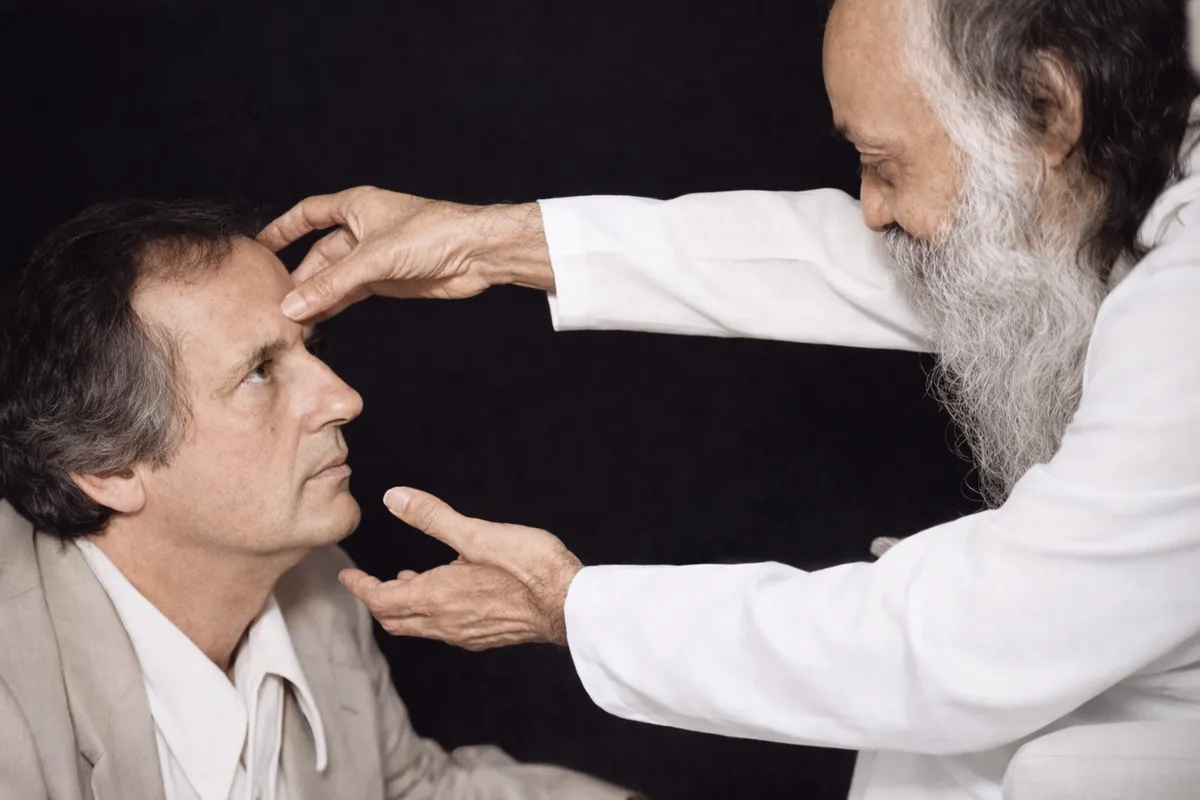
Osho's original Hindi beside Osho Live's English translation, matched passage by passage.
अब सूत्र:
तथा हे अर्जुन, जो पुरुष इस धर्ममय हम दोनों के संवाद-रूप गीता को पढ़ेगा अर्थात नित्य पाठ करेगा, उसके द्वारा मैं ज्ञान-यज्ञ से पूजित होऊंगा, ऐसा मेरा मत है।
Now the sutra: “Thus, O Arjuna, the man who reads this righteous dialogue of ours in the form of the Gita—who makes a daily recitation—by him I am worshiped through the sacrifice of knowledge; such is my view.”
हे अर्जुन, जो पुरुष इस धर्ममय हम दोनों के संवाद-रूप गीता को पढ़ेगा.।
“O Arjuna, the man who reads this righteous dialogue of ours…”
जिस संभोग की मैंने बात कही, वही कृष्ण कह रहे हैं, इस धर्ममय हम दोनों के संवाद-रूप.।
The very union I have spoken of—Krishna says “this righteous dialogue of ours…”
एक तो विवाद है, जहां जो भी तुमसे कहा जाता है, तुम उसके विपरीत सोचते हो। एक संवाद है, जहां तुमसे जो भी कहा जाता है, तुम उसके अनुकूल सोचते हो, सामंजस्य का अनुभव करते हो। तुम्हारा हृदय उसके साथ-साथ धड़कता है, विपरीत नहीं। एक गहन सहयोग होता है।
There is debate, where whatever is said to you, you think the opposite. And there is dialogue, where whatever is said to you, you think in harmony with it; you feel a resonance. Your heart beats along with it, not against it. There is deep cooperation.
तो कृष्ण कहते हैं, इस धर्ममय हम दोनों के संवाद-रूप गीता को जो भी पढ़ेगा.।
So Krishna says, “Whoever reads this righteous dialogue of ours…”
एक संवाद घटित हुआ है, एक अनूठी घटना घटी है। दो व्यक्तियों ने एक-दूसरे को अपने में उंडेला है, एक-दूसरे में डूबे हैं।
A dialogue happened—an incomparable event. Two persons poured themselves into each other, were immersed in one another.
इस अनूठी घटना को कृष्ण धर्ममय कहते हैं। यही धर्म की घटना है, जहां दो चेतनाएं इतने अपूर्व रूप से एक-दूसरे में डूब जाती हैं कि कोई अस्मिता और अहंकार की घोषणा नहीं रह जाती कि हम अलग-अलग हैं; अपनी कोई सुरक्षा की आकांक्षा नहीं रह जाती। बूंद जैसे सागर में डूब जाए, सरिता जैसे सागर में कूद जाए!
This incomparable event Krishna calls dharmamaya—full of dharma. This is the event of religion: two consciousnesses plunge into each other so extraordinarily that no assertion of “I” remains—no declaration that “we are separate,” no craving to protect one’s own identity. As a drop is lost in the ocean, as a river dives into the sea!
इस धर्ममय हम दोनों के संवाद-रूप गीता को जो पढ़ेगा, नित्य पाठ करेगा.।
“Whoever reads this righteous dialogue of ours—who makes it his daily recitation…”
नित्य पाठ एक अनूठी बात है, जो पूरब में ही विकसित हुई। पश्चिम में नित्य पाठ जैसी कोई चीज नहीं है। पश्चिम में लोग किताबें पढ़ते हैं, पाठ नहीं करते। किताब पढ़ने का अर्थ है, पढ़ ली एक बार, खतम हो गई बात; अब उसे दुबारा क्या पढ़ना? जो पढ़ ही ली, उसे दुबारा क्या पढ़ना? एक फिल्म एक बार देख ली, बात खतम हो गई, दुबारा क्या देखने को बचता है? एक उपन्यास एक बार पढ़ लिया, बात खतम हो गई। फिर दुबारा उसे वही पढ़ेगा, जो मंदबुद्धि हो, जिसकी अकल में कुछ भी न आया हो। दुबारा कोई क्यों पढ़ेगा?
लेकिन पाठ का अर्थ है, करोड़ों बार पढ़ना, रोज पढ़ना, जीवनभर पढ़ना।
Daily recitation—nitya path—is a unique thing that developed only in the East. In the West there is no such thing. In the West people read books; they do not recite them. Reading means, “I read it once—finished; why read it again? A film seen once—is done; why see again? A novel read once—finished.” To read it again is for the dull-witted, for one who didn’t grasp it. Why read again?
नित्य पाठ का क्या अर्थ है फिर? यह साधारण पढ़ना नहीं है। नित्य पाठ का अर्थ है, धर्म के वचन ऐसे वचन हैं कि तुम एक बार उन्हें पढ़ लो, तो यह मत समझना कि तुमने पढ़ लिया। उनमें पर्त दर पर्त अर्थ हैं। उनमें गहरे-गहरे अर्थ हैं। तुम जैसे-जैसे गहरे उतरोगे, वैसे-वैसे नए अर्थ प्रकट होंगे। जैसे-जैसे तुम उनमें प्रवेश करोगे, वैसे-वैसे पाओगे, और नए द्वार खुलते जाते हैं।
But path—recitation—means to read it millions of times; to read it daily; to read it lifelong.
What then is the meaning of daily recitation? It is not ordinary reading. It means that words of dharma are such that if you read them once, do not imagine you have read them. There are layers upon layers of meaning. There are depths upon depths. As you go deeper, newer meanings appear. As you enter more, more doors open.
गीता को तुम जितनी बार पढ़ोगे, उतने ही अर्थ हो जाएंगे। बहुआयामी है प्रत्येक शब्द धर्म का। और तुम्हारी जितनी प्रज्ञा विकसित होगी, उतनी ही ज्यादा तुम्हें अर्थ की अभिव्यंजना होने लगेगी। कृष्ण का ठीक-ठीक अर्थ जानते-जानते तो तुम कृष्ण ही हो जाओगे, तभी जान पाओगे, उसके पहले न जान पाओगे।
The more you read the Gita, the more meanings it yields. Every word of dharma is multi-dimensional. And as your own intelligence deepens, so too will meaning unfold. To know the precise meaning of Krishna, you will have to become Krishna; only then will you know—before that you cannot.
ऐसा समझो कि जब तुम गीता शुरू करोगे, तो तुम ऐसे पढ़ोगे, जैसा अर्जुन है; और जब गीता पूरी होगी, तो तुम ऐसे पढ़ोगे, जैसे कृष्ण हैं। और बीच में हजारों सीढ़ियां होंगी।
Understand it like this: when you begin the Gita, you will read as Arjuna reads; when the Gita is complete, you will read as Krishna reads. And in between there will be a thousand steps.
बहुत बार, बहुत बार तुम्हें लगेगा, इतनी बार पढ़ने के बाद भी यह अर्थ इसके पहले क्यों नहीं दिखाई पड़ा? यह शब्द कितनी बार मैं पढ़ गया हूं, लेकिन इस शब्द ने कभी ऐसी धुन नहीं बजाई मेरे भीतर! आज क्या हुआ?
Many times you will feel: “After reading so many times, why did this meaning not appear before? I have read this word so many times, but it never sounded this note within me—what happened today?”
आज भाव-दशा और थी। आज तुम्हारा चित्त शांत था, तुम आनंदित थे, तुम प्रफुल्लित थे, तुम थोड़े ज्यादा मौन थे, नया अर्थ प्रकट हो गया। कल तुम परेशान थे, मन उपद्रव से भरा था, यही शब्द तुम्हारी आंख के सामने से गुजरा था; लेकिन हृदय पर इसका कोई अंकुरण नहीं हुआ था, कोई छाप नहीं छोड़ सका था, कोई संस्कार नहीं बना सका था।
Today your inner mood was different. You were peaceful, joyful, uplifted, a little more silent—new meaning appeared. Yesterday you were troubled, the mind was in turmoil; the same word passed before your eyes, but it could not sprout in the heart, leave an imprint, make a samskara.
ऐसे बहुत-बहुत भाव-दशाओं में, बहुत-बहुत चेतना की स्थितियों में तुम गीता का पाठ करते रहना, बहुत-बहुत तरफ से गीता को देखते रहना, तुम्हें नए-नए अर्थ मिलते चले जाएंगे।
Read the Gita through very many inner moods, in very many states of consciousness; look at it from many sides—and you will keep receiving new meanings.
हम धर्मग्रंथ उसी को कहते हैं, जो पढ़ने से न पढ़ा जा सके, जो केवल पाठ से पढ़ा जा सके। इसलिए हर किताब का पाठ नहीं किया जाता, सिर्फ धर्मग्रंथ का पाठ किया जाता है।
We call it a scripture when it cannot be “read” by reading, but only by recitation. That is why not every book is recited; only scripture is recited.
असल में जिसका पाठ किया जा सकता है, वही धर्मग्रंथ है। जिसमें रोज-रोज नए-नए अर्थ की कलमें लगती जाएं, नए फूल खिलते जाएं; तुम हैरान ही हो जाओ कि तुम जितने भीतर जाते हो, और नए रहस्य खुलते चले जाते हैं, इनका कोई अंत नहीं मालूम होता, तभी तुम धर्मग्रंथ पढ़ रहे हो। इसे तुम्हें रोज ही पढ़ना होगा। यह तुम्हें तब तक पढ़ना होगा, जब तक कि आखिरी अर्थ प्रकट न हो जाए, जब तक कि कृष्ण का अर्थ प्रकट न हो जाए।
In truth, that to which daily recitation applies is scripture. Where newer and newer shoots of meaning keep grafting themselves daily, newer flowers keep blooming; where you are amazed that the deeper you go, newer mysteries keep opening with no end—then you are reading scripture. You will have to read it every day. You will have to read it until the last meaning is revealed—until Krishna’s meaning is revealed.
जैसे हम प्याज को छीलते हैं, ऐसे गीता कोरोज छीलते चले जाना। एक पर्त उघाड़ोगे, नयी ताजी पर्त प्रकट होगी। वह पहले से ज्यादा ताजी होगी, नयी होगी, गहरी होगी। उसे भी उघाड़ोगे, और भी नयी पर्त मिलेगी। ऐसे उघाड़ते जाओगे, उघाड़ते जाओगे, एक दिन सब पर्तें खो जाएंगी, भीतर का शून्य प्रकट होगा।
As we peel an onion, so keep peeling the Gita daily. Uncover one layer—a fresh layer appears, fresher, newer, deeper than before. Uncover that too; a still newer layer appears. Keep uncovering; one day all the layers are gone, and the inner void is revealed.
वही शून्य कृष्ण का अर्थ है। उस शून्य में ही समर्पण हो जाता है, उस शून्य में ही कोई डूब जाता है।
That very void is the meaning of Krishna. In that void surrender happens; in that void one is drowned.
इसलिए कृष्ण कहते हैं, जो हम दोनों के इस धर्ममय संवाद-रूप गीता को पढ़ेगा, नित्य पाठ करेगा, उसके द्वारा मैं ज्ञान-यज्ञ से पूजित होऊंगा, ऐसा मेरा मत है।
Therefore Krishna says: whoever reads this righteous dialogue of ours, makes it his daily recitation—by him I am worshiped through the sacrifice of knowledge; such is my view.
उसे कोई और यज्ञ करने की जरूरत नहीं; उसने रोज ज्ञान-यज्ञ कर लिया। जितनी बार उसने मेरे शब्दों को, तुझसे कहे शब्दों को अर्जुन, बड़े प्रेम और श्रद्धा और आस्था से पढ़ा; और जितनी बार इस गीत का उसके भीतर भी थोड़ा-थोड़ा उदय हुआ; वह भी नाचा और डोला और मतवाला हुआ; उसने भी यह शराब पी, जो हम दोनों के बीच घटी है; वह भी इसी मस्ती में मस्त हुआ, जिसमें हम दोनों डोलते गए हैं और डूबते गए हैं, उतनी ही बार उसने ज्ञान-यज्ञ किया, ऐसा मेरा मत है। उसे किसी और यज्ञ की कोई जरूरत भी नहीं है।
He has no need to perform any other yajna; he has performed the yajna of knowledge daily. As many times as he has read—Arjuna—my words to you with great love, reverence, and trust; and as many times as this song has dawned within him even a little; he too has danced, swayed, been intoxicated; he too has drunk the wine that happened between us; he too has been drunk with the same ecstasy in which we swayed and drowned—as many times as that, he has performed the yajna of knowledge. Such is my view. He needs no other yajna.
तथा जो पुरुष श्रद्धायुक्त और दोष-दृष्टि से रहित इस गीता का श्रवण-मात्र भी करेगा, वह भी पापों से मुक्त हुआ पुण्य कर्म करने वालों के श्रेष्ठ लोकों को प्राप्त होवेगा।
“And the man who, endowed with faith and free from fault-finding, even merely listens to this Gita, he too—freed from sins—will attain the highest realms attained by the doers of meritorious deeds.”
और जो पुरुष श्रद्धायुक्त.।
“And the man endowed with faith…”
बड़े प्रीतिभाव से, अनन्य श्रद्धा से। संदेह की एक रेखा भी न उठती हो।
With great affection, with undivided trust; not a line of doubt arising.
दोष-दृष्टि से रहित.।
“Free from fault-finding…”
दोष न खोजने को तैयार हो। क्योंकि दोष जो खोजने को तैयार है, उसे मिल ही जाएंगे। लेकिन इन दोषों के मिल जाने से किसी और की कोई हानि नहीं है, उसकी ही हानि है। तुम अगर गुलाब के पौधे के पास जाओगे और कांटे ही खोजना चाहते हो, तो मिल ही जाएंगे। वे वहां हैं, काफी हैं। मगर इससे सिर्फ तुम्हारी हानि हुई। जो गुलाब के फूल का दर्शन हो सकता था, और जो दर्शन तुम्हारे जीवन को रूपांतरित कर देता, उससे तुम वंचित हो गए।
Not ready to hunt for flaws. For one who is ready to hunt flaws will surely find them. But in finding them no one else loses—only he loses. If you go to a rosebush looking for thorns, you will find them—there are plenty. But only you have lost. The vision of the flower that could have transformed your life—you were deprived of it.
जो दोष-दृष्टि से रहित, श्रद्धाभाव से.।
“Free from fault-finding; with trust…”
कांटों को नहीं गिनेगा जो, फूलों को छुएगा जो, फूलों की गंध को अपने भीतर ले जाएगा। अपने द्वार खोलेगा। भयभीत नहीं, संदिग्ध नहीं, असंशय, आस्था से भरा हुआ।
वह श्रवण-मात्र से भी.!
He who does not count the thorns, but touches the flowers, carries their fragrance within. He opens his doors—not fearful, not suspicious, free of doubt, full of trust.
क्योंकि ऐसी घड़ी में, ऐसी भाव-दशा में श्रवण भी काफी है। ऐसा सुन लिया, तो सुनने से भी पार हो जाता है। क्योंकि ऐसा सुना हुआ तीर की तरह प्राणों के प्राण तक उतर जाता है।
“Even by mere listening!”
Because in such a moment, in such a mood, listening is enough. Listening in that way takes you beyond listening, for it enters like an arrow to the very life of life.
श्रवण-मात्र भी करेगा, वह पापों से मुक्त हुआ पुण्य कर्म करने वालों के श्रेष्ठ लोकों को प्राप्त हो जाएगा।
“Even by mere listening, he will, freed from sins, attain the highest realms of the meritorious.”
मात्र श्रवण से भी!
Mere listening!
बुद्ध ने बड़ा जोर दिया है, सम्यक श्रवण। महावीर ने कहा है कि मेरा एक घाट श्रावक का है। जिसने ठीक से सुन लिया, वह भी नाव पर सवार हो गया, वह भी उस पार पहुंच जाएगा। कृष्णमूर्ति राइट लिसनिंग पर रोज-रोज समझाते हैं, ठीक से सुन लो।
Buddha greatly emphasized right listening. Mahavira said one of my ferries is the shravaka—the listener. One who has truly listened has boarded the boat; he too will reach the other shore. Krishnamurti explains day after day: right listening—just listen rightly.
जानने का अर्थ सिर्फ ठीक से सुन लेना है। लेकिन ठीक से सुन लेना बड़ी मुश्किल से घटता है। क्योंकि हजार बाधाएं हैं; आलोचक की दृष्टि है; दोष देखने का भाव है; निंदा का रस है। उसमें तुम कांटों में उलझ जाते हो।
To know is simply to listen rightly. But listening rightly happens with great difficulty—there are a thousand obstacles: the critic’s eye, the taste for picking faults, the relish of slander. You get tangled in thorns.
कांटे हैं। मेरे पास तुम सुन रहे हो; अगर दोष देखने की दृष्टि हो, दोष मिल जाएंगे। इस पृथ्वी पर ऐसा कुछ भी नहीं है, जहां कांटे न हों। क्योंकि कांटे फूलों की रक्षा के लिए हैं। कांटे फूलों के दुश्मन नहीं हैं, विपरीत भी नहीं हैं। वे फूलों की रक्षा के लिए हैं; वे फूलों के पहरेदार हैं; उनके बिना फूल नहीं हो सकते। और जितना सुगंधयुक्त गुलाब होगा, उतने ही बड़े कांटे होंगे। जितना बड़ा गुलाब का फूल होगा, उतने ही बड़े कांटे होंगे। वे रक्षा कर रहे हैं।
There are thorns. If you are listening to me with the eye to fault, you will find faults. On this earth there is nothing that has no thorns—because thorns protect the flowers. They are not enemies, not opposites; they guard the flowers. Without thorns, flowers cannot be. And the more fragrant the rose, the bigger the thorns; the larger the blossom, the larger the thorns. They are protecting.
तो तुम्हें कांटों से उलझने की कोई जरूरत नहीं है। कांटे हैं; तुम फूल को देखो।
So you need not get entangled with thorns. They are there; you look at the flower.
और एक मजे की बात है। अगर तुमने फूल को ठीक से देखा, जीया, अपने भीतर जाने दिया, तो तुम एक दिन पाओगे कि सब कांटे फूल हो गए। तुम्हारी दृष्टि फूल की हो गयी, अब तुम्हें कांटे दिखायी ही नहीं पड़ते। और अगर तुमने कांटों को ही गिना और उनको ही चुभा-चुभाकर देखा, घाव बनाए, तो तुम फूल से भी डर जाओगे; फूल से भी ऐसे डरोगे, जैसे फूल भी कांटा है। एक दिन तुम पाओगे, फूल बचे ही नहीं तुम्हारे लिए, कांटे ही कांटे हो गए।
And there is a delightful fact: if you truly see the flower, live it, let it enter you, one day you will find that all thorns have become flowers. Your vision has become the flower’s; now you do not see the thorns at all. But if you count only thorns, prick yourself with them, make wounds, then you will even begin to fear the flower as though it too were a thorn. One day you will find there are no flowers left for you—only thorns.
तुम्हारी दृष्टि ही अंततः तुम्हारा जीवन बन जाती है।
Your very vision finally becomes your life.
तो जिसने श्रद्धा से, प्रेम से, अहोभाव से, दोष-दृष्टि से नहीं, सत्य की आकांक्षा-अभीप्सा से मात्र सुना भी, वह भी मुक्त हो जाता है।
So one who has listened with trust, with love, with gratitude—not with fault-finding, but with the longing for truth—even he becomes free.
इससे बड़ी भूल पैदा हुई। कृष्ण के इन वचनों से वही हुआ जिसका डर था। लोगों ने समझा, तो फिर ठीक है, गीता सुन लेने से सब हो जाता है। मगर वे भूल गए कि शर्तें हैं: श्रद्धायुक्त, दोष-दृष्टि से रहित.।
From Krishna’s words a great mistake arose—the very fear that was. People understood: “Fine then, everything is accomplished by listening to the Gita.” But they forgot the conditions: “endowed with faith, free from fault-finding…”
इसका मतलब यह नहीं कि सोए-सोए सुन लेना। सोए रहोगे, न संदेह उठेगा, न दोष-दृष्टि होगी; आंख बंद किए झपकी लेते रहना। धार्मिक सभाओं में लोग सोए रहते हैं। इसका मतलब सोए-सोए सुनना नहीं है; इसका मतलब है, बहुत जागरूक होकर सुनना, ताकि दोष-दृष्टि प्रविष्ट न हो जाए। दोष-दृष्टि नींद का हिस्सा है, मूर्च्छा का हिस्सा है।
It does not mean listening while dozing. If you are asleep, no doubt will arise, no fault-finding either; keep nodding through the sermon. People sleep in religious gatherings. It does not mean sleepy listening; it means listening with great awareness, so that fault-finding cannot enter. Fault-finding is part of sleep, of stupor.
बहुत अनन्य जागरूक, चैतन्य होकर सुनना, ताकि श्रद्धा का आविर्भाव हो जाए। तो ही सुनने से भी कोई पार हो जाता है।
Listen with very single-pointed alertness and consciousness, so that trust arises. Only then does even listening take one beyond.
आज इतना ही।
That is all for today.
पहली बात, बजाय यह सोचने के कि किसको सुनाना चाहिए, पहले यह सोच लेना चाहिए कि मैं सुनाने योग्य हूं या नहीं। और यदि तुम सुनाने योग्य हो, तो तुम्हें दर्पण की भांति स्पष्ट हो जाएगा, किसको सुनाना चाहिए, किसको नहीं सुनाना चाहिए। तब निर्भर करेगा--जो व्यक्ति तप और भक्ति से रहित है, वह भी तप और भक्ति के लिए लालायित हो सकता है। जो आज दूर है, कल पास हो जाएगा। जो आज गिरा है, कल उठेगा।
First thing: rather than thinking whom one should speak to, first see whether I am fit to speak at all. And if you are fit to speak, it will become as clear as a mirror whom to speak to and whom not to. Then it will depend—someone lacking tapas and bhakti may still be yearning for tapas and bhakti. One who is far today may be near tomorrow. One who has fallen today may rise tomorrow.
तप और भक्ति से रहित व्यक्ति यदि सुनना चाहे, तो सुनना चाहने के दो कारण हो सकते हैं। एक, मात्र कुतूहल। तब तो नहीं सुनाना चाहिए। क्योंकि कुतूहल तो खुजली जैसा है; वह कहीं ले जाने वाला नहीं है। खुजाओ, थोड़ा रस मालूम होता है। लेकिन खुजली से घाव बनते हैं।
If a person without austerity and devotion wishes to listen, there can be two reasons for that desire. One, mere curiosity. Then you should not speak. Curiosity is like an itch; it leads nowhere. You scratch it and there is a little sensation—but an itch ends in sores.
अगर कुतूहल मात्र हो, तो गीता के शब्द ही पहुंच पाएंगे उसके पास, अर्थ न पहुंच पाएगा। अर्थ की उसे आकांक्षा भी नहीं है। और उसके जीवन में गीता के शब्दों के घाव बन जाएंगे। गीता के अर्थों के फूल तो न लगेंगे; शब्दों के घाव बन जाएंगे। तुम्हारे सुनाने से अहित होगा उसका, हित न होगा। वह पंडित हो जाएगा। कुतूहल ज्यादा से ज्यादा पांडित्य तक ले जा सकता है, क्योंकि कुतूहल बौद्धिक खुजलाहट है।
If it is only curiosity, only the words of the Gita will reach him, not their meaning. He has no longing for meaning anyway. And in his life the words of the Gita will become sores. The flowers of meaning will not bloom; the wounds of words will form. By your speaking, harm will be done to him, not benefit. He will become a pundit. Curiosity can at most lead to pedantry, because curiosity is an intellectual itch.
लेकिन यह भी हो सकता है कि तप और भक्ति से रहित व्यक्ति जिज्ञासु हो; कुतूहल न हो, वस्तुतः जिज्ञासा जगी हो। अभी तप और भक्ति का उदय तो नहीं हुआ, लेकिन प्राणों में एक प्यास की पहली आवाज सुनाई पड़ी है, पहली पुकार उठी है। स्वभावतः, पहली पुकार जिज्ञासा की ही तरह उठेगी।
But it may also be that the person lacking tapas and bhakti is an inquirer; not merely curious, but truly stirred by inquiry. The dawn of austerity and devotion has not yet come, but in his being the first sound of thirst has been heard, the first call has arisen. Naturally, the first call will look very much like curiosity.
गीता सुनाने से जिज्ञासु का खोज का द्वार खुलता है। उसके भीतर धीरे-धीरे मुमुक्षा का जन्म होने लगेगा।
Telling the Gita to such an inquirer opens the door of the quest. Gradually a longing for liberation (mumuksha) will be born within him.
लेकिन यह सारी बात तुम्हें दिखाई पड़ जाएगी, अगर तुम सुनाने के योग्य हो।
But all this will be visible to you only if you are fit to speak.
कृष्ण ने कुछ भी नहीं कहा इस संबंध में कि कौन सुनाए। किसको सुनाए, यह तो कहा; कौन सुनाए, यह नहीं कहा। उसका कारण है। क्योंकि कृष्ण को यह खयाल भी नहीं आया कि कृष्ण हुए बिना कोई सुनाने की कोशिश करेगा। लेकिन लोगों ने की है। तो गीता के आस-पास पंडितों की टीकाओं-टिप्पणियों का बड़ा जाल खड़ा हो गया है।
Krishna said nothing about who should speak. He did say whom it should be spoken to; he did not say who should speak. There is a reason. It never occurred to Krishna that anyone would try to speak without first becoming Krishna. But people have tried. So around the Gita a vast web of pundits’ commentaries and annotations has arisen.
सुनने वाला हो सकता है, गलत ढंग से सुने और भटक जाए। लेकिन एक ही सुनने वाला गलत ढंग से सुनता है, भटकता है। सुनाने वाला तो हजारों लोगों को सुनाता है, लाखों को सुनाता है। अगर सुनाने वाला ही गलत है, तो वह लाखों-करोड़ों को भटका देता है। और ध्यान रखना, गलत सुनाने वाला अनिवार्य रूप से गलत सुनने वाले को आकर्षित कर लेगा।
A listener may hear wrongly and go astray. But only one listener goes astray by hearing wrongly. A speaker addresses thousands, hundreds of thousands. If the speaker himself is wrong, he misleads millions. And remember, a wrong speaker will inevitably attract wrong listeners.
जीवन में आकर्षण के बड़े सूक्ष्म जाल हैं। जैसे स्त्री पुरुष को आकर्षित कर लेती है, या पुरुष स्त्री को आकर्षित कर लेता है; जैसे चुंबक के पास लोहकण खिंचे चले आते हैं, ऐसे जीवन में बड़े सूक्ष्म जाल हैं आकर्षण के।
Life has very subtle webs of attraction. As a woman attracts a man or a man attracts a woman; as iron filings are drawn to a magnet—so in life there are fine meshes of attraction.
अगर गलत सुनाने वाला व्यक्ति है, तो गलत सुनने वालों की भीड़ अपने आप इकट्ठी हो जाएगी। ठीक सुनने वाला तो वहां टिक ही न सकेगा। क्योंकि ठीक सुनने वाले को तो वहां कुछ दिखाई ही न पड़ेगा सिवाय अंधकार के। ठीक सुनने वाले की कसौटी पर तो ठीक सुनाने वाला ही उतरेगा। लेकिन गलत सुनने वालों की भीड़ इकट्ठी हो जाएगी।
If the speaker is wrong, a crowd of wrong listeners will gather around him of its own accord. A right listener cannot even stay there, because for him there will be nothing but darkness. On the touchstone of a right listener only a right speaker stands the test. But a crowd of wrong listeners will assemble.
कृष्ण ने कुछ कहा नहीं उस संबंध में, क्योंकि कहना भी मुश्किल है। और कृष्ण को खयाल भी न आया होगा कि लोग ऐसी अहम्मन्यता भी करेंगे। उन दिनों ऐसी अहम्मन्यता होती भी नहीं थी।
Krishna said nothing in that regard because it is difficult to say—and it likely never occurred to him that people would be so egotistical. In those days such egomania hardly existed.
कृष्ण, महावीर और बुद्ध के समय में वही व्यक्ति बोलने जाता था, जिसने जाना हो; जिसने जाना न हो, वह बोलने की चेष्टा भी नहीं करता था। क्योंकि बिना जाने बोलना महा अपराध है। उससे तुम न मालूम कितने लोगों के जीवन में कांटे बो दोगे। शायद तुम्हें बोलने में थोड़ा मजा आ जाए, रस आ जाए; शायद बोलते-बोलते तुम्हें लगे कि तुम बड़े महत्वपूर्ण हो गए हो, क्योंकि कई लोग तुम्हें सुन रहे हैं; शायद पांडित्य की अकड़ और अहंकार में थोड़ी तुम्हें तृप्ति मिले। लेकिन तुम्हारी व्यर्थ की तृप्ति के लिए न मालूम कितने लोग मार्ग से च्युत हो जाएंगे। तुम उन्हें भटका दोगे।
In the time of Krishna, Mahavira, and Buddha, only one who had known would go to speak; one who had not known would not even attempt it. To speak without knowing is a great sin. Who knows how many thorns you will sow in people’s lives. Perhaps you will get a little pleasure from speaking, a taste of it; perhaps while speaking you will feel important because many are listening; perhaps your pedantry and ego will be a little gratified. But for your futile gratification, who knows how many will fall from the path. You will mislead them.
और इस संसार में बड़ा से बड़ा पाप हत्या नहीं है; इस संसार में बड़ा से बड़ा पाप किसी को उसके मार्ग से भटका देना है।
And in this world the greatest sin is not murder; the greatest sin is to deflect someone from his path.
तो जितने बड़े पाप अपात्र बोलने वालों ने किए हैं, उतने बड़े पाप किसी ने भी नहीं किए हैं। क्योंकि कोई गरदन पर तुम्हारी तलवार मार दे, तो शरीर ही कटता है, फिर शरीर मिल जाएगा। लेकिन कोई तुम्हारी आत्मा को रास्ते से भटका दे, तो कुछ ऐसी चीज भटक जाती है कि जन्मों-जन्मों खोजकर शायद तुम मुश्किल से वापस अपनी जगह पर आ पाओगे। क्योंकि एक भटकाव दूसरे भटकाव में ले जाता है, कड़ियां जुड़ी हैं। दूसरा भटकाव तीसरे भटकाव में ले जाता है। और पीछे लौटना मुश्किल होता चला जाता है।
So the unfit speakers have committed the gravest sins—no one has committed greater. If someone strikes your neck with a sword, only the body is cut; another body can be found again. But if someone leads your soul away from its path, something wanders so far that through birth after birth you may hardly find your way back. One deviation leads to another—links join. The second deviation leads to a third, and returning becomes harder and harder.
तो पहली तो बात ध्यान रखना, इसकी फिक्र मत करना कि कौन पात्र है सुनने में, कौन नहीं। पहले तो इसकी फिक्र करना कि मैं बोलने में पात्र हूं? मैं कृष्ण पर कुछ कहूं? जब तक कृष्ण-चेतना का आविर्भाव न हुआ हो, तब तक मत कहना।
So first remember this: do not worry about who is fit to hear and who is not. First worry: am I fit to speak? Am I to say anything about Krishna? Until Krishna-consciousness has arisen in you, do not speak.
और इसके लिए किसी से पूछने जाना है? यह तो तुम भीतर ही जान सकोगे कि कृष्ण-चेतना का आविर्भाव हुआ या नहीं हुआ। इसकी और किसी से कसौटी लेने की जरूरत भी नहीं है; किसी से पूछने का कोई कारण भी नहीं है। पूछने तो वही जाएगा, जो संदिग्ध है। और कृष्ण-चेतना में संदेह नहीं है; वह असंदिग्ध, स्वतःप्रमाण्य अवस्था है। जब भीतर उदित होती है, तो तुम जानते हो, जैसे सूरज उग गया। अब तुम किसी से पूछते थोड़े ही हो कि रात है या दिन! और पूछो, तो बताओगे कि तुम अंधे हो।
And do you need to ask anyone about this? You will know within whether Krishna-consciousness has blossomed or not. There is no need to take anyone else’s test; no reason to ask anyone. Only one who is doubtful goes to ask. And in Krishna-consciousness there is no doubt; it is an unquestionable, self-evident state. When it dawns within, you know—just as you know the sun has risen. You don’t go around asking whether it is night or day! And if you do, people will say you are blind.
कृष्ण ने नहीं लगाई कोई शर्त बोलने वाले पर, क्योंकि उन दिनों यह होता ही न था कि जो न जानता हो, वह बोले। जानकर ही कोई बोलता था। और जब तक न जान लेता था, तब तक कितना ही शास्त्रों से इकट्ठा कर ले, इस भ्रांति में नहीं पड़ता था कि मुझे अनुभव हो गया है।
Krishna placed no condition on the speaker, because in those days it never happened that one who did not know would speak. Only one who had known would speak. And until one had known, however much he had gathered from the scriptures, he would not fall into the delusion that he had attained.
श्वेतकेतु घर लौटा अपने पिता के पास। उद्दालक ने कहा कि तू उस एक को जानकर आ गया, जिसे जानने से सब जान लिया जाता है? क्योंकि श्वेतकेतु बड़ा अकड़कर आ रहा था, जैसा कि पंडित सदा ही अकड़ जाता है। सब परीक्षाएं उत्तीर्ण कर लीं; सभी शास्त्र जानकर आ रहा था; वेदों का पारंगत ज्ञाता हो गया था। जो कुछ भी विश्वविद्यालय में सिखाया जा सकता था, सब सीख लिया था। गुरु के आश्रम में अब कुछ और बचा ही न था सीखने को। स्वभावतः, युवा था; अभी अहंकार ताजा था; अभी अकड़ नई थी; अभी बाढ़ में था जीवन; अकड़कर आ रहा था।
Shvetaketu returned home to his father. Uddalaka said, “Have you come knowing that One, by knowing which all is known? For Shvetaketu was returning with great swagger—as scholars always do. He had passed all the examinations; he knew all the scriptures; he had mastered the Vedas. Whatever could be taught in the university he had learned. In the guru’s ashram nothing remained to be learned. Naturally, he was young; the ego was fresh; the strut was new; life was in flood—he came home strutting.
पिता ने देखा उसे आते, उसकी अकड़ लगी कि गलत है। क्योंकि जानने वाला ऐसे अकड़कर कहीं आता है! यह तो अज्ञानी का लक्षण है।
Seeing him, the father sensed that the swagger was wrong. Does a knower ever walk in like that? That is the mark of the ignorant.
पहली ही बात, बेटा आकर चरणों में झुका, पिता ने पूछा कि मालूम होता है, तू सब जानकर आ गया! श्वेतकेतु ने कहा, आप ठीक पहचाने। कुछ मैंने छोड़ा नहीं; जो भी जानने योग्य था, सब जान लिया। सब चुकता करके आया हूं, कुछ बचा नहीं है।
The very first thing: the son bowed at his feet. The father asked, “It seems you have come knowing everything!” Shvetaketu said, “You have recognized correctly. I have left nothing out; whatever was worth knowing, I have known. I have settled all accounts; nothing remains.”
तो पिता ने कहा, एक बात का उत्तर दे। तूने उस एक को जाना, जिसे जानने से सब जान लिया जाता है? और जिसे न जानने से, कुछ भी जाना हो, तो जानने का कोई मूल्य नहीं?
The father said, “Answer me one thing. Have you known that One, by knowing which all is known, and without knowing which whatever you know has no value?”
श्वेतकेतु ने कहा, कैसा एक? कौन-सा एक? गुरु ने उसकी तो कोई बात ही नहीं की!
Shvetaketu said, “What is that One? Which One? My guru never spoke of it!”
तो पिता ने कहा, फिर वापस जा। यह भी कोई जानना है? हमारे कुल में नाममात्र के ब्राह्मण नहीं हुए हैं। हम ब्रह्म को जानकर ही अपने को ब्राह्मण कहते रहे हैं। ऐसा पैदाइश से हमारे कुल में कोई ब्राह्मण अपने को नहीं कहा है। तू जानकर लौट, ब्रह्म को जानकर लौट; अन्यथा ब्राह्मण न कहला सकेगा।
The father said, “Then go back. Is this any knowing? In our lineage there have never been brahmins in name only. We have called ourselves brahmins only on knowing Brahman. No one in our family has called himself a brahmin by birth. Return after knowing—return after knowing Brahman; otherwise you cannot be called a brahmin.”
उन दिनों कोई जरूरत न थी यह बात कहने की, क्योंकि ऐसा महापातक कोई करता ही न था। इसलिए कृष्ण ने कहने वाले के लिए कुछ भी नहीं कहा है, सुनने वाले के लिए कहा है।
In those days there was no need to say such things, because no one committed that great sacrilege. Therefore Krishna said nothing about the speaker; he spoke of the listener.
और अगर तुम्हारे भीतर जागरण हो गया है चैतन्य का, तो उस जागरण में तुम प्रत्यक्ष देख लोगे, किससे कहना, किससे नहीं कहना। कुतूहल वाले व्यक्ति को मत कहना; जिज्ञासु को कहना।
And if awakening of consciousness has happened within you, then in that very awakening you will directly see to whom to speak and to whom not to. Do not speak to the merely curious; speak to the inquirer.
जिज्ञासा और कुतूहल में बड़ा बारीक फासला है। वे एक जैसे दिखाई पड़ते हैं। कुतूहल जिज्ञासा का झूठा सिक्का है। एक जैसे दिखाई पड़ते हैं।
Between inquiry and curiosity there is a very fine distance. They look alike. Curiosity is the counterfeit coin of inquiry. They look the same.
जैसे छोटा बच्चा पूछता है; चले जा रहे हो रास्ते पर, तुम्हारा बच्चा साथ है, वह पूछता है, पक्षियों को दो पंख क्यों हैं? वृक्ष में लाल फूल क्यों लगे हैं? सूरज सुबह ही क्यों उगता है? उगना तो रात में चाहिए, जब अंधेरा रहता है! परमात्मा नासमझ है; सुबह उगाता है, जब कि प्रकाश है; और रात में डुबा देता है जब कि अंधेरा है। वह पूछता जाता है।
A small child asks: you are walking on the road, your child with you; he asks, Why do birds have two wings? Why are there red flowers on the tree? Why does the sun rise only in the morning? It should rise at night when it is dark! God is unintelligent; He brings it up in the morning when there is already light and sinks it at night when there is darkness. He keeps on asking.
तुम उसकी बात पर बहुत ज्यादा ध्यान नहीं देते। तुम कुछ-कुछ कहकर उसे टालते रहते हो। और तुम न भी टालो, तो वह खुद ही एक क्षण बाद भूल जाता है कि उसने क्या पूछा था, क्योंकि दूसरे प्रश्न खड़े हो जाते हैं।
You do not pay much attention. You say something or other and put him off. And even if you don’t, he himself forgets within a moment what he asked, because other questions arise.
वह कुछ पूछने के लिए नहीं पूछ रहा है। उसकी कोई जिज्ञासा नहीं है; कुतूहल है। उसके मन में तरंगें उठ रही हैं। हर चीज प्रश्नवाची है। लेकिन तुम यह मत सोचना कि वह कोई किसी प्रश्न से अटका है; कि इस प्रश्न का हल न हुआ, तो उसका जीवन दांव पर लग जाएगा। उसे कुछ मतलब ही नहीं है। तुम इतना ही कह दो, बड़े होकर जान लोगे, बात खतम हो गई। वह यह भी नहीं पूछता कि तुम बड़े हो गए हो, तुमने जाना? वह कहता है, ठीक होगा। तुम कुछ भी उत्तर दे दो, उत्तर में उसे बहुत रस भी नहीं है; उसे पूछने का मजा है।
He is not asking in order to know. There is no inquiry in him; there is curiosity. Waves are arising in his mind. Everything appears as a question. But do not think he is stuck on any question—that if it is not solved his life will be at stake. He is not concerned. Just tell him, “You will know when you grow up,” and the matter is finished. He does not even ask, “You are already grown up—have you known?” He says, “All right.” Give him any answer; he has little interest in the answer—he enjoys asking.
जैसे पंडित को बोलने का मजा है, वैसे कुतूहली को पूछने का मजा है। इसलिए पंडित और कुतूहली का मेल बैठ जाता है। पंडितों के पास कुतूहली लोग इकट्ठे हो जाते हैं।
As the pundit enjoys speaking, so the curious enjoy asking. Therefore the curious gather around pundits.
जिज्ञासु को पूछने के लिए नहीं पूछना है; पूछने पर प्राण अटके हैं; पूछने पर निर्भर है सब कुछ; पूछने पर दांव लगा है, या इस पार या उस पार; वह जीवन-मरण का सवाल है; वह हर कुछ नहीं पूछ रहा है। इसलिए जिज्ञासु कभी-कभी पूछेगा; लेकिन अपने प्राण उस एक प्रश्न में डुबा देगा। कुतूहली रोज पूछेगा, दिन में हजार बातें पूछेगा, और भूल जाएगा पूछकर, फिर दुबारा याद भी नहीं करेगा।
The inquirer does not ask for the sake of asking; his very life is staked on the question. Everything depends on it; it is either this shore or the other; it is a life-and-death matter. He is not asking about everything. Therefore the inquirer will ask only sometimes, but he will drown his whole being in that one question. The curious will ask every day, ask a thousand things in a day, and after asking will forget—never returning to them.
परमात्मा कुतूहल से नहीं जाना जाता। कुतूहल बहुत सस्ता है, जिसमें तुम दांव ही नहीं लगाते। बस, पूछ लिया; राह चलते पूछ लिया!
The divine is not known through curiosity. Curiosity is very cheap—you stake nothing on it. You just ask—in passing!
मेरे पास ऐसे लोग आ जाते थे। मैं यात्राओं में था। मैं ट्रेन पकड़ने के लिए प्लेटफार्म पर चला जा रहा हूं; कोई आदमी देख लेगा, पहचान जाएगा, पास आ जाएगा; कि आपसे जरा एक बात पूछनी है, मन शांत कैसे हो?
People like this used to come to me. I was traveling. I would be walking to the platform to catch a train; someone would see me, recognize me, come up: “I just want to ask one thing—how can the mind be made silent?”
मैं ट्रेन पकड़ रहा हूं, ट्रेन छूटने को है, उसको खुद भी ट्रेन पकड़नी है! स्टेशन पर पूछ रहा है, मन शांत कैसे हो? जैसे कोई बच्चों का खेल है! कि कोई पूछता है कि ईश्वर है या नहीं? आप संक्षिप्त में उत्तर दे दें, हां या ना?
I am catching a train; it is about to leave; he too has to catch a train! On the station he asks, “How can the mind be made silent?” As if it were a children’s game! Or someone asks, “Is there God or not? Give a brief answer—yes or no.”
मेरे हां और न से क्या हल होगा? अगर मेरे हां और न से तुम्हारी ईश्वर की खोज पूरी हो जाती, तो वह कोई खोज थी? वह दो कौड़ी की थी। खोज ही न थी।
What will be resolved by my yes or no? If your search for God could be completed by my yes or no, what sort of search would that be? It would be worth two pennies. It would not be a search at all.
जिज्ञासा बात और है। तुम जिज्ञासा को हल करने के लिए चुकाने को तैयार होते हो, चाहे पूरा जीवन भी चुकाना पड़े। प्रश्न केवल प्रश्न नहीं हैं; प्रश्न तुम्हारे भीतर की अंतर्व्यथा हैं। जीवन में उलझाव है, तुम समाधान चाहते हो, उत्तर नहीं।
Inquiry is another matter. To resolve an inquiry you are ready to pay—even if it costs your whole life. Questions are not just questions; they are your inner anguish. Life is entangled; you seek resolution, not an answer.
कुतूहली उत्तर चाहता है; जिज्ञासु समाधान चाहता है। इसलिए कुतूहली पांडित्य तक पहुंच जाएगा कभी; जिज्ञासु समाधि तक जाएगा।
The curious wants answers; the inquirer wants resolution. Therefore the curious reaches pedantry; the inquirer moves toward samadhi.
लेकिन जिसके भीतर कृष्ण-चैतन्य का आविर्भाव हुआ है, वह देख लेगा, कहां कुतूहल है, कहां जिज्ञासा है। उसे पहचानने में जरा भी भूल नहीं होती। ऐसे ही जैसे तुम मुरदे को पहचान लेते हो और जिंदा आदमी को पहचान लेते हो। भला तुम बहुत बड़े चिकित्साशास्त्र के ज्ञाता न होओ, क्या तुम्हें अड़चन लगती है जानने में कि यह आदमी मुरदा है और यह आदमी जिंदा है? लाश को पहचानने में किसे देर लगती है!
But one in whom Krishna-consciousness has arisen will see clearly where there is curiosity and where there is inquiry. He does not make the slightest mistake in recognizing it—just as you can tell a corpse from a living man. Even if you are not a great medical expert, do you have any difficulty knowing whether this one is dead and that one is alive? Who takes long to recognize a corpse!
जिज्ञासा तो जीवंत है। कुतूहल मुरदा है, लाश है। और लाश के साथ सिर मत फोड़ना।
Inquiry is living. Curiosity is dead—a corpse. And do not bang your head against a corpse.
उत्तर तो बाद में, पहले प्रश्न को समझने की कोशिश करनी चाहिए।
The answer can come later; first try to understand the question.
अहंकार बड़े सूक्ष्म रूप लेता है। मुझे सुन भी रहे हो, तो वह भी तुमने पिछले जन्म में अर्जित किया होगा पुण्य! तुम्हारे भाव में प्रसाद-रूप से कभी कुछ घटित ही नहीं होता! तुम्हारे कर्तापन की अकड़ बड़ी गहरी है।
Ego takes very subtle forms. Even the fact that you are listening to me—ah, that too you think you must have earned by merit in a past life! In your feeling, nothing ever happens as prasad—as grace! Your stiffness of doership runs very deep.
इस जन्म में तो दिखाई नहीं पड़ता कि तुमने कुछ अर्जित किया हो, तो निश्चित तुमने पिछले जन्म में पुण्य किए होंगे, तभी तुम सुन रहे हो! तुम मुझे धन्यवाद भी तो नहीं दे सकते।
तुम्हारा ही अर्जन है! तुमने कमाया है! अगर मैं तुमसे बोल रहा हूं, तो तुम्हारी ही कमाई की वजह से बोल रहा हूं! तुम्हें प्रसाद कहीं भी दिखाई नहीं पड़ता?
In this life it doesn’t appear that you have earned anything, so certainly you must have done great merits in a past life—only then are you listening! You cannot even thank me. It is your earning! You have earned it! If I am speaking to you, it is because of your earnings! Do you never see anything as grace anywhere?
तुम अगर परमात्मा के पास भी पहुंच जाओगे, तो तुम यही कहोगे कि जन्मों-जन्मों के पुण्य कर्मों से तुझे कमाया है! वहीं तुम चूक जाओगे। यह अकड़ तुम्हें कहीं का न रखेगी। तुम पहुंच ही न पाओगे, क्योंकि यह अकड़ ही तो रोक लेगी।
Even if you were to reach God, you would say, “By the merit of births upon births I have earned You!” There you will miss. That rigidity will leave you nowhere. In fact you won’t reach at all, because this rigidity itself will block the way.
जिसने पुण्य किया है, वह तो विनम्र होता है। वह तो यह कहता है कि मेरा क्या पुण्य है? मैंने कुछ भी तो किया नहीं; और इतना पा लिया है। निश्चित ही, परमात्मा की अनुकंपा होगी, अनुग्रह होगा। मुझ अपात्र पर इतनी वर्षा हुई है! मैं धन्यभागी हूं! लेकिन.जिसने पुण्य किया है, उसकी तो यह भाव-दशा होगी कि मैं धन्यभागी हूं, क्योंकि मुझ अपात्र पर वर्षा हो गई है। मैंने कुछ भी तो नहीं किया।
One who has truly done merit is humble. He says, “What merit of mine? I did nothing, and yet I have received so much. Surely it must be God’s compassion, His grace. So much rain has fallen upon one so unworthy. I am blessed!” The one who has truly done merit has this inner state: “I am blessed, for grace has showered on one so unworthy. I have done nothing.”
और जिसने पुण्य नहीं किया है, उसका यह अहंकार होगा कि जो कुछ हुआ है, मेरे ही पुण्यों का अर्जन है। मैंने कमाया था, मैंने पाया है।
And the one who has not done merit has this ego: “Whatever has happened is the earning of my merits. I earned it; I have obtained it.”
शायद दूसरे तरह के आदमी को यह भी लगे कि जितना मिलना था, उतना भी नहीं मिला। कमाया तो बहुत था, उसके योग्य पाया भी नहीं है अभी। क्योंकि अहंकार को सदा ऐसा लगता है कि मेरा श्रम ज्यादा है, पुरस्कार कम है। निर-अहंकारिता को सदा ऐसा लगता है कि मेरा श्रम तो कुछ भी नहीं है, पुरस्कार बहुत है। ना-कुछ किए मिल रहा है, अनायास मिल रहा है!
Perhaps another kind of person will even feel that he has not received as much as he ought to have. He earned so much, yet has not received in proportion. For the ego always feels: my effort is more, the reward is less. Egolessness always feels: my effort is almost nothing, the reward is immense. It is being given without my doing, unasked, effortlessly!
तो पहले तो अपने प्रश्नों को बहुत गौर से सोचा करें। तुम्हारे प्रश्न ऐसे ही आकाश से नहीं आते, तुमसे आते हैं। तुम्हारे प्रश्न ऐसे ही शून्य से अवतरित नहीं हो जाते, तुम्हारे चित्त की गंध को साथ लाते हैं। सुगंध हो, तो सुगंध को लाते हैं; दुर्गंध हो, तो दुर्गंध को लाते हैं। तुम्हारे प्रश्नों में तुम्हारी पूरी आत्मा धड़कती है, तुम्हारी पूरी भाव-दशा धड़कती है।
So first, think over your questions very carefully. They do not fall out of the sky; they come from you. They do not descend from a blank void; they bring with them the fragrance of your inner climate. If there is fragrance, they bring fragrance; if there is stench, they bring stench. Your questions throb with your whole soul, with your whole inner state.
क्या तुम कभी भी प्रसाद को न समझ पाओगे? और यह पूरी गीता प्रसाद की चर्चा है! और गीता पूरी होने आ गई और तुम पूछ रहे हो, क्या मेरे पुण्य कर्मों के कारण ही आपके अमृत वचन सुनने का अवसर मिला?
Will you never be able to understand prasad? And the entire Gita is a discourse on prasad—on grace! The Gita is coming to its close, and you ask whether it is only because of your meritorious deeds that you got the chance to hear these nectar-like words?
तुम कर्ता को क्यों नहीं छोड़ सकते? तुम यह कर्तापन को क्यों पकड़े हुए हो? इसी कर्तापन के पीछे तुम्हारा अहंकार छिपा है।
Why can’t you drop the doer? Why are you clinging to doership? Hidden behind this doership is your ego.
समझो! जानो! तुम्हारे किए से क्या मिलेगा? तुम्हारे हाथ कितने छोटे हैं! तुम इन छोटे-छोटे हाथों में परमात्मा को बांधने चले हो, आलिंगन करने चले हो। कर पाओगे? तुम्हारी बुद्धि कितनी छोटी है! उस बुद्धि के छोटे-से छिद्र में तुम परमात्मा के विराट आकाश को भरने चले हो। भर पाओगे?
Understand! Know! What will your doing fetch? How small your hands are! With these little hands you are trying to bind God, to embrace Him. Will you be able to? How small your intellect is! Through that tiny aperture you are trying to pour the vast sky of the Divine. Will you be able to fill it?
तुम्हारे कृत्य का मूल्य क्या है? तुमने पुण्य भी किए होंगे, तो क्या किए होंगे? किसी भिखारी को कुछ पैसे दे दिए होंगे। और पहले उसे भिखारी बनाया होगा शोषण करके, तब पैसे दिए होंगे। पैसे कहां से आए थे तुम्हारे पास देने को? पहले शोषण, फिर दान! पहले पाप, फिर पुण्य! पहले हाथ रंग लो खून से, फिर धो लेना!
What is the worth of your actions? Even if you have done merits, what have you done? Perhaps you gave a few coins to a beggar. And first you made him a beggar by your exploitation, then you gave him coins. From where did those coins come into your hands? First exploitation, then charity! First sin, then virtue! First stain your hands with blood, then wash them!
तुम्हारे सभी पुण्य तुम्हारे पाप का प्रायश्चित्त हो सकते हैं, इससे ज्यादा उनका कोई मूल्य नहीं है। उनसे तुम कुछ पाते नहीं हो। उनसे तुम कुछ बहुत अहोभाव से मत भर जाना, कि तुमने एक अस्पताल खोल दिया, कि एक धर्मशाला बना दी। तुम्हारे कारण कितने लोग बीमार हुए हैं, इसका तुमने हिसाब रखा है? और तुम्हारे कारण कितने लोग बेघरबार हुए हैं, इसका तुमने हिसाब रखा है? एक धर्मशाला बना दी, उसका तुमने हिसाब रखा है!
All your virtues can at best be the penance for your sins; beyond that they have no value. You do not gain anything real by them. Do not get puffed up that you opened a hospital, that you built a rest house. Have you kept account of how many people fell ill because of you? Have you kept account of how many became homeless because of you? You built a rest house—have you kept that account?
तुमने कितने प्राणों को चोट पहुंचाई है, रुग्ण किया है, कितने प्राणों में घाव बनाए हैं, उसका तुमने हिसाब रखा है? नहीं, तुमने एक छोटा-सा दवाखाना खोल दिया, जहां होमियोपैथी की दो पैसे की दवाएं तुम बांटते रहते हो। वह तुमने पुण्य किया है!
Have you kept account of how many lives you have hurt, sickened, wounded? No—you opened a little clinic where you hand out two-paisa homeopathic pills. That you call virtue!
तुम्हारे पुण्य क्या हैं?
What are your virtues?
पुण्यवान व्यक्ति को ऐसा लगता है कि पुण्य कर ही कैसे सकता हूं? मेरा करना ही क्या है? यह पापी की दृष्टि है कि वह कहता है, मैंने पुण्य किए हैं। यह पाप का ही भाव है कि मैंने किया है।
अहंकार पाप है। और पुण्य का अहंकार तो बहुत गहन पाप है। पुण्यात्मा को तो पता ही इतना चलता है कि मैंने भूलें ही भूलें की हैं। थोड़ा-बहुत सुधारने की कोशिश की; लेकिन क्या हल होता है! भूलें अनंत हैं, सुधार न के बराबर है।
A truly virtuous person feels, “How can I do virtue? What is there of mine to do?” It is the sinner’s vision that says, “I have performed virtues.” The very feeling “I have done” is sin. Ego is sin. And the ego of virtue is a very deep sin. The truly righteous sees only this: I have made mistake upon mistake; I tried a little to set things right, but what is resolved? Mistakes are infinite; the corrections are next to nothing.
इसलिए पुण्यवान तो कहेगा, परमात्मा जब मिलेगा, वह उसके प्रसाद-रूप मिलता है, मेरे प्रयास-रूप नहीं। वह उसकी कृपा से मिलेगा, मेरे कर्मों से नहीं। मैं कर भी क्या सकूंगा?
Therefore the virtuous will say: When God is found, He is received as prasad—as grace—not as the result of my effort. He will be attained through His compassion, not by my deeds. What can I ever do?
और जिस दिन तुम्हें यह प्रसाद की भावना का उदय होगा, उस दिन तुम पाओगे, तुम्हारे जीवन में क्रांति होने लगी। नहीं तो तुम अपने अहंकार को बचाए ही चले जाओगे नए-नए रूपों में।
And the day the feeling of prasad arises in you, that day you will find a revolution beginning in your life. Otherwise you will go on protecting your ego in ever-new forms.
अब यह तुमने खूब नई तरकीब खोजी! मुझे सुन रहे हो, उसमें भी तुम अपने कर्ता को ले आए! सुनने जैसी सरल क्रिया में भी तुम्हारा तिरछा कर्ता आ गया।
Now see what a clever new trick you have found! Even in listening to me, you have dragged in your doer! In an act as simple as listening, your crooked doer has slipped in.
तुम्हें कुछ भी नहीं करना पड़ रहा है; तुम सिर्फ सुन रहे हो। वह भी पूरी तरह सुन रहे हो, यह संदिग्ध है। सुनने में भी तुम अपना प्राण लगाए हो, यह भी निश्चित नहीं है। इधर सुने, उधर भूल जाते हो। मगर निश्चित, तुम्हारा अहंकार कहता है कि अगर यह सुनने का अवसर मिला है, तो जरूर पिछले जन्म में कोई पुण्य कर्म किए होंगे। अन्यथा यह मिलता ही कैसे!
You are not required to do anything; you are only listening. Even that—are you listening wholly? It is doubtful. Are you pouring your very life into listening? That too is uncertain. You hear here, and forget there. But of course your ego says: If this opportunity to listen has come, then surely I must have done some meritorious deeds in a past life; otherwise how would this be given?
प्रसाद-रूप कुछ मिलता ही नहीं? तो फिर तुम गीता को कभी भी न समझ पाओगे। फिर गीता से तुम्हारा कोई ताल ही न बैठेगा। तुम्हारे सुर अलग ही बज रहे हैं।
Does nothing ever come as prasad? If so, you will never understand the Gita. You will find no harmony with it. Your notes are playing a different tune.
गीता की पूरी भूमिका इतनी है कि आदमी के किए कुछ होता है! सब उसके किए होता है। और जिस दिन तुम यह पहचान लेते हो, उसी दिन पुण्य का आविर्भाव होता है; उसके पहले पाप ही पाप है।
The whole purport of the Gita is just this: nothing happens by man’s doing; all happens by His doing. And the day you recognize this, that very day virtue dawns; before that there is only sin.
अगर सार में समझो, तो अहंकार पाप है, निर-अहंकारिता पुण्य है। इसलिए पुण्य को यह तो भाव हो ही नहीं सकता कि मैंने किया है; यह भाव पाप को ही हो सकता है। करने की बात ही जरा दुर्गंधयुक्त है।
In essence, ego is sin; egolessness is virtue. Therefore virtue cannot carry the feeling “I have done”; that feeling belongs only to sin. The very talk of doing has a faint stench about it.
एक मां है। उससे पूछो कि तूने अपने बेटे के लिए कितना किया है? वह कहेगी, कुछ भी नहीं किया। जो-जो करना था, कुछ भी नहीं कर पायी। वह रोने लगेगी; कि जो कपड़े देने थे बेटे को, नहीं दे पायी। गरीबी है। जो दवा देनी थी, वह नहीं दे पायी। पैसे नहीं हैं। जो शिक्षा देनी थी, वह नहीं दे पायी।
There is a mother. Ask her how much she has done for her son. She will say, “Nothing at all. Whatever needed to be done, I could not do.” She will begin to weep: the clothes that should have been given, I could not give—poverty; the medicine that should have been given, I could not—no money; the education that should have been given, I could not.
एक मां से पूछो कि तूने क्या-क्या किया है, तो वह गिना ही न सकेगी कि उसने क्या किया है। और उसने बहुत किया है! एक मां के करने का कोई अंत नहीं है। लेकिन वह गिना न सकेगी। अगर तुम उससे फेहरिस्त बनाने को कहो, तो कागज खाली रहेगा; सिर्फ उसके आंसुओं की बूंदें उस पर टपक जाएंगी। वह कहेगी, और कुछ भी नहीं किया, बस.! जो होना था, वह तो हो ही नहीं पाया।
Ask a mother what she has done, and she will not be able to list it—though she has done so much! There is no end to a mother’s doing. Yet she cannot enumerate it. If you ask her to make a list, the paper will remain blank; only drops of her tears will fall upon it. She will say, “Nothing else was done; what should have been, did not happen.”
लेकिन किसी संस्था के सेक्रेटरी को पूछो, या किसी देश के प्रधानमंत्री को पूछो! फेहरिस्त लंबी होती जाएगी कि क्या-क्या किया है। जो नहीं किया है, वह भी उसमें जुड़ा है। जो कभी सोचा भी नहीं करने का, वह भी लिस्ट में है। लिस्ट बड़ी होती चली जाती है। संस्था का सेक्रेटरी, यह कोई प्रेम का संबंध नहीं है।
But ask the secretary of an organization, or the prime minister of a country! The list of what all he has done will go on getting longer. What has not been done will be included too. What was never even thought of doing will also find a place on the list. An organization’s secretary—there is no relationship of love there.
जहां प्रेम है, वहां लगता है, कुछ भी तो नहीं कर पाए। जो-जो करना था, सब अधूरा रह गया। जहां प्रेम का संबंध नहीं है, लाभ-लोभ का संबंध है, वहां जो नहीं किया है, उसका भी दावा है कि किया है; जो नहीं हुआ है, उसकी भी घोषणा है कि हो गया है।
Where there is love, it feels, “I could do nothing; whatever needed to be done remained incomplete.” Where there is no relationship of love but of profit and greed, there even what has not been done is claimed as done; even what has not happened is announced as accomplished.
पुण्य की भाव-दशा तो मां के हृदय जैसी होगी। तुम बता ही न पाओगे, क्या-क्या तुमने किया है। तुम जब भी परमात्मा के सामने मौजूद होओगे, तुम गिर पड़ोगे, तुम रोओगे; तुम कहोगे कि मेरी कोई पात्रता न थी! यह तेरी अनुकंपा है! अगर तू मुझे नर्क भी भेज देता, तो भी बुरा न था। उससे गणित सीधा बैठ जाता। उसके मैं योग्य था। वह मेरे सारे कर्तव्य की सार-संपदा थी, नर्क ले आया। लेकिन तू मुझे अपने पास बुला लिया है। यह तो मेरे कृत्य से इसका कोई संबंध नहीं जुड़ता। हां, इससे तेरी करुणा का संबंध होगा; मेरे कृत्य का कोई संबंध नहीं है।
The inner feeling of virtue is like a mother’s heart. You will not be able to say what all you have done. Whenever you stand before God, you will fall down, you will weep; you will say, “I had no worthiness! This is Your compassion! Even if You had sent me to hell, it would not have been wrong. The arithmetic would have balanced. I was worthy of that; the total sum of my deeds was—hell. But You have called me to Yourself. This has no connection with my deeds. Yes, it is related to Your compassion; it has no relation to my actions.”
अपने प्रश्नों को थोड़ा गौर से देखा करें। वे तुम्हारे भीतर की अचेतन खबरें लाते हैं।
Look a little closely at your questions. They bring news from your unconscious within.
गोपनीयता कुछ ऐसी है कि नष्ट की ही नहीं जा सकती। गोपनीयता न तो बोलने से नष्ट हो सकती है, न लिखने से नष्ट हो सकती है। गोपनीयता, जो कहा है, उसके स्वभाव में है।
Secrecy is of such a nature that it cannot be destroyed. It is not destroyed by speaking, nor by writing. Secrecy lies in the very nature of what is being said.
गीता बिक रही है, इससे गीता और भी गोपनीय हो गयी है। यह सुनकर तुम थोड़े हैरान होओगे।
The Gita is being sold—and because of that it has become even more secret. You may be a little surprised to hear this.
इजिप्त में एक पुरानी कहावत है कि जिस चीज को आदमी से छिपाना हो, वह उसकी आंख के सामने रख दो, फिर वह उसे न देख पाएगा।
In Egypt there is an old saying: if you want to hide something from a man, put it right before his eyes; then he will not be able to see it.
तुम्हें याद है, तुमने कितने दिनों से अपनी पत्नी का चेहरा नहीं देखा? खयाल है तुम्हें कि तुमने कब से अपनी मां की आंख में आंख डालकर नहीं देखा?
पत्नी इतनी मौजूद है, मां इतनी पास है, देखना क्या! तुम भूल ही गए हो कि उसका होना भी होता है। पत्नी मर जाती है, तब पता चलता है कि थी। पति जा चुका होता है, तब याद आती है कि अरे, यह आदमी इतने दिन साथ रहा, परिचय भी न हो पाया!
Do you remember how long it has been since you really looked at your wife’s face? Since you looked into your mother’s eyes, eye to eye? The wife is so present, the mother so close—what is there to look at! You have forgotten that their being even is. Only when the wife dies do you realize she was there. When the husband is gone, then it comes to mind: Ah, this man was with me so many days, and we never even became acquainted!
इसीलिए तो लोग किसी के मर जाने पर इतना रोते हैं। वे रोते उसके मर जाने के कारण नहीं हैं; वे रोते इसलिए हैं कि जिसके साथ इतने दिन थे, उसे देख भी न पाए भर आंख; जिसके पास इतने दिन थे, उसके हृदय की धड़कन भी न सुन पाए; उससे कोई पहचान ही न हो पायी; वह अजनबी ही रहा, अजनबी ही विदा हो गया! और अब कोई उपाय नहीं है। इस विराट संसार में कहीं मिलना होगा दुबारा उससे, अब कोई उपाय नहीं है। यह अब घटना कभी घटेगी, कहा नहीं जा सकता। घटी थी और चूक गए। इसलिए लोग रोते हैं।
That is why people weep so much when someone dies. They do not weep because he has died; they weep because with the one they lived so long, they never really looked; with the one they were so near, they never even heard the heartbeat; there was no true meeting—he remained a stranger and left as a stranger! And now there is no way. In this vast universe, who knows when we will meet again? There is no way. Whether it will ever happen again, who can say? It happened—and we missed. Hence the tears.
जब तुम्हारा प्रियजन चल बसता है, तो तुम रोते इसलिए हो कि अवसर मिला था और चूक गया; हम उसे प्रेम भी न कर पाए।
When your beloved passes away, you weep because the opportunity came and was missed; you could not even love.
वे इजिप्शियन फकीर ठीक कहते हैं कि जिस चीज को छिपाना हो, उसे लोगों की आंख के सामने रख दो। जो चीज जितनी निकट होगी, उतनी ही ज्यादा भूल जाती है। और जो चीज जितनी ज्यादा साफ होगी, उतनी ही उलझ जाती है।
Those Egyptian fakirs are right: if you want to hide something, put it in front of people’s eyes. The nearer a thing is, the more it is forgotten. The clearer a thing is, the more it confounds.
गीता इतनी गूढ़ कभी भी न थी, जब छपी न थी; जब से छप गयी, बहुत गूढ़ हो गयी। घर के सामने रखी है; किताब खुली है; बैठे हो, पढ़ रहे हो; हजार दफे पढ़ लिए। और तुम्हें यह भ्रम पैदा हो गया है हजार दफे पढ़ लेने से कि जान लिया, अब जानने को बचा क्या?
The Gita was never as esoteric as it has become since it was printed. When it was not printed, it was far less secret. Now it is on the table before you; the book is open; you sit and read; you have read it a thousand times. And from reading it a thousand times a delusion arises in you that you know it—what remains now to be known?
यही उसकी गोपनीयता है, बिना जाने तुम सोच रहे हो कि तुमने जान लिया। शब्द के परिचय को तुम अर्थ का परिचय समझ रहे हो! शरीर की पहचान को तुम आत्मा की पहचान समझ रहे हो!
That is its secrecy: without knowing, you go on thinking you have known. You take acquaintance with words to be acquaintance with meaning. You mistake recognition of the body for recognition of the soul.
शब्द अर्थ नहीं है। शब्द तो केवल अर्थ को खोलने की कुंजी है।
The word is not the meaning. The word is only a key that can open the meaning.
गीता, बाइबिल या कुरान जिस दिन से छप गई हैं, उस दिन से बहुत गोपनीय हो गई हैं सब चीजें। जब ये छपी हुई न थीं, जब ऐसी सरलता से उपलब्ध न थीं, तो लोग हजारों मील की यात्रा करते थे। अब कहीं जाने की जरूरत नहीं है। गीता प्रेस गोरखपुर की गीता चार पैसे में बाजार-बाजार में उपलब्ध है। ज्ञान बाजार में बिक रहा है, खरीद लाओ! जितनी गठरी भरनी हो, भर लाओ!
Ever since the Gita, the Bible, the Quran were printed, they have all become very secret. When they were not printed, not so easily available, people would travel thousands of miles. Now there is no need to go anywhere. The Gita from Gita Press, Gorakhpur, is available for a few pennies in every marketplace. Knowledge is sold in the bazaar—go buy it! Fill your bundle with as many as you like!
जब शास्त्र छपे न थे, तब तुम्हें गुरु खोजना पड़ता था, क्योंकि शास्त्र को तुम सीधा समझ ही न सकोगे। तुम्हें कोई व्यक्ति खोजना पड़ता था, जो शास्त्र का धनी हो; जो शास्त्र को तुम्हारे लिए गम्य बनाए; जो शास्त्र की गोपनीयता को उघाड़े; जो परदे उठाए, जो घूंघट हटाए।
When the scriptures were not printed, you had to find a master, because you could not understand a scripture directly. You had to find someone who was the custodian of the scripture, who could make it accessible to you, who could unveil its secrecy, who could lift the curtains, remove the veil.
तुम्हें कोई व्यक्ति खोजना पड़ता था। तुम बुद्ध को, महावीर को, कृष्ण को खोजते फिरते थे। हजारों मील की यात्रा लोग करते थे। कोई ऐसा व्यक्ति मिल जाए, जो उस गुप्त को प्रकट कर दे।
You had to find a living person. People searched for a Buddha, a Mahavira, a Krishna. They traveled thousands of miles. If only they could find someone who would reveal the hidden.
उस यात्रा में ही तुम्हारे जीवन में क्रांति घटती थी, क्योंकि वह यात्रा ही तपश्चर्या थी। उस यात्रा में टिके रहना ही तुम्हारी भक्ति थी, तुम्हारी श्रद्धा थी। वह यात्रा कठिन थी। जीवन लग जाता था। मुश्किल से कुंजियां हाथ आती थीं। जितनी मुश्किल थी, उतनी ही तुम खोज में जाते थे।
In that very journey a revolution happened in your life, because the journey itself was tapas, austerity. To stay with that journey was your devotion, your trust. The journey was arduous. It took a lifetime. Keys were won with difficulty. And the harder it was, the deeper you went into the search.
अब खोज की जरूरत क्या है? अब गीता समझने तुम हिमालय जाओगे? अब गीता समझने के लिए तुम किसको खोजोगे? किसी व्यास को खोजोगे? किसी कणाद को, किसी कपिल को, किसी बुद्ध को? किसी पतंजलि के चरणों में बैठोगे? क्या जरूरत है! चार पैसे में मिलती है गीता, इसके लिए इतने परेशान होने की जरूरत क्या! खरीद लाओ!
Now what need is there to search? Will you go to the Himalayas to understand the Gita? Whom will you seek to understand the Gita—some Vyasa? Some Kanada, some Kapila, some Buddha? Will you sit at the feet of a Patanjali? What is the need! The Gita is available for a few pennies—why go to such trouble! Just buy it and bring it home.
लेकिन जो किताब तुम घर ले आओगे, उस किताब का कृष्ण से कोई भी संबंध नहीं है। क्योंकि उस किताब में से तुम जो अर्थ निकालोगे, वे तुम्हारे होंगे। तुम अपने से ज्यादा अर्थ थोड़े ही निकाल पाओगे। तुम अपने को ही पढ़ लोगे किताब में; तुम कृष्ण को थोड़े ही पढ़ सकोगे। तुम्हारी जहां तक पहुंच है, वहीं तक तो तुम उन शब्दों में भी पहुंच पाओगे। तुमने अब तक जो सोचा-समझा है, वहीं तक तुम सोच-समझ पाओगे। तुमसे पार किताब तुम्हें कैसे ले जाएगी?
But the book you bring home has no connection with Krishna, because the meanings you draw from it will be your meanings. You will not be able to draw meanings beyond yourself. You will read yourself in the book; you will not be able to read Krishna. As far as your reach goes, only that far will you reach in those words. What you have thought and understood till now—only that much will you be able to think and understand. How will a book take you beyond yourself?
नहीं, किताब जिस दिन से छप गयी है, उस दिन से गोपनीयता गहन हो गयी है, बहुत गहरी हो गयी है। अब तो मुश्किल से कभी कोई उसका घूंघट उठाने की यात्रा पर जाता है। और मुश्किल से कभी तुम्हें वह आदमी मिल सकेगा जो घूंघट उठाने में समर्थ है।
No: from the day the book was printed, its secrecy became more and more profound. Now only rarely does someone set out on the journey to lift its veil. And only rarely will you find the person who is capable of lifting it.
हां, तुम्हें गीता के पंडित अब बहुत मिल जाएंगे; कृष्ण न मिल सकेंगे। गीता की किताबों ने गीता के पंडित खड़े कर दिए हैं। उनसे जाकर तुम सब समझ लोगे जो ऊपर-ऊपर का है। वे शब्द की खाल निचोड़कर रख देंगे, बाल की खाल निकाल देंगे।
Yes, you will find many pundits of the Gita now; you will not find Krishna. The printed Gita has produced Gita pundits. They will explain everything that lies on the surface. They will squeeze the skin of the words, and split hairs endlessly.
लेकिन जब तुम आओगे, तो जैसे खाली हाथ गए थे, वैसे ही खाली हाथ वापस लौट आओगे। तुम्हारे प्राण भरे हुए न होंगे। तुम्हारे भीतर का दीया वैसा ही बुझा होगा। और खतरा यह है कि हो सकता है, तुम यह सोचकर लौट आओ कि समझकर आ गए--गोपनीयता और महा गोपनीयता हो गयी!
But when you return, you will come back as empty-handed as you went. Your life-breath will not be filled. The lamp within will remain unlit as before. And the danger is that you may return thinking, “Now I have understood”—and the secrecy will have become even more secret!
नहीं; छापेखाने से गोपनीयता मिटी नहीं, बढ़ गयी है। और अब तो बहुत गहरी खोज हो, तो ही तुम खोज पाओगे।
No, the printing press has not destroyed secrecy; it has increased it. And only through a very deep search will you now be able to find.
यात्रा करते थे लोग हजारों मील की।
बौद्धों का बड़ा विश्वविद्यालय था, नालंदा। दस हजार विद्यार्थी थे। चीन और लंका और कंबोदिया और जापान और दूर-दूर से लोग, मध्य एशिया और इजिप्त, सब तरफ से विद्यार्थी आते थे। पैदल यात्रा थी। जो चल पड़ा, वह लौटकर भी आएगा घर वापस, इसका पक्का न था। लोग रो लेते थे; मान लेते थे कि यह आदमी मरा।
People once journeyed thousands of miles. The Buddhists had a great university—Nalanda. Ten thousand students studied there. From China and Lanka and Cambodia and Japan and faraway lands—Central Asia and Egypt—students would come. They traveled on foot. One who set out could not be sure he would ever return home. People wept when someone left; they took it that he had died.
जो भी तीर्थयात्रा को जाता, लोग रो लेते और गांव के बाहर जाकर विदा कर आते कि गया यह आदमी, अब क्या लौटेगा! घने जंगल थे, पहाड़-पर्वत थे, भयंकर खाइयां थीं, डाकू थे, जंगली जानवर थे। और फिर जो गया है ऐसी खोज में, वह कहीं लौटता है! यह खोज ऐसी है।
A pilgrim would be wept over and seen off beyond the village boundaries: “He is gone; who knows if he will ever return!” Dense forests, mountains, perilous ravines, bandits, wild beasts—and one who goes in such a search rarely returns! Such is the search.
नालंदा जैसी जगह में, जहां ज्ञानियों का वास था, वहां वर्षों लग जाते। जवान आते लोग और बूढ़े हो जाते। और जब तक गुरु कह न दे कि हां, पूरी हो गयी बात.। तीन विद्यार्थी आखिरी परीक्षा पार कर लिए थे, लेकिन गुरु जाने के लिए नहीं कह रहा था। आखिर एक दिन एक ने पूछा कि हम सुनते हैं कि आखिरी परीक्षा भी हमारी हो गयी, लेकिन लगता है हुई नहीं, क्योंकि हमसे जाने के लिए नहीं कहा जा रहा है! बीस वर्ष हो गए हमें आए हुए। घर के लोग जीवित हैं या नहीं; जिनको पीछे छोड़ आए हैं, वे बचे भी या नहीं; मां-बाप बूढ़े हैं! अब हम जाएं अगर हमारी परीक्षा पूरी हो गयी हो?
In a place like Nalanda, where the wise lived, years and years would pass. People came as youths and grew old there. And until the master would say, “Yes, it is complete,” it was not complete. Three students had passed the final examination, but the master was not saying they could go. At last, one day one of them asked, “We hear that the final test is done, yet it seems it is not, because we are not being told to leave. It has been twenty years since we came. Are our parents even alive? Are those we left behind still there? Our parents are old! If our examination is complete, may we go?”
तो गुरु ने कहा, आज सांझ तुम जा सकते हो।
The master said, “At dusk today you may go.”
लेकिन आखिरी परीक्षा शेष रह गयी थी। पर आखिरी परीक्षा ऐसी थी कि वह ली नहीं जा सकती थी; वह तो एक तरह की कसौटी थी, जिसमें से गुजरना पड़ता।
But the last test still remained. And the final test was such that it could not be administered; it was a touchstone one had to pass through.
सांझ को तीनों विद्यार्थी विदा हुए। दूर नगर है, जहां रात जाकर टिकेंगे। सांझ होने लगी, सूरज ढल गया। एक झाड़ी के पास आए। गुरु झाड़ी में छिपा बैठा है। उसने झाड़ी के बाहर कांटे बिछा दिए हैं; छोटी-सी पगडंडी है, कांटे बिछा दिए हैं। एक विद्यार्थी पगडंडी से नीचे उतरकर, कांटों को पार करके आगे बढ़ गया। दूसरे विद्यार्थी ने छलांग लगा ली। तीसरा रुक गया और कांटों को बीनकर झाड़ी में डालने लगा।
At dusk the three students took leave. A distant town lay where they would spend the night. The sun was setting, and then it set. They came to a thicket. The master was hidden in the bush. He had strewn thorns across the little footpath. One student stepped down off the path and went around the thorns. The second leapt over them. The third stopped and began to pick up the thorns and toss them into the thicket.
उन दो ने कहा, यह क्या कर रहे हो? जल्दी ही रात हो जाएगी। दूर हमें जाना है; जंगल है, बीहड़ है, खतरा है। ये कांटे-वांटे बीनने में मत लगो।
The other two said, “What are you doing? Night will fall soon. We have far to go; the jungle is dense; it is dangerous. Don’t waste time picking thorns.”
पर उस तीसरे विद्यार्थी ने कहा कि सूरज डूब गया है, रात होने के करीब है। हमारे बाद जो भी आएगा, उसे दिखायी नहीं पड़ेगा। हम आखिरी हैं इस पगडंडी पर आज की रात, जिनको कि दिखायी पड़ रहा है। बस, अब ढला सूरज, ढला। रात उतर रही है। इन्हीं बीनना ही पड़ेगा। तुम चलो, मैं थोड़े पीछे हो लूंगा।
But the third student said, “The sun has set; night is near. Whoever comes after us will not be able to see. We are the last ones on this path tonight who can still see. The sun has just gone down. Night is descending. These must be picked. You go on; I will be a little behind.”
और तभी वे चौंके कि झाड़ी से गुरु बाहर आ गया और उसने कहा, दो जो चले गए हैं, वापस लौट आएं, वे परीक्षा में असफल हो गए। अभी उन्हें कुछ वर्ष और रुकना पड़ेगा। और तीसरा जो रुक गया है कांटे बीनने, वह उत्तीर्ण हो गया; वह जा सकता है।
Just then they were startled: the master stepped out of the bush and said, “The two who have gone ahead, come back—they have failed the test. They must remain a few more years. And the third, who stopped to pick up the thorns, has passed; he may go.”
क्योंकि अंतिम परीक्षा शब्द की नहीं है; अंतिम परीक्षा तो प्रेम की है। अंतिम परीक्षा पांडित्य की नहीं है; अंतिम परीक्षा तो करुणा की है।
Because the final test is not of words; the final test is of love. The last test is not of erudition; the last test is of compassion.
गुरु के चरणों में बैठकर लोग सीखते थे, वर्षों लग जाते थे। अजीब-अजीब परीक्षाएं थीं। लेकिन खोजी खोज ही लेते थे उन चरणों को, जहां घूंघट उठ जाते हैं।
People learned at the feet of a master; it took years. Strange tests there were. But seekers would find those feet where veils are lifted.
देर लगती थी, कठिनाई होती थी। लेकिन कठिनाई की भी अपनी खूबी है। कठिनाई भी निखारती है; भीतर की राख को अलग करके झाड़ देती है, कूड़ा-करकट को जला देती है।
It took time; it was difficult. But difficulty has its own beauty. Difficulty refines; it blows away the ash within, burns up the rubbish.
अब कुछ कठिन नहीं है। गीता चार पैसे में खरीद लो, खुद पढ़ लो। सब सरल अर्थ लिख दिए गए हैं। तुम यह मत सोचना कि गीता की गोपनीयता नष्ट हो गयी; गोपनीयता बहुत बढ़ गयी है। गीता आंख के सामने रख दी गयी है, अब तुम्हें गीता दिखायी ही नहीं पड़ रही है।
Now nothing is difficult. Buy the Gita for a few pennies; read it yourself. All the simple meanings are written down. Do not think the secrecy of the Gita has been destroyed; the secrecy has greatly increased. The Gita has been placed before your eyes—and now you do not see it at all.
अब तो बहुत थोड़े-से लोग, जिनको समझ है इस बात की कि तुम पढ़ोगे, तो तुम अपने को ही पढ़ोगे शास्त्र में, शास्त्र को कैसे पढ़ोगे? तुम्हें जो पता ही नहीं है, वह तुम शास्त्र में कैसे निकाल लोगे? जो तुम्हें ज्ञात है, उसी की प्रतिध्वनि तुम्हें शब्द में भी सुनाई पड़ेगी। जिन्हें यह बोध है, वे केवल गुरु की तलाश में जाएंगे।
Only a very few now understand that if you read, you will read yourself in the scripture—how will you read the scripture? How will you draw from it what you do not already know? Only the echo of what is known to you will be heard in those words. Those who have this understanding will go only in search of a master.
शास्त्र की कुंजियां भी शास्ताओं के हाथ में हैं। शास्त्र अपने आप में समर्थ नहीं हैं। वह भी किसी शास्ता के हाथ में पड़कर जीवंत होता है।
The keys to the scriptures are in the hands of the masters. A scripture by itself is not potent. It becomes alive only in the hands of a master.
तुम शास्त्र को लिए घूमते रहो, इससे कुछ भी न होगा। जब तक कि किसी शास्ता को न खोज लो, जो तुम्हारे शास्त्र को पुनरुज्जीवित कर दे, जो अपने प्राण डाल दे उसमें, जो अपना अर्थ उसमें डाल दे और तुम्हारे सामने आविर्भूत हो जाए वह चैतन्य, जिससे पहली दफा शास्त्र उतरा होगा। अन्यथा गोपनीय गोपनीय रहेगा। गोपनीय इतनी आसानी से खुलता नहीं।
You may carry the scripture around—nothing will happen. Until you find a master who can re-enliven your scripture, who can pour his life into it, pour his meaning into it, and make present before you the very consciousness from which the scripture first descended, otherwise the secret will remain secret. The secret does not open so easily.
सत्य का स्वभाव उसकी गोपनीयता है। तुम उसे बाजार में बेच ही नहीं सकते।
Secrecy is the very nature of truth. You cannot sell it in the marketplace.
मैंने सुना है कि एक रात ऐसा हुआ, एक पति घर वापस लौटा थका-मांदा यात्रा से। प्यासा था, थका था। आकर बिस्तर पर बैठ गया। उसने अपनी पत्नी से कहा कि पानी ले आ, मुझे बड़ी प्यास लगी है।
I have heard that one night a husband returned home exhausted from a journey. He was thirsty, worn out. He sat on the bed and said to his wife, “Bring me water; I am very thirsty.”
पत्नी पानी लेकर आयी, लेकिन वह इतना थका-मांदा था कि लेट गया, उसकी नींद लग गयी। तो पत्नी रातभर पानी का गिलास लिए खड़ी रही बिस्तर के पास। क्योंकि उठाए, तो ठीक नहीं, नींद टूटेगी। खुद सो जाए, तो ठीक नहीं, पता नहीं कब नींद टूटे और पानी की मांग उठे; क्योंकि पति प्यासा सो गया है। तो रातभर गिलास लिए खड़ी रही।
The wife brought water, but he was so weary he lay down and fell asleep. So the wife stood through the night by the bed holding the glass of water. To wake him would not be right—his sleep would be broken. To sleep herself would not be right—who knows when he might wake and ask for water; he had fallen asleep thirsty. So she stood holding the glass all night.
सुबह पति की आंख खुली, तो उसने कहा, पागल, तू सो गयी होती! उसने कहा, यह संभव न था। तुम्हें प्यास थी, तुम कभी भी उठ आते! तो तू उठा लेती, पति ने कहा। उसने कहा, वह भी मुझसे न हो सका, क्योंकि तुम थके भी थे और तुम्हें नींद भी आ गयी थी। तो यही उचित था कि तुम सोए रहो, मैं गिलास लिए खड़ी रहूं। जब नींद खुलेगी, पानी पी लोगे। नहीं नींद खुलेगी, तो कोई हर्जा नहीं, एक रात जागने से कुछ बिगड़ा तो नहीं जाता है।
In the morning, when the husband awoke, he said, “Foolish woman, you could have slept!” She said, “That was not possible. You were thirsty; you might have awakened at any time!” “Then you could have woken me,” said the husband. She answered, “That too I could not do, for you were weary and had fallen asleep. The right thing was that you sleep and I stand holding the glass. When you woke you could drink; if you did not wake, no harm—nothing is lost by one sleepless night.”
यह बात पूरे गांव में फैल गयी। सम्राट ने गांव के उस पत्नी को बुलाकर बहुत हीरे-जवाहरातों से स्वागत किया। उसने कहा कि ऐसी प्रेम की धारा मेरी इस राजधानी में थोड़ी भी बहती है, तो हम अभी मर नहीं गए हैं; अभी हमारी संस्कृति का प्राण जीवित है, स्पंदित है।
This spread through the village. The emperor summoned that wife to his court and welcomed her with jewels and precious stones. He said, “If even a little stream of such love flows in my capital, we have not yet died; the life-breath of our culture is still alive, still throbbing.”
पड़ोस की महिला इससे बड़ी ईर्ष्या से भर गयी कि यह भी कोई खास बात थी! एक रात गिलास हाथ में लिए खड़े रहे, इसके लिए लाखों रुपए के हीरे-जवाहरात दे दिए हैं! यह भी कोई बात है?
A neighbor woman was filled with jealousy: “Was that any great thing? Standing one night with a glass—and she got lakhs of rupees’ worth of jewels! What is that!”
उसने अपने पति से कहा कि देखो जी, आज तुम थके-मांदे होकर लौटना। आते से ही बिस्तर पर बैठ जाना। पानी मांगना। मैं पानी लेकर आ जाऊंगी। लेकिन तुम आंख बंद करके सो जाना और मैं खड़ी रहूंगी रातभर। और सुबह जब तुम्हारी आंख खुले, तो तुम इस-इस तरह के वचन मुझसे बोलना, कि तू क्यों रातभर खड़ी रही? तू उठा लेती। मैं कहूंगी, कैसे उठा सकती थी? तुम थके-मांदे थे। कि तू सो जाती! तो मैं कहूंगी, कैसे सो जाती? तुम्हें प्यास लगी थी। और इतने जोर से यह बात होनी चाहिए कि पड़ोस में लोगों को पता चल जाए, सुनाई पड़ जाए। क्योंकि यह तो हद हो गयी! जरा रातभर.और किसको पक्का पता है कि खड़ी भी रही कि नहीं, क्योंकि रात सो ली हो, झपकी ले ली हो और फिर सुबह उठ आयी हो, और बात फैला दी हो! मगर हमें भी यह सम्राट से पुरस्कार लेना है।
She said to her husband, “Listen, today you come back exhausted. The moment you arrive, sit on the bed. Ask for water. I will bring it. Then you close your eyes and go to sleep, and I will stand all night. In the morning, when you wake, you say this and this to me: ‘Why did you stand all night? You could have woken me.’ I will say, ‘How could I wake you? You were exhausted.’ Then you say, ‘You could have slept.’ I will say, ‘How could I sleep? You were thirsty.’ And speak loudly so the neighbors hear. Because this is the limit! After all, who can be sure one really stood all night—one might have dozed off and then, in the morning, spread the story! But we too must get the emperor’s reward.”
पति सांझ थका-मांदा वापस लौटा। लौटना पड़ा, जब पत्नी कहे, थके-मांदे लौटो; लौटना पड़ा। आते ही बिस्तर पर बैठा। कहा, प्यास लगी है। पत्नी पानी लेकर आयी। पति आंख बंद करके लेट गया। कोई नींद तो आई नहीं, लेकिन मजबूरी है। जब पत्नी कहती है, तो मानना पड़ेगा। और फिर लाखों-करोड़ों के हीरे-जवाहरात उसके मन को भी भा गए।
In the evening the husband returned “exhausted.” One must, when the wife orders. He sat on the bed and said, “I’m thirsty.” The wife brought water. The husband lay down with his eyes closed. Of course, no sleep came—but there was no choice. And the thought of lakhs of jewels appealed to him too.
अब पत्नी ने सोचा कि बाकी दृश्य तो सुबह ही होने वाला है। अब कोई रातभर बेकार खड़े रहने में भी क्या सार है? और किसको पता चलता है कि खड़े रहे कि नहीं खड़े रहे? वह भी सो गयी गिलास-विलास रखकर।
The wife thought, “The rest of the scene will be in the morning. What sense is there in standing uselessly all night? And who will know whether I stood or not?” She too slept, putting the glass aside.
सुबह उठकर उसने जोर से बातचीत शुरू की कि पड़ोस जान ले। सम्राट के द्वार से उसके लिए भी बुलावा आया, तो बहुत प्रसन्न हुई। लेकिन जब दरबार में पहुंची, तो बड़ी हैरान हुई; सम्राट ने वहां कोड़े लिए हुए आदमी तैयार रखे थे, और उस पर कोड़ों की वर्षा करवा दी। वह चीखी-चिल्लाई कि यह क्या अन्याय है? एक को हीरे-जवाहरात; मुझे कोड़े? किया मैंने भी वही है!
In the morning she began a loud conversation so the neighbors would know. A summons came for her from the emperor, and she was very pleased. But when she reached the court, she was astonished: the emperor had men with whips ready, and he had her flogged. She cried out, “What injustice! One gets jewels; I get lashes! I did the same thing!”
सम्राट ने कहा, किया वही है, हुआ नहीं है। और होने का मूल्य है; करने का कोई मूल्य नहीं है।
The emperor said, “You did the same thing—but it did not happen. And only happening has value; doing has none.”
और जीवन में यह रोज होता है। अगर हृदय में स्पंदन न हो रहा हो, तो तुम कर सकते हो; लेकिन उस करने से क्या अर्थ है?
This is what happens in life every day. If there is no throbbing in the heart, you can do—but what is the meaning of that doing?
सारे मंदिर, मस्जिद, गिरजे, गुरुद्वारे कर रहे हैं। धर्म क्रियाकांड है। हो नहीं रहा है। गीता पढ़ी जा रही है, की जा रही है; हो नहीं रही है। तुमने सुन लिया है कि गीता को पढ़ने वाले पाप से मुक्त हो गए, मोक्ष को उपलब्ध हो गए। तुमने सोचा, हम भी हो जाएं! तुमने भी पढ़ ली।
All the temples, mosques, churches, gurdwaras are busy doing. Religion has become ritual. It is not happening. The Gita is being read—done; it is not happening. You have heard that those who read the Gita were freed of sin, attained liberation, so you thought, “Let me do it too!” You read it too.
लेकिन तुम्हारा पढ़ना उस दूसरी पत्नी जैसा है। तुम परमात्मा को धोखा न दे पाओगे। साधारण सम्राट भी धोखा न खा सका; वह भी समझ गया कि ऐसी घटनाएं रोज नहीं घटतीं। और पड़ोस में ही घट गई! और वही की वही घटी, बिलकुल वैसी ही घटी! यह तो कोई नाटक हुआ।
But your reading is like that second wife. You cannot deceive the divine. Even an ordinary emperor could not be deceived; he understood that such events do not happen every day. And right next door—and exactly the same! It was a play.
जीवन पुनरुक्त नहीं होता। हर भक्त ने परमात्मा की प्रार्थना अपने ढंग से की है, किसी और के ढंग से नहीं। हर प्रेमी ने प्रेम अपने ढंग से किया है। कोई मजनू और शीरी और फरिहाद, उनकी किताब रखकर और पन्ने पढ़-पढ़ कर और कंठस्थ कर-कर के प्रेम नहीं किया है।
Life is not a repetition. Every devotee has prayed to the divine in his own way, not in someone else’s. Every lover has loved in his own way. No Majnu, Shirin, Farhad ever loved with a book in hand, reading pages and memorizing lines.
कोई जीवन नाटक नहीं है कि उसमें पीछे प्राम्पटर खड़ा है, और वह कहे चले जा रहा है, अब यह कहो, अब यह कहो। जीवन जीवन है। तुम उसे पुनरुक्त करके खराब कर लोगे।
Life is not a drama with a prompter standing behind, saying, “Now say this, now say that.” Life is life. Repeat it and you will spoil it.
गीता तुम हजार दफे पढ़ लो; लेकिन जैसे अर्जुन ने पूछा था, वैसी जिज्ञासा न होगी, वैसी प्राणपण से उठी हुई मुमुक्षा न होगी। तो जो कृष्ण को सरल हुआ कहना, जो अर्जुन को संभव हुआ समझना, वह तुम्हें न घट सकेगा।
You can read the Gita a thousand times, but unless the kind of inquiry Arjuna had arises in you—unless that life-and-death urgency for liberation flames up—what Krishna could simply say to Arjuna will not happen to you.
दोहराया जा ही नहीं सकता जगत में कुछ। प्रत्येक घटना अनूठी है। इसलिए सभी रिचुअल, सभी क्रियाकांड धोखाधड़ी है, पाखंड है। तुम भूलकर भी किसी की पुनरुक्ति मत करना, क्योंकि वहीं धोखा आ जाता है और प्रामाणिकता खो जाती है।
Nothing in this world can be repeated. Every event is unique. Therefore all rituals are deceit, hypocrisy. Never, even by mistake, imitate anyone, because there the fraud enters and authenticity is lost.
प्रामाणिक के लिए मुक्ति है, पाखंड के लिए मुक्ति नहीं है। और तुम कितना ही लाख सिर पटको और कहो कि मैंने भी तो वैसा ही किया था, मैंने भी तो ठीक अक्षरशः पालन किया था नियम का, फिर यह अन्याय क्यों हो रहा है? अक्षरशः पालन का सवाल ही नहीं है। हृदय के साथ उठे स्वर!
For the authentic there is liberation; for the pretender there is none. Pound your head as much as you like and say, “But I did exactly the same; I followed the rule to the letter—why this injustice?” It is not a matter of literal observance. It is the voice that rises with the heart!
नहीं, ज्ञानी कुछ भी छिपाता नहीं; लेकिन सत्य का स्वभाव छिपा होना है। ज्ञानी तो सब बता देना चाहता है, लेकिन चाहकर भी बता नहीं सकता। सत्य का स्वभाव अभिव्यक्ति में आता नहीं, उसकी अभिव्यंजना होती नहीं। बांधो-बांधो, शब्द तो आ जाता है बाहर, अर्थ पीछे ही छूट जाता है।
No, the enlightened one hides nothing; but it is the very nature of truth to remain hidden. The sage wants to tell everything, yet even with all his wanting he cannot. Truth does not come into expression; it does not lend itself to articulation. Bind it, bind it—words come out, but the meaning is left behind.
इसलिए लाओत्सु कहता है, जो कहा जा सके, वह धर्म नहीं, सत्य नहीं, ताओ नहीं। जो न कहा जा सके, वही सत्य है।
Therefore Lao Tzu says: that which can be said is not the Dharma, not the Truth, not the Tao. That which cannot be said—that alone is the Truth.
तो गुरु तो सब देना चाहता है। गुरु और कृपण होगा देने में, यह बात ही मानने की नहीं है। वह तो तुम पात्र न भी होओगे, तो भी उंडेल देना चाहता है। लेकिन कुछ ऐसा है, जो देकर दिया ही नहीं जा सकता। वह तो तुम जब पात्र हो जाओगे, तब घटता है। कोई देता नहीं, कोई लेता नहीं, घटता है।
So the Master wants to give everything. That a Master would be miserly in giving—this is not to be believed. Even if you are not yet a worthy vessel, he wants to pour himself out. But there is something which, even when given, cannot be given. It happens only when you become a vessel. No one gives, no one takes—it happens.
फिर से तुमसे कहता हूं कल की बात कि बगुलों की कतार निकल जाती है झील के ऊपर से; न तो बगुलों की कोई आकांक्षा है कि झील में प्रतिबिंब बने और न झील का कोई मनोभाव है कि प्रतिबिंब बनाए; पर बगुलों की कतार गुजरती है, प्रतिबिंब बनता है।
Let me remind you again of yesterday’s image: a line of cranes passes over a lake. Neither do the cranes have any desire that a reflection be formed in the lake, nor does the lake have any intention to make a reflection. Yet the line of cranes passes, and the reflection appears.
वह जो परम गोपनीय है, प्रकट होता है, जब गुरु और शिष्य का मिलन होता है; शब्द का संवाद नहीं, अंतरतम का मिलन होता है; एक गहन चैतन्य का आलिंगन होता है। वह ठीक वैसी ही अवस्था है, जैसे कभी प्रेमी और प्रेयसी के संभोग में घटती है। वह शरीर का संभोग है। गुरु और शिष्य के बीच आत्मा का संभोग घटित होता है। संभोग शब्द ही उसके लिए सही है; उससे कम कोई शब्द काम नहीं देगा।
That which is supremely secret is revealed when Master and disciple meet—not a dialogue of words, but a meeting of the innermost; an embrace of deep consciousness. It is just such a state as sometimes happens in the lovemaking of lovers. That is a union of bodies. Between Master and disciple the union of souls takes place. The word sambhog—consummation—is the right word for it; nothing less will do.
पुरुष और स्त्री के बीच, दो प्रेमियों के बीच तो शरीर मिलते हैं, शरीर की ऊर्जा का लेन-देन होता है। उसी लेन-देन से नए शरीर का जन्म होता है, बच्चे पैदा होते हैं, जीवन का आविर्भाव होता है। गुरु और शिष्य के बीच एक संभोग घटित होता है। वह चैतन्य का है। वहां दो आत्माएं मिलती हैं और एक हो जाती हैं। और उन्हीं दो आत्माओं के मिलन में शिष्य का पुनर्जन्म होता है। एक नया व्यक्ति पैदा होता है। शिष्य जो था कल तक, एक क्षण पहले तक, वह गया; अब जो आता है, वह बिलकुल और है।
Between man and woman, between two lovers, bodies meet; the exchange is of bodily energy. From that exchange new bodies are born, children are born, life appears. Between Master and disciple a consummation happens—it is of consciousness. There two souls meet and become one. And in the meeting of those two souls, the disciple is reborn. A new person is born. The disciple who was until yesterday, until a moment before, is gone; what comes now is altogether different.
इन दोनों के बीच कोई सातत्य भी नहीं। इन दोनों के बीच कोई सिलसिला भी नहीं, कोई श्रृंखला भी नहीं। पुराना गया, नए का आविर्भाव होता है। यह नया पुराने का ही सुधरा हुआ रूप नहीं है; यह पुराने में ही की गयी टीम-टाम, ऊपर से लीपा-पोती नहीं है; यह बिलकुल नया है। पुराने को इसका पता ही न था। एक बीच में खाई पड़ गयी। पुराना, नया; बीच में खाई है, कोई सेतु नहीं है।
There is no continuity between the two. There is no sequence, no chain linking them. The old is gone; the new appears. This new is not a refurbished version of the old; it is not tinkering and touch-ups, not a bit of whitewash on top. It is utterly new. The old had no inkling of it. A chasm has opened between them. Old, new—and in between, a gulf with no bridge.
इसको हमने द्विज होना कहा है। जब गुरु की चेतना से शिष्य की चेतना का संभोग घटित होता है, तो शिष्य द्विज हो जाता है, ट्वाइस बॉर्न, उसका दुबारा जन्म हुआ! तभी हम उसको ब्राह्मण कहते हैं; उसके पहले उसे ब्राह्मण मत कहना। क्योंकि द्विज जब तक कोई नहीं, वह क्या ब्राह्मण? वह नाममात्र को ब्राह्मण है। ठीक ब्राह्मण तो तभी है, जब फिर से जन्म हो गया।
This is what we have called being dvija—twice-born. When the consummation of the Master’s consciousness with the disciple’s consciousness happens, the disciple becomes dvija, twice-born; only then do we call him a Brahmin. Before that, do not call him a Brahmin. For until one is twice-born, how can he be a Brahmin? At best he is a Brahmin in name. Truly a Brahmin he is only when he is born again.
एक जन्म मिलता है मां-बाप से; वह जन्म दो शरीरों के मिलन से होता है। एक जन्म मिलता है गुरु से; वह जन्म दो चेतनाओं के मिलन से होता है।
One birth is received from the mother and father; that birth comes from the union of two bodies. The other birth is received from the Master; that birth comes from the union of two consciousnesses.
शरीर तो कितने ही पास आ जाएं, तो भी दूर बने रहते हैं। क्षणभर को शायद बस मिलन होता है। वह मिलन भी पूरा नहीं है। उस मिलन में भी फासला रहता है। कम रहता है, बहुत कम रहता है, दूरी न के बराबर रहती है; लेकिन न के बराबर दूरी भी काफी दूरी है।
Bodies, however close they come, still remain apart. Perhaps for a moment there is union—but even that union is not complete. There remains a distance—small, very small, almost negligible; yet even an almost negligible distance is still distance enough.
असली मिलन तो आत्माओं का है, जहां कोई दूरी नहीं रह जाती; जहां कल तक दो थे, अब एक ही धड़कता है।
Real union is of souls, where no distance remains; where, till yesterday there were two, now only one throbs.
तो गुरु छिपाता कुछ भी नहीं; लेकिन कुछ है, जिसे वह चाहे तो भी प्रकट नहीं कर सकता। उस कुछ का स्वभाव गोपनीयता है। वह घटता है किसी मिलन के क्षण में।
So the Master hides nothing; but there is something he cannot reveal even if he wishes. The nature of that something is secrecy. It happens in a moment of communion.
बुद्ध एक पहाड़ से गुजर रहे हैं। जंगल है और पतझड़ के दिन हैं, और पत्ते ही पत्ते रास्तों पर बिछे हैं। आनंद ने उनसे पूछा कि भंते, भगवान, क्या आपने सभी कह दिया है जो आप कहना चाहते थे या कुछ छिपा लिया है?
Buddha was passing by a mountain. It was forest, the days of autumn, and leaves upon leaves were strewn along the paths. Ananda asked him, “Bhante, Bhagwan, have you said everything you wanted to say, or have you kept something back?”
बुद्ध ने सूखे पत्ते अपने हाथ में उठा लिए मुट्ठियों में और कहा, आनंद, देखता है मेरे हाथ में कितने पत्ते हैं? आनंद ने कहा, देखता हूं। तो बुद्ध ने कहा, इतना मैंने कहा है। और देखता है, इस वन-प्रांत में कितने पत्ते पड़े हैं? इतना अनकहा रह गया है।
Buddha gathered dry leaves in his hands, in his fists, and said, “Ananda, do you see how many leaves are in my hands?” Ananda said, “I see.” Buddha said, “So much I have said. And do you see how many leaves lie in this forest glade? So much has remained unsaid.
लेकिन तू यह मत सोचना कि मैंने उसे बचाया है; वह कहा ही नहीं जा सकता है। मेरी सब चेष्टा के बावजूद भी इतना कह पाया हूं, जितने मेरे हाथ में पत्ते हैं। इतना अनकहा रह गया है।
“But do not think I saved it up; it simply cannot be said. Despite all my effort, only this much could be said—what is in my hands. So much has remained unsaid.
लेकिन जिसने मेरे हाथ के पत्तों की कुंजियां समझ लीं, वह इस अनकहे को भी खोल लेगा। जो मैंने कहा है, वह कुंजी जैसा छोटा है, लेकिन महल खुल जाएंगे। जो उसे समझ गया, उसे यह सब अनकहा भी एक दिन सुना हुआ हो जाएगा। जो मैंने कभी कहा नहीं, वह भी सुन लिया जाएगा।
“Yet the one who understands the keys in the leaves of my hands will open the unsaid as well. What I have said is small like a key, but palaces will open. Whoever understands it will one day hear all that unsaid too. What I have never spoken will also be heard.”
नहीं, गुरु तो कुछ छिपाता नहीं। छिपाना उसका स्वभाव नहीं है। लेकिन सत्य का स्वभाव छिपा होना है। सत्य ऐसा ऊपर सतह पर आता नहीं; वह गहराई में होता है।
No, the Master hides nothing. Hiding is not his nature. But the nature of truth is to be hidden. Truth does not rise to the surface; it abides in the depths.
इसलिए कहते हैं; कहने की भरसक चेष्टा होती है, थोड़ी-बहुत भनक आती भी है; बस भनक ही आती है; असली पीछे छूट जाता है। उस असली को जानने के लिए तो गुरु के साथ परम मिलन की अवस्था! उसके पूर्व वह घटित नहीं होता है।
Therefore, though one makes the utmost effort to say it, at most a slight hint arrives—only a hint; the real remains behind. To know that real requires the state of supreme union with the Master. Before that, it does not happen.
कोई किसी के लिए द्वार बंद नहीं करता है। द्वार तो खुला ही हुआ है, लेकिन तुम अगर प्रवेश ही न करना चाहो, तो जबरदस्ती धक्के देकर प्रविष्ट भी नहीं किए जा सकते। तुम अगर द्वार को देखना ही न चाहो, तो तुम्हें कोई भी नहीं दिखा सकता। हजार कृष्ण तुम्हारे आस-पास खड़े हो जाएं, तो भी तुम्हें नहीं दिखा सकते। तुमने अगर न देखने का तय ही कर रखा हो, तो देखने का कोई उपाय नहीं है।
No one closes the door for anyone. The door is open; but if you do not wish to enter, no one can shove you in by force. If you refuse even to look at the door, no one can make you see it. Even if a thousand Krishnas were to stand around you, they could not make you see. If you have decided not to see, there is no way to make you see.
नहीं, कृष्ण किसी के लिए द्वार बंद नहीं कर रहे हैं। वे तो इतना ही कह रहे हैं, जो न देखना चाहें, उनको व्यर्थ कष्ट मत देना; उनको स्वतंत्रता देना। कृष्ण कह रहे हैं, जो सुनना न चाहे, उसे सुनाना मत।
No, Krishna is not closing the door on anyone. He is only saying: do not inflict needless pain on those who do not wish to see; grant them their freedom. Krishna is saying: if someone does not wish to listen, do not make him listen.
क्या तुम चाहते हो, उसको सुनाया जाए, जो सुनना नहीं चाहता? यह तो पाप होगा। यह तो हिंसा होगी। यह द्वार खोलना न होगा; यह तो द्वार और भी बंद कर देना होगा। क्योंकि जो सुनना नहीं चाहता था, सुनने से और भी नाराज हो जाएगा। जो सुनना न चाहता था, उसके भीतर प्रतिरोध पैदा होगा। उसके भीतर तुम ऐसी दशा पैदा कर दोगे कि वह कभी अगर सुनना भी चाहता भविष्य में, तो अब वह भी न हो सकेगा।
Do you want to make one listen who does not want to listen? That would be sin. That would be violence. That would not be opening the door; that would shut it even more. For the one who didn’t want to listen will only grow angrier when made to listen. Resistance will arise in him. You will create such a state in him that even if in the future he wished to listen, that too may no longer be possible.
बहुत बार जबरदस्ती लोगों को अच्छा बनाने की चेष्टा ही उन्हें बुरा बनाने का कारण होती है। जबरदस्ती किसी को साधु नहीं बनाया जा सकता। क्योंकि साधुता स्वतंत्रता से फलित होती है। जबरदस्ती से साधुता का कोई संबंध ही नहीं है।
Very often the attempt to make people good by force becomes the very cause of their turning bad. No one can be made a saint by coercion, because saintliness ripens from freedom. Saintliness has nothing to do with force.
तुम थोड़ा सोचो, क्या तुम्हें जबरदस्ती मोक्ष में ले जाया जा सकता है? यह तो बात ही उलटी हो जाएगी। क्योंकि मोक्ष का अर्थ ही मुक्ति है। वहां भी अगर जबरदस्ती से ले जाए गए--हाथ में हथकड़ियां डालकर और पीछे बंदूक लगाकर--तो वह नर्क होगा; मोक्ष कैसे होगा! वह तो तुम्हारी स्वतंत्रता से ही फलित होगा। तुम ही जाओगे नाचते हुए, अहोभाव से भरे हुए, तो ही जा सकते हो। कोई तुम्हें धक्के नहीं दे सकता।
Think a little: can you be dragged into liberation by force? The idea itself is upside down, because moksha means freedom. If you are hauled there in handcuffs with a gun at your back, that would be hell—how could it be liberation! It can flower only out of your freedom. You will go dancing, filled with awe and gratitude—only then can you go. No one can push you there.
कृष्ण इतना ही कह रहे हैं कि जो न सुनना चाहे, उसे मत सुनाना। यह भी करुणावश!
Krishna is saying only this: do not speak to one who does not wish to hear. This too is out of compassion.
तुम्हें बड़ा कठिन होगा यह समझना कि इसमें कैसी करुणा हो सकती है! करुणा तो यह है कि कोई सुने या न सुने, तुम लाउडस्पीकर लगाकर उसकी छाती पर घूंघर मूतना। ऐसा लोग करते हैं। और उनसे अगर तुम कहोगे कि भई, तुम यह लाउडस्पीकर लगाकर क्यों गीता का पाठ कर रहे हो? तो वे कहते हैं, यह धार्मिक काम है; इसमें सबको सुनना ही चाहिए।
विद्यार्थियों को परीक्षा देनी है और वे धार्मिक काम कर रहे हैं! वे रातभर अखंड गीता का पाठ कर देते हैं। वे पाप कर रहे हैं।
You may find it hard to understand how there can be compassion in this! People think compassion is to strap on a loudspeaker and, as if fixing it on someone’s chest, jingle your ankle-bells and urinate on him—people actually do this. And if you ask, “Brother, why are you blaring the Gita through loudspeakers?” they say, “It’s a religious act; everyone must hear it.” Students have examinations to take and they carry on all night with an unbroken recitation of the Gita. They are committing sin.
असल में गीता तो गुफ्तगू है। वह तो जो सुनना चाहता है उसके बीच, और जो सुनाने की योग्यता रखता है उसके बीच, एक निजी संबंध है। उसके लिए बाजार में लाउडस्पीकर लगाकर और जो नहीं सुनना चाहते, उनको सुनवाना! धर्म की जो तुम वर्षा मुफ्त करवाते हो, वह अधर्म की हो जाती है।
In truth the Gita is a private conversation—between one who wishes to hear and one who has the capability to speak—an intimate relationship. To mount loudspeakers in the bazaar and force those who do not wish to hear to listen! The free downpour of religion you make becomes irreligion.
तुम्हारी करुणा है, अगर तुम उसको जबरदस्ती न सुनाओ जो सुनना नहीं चाहता। क्यों? क्योंकि शायद तब किसी दिन वह सुनने को अपने आप राजी हो जाए। उसे जीवन से ही सीखने दो।
Your compassion is to not force one who does not want to listen. Why? Because perhaps someday he himself will agree to listen. Let him learn from life itself.
इसलिए अक्सर ऐसा होता है, अच्छे मां-बाप के घर अच्छे बेटे पैदा नहीं होते। क्योंकि अच्छे मां-बाप अच्छा बनाने की इतनी चेष्टा करते हैं; उसी में बिगाड़ देते हैं।
That is why it often happens that good parents do not produce good children—because good parents try so hard to make them good that they spoil them in the process.
गांधी जैसे अच्छे बाप को खोजना मुश्किल है। लेकिन गांधी के लड़के सब तीन तेरह हो गए। बड़ा लड़का मुसलमान हो गया। मुसलमान होने में कुछ हर्जा नहीं है। लेकिन गांधी का लड़का मुसलमान हो क्यों गया? शराब पीने लगा, जुआरी हो गया। हरिदास उसका नाम था, उसने अपना नाम अब्दुल्ला गांधी रख लिया।
It is hard to find a father as good as Gandhi, and yet Gandhi’s sons all went astray. The eldest became a Muslim. There is nothing wrong in becoming a Muslim—but why did Gandhi’s son become a Muslim? He began to drink, to gamble. His name was Haridas; he changed it to Abdullah Gandhi.
गांधी का ही हाथ था इसमें। गांधी समझ नहीं पाए। वे जबरदस्ती सुधारने की कोशिश में लगे थे। जबरदस्ती सुधारने की कोशिश का यह फल हुआ। उठो तीन बजे ब्रह्ममुहूर्त में! पूजा, स्नान-ध्यान! बच्चे बच्चे हैं। क्रोध आता है। नींद के दिन हैं अभी। अभी सुबह बड़ी मधुर लगती है, मधुर नींद आती है। उस वक्त वेद-वचन और उपनिषद और गीता बड़े कर्कश मालूम होते हैं। उस समय मधुरतम वाणी भी बड़ी बेसुरी लगती है।
Gandhi’s own hand was in this. He did not understand. He kept trying to reform by force. The result of trying to reform by force was this: “Rise at three in the brahma-muhurt! Worship, bathe, meditate!” Children are children. Anger rises in them. These are the days of sleep. The early morning still feels so sweet; the sleep is sweet. At such a time the Vedas, the Upanishads, the Gita sound harsh. Even the sweetest voice sounds out of tune then.
जबरदस्ती उठाए जाओ; जबरदस्ती श्रम में लगाए जाओ, जबरदस्ती पूजा-पाठ-प्रार्थना। न यह खा सकते हो, न वह पी सकते हो। बच्चे के साथ ऐसा व्यवहार किया जाए जो कि बूढ़ा भी जरा बेचैनी अनुभव करता है करने में। न सिनेमा देख सकते, न नाटक जा सकते; न होटल में जा सकते हो, न मिठाई खा सकते हो; न ज्यादा नमक, न ज्यादा मिर्च, न ज्यादा मसाला। सब तरह से बच्चों को ऐसा सताया! न स्कूल-कालेज में पढ़ने जा सकते हो, क्योंकि यह शिक्षा अधार्मिक है! तो गांधी ही बाप, वही शिक्षक, वही गुरु! उन्होंने चौबीस घंटे सता दिया इन बच्चों को। यह लड़का भाग खड़ा हुआ।
Being hauled out of bed; forced labor; forced worship and prayer. You may not eat this or drink that. Treating a child in ways that even an old man would feel uneasy doing. No cinema, no plays, no hotels, no sweets; not too much salt, chili, spice. Tormenting children in every way! No school or college, because that education is irreligious! So Gandhi alone as father, teacher, and guru! He harried those children twenty‑four hours a day. The boy ran away.
यह मुसलमान क्यों हो गया? और जब मुसलमान हुआ, और गांधी को खबर मिली और गांधी दुखी हुए, तो वह बहुत प्रसन्न हुआ। तो उसने कहा, फिर क्या हुआ गांधी का वह अल्लाह ईश्वर तेरे नाम सब को सन्मति दे भगवान? जब वे सदा यही कहते हैं कि अल्लाह और ईश्वर एक के ही नाम हैं, तो मेरे मुसलमान होने से तकलीफ क्यों हो रही है?
Why did he become a Muslim? And when he did and Gandhi heard and was distressed, the boy was very pleased. He said, “Then what of Gandhi’s ‘Allah–Ishwar are one—may God give good sense to all’? If he always says Allah and Ishwar are names of the same one, why does my becoming a Muslim upset him?”
वह जानना चाहता था कि तकलीफ होती है या नहीं! होती है, तो तुम नाहक झूठी बातें कर रहे थे। जुआ खेलने लगा, शराब पीने लगा, मांसाहारी हो गया। गांधी ने शाकाहारी बनाने की ऐसी अथक चेष्टा की कि मांसाहारी बना डाला। इसमें गांधी जिम्मेवार हैं।
He wanted to know whether it would hurt or not. If it does, then you were speaking falsely. He began to gamble, to drink, to eat meat. Gandhi made such tireless efforts to make him a vegetarian that he turned him into a meat-eater. Gandhi is responsible.
अतिशय नियम बगावत पर ले जाता है, विद्रोह पर ले जाता है, प्रतिक्रिया पैदा करता है।
Excess of rules leads to revolt, to rebellion; it creates reaction.
कृष्ण कहते हैं--कृष्ण की समझ बहुत गहरी है--जो न सुनना चाहे, उसे मत सुनाना। नाराज भी होने की कोई जरूरत नहीं है। यह स्वतंत्रता है उसकी।
Krishna says—his understanding is very deep—do not speak to one who does not wish to hear. There is no need even to be annoyed. It is his freedom.
और जो भक्तिपूर्वक न सुनना चाहे, उसे भी मत सुनाना। कोई सुनना भी चाहे और भक्तिपूर्वक न सुनना चाहे, उसे भी मत सुनाना। क्योंकि यह बात ही ऐसी है कि बहुत प्रेम में ही समझ में आती है। उसका समय क्यों खराब करना? अपना समय क्यों खराब करना?
And if someone wishes to hear but not with devotion, do not speak to him either. Even if he wants to hear but not devoutly, do not speak to him. Because this matter can be understood only in great love. Why spoil his time? Why spoil your own?
और अगर कोई तपपूर्वक न सुनना चाहे, तो मत सुनाना। क्योंकि यह बात ऐसी है, यह जीवन को निखारने की है। अग्नि से गुजरना होगा। तपश्चर्या मार्ग है। जो इसके लिए राजी न हो, उसके लिए ऐसी बातें सुनाकर उसके संसार को खराब मत करना। उसको संसार में चलने दो, भोगने दो। वह अपने ही भोगने से किसी दिन त्याग के तत्व को समझेगा; तभी उसे समझाना।
And if someone is unwilling to hear in a spirit of austerity, then do not speak to him. Because this is a matter of refining life; one will have to pass through fire. Tapas is the path. If someone is not ready for that, do not spoil his worldly life by telling him such things. Let him move in the world, let him enjoy. From his own enjoyment someday he will understand the element of renunciation; only then tell him.
कृष्ण किसी के लिए द्वार बंद नहीं कर रहे हैं; जो द्वार से नहीं जाना चाहते, उन्हें जबरदस्ती धक्के मत देना, इतना ही कह रहे हैं।
Krishna is not closing the door on anyone; he is only saying, do not push by force those who do not wish to pass through the door.
और यह शुद्धतम करुणा है।
And this is purest compassion.
आखिरी सवाल:
अक्सर हिंदुओं में वृद्धजनों को उनके मरणकाल में गीता सुनाई जाती है। क्या यह महज क्रियाकांड है अथवा इसमें कुछ तत्व है?
A last question: Among Hindus it is common to recite the Gita at the time of an elder’s death. Is this mere ritual, or is there some essence in it?
तत्व तो था, है नहीं अब। अब तो महज क्रियाकांड है।
There was essence; now it is not. Now it is mere ritual.
तत्व था, और तत्व फिर भी हो सकता है। तत्व तब हो सकता है, जब किसी ने जीवनभर गीता के साथ अपनी सुर-धुन बजाई हो; गीता के साथ कोई रमा हो; गीता के साथ नाचा हो; गीत गीता का गूंजा हो प्राणों में; जीवनभर कोई गीता की छाया में जीया हो; गीता में विश्रांति पायी हो; गीता में शरण खोजी हो; गीता में ज्योतिर्मय का दर्शन हुआ हो; गीता के शब्द शब्द ही न रहे हों, गीता के शब्दों में छिपे हुए अर्थ की थोड़ी-थोड़ी प्रतीति, थोड़ा-थोड़ा स्वाद आना शुरू हुआ हो--ऐसा जीवनभर किसी ने साधा हो, तो फिर मृत्यु के क्षण में गीता से ही विदा देना सार्थकता है। क्योंकि मृत्यु के क्षण में जीवनभर का सारा निचोड़ संगृहीत होता है। मृत्यु के क्षण में प्राण जीवनभर के अनुभव को इकट्ठा करते हैं, फिर पंख फैलाते हैं और नयी यात्रा पर जाते हैं।
There was essence—and it can be again. There can be essence when someone has tuned his life in harmony with the Gita; when someone has been steeped in it; when the song of the Gita has resonated in his very life-breath; when he has lived all his life in its shade; found rest in it; sought refuge in it; had a glimpse of the luminous within it; when the words of the Gita ceased to be mere words and the meanings hidden within them began to be tasted, little by little—if someone has practiced like this all his life, then to bid him farewell at the moment of death with the Gita is meaningful. Because at the moment of death the entire distillation of a lifetime is gathered. In that moment the life-breath gathers all it has learned and then spreads its wings and sets out on a new journey.
तो जीवनभर जो स्वर बजा हो, उसी स्वर के साथ समाप्ति हो, समारोप हो, ताकि अगले जीवन का आधार बन जाए गीता। क्योंकि इस जीवन में जो आखिरी भाव-दशा होगी, वही अगले जीवन में पहली भाव-दशा होगी। इस जीवन में जो अंत है, शिखर है, वही अगले जीवन की बुनियाद है।
So let the ending, the closure, be in the same tone that has sounded all life long, so that in the next life the foundation is the Gita. For whatever the last inner mood of this life is will be the first inner mood of the next. The peak that is the end of this life becomes the base of the next.
लेकिन किसी आदमी का जीवनभर गीता से कोई संबंध ही न रहा हो; कृष्ण से कुछ लेना-देना न रहा हो; कोई आत्मीयता ही न हो; जीवनभर बाजार में बीता हो; धन-पद की चौकड़ी में ही जीवन गया हो; राजनीति की शतरंज में ही सब गंवा दिया हो; व्यर्थ की दौड़-धूप में, आपा-धापी में सब गंवा दिया हो--ऐसे हारे-थके आदमी को अब और गीता का कष्ट मत देना।
But if a person had no relationship with the Gita all his life; had nothing to do with Krishna; no intimacy at all; if life was spent in the marketplace; spent in the scramble for wealth and position; lost on the chessboard of politics; squandered in futile running and flurry—then do not burden such a defeated, exhausted man with the Gita.
अब इसे कम से कम शांति से मर जाने दो। इसका गीता से कुछ लेना-देना नहीं है; इसे गीता बड़ी बेसुरी मालूम पड़ेगी, अनजाना स्वर मालूम पड़ेगा। इसके कान में गीता से रस पैदा नहीं होगा, विरसता आएगी। इस मरते आदमी को कम से कम शांति से मर जाने दो।
At least let him die in peace. He has nothing to do with the Gita; to him the Gita will sound off-key, an unfamiliar tone. His ears will find no juice in it; there will be distaste. At least let this dying man die in peace.
अच्छा तो यही होगा कि जब यह मर रहा हो, तो इसके पास रुपए खनकाना। इसके जीवनभर का सार वही है। जब यह मर रहा हो, तो कहना, घबड़ाओ मत, मरने के बाद तुम्हें नोबल प्राइज मिलने वाली है; कि घबड़ाओ मत, राष्ट्रपति ने तय कर लिया है, भारत-भूषण या भारत-रत्न मरने के बाद, पोस्ट्यूमस तुम्हें उपाधि मिलने वाली है; कि घबड़ाओ मत, इस जिंदगी में तो प्रधानमंत्री न हो सके, लेकिन अगली जिंदगी में बिलकुल निश्चित है। कुछ ऐसी बातें कहना, जिससे इसके प्राण का तालमेल हो। जीवनभर जो अशांति रही, कम से कम इसको मरते वक्त झूठी सांत्वना दे देना, कम से कम विदा होते वक्त उधेड़बुन में न जाए। अब और गीता मत सुनाना। क्योंकि गीता से इसका क्या लेना-देना?
It would be better that as he is dying you jingle coins beside him—this is the essence of his life. As he is dying, say, “Do not fear; after death you will receive the Nobel Prize,” or “Do not fear; the President has decided that after your death, posthumously, you will be awarded the Bharat‑Bhushan or the Bharat‑Ratna,” or “Do not fear; you could not become Prime Minister in this life, but it is quite certain in the next.” Say something that harmonizes with his life-breath. If he has known unrest all his life, at least give him some false consolation while dying, so he does not depart in inner turmoil. But do not recite the Gita to him. What has he to do with the Gita?
यह गीता उसे ऐसी लगेगी कि यह क्या हो रहा है? इससे इसका कोई संबंध ही नहीं है। लेकिन मरता बेचारा कुछ कर भी नहीं सकता; वह करीब-करीब बेहोश हालत में हुआ जा रहा है और तुम गीता रटे जा रहे हो। अब तुम जो भी दुष्टता करना चाहो, वह कर सकते हो।
To him the Gita will feel like, “What is going on?” He has no connection with it. The poor man can do nothing in dying; he is almost unconscious, and you keep rattling off the Gita. Now whatever villainy you wish to commit, you can.
और कृष्ण ने कहा है, जो सुनना न चाहे, उसे सुनाना मत। कृष्ण ने कहा है, जो भक्ति से न सुनना चाहे, उसे सुनाना मत। कृष्ण ने कहा है, जो तपपूर्वक न सुनना चाहे, उसे सुनाना मत। इस मरते हुए आदमी में तुम क्या देख रहे हो? यह सुनना चाहता है? भक्तिपूर्वक सुनना चाहता है? तपपूर्वक सुनना चाहता है?
And Krishna has said: do not speak to one who does not wish to hear. Krishna has said: do not speak to one who does not wish to hear with devotion. Krishna has said: do not speak to one who does not wish to hear in a spirit of austerity. In this dying man, what do you see? Does he wish to hear? Does he wish to hear devoutly? Does he wish to hear austerely?
जिसने जीवन में न सुना, वह मृत्यु में कैसे सुनना चाहेगा? मृत्यु तो सार-निचोड़ है जीवन का। तुम इसे दुख मत दो। तुम इसे चुपचाप मर जाने दो।
One who did not listen in life—how will he wish to listen in death? Death is the distillation of life. Do not give him suffering. Let him die quietly.
लेकिन अक्सर ऐसा होता है कि जिसने जिंदगीभर राम का नाम न लिया, उसके कान में हम राम दोहराते हैं। हम सोचते हैं कि चलो जिंदगीभर नहीं हुआ, मरते वक्त तो कम से कम हो जाए। लेकिन जो इसने नहीं किया है, वह किया नहीं जा सकता। कोई दूसरा थोड़े ही इसके लिए नाम ले सकता है। जो इसने अपनी स्वतंत्रता से नहीं किया है, वह इसकी संपदा नहीं बन सकता।
But it often happens that one who never took the name of Ram all his life—we repeat “Ram” in his ear at death. We think, “If not for a lifetime, at least at the time of death.” But what he has not done cannot be done for him. No one else can take the divine Name on his behalf. What he has not done out of his own freedom cannot become his treasure.
तुम नाम लोगे राम का। तुम भी कहां लोगे! घर के लोगों को भी कहां फुर्सत है! उनको दुकान, बाजार, पच्चीस चीजें हैं! वे एक पंडित-पुरोहित को पकड़ लाएंगे, किराए का एक आदमी! वह इसके कान में राम-राम जपेगा। उसको भी कोई मतलब नहीं है; उसको भी अपने से मतलब है, काम पूरा हो, समय बीते, पैसा ले, अपने घर जाए। मरते वक्त उसको भी कोई किराए का आदमी ही सुनाएगा।
You will recite the name of Ram. But even you—where will you recite! The family has no time either—shop, market, twenty-five things! They will fetch a priest, a hireling. He will chant Ram-Ram into the dying man’s ear. He too has no real stake; he is concerned for himself—finish the job, see the time through, take the money, go home. At the time of death even he will be a hired man reciting.
धर्म कहीं किराए के आदमियों से हो सकता है? तुम किसी से प्रेम करते हो। क्या तुम प्रेम करने के लिए किसी किराए के आदमी को भेज सकते हो? कि मुझे जरा फुर्सत नहीं, काम-धाम में लगा हूं, तू जरा चला जा और मेरी प्रेयसी को प्रेम कर आ! वह अकेली है और तड़फती होगी, उसे मेरी याद आती होगी, लेकिन अभी मैं उलझा हूं।
Can religion ever happen through hired men? You love someone—can you send a hired man to love on your behalf? “I don’t have a moment to spare; I am busy—please go and love my beloved for me! She is alone and pining, she must be thinking of me, but I am tied up right now.”
अगर तुम प्रेम किराए के आदमी से नहीं करवा सकते, तो प्रार्थना तुम कैसे करवा सकते हो? तुम परमात्मा के पास दलाल भेजते हो? तुम कहते हो, हम तो न आ सकेंगे, जरा उलझे हैं; मगर आप नाराज मत होना, एक किराए का आदमी भेज देते हैं!
If you cannot have a hired man love in your place, how will you have him pray in your place? Do you send a broker to God? “We cannot come; we are a bit entangled—but please do not be displeased, we send a hired man!”
इससे तो बेहतर था, तुम किसी को भी न भेजते। कम से कम शोभन था। यह तो बहुत अशोभन है। किराए का आदमी और धर्म में बीच में लाना? बिलकुल अशोभन है। यह तो अपमानजनक है। यह तो तुम परमात्मा का तिरस्कार कर रहे हो। इससे बड़ा और तिरस्कार क्या हो सकता है?
Better not to send anyone. At least it would be seemly. To bring a hired man into religion is utterly unseemly. It is insulting. You are insulting the Divine. What greater insult could there be?
नहीं, भूलकर भी नहीं। हां, जिस आदमी के जीवन में गीता गुंथी रही हो, उसे सुना देना चाहे। हालांकि उसे सुनाने की कोई जरूरत नहीं; उसके भीतर गूंज होती ही रहेगी। गीता उसके कंठ में ही होगी। कृष्ण उसके प्राण में ही होंगे, जब वह विदा होगा। यही तो उसका निचोड़ है। जीवनभर फूलों से यही तो उसने इत्र छांटा है। वह इसी में डूबा हुआ जाएगा। तुम्हारे सुनाने की जरूरत नहीं। लेकिन सुना दो, तो कोई हर्जा नहीं।
No—never, not even by mistake. Yes, if someone’s life has been braided with the Gita, you may recite it. Though even then there is no need to recite; it will be resonating within him anyway. The Gita will be at his throat. Krishna will be in his very life-breath when he departs. That is his distillation. All his life he has distilled perfume from these flowers. He will go immersed in this. Your reciting is not needed. But if you do, there is no harm.
पर उसको तो सुनाना ही मत, जिसका गीता से कोई संबंध न रहा हो। वह तो बड़ी बेतुकी बात हो जाएगी। वह तो ऐसे हो जाएगा कि जिसने कभी शास्त्रीय संगीत में कोई रस न लिया हो, वह मर रहा है और तुम शास्त्रीय संगीतज्ञ उसके पास बिठा दो। वह कहेगा कि कम से कम मुझे शांति से मर जाने दो। यह दुखस्वप्न और क्यों पैदा कर रहे हो? यह इनका आलाप मेरे प्राणों को कंपाता है! ये मुझे यमदूत जैसे मालूम होते हैं!
But do not recite to one who has had no relationship with the Gita. That would be absurd—like seating a classical musician by the bed of one who never had any taste for classical music. He will say, “At least let me die in peace. Why are you creating a nightmare? These alap shake my life-breath! They seem like messengers of Yama!”
मैंने सुना है, मुल्ला नसरुद्दीन सुनने गया था एक शास्त्रीय संगीतज्ञ को। जब वह आलाप भरने लगा, तो उसकी आंख से आंसू गिरने लगे। वह एकदम बहुत विह्वल होकर रोने लगा। पड़ोसी ने कहा उसे कि क्या हुआ नसरुद्दीन? हमने कभी सोचा भी न था कि तुम शास्त्रीय संगीत के इतने बड़े प्रेमी हो। तुम्हारी आंख से आंसू बह रहे हैं!
I have heard that Mulla Nasruddin once went to hear a classical musician. When the singer began his long alap, tears started rolling from Nasruddin’s eyes; he began to weep in deep agitation. A neighbor said, “What happened, Nasruddin? We never imagined you were such a lover of classical music. Tears are flowing from your eyes!”
नसरुद्दीन ने कहा कि मैं तुम्हें बताता हूं भाईजान, यही बीमारी मेरे बकरे को भी हो गयी थी। बस, ऐसे ही आऽऽऽ.आऽऽ. आऽ.करते-करते मेरा बकरा भी मरा था। यह आदमी मरेगा। शास्त्रीय संगीत से मुझे कुछ लेना-देना नहीं, मगर यह आदमी बीमार है।
Nasruddin said, “Let me tell you, brother—that same illness befell my goat. Just like this—aa… aa… aa…—and my goat died. This man will die. I have nothing to do with classical music, but this man is sick.”
तुम गीता सुना रहे हो उसको, जिसका शास्त्रीय संगीत से कोई संबंध नहीं! वह समझेगा कि क्यों ये बकरे मर रहे हैं! ये क्यों आऽऽ.ऽऽ.ऽ.का आलाप कर रहे हैं?
You are reciting the Gita to someone who has no relationship with classical music! He will think, “Why are these goats dying here? Why these aa… aa… alap?”
जीवन में एक संगति है। जो कदम तुमने कभी नहीं उठाया, वह मरते वक्त न उठा सकोगे। उसका कोई उपाय नहीं है।
There is a harmony in life. The step you never took in life you cannot take at the time of death. There is no way.