
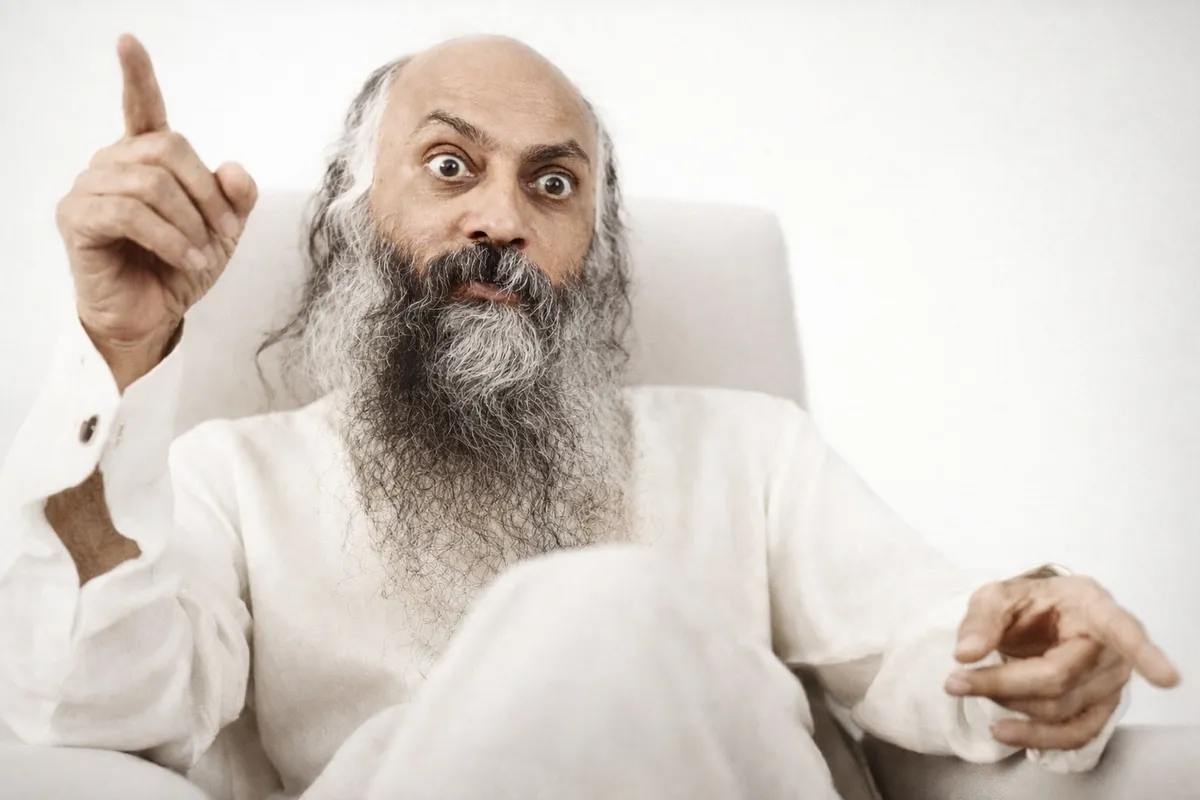
Osho's original Hindi beside Osho Live's English translation, matched passage by passage.
अब हम सूत्र लें।
Now, let us take up the sutra.
और जो न कभी हर्षित होता है, न द्वेष करता है; न सोच-चिंता करता है, न कामना करता है तथा जो शुभ और अशुभ संपूर्ण कर्मों के फल का त्यागी है, वह भक्तियुक्त पुरुष मेरे को प्रिय है। और जो पुरुष शत्रु और मित्र में तथा मान और अपमान में सम है तथा सर्दी-गर्मी और सुख-दुखादिक द्वंद्वों में सम है और सब संसार में आसक्ति से रहित है, वह मुझको प्रिय है।
“He who neither ever rejoices nor hates; who neither worries nor desires; who has renounced the fruits of all auspicious and inauspicious actions—that devotee is dear to me. And he who is the same toward enemy and friend, in honor and dishonor, the same in heat and cold and in the pairs of opposites like pleasure and pain, and who is unattached to the whole world—he is dear to me.”
जो न कभी हर्षित होता है, न द्वेष करता है; न सोच करता है, न कामना करता है; जो शुभ-अशुभ संपूर्ण कर्मों के फल का त्यागी है, वह भक्तियुक्त पुरुष मेरे को प्रिय है।
“He who neither ever rejoices nor hates; who neither worries nor desires; who has renounced the fruits of all auspicious and inauspicious actions—that devotee is dear to me.”
क्या है इसका अर्थ? आप सोचकर थोड़े हैरान होंगे कि जो न कभी हर्षित होता है, न द्वेष करता है। क्या प्रसन्न होना भी बाधा है? क्या हर्षित होना भी बाधा है? कृष्ण के वचन से लगता है। थोड़ा इसके मनोविज्ञान में प्रवेश करना पड़े।
What does this mean? You may wonder: “He who is never elated”—is even joy a hindrance? Is rejoicing a barrier? Krishna’s words seem to suggest so. We need to enter the psychology of it a little.
आप हंसते क्यों हैं? कभी आपने सोचा? क्या आप इसलिए हंसते हैं कि आप प्रसन्न हैं? या आप इसलिए हंसते हैं कि आप दुखी हैं?
Why do you laugh? Have you ever asked yourself? Do you laugh because you are happy—or because you are unhappy?
उलटा लगेगा, लेकिन आप हंसते इसलिए हैं, क्योंकि आप दुखी हैं। दुख के कारण आप हंसते हैं। हंसना आपका दुख भुलाने का उपाय है। हंसना एंटीडोट है, उससे दुख विस्मृत होता है। आप दूसरे पहलू पर घूम जाते हैं। आपके भीतर बड़ा तनाव है। हंस लेते हैं, वह तनाव बिखर जाता है और निकल जाता है।
It will sound the reverse—but you laugh because you are unhappy. Laughter is because of sorrow. You laugh to forget sorrow. Laughter is an antidote; it makes grief slip from memory. You switch to the other side. Inside you there is great tension; you laugh, the tension scatters and dissipates.
इसलिए आप यह मत समझना कि बहुत हंसने वाले लोग, बहुत प्रसन्न लोग हैं। संभावना उलटी है। संभावना यह है कि वे भीतर बहुत दुखी हैं।
So don’t assume that those who laugh much are very happy people. Likely the opposite: they are deeply unhappy inside.
नीत्शे ने कहाहै कि मैं हंसता रहता हूं। लोग मुझसे पूछते हैं कि क्यों हंसते रहते हो, तो मैं छिपा जाता हूं। क्योंकि बात बड़ी उलटी है। मैं इसलिए हंसता रहता हूं कि कहीं रोने न लगूं। अगर न हंसूं, तो रोने लगूंगा। वे आंसू न दिख जाएं किसी को, वह दीनता न प्रकट हो जाए, तो मैं हंसता रहता हूं। मेरी हंसी एक आवरण है, जिसमें मैं दुख को छिपाए हुए हूं।
Nietzsche said, “I keep laughing. People ask me why, and I evade them—because the truth is reversed. I laugh so that I don’t start crying. If I stop laughing, I will cry. So that no one sees my tears, so that my helplessness is not exposed, I keep laughing. My laughter is a veil in which I hide my sorrow.”
दुखी लोग अक्सर हंसते रहते हैं। कुछ भी मजाक खोज लेंगे, कुछ बात खोज लेंगे और हंस लेंगे। हंसने से थोड़ा हलकापन आ जाता है। लेकिन अगर कोई आदमी भीतर से बिलकुल दुखी न रहा हो, तो फिर हर्षित होने की यह व्यवस्था तो टूट जाएगी। जब भीतर से दुख ही चला गया हो, तो यह जो हंसी थी, यह जो हर्षित होना था, यह तो समाप्त हो जाएगा, यह तो नहीं बचेगा।
The unhappy often laugh a lot. They’ll find some joke, some excuse—and laugh. Laughter brings a little lightness. But if a person ceases to be unhappy within, then this arrangement of “cheering up” breaks down. When sorrow has vanished from within, then this laughter, this being “elated,” ends; it does not survive.
इसका यह मतलब नहीं है कि वह अप्रसन्न रहेगा। पर उसकी प्रसन्नता का गुण और होगा। उसकी प्रसन्नता किसी दुख का विरोध न होगी। उसकी प्रसन्नता किसी दुख में आधारित न होगी। उसकी प्रसन्नता सहज होगी, अकारण होगी।
This does not mean he will be gloomy. But the quality of his joy will be different. His joy will not be the opposite of sorrow; it will not be based upon sorrow. His joy will be natural, causeless.
आपकी प्रसन्नता सकारण होती है। भीतर तो दुख रहता है, फिर कोई कारण उपस्थित हो जाता है, तो आप थोड़ा हंस लेते हैं। लेकिन उसकी प्रसन्नता अकारण होगी। वह हंसेगा नहीं। अगर इसे हम ऐसा कहें कि वह हंसता हुआ ही रहेगा, तो शायद बात समझ में आ जाए। वह हंसेगा नहीं, वह हंसता हुआ ही रहेगा। उसे पता ही नहीं चलेगा कि वह कब हर्षित हो रहा है। क्योंकि वह कभी दुखी नहीं होता। इसलिए भेद उसे पता भी नहीं रहेगा।
Your joy is with a cause. Sorrow sits inside; then some cause appears and you brighten a little. His joy will be causeless. He will not laugh; rather, he will be laughter. If we put it this way—he will be in a laughing state—it may make sense. He will not laugh; he will be laughter. He will not even know when he is being “elated,” because he never turns sorrowful; there is no contrast to make him notice.
कृष्ण का चेहरा ऐसा नहीं लगता कि वे उदास हों। उनकी बांसुरी बजती ही रहती है। लेकिन हमारे जैसा हर्ष नहीं है। हमारा हर्ष रुग्ण है। हम हंसते भी हैं, तो वह रोग से भरा हुआ है, पैथालाजिकल है। उसके भीतर दुख छिपा हुआ है, हिंसा छिपी हुई है, तनाव छिपे हुए हैं। वे उसमें प्रकट होते हैं।
Krishna’s face never looks gloomy. His flute is always playing. But his joy is not like ours. Our joy is sickly; even our laughter is pathological—filled with sorrow within, with violence and tension concealed in it that come out through it.
कृष्ण का हंसना एक सहज आनंद का भाव है। उसे हम ऐसा समझें कि सुबह जब सूरज नहीं निकला होता है, रात चली गई होती है और सूरज अभी नहीं निकला होता है, तो जो प्रकाश होता है। आलोक, सुबह के भोर का आलोक। ठंडा, कोई तेजी नहीं है। अंधेरे के विपरीत भी नहीं है, अभी प्रकाश भी नहीं है। अभी बीच में संध्या में है। कृष्ण जैसे लोग, बुद्ध जैसे लोगों की प्रसन्नता आलोक जैसी है। दुख नहीं है; सुख नहीं है; दोनों के बीच में संध्या है।
Krishna’s laughter is the fragrance of a natural bliss. Think of that light before sunrise—night has gone, the sun not yet risen—the first soft glow of dawn: cool, with no glare, not even in opposition to darkness; twilight between the two. The joy of Krishnas and Buddhas is like that dawn-glow: no sorrow, no “pleasure”—twilight between both.
तो कृष्ण कहते हैं, जो न कभी हर्षित होता है.।
So Krishna says, “He who never rejoices...”
कभी! कभी तो वही हर्षित होगा, जो बीच-बीच में दुखी हो, नहीं तो कभी का कोई मतलब नहीं है।
“Never”! Only one who is sometimes sad can be sometimes elated; otherwise “never” has no meaning.
जो न कभी हर्षित होता है, न द्वेष करता है.।
“He who neither ever rejoices nor hates...”
क्योंकि सब दुखों का कारण द्वेष है। और जो द्वेष करता है, वह दुखी होगा।
Because the root of all sorrow is hatred. One who hates will be unhappy.
आपको पता है, आपके दुख का कारण आपके दुख कम और दूसरों के सुख ज्यादा हैं! आपका मकान हो सकता है काफी हो आपके लिए, लेकिन पड़ोस में एक बड़ा मकान बन गया, अब दुख शुरू हो गया।
You know it—your sorrows are less from your own grief and more from others’ happiness! Your house may be enough for you; let the neighbor build a bigger one—and your misery begins.
एक मित्र के घर मैं रुकता था। बड़े प्रसन्न थे वे। और जब जाता था, तो अपना घर दिखाते थे। स्विमिंग पूल दिखाते थे; बगीचा दिखाते थे। बहुत अच्छा, प्यारा घर था। बड़ा बगीचा था। सब शानदार था। खूब संगमरमर लगाया था। जब मैं उनके घर जाता था, तो घर में रहना मुश्किल था; घर की बातें ही सुननी पड़ती थीं, घर के बाबत ही, कि यह बनाया, यह बनाया। मुझे सुबह से वही देखना पड़ता था। जब भी गया, यही था। वे कुछ न कुछ बनाए जाते थे।
I used to stay with a friend who was very pleased with his home. Whenever I visited, he proudly showed it: the swimming pool, the garden. It was a lovely house, a large garden, lots of marble—everything splendid. When I went there, it was hard to sit and talk; I had to listen to house-talk all day: this was made, and that was done. Every visit was the same; he was always building something.
फिर एक बार गया। उन्होंने घर की बात न चलाई। तो मैं थोड़ा परेशान हुआ। क्योंकि वे बिलकुल पागल थे। वे घर के पीछे दीवाने थे। जैसे घर बनाने को ही जमीन पर आए थे। उसके सिवाय उनके सपने में भी कुछ नहीं था।
Then once I went, and he said nothing about the house. I was puzzled. He had been mad about it—like he had come to earth only to build this house, with nothing else in his dream.
उनकी पत्नी भी परेशान थी। वह भी मुझसे बोली थी कि हम तो सोचे थे कि यह घर मेरे लिए बना रहे हैं, घरवाली के लिए बना रहे हैं। अब तो ऐसा लगता है कि घरवाली को घर के लिए लाए हैं! कि घर खाली-खाली न लगे, इसलिए शादी की है, ऐसा मालूम पड़ता है। पहले तो मैं यह सोचती थी, उनकी पत्नी ने मुझे कहा, कि मुझसे शादी की, इसलिए घर बना रहे हैं। अब लगता है, यह खयाल मेरा गलत था।
Even his wife was distressed. She told me, “I thought he was building this house for me—for the homemaker. Now it seems he brought a wife for the house—so the house won’t feel empty! I used to think he married me and therefore is building; now I feel I was wrong.”
लेकिन जब मैंने पाया कि अब वे चुप हैं, घर के बाबत कुछ नहीं कहते, तो मैंने उनसे दोपहर पूछा कि बात क्या है? बड़ी बेचैनी-सी लगती है घर में। आप घर के संबंध में चुप क्यों हैं? उन्होंने कहा, देखते नहीं कि पड़ोस में एक बड़ा घर बन गया है! अब क्या खाक बात करें इसकी! अब रुको। दो-चार साल बाद करेंगे। जब तक इससे ऊंचा न कर लूं.।
When I found him silent about the house, I asked at noon, “What’s the matter? There’s a strange gloom. Why no mention of the house?” He said, “Don’t you see? Next door they’ve built a bigger one! What’s left to say about mine? Wait. In two or four years we’ll talk—once I’ve raised this higher than that...”
दुखी हैं, उदास हैं। घर उनका वही का वही है। लेकिन पड़ोस में एक बड़ा घर बन गया है। बड़ी लकीर खींच दी किसी ने। उनकी लकीर छोटी हो गई है!
He was miserable, depressed. His house was unchanged. But a longer line got drawn next door; his line became shorter.
आपके अधिक दुख आपके दुख नहीं हैं, आपके अधिक दुख दूसरों के सुख हैं। और इससे उलटी बात भी आप समझ लेना। आपके अधिक सुख भी आपके सुख नहीं हैं, दूसरे लोगों के दुख हैं।
Your greater miseries aren’t your own; they are others’ happiness. And the converse is also true: your greater pleasures aren’t yours; they are others’ sorrows.
जब आप किसी का मकान छोटा कर लेते हैं, तब सुखी होते हैं। आपको अपने मकान से सुख नहीं मिलता। और जब कोई आपका मकान छोटा कर देता है, तो दुखी होते हैं। आपको अपने मकान से न दुख मिलता है, न सुख। दूसरों के मकान! द्वेष, ईर्ष्या.।
You feel happy when you make someone else’s house look smaller. Your own house gives you no joy. And when someone makes your house look small, you are miserable. Your house gives you neither joy nor sorrow; it’s others’ houses! Envy, jealousy...
कृष्ण कहते हैं, न जो द्वेष करता है, न हर्षित होता है, न चिंता करता है.।
Krishna says: he who neither hates nor rejoices, who does not worry...
चिंता क्या है? क्या है चिंता हमारे भीतर? जो हो चुका है, उसको जुगाली करते रहते हैं। आदमी की खोपड़ी को खोलें, तो वह जुगाली कर रहा है। सालों पुरानी बातें जुगाली कर रहा है, कि कभी ऐसा हुआ, कभी वैसा हुआ।
What is worry? What is this churn within? We endlessly ruminate on what has happened. If you opened a man’s skull, you’d find a ruminant—chewing years-old cud: this happened, that happened.
जो अब नहीं है, उसको आप क्यों ढो रहे हैं? या भविष्य की फिक्र कर रहा है, जो अभी है नहीं। या तो अतीत की फिक्र कर रहा है, जो जा चुका। या भविष्य की फिक्र कर रहा है, जो अभी आया नहीं। और जो अभी, यहीं है, वर्तमान, उसे खो रहा है इस चिंता में। और परमात्मा अभी है, यहां। और आप या तो अतीत में हैं या भविष्य में। यह चिंता प्राण ले लेती है। यही चुका देती है।
Why carry what is no more? Or we fret about a future that isn’t yet. Either the past that has gone, or the future that has not come—and in this worrying we lose the present. God is now, here. And you are in the past or future. This worry bleeds life out; it exhausts you.
तो कृष्ण कहते हैं, जो चिंता नहीं करता.। चिंता का मतलब यह कि जो शांत है; यहीं है; न अतीत में उलझा है, न भविष्य में। वर्तमान के क्षण में जो है, निश्चिंत, चिंतनशून्य, विचारमुक्त।
So Krishna says: one who does not worry—meaning, one who is quiet, here, neither entangled in past nor future—who abides in the present moment, untroubled, thought-free, beyond thought.
वर्तमान में कोई विचार नहीं है। सब विचार अतीत के हैं या भविष्य के हैं। और भविष्य कुछ भी नहीं है, अतीत का ही प्रक्षेपण है। और हम इसी में डूबे हुए हैं। या तो आप पीछे की तरफ चले गए हैं या आगे की तरफ। यहां! यहां आप बिलकुल नहीं हैं। और यहीं है परमात्मा, इसलिए आपका मिलन नहीं हो पाता।
In the present there are no thoughts. All thoughts are of past or future. And the future is nothing but the projection of the past. Yet we drown in these—backward or forward. But here? Here you are not at all. And here is God. Hence no meeting.
कृष्ण कहते हैं, न जो चिंता करता है, न कामना करता है, और शुभ-अशुभ कर्मों के फल का त्यागी है। और जिसने सब शुभ-अशुभ कर्म परमात्मा पर छोड़ दिए कि तू करवाता है। वह भक्तियुक्त पुरुष मुझे प्रिय है।
Krishna says: one who does not worry, who does not desire, who has renounced the fruits of all auspicious and inauspicious actions—who has left all doership to God: “You are the doer.” Such a devotee is dear to me.
जो पुरुष शत्रु और मित्र में, मान-अपमान में सम है, सर्दी-गर्मी में, सुख-दुख में सम है, आसक्ति से रहित है, वह पुरुष मुझे प्रिय है।
He who is the same toward enemy and friend, in honor and dishonor, in heat and cold, in pleasure and pain—unattached—is dear to me.
जो सम है, जो डोलता नहीं है एक से दूसरे पर। हम निरंतर डोलते हैं। जिसको आप प्रेम करते हैं, उसी को घृणा भी करते हैं। सुबह प्रेम करते हैं, सांझ घृणा करते हैं। जिसको आप सुंदर मानते हैं, उसी को कुरूप भी मानते हैं। सांझ सुंदर मानते हैं, सुबह कुरूप मान लेते हैं। जो अच्छा लगता है, वही आपको बुरा भी लगता है। और चौबीस घंटे आप इसी में डोलते रहते हैं द्वंद्व में, घड़ी के पेंडुलम की तरह, बाएं से दाएं, दाएं से बाएं। यह जो डोलता हुआ मन है, विषम, यह मन उपलब्ध नहीं हो पाता अस्तित्व की गहराई को।
One who is even, who does not swing from one extreme to the other. We swing constantly. The one you love, you also hate. In the morning you love; by evening you hate. The one you find beautiful, you also find ugly—beautiful at dusk, ugly at dawn. What you like you also dislike; you swing round the clock, like a pendulum—left to right, right to left. This wavering, uneven mind cannot fathom the depths of existence.
कृष्ण कहते हैं, जो सम है। सुख आ जाए, तो भी विचलित नहीं होता। दुख आ जाए, तो भी विचलित नहीं होता।
Krishna says: one who is even. If happiness comes, he is unshaken; if sorrow comes, unshaken.
आप सब हालत में विचलित होते हैं। दुख में तो विचलित होते ही हैं, लाटरी मिल जाए, तो भी हार्ट अटैक होता है। तो भी गए!
You are shaken in every condition. In sorrow you are shaken—and if you win a lottery, you may die of a heart attack!
मैंने सुना है कि चर्च का एक पादरी बड़ी मुश्किल में पड़ गया था। एक आदमी को लाटरी मिली लाख रुपए की। उसकी पत्नी को खबर आई। पति तो बाहर गया था। पत्नी घबड़ा गई। घबड़ा गई यह सोचकर कि जैसे ही पति को पता लगेगा कि लाख रुपए की लाटरी मिली है, उनके हृदय के बचने का उपाय नहीं है। वह जानती थी अपने पति को कि एक रुपया मिल जाए, तो वे दीवाने हो जाते हैं। लाख रुपया! पागल हो जाएंगे या मर जाएंगे।
I have heard: a church priest once got into trouble. A man had won a lakh-rupee lottery. His wife heard the news while the husband was out. She panicked: as soon as he hears about a lakh, his heart won’t stand it. She knew him—if he gets a rupee he goes wild; a lakh—he’ll go mad or die.
तो उसने सोचा कि कुछ जल्दी उपाय करना चाहिए, इसके पहले कि वे घर आएं। तो उसे खयाल आया कि पड़ोस में चर्च का पादरी है; होशियार, बुद्धिमान पुरोहित है। उसको जाकर कहे कि कुछ कर दो। कुछ ऐसा इंतजाम जमाओ।
तो चर्च के पादरी को उसने जाकर बताया कि लाख रुपए की लाटरी मिल गई है मेरे पति के नाम। और अब वे आते ही होंगे बाजार से। आप घर चलें मेरे। और जरा इस ढंग से उनको समझाएं, इस ढंग से बात को प्रकट करें कि उनको कोई सदमा न पहुंच जाए सुख का। और वे बच जाएं; कोई नुकसान न हो।
She thought, “I must do something before he gets home.” The priest next door was clever, wise. She went to him: “My husband has won a lakh-rupee lottery. He’ll be home soon. Please come over and break it to him in such a way that he doesn’t suffer the shock of happiness.”
तो पादरी ने पूछा कि तू मुझे क्या देगी? तो उसने कहा, पांच हजार आप ले लेना। पादरी ने कहा, क्या कहा? पांच हजार! उसको हार्ट अटैक हो गया। वह वहीं गिर पड़ा। सच, पांच हजार! वह पहली दुर्घटना चर्च के पादरी के साथ हो गई।
The priest asked, “What will you give me?” She said, “Take five thousand.” He exclaimed, “What did you say—five thousand!” He had a heart attack and fell right there. The first casualty was the priest.
आदमी, सुख हो या दुख, जब भी कुछ तीव्र होता है, तो विचलित हो जाता है। सम का अर्थ है, जो विचलित नहीं होता। जो भी आता है, उसे ले लेता है; कि ठीक है, आया, चला जाएगा। सुबह आई, सांझ आई, अंधेरा आया, प्रकाश आया, सुख-दुख आया, मित्र-शत्रु--ले लेता है चुपचाप और अलिप्त दूर खड़ा देखता रहता है।
Human beings are shaken by the intense—whether pleasure or pain. Equanimity means not being shaken. Whatever comes, he receives it: “All right—come, and go.” Morning comes, evening comes, darkness, light, pleasure, pain, friend, foe—he accepts them quietly and stands apart, aloof, watching.
ऐसा व्यक्ति, कृष्ण कहते हैं, मुझे प्रिय है।
Such a person, Krishna says, is dear to me.
दो-तीन बातें कल के संबंध में। कल वे ही मित्र यहां आएं, जो सच में ही भक्ति के इस भाव में उतरना चाहते हों, क्योंकि कल प्रयोग का दिन होगा। गीता का एक सूत्र बचा है, वह मैं परसों लूंगा। कल कोई गीता का सूत्र नहीं लूंगा। कल बात नहीं होगी, कुछ कृत्य होगा।
A few announcements for tomorrow. Only those friends should come who truly want to enter into this mood of devotion, because tomorrow will be for experiment. One sutra of the Gita remains; I will take it the day after tomorrow. Tomorrow there will be no Gita sutra. Tomorrow there will be no talk—something will be done.
इतने दिन जिन्होंने सुना है, अगर उन्हें लगता हो कि कुछ करने जैसा भी है, सिर्फ सुनने जैसा नहीं है, केवल वे ही लोग आएं। जिनको सुनना है, वे परसों आएं, कल उनके लिए छुट्टी है। जिन्हें कुछ करना है, कल वे ही लोग आएं।
Those who have listened these days—if you feel there is something to do, not only to hear—only those should come. Those who only want to hear can come the day after; tomorrow is their holiday. Those who want to do, come tomorrow.
इसे जरा ईमानदारी से खयाल रख लेना, क्योंकि यहां कोई रुकावट नहीं लगाई जा सकती। अगर आपको नहीं करना है, तो भी आप आ गए, तो कोई रुकावट नहीं लग सकती। लेकिन वह आपकी बेईमानी होगी। आप मत आएं। आते हों, तो करने का तय करके आएं कि यहां कुछ प्रयोग होगा, उसमें सम्मिलित होना है। पहली बात।
Please keep this in honesty, because we cannot put up barriers here. If you don’t want to do and still come, we cannot stop you—but that will be your dishonesty. Don’t come. If you do, come resolved to participate in the experiment. That is the first point.
दूसरी बात, जो लोग यहां आने वाले हैं, वे एक फूल अपने साथ, कोई भी फूल ले आएं। और पूरे रास्ते एक ही बात मन में पुनरुक्त करते रहें बार-बार जप की तरह, कि यह फूल मेरा अहंकार है, यह फूल मेरी अस्मिता है, यही मेरी ईगो है। उस फूल में अपने सारे अहंकार को समाविष्ट कर दें।
Second, those who are coming should bring a flower—any flower. And on the way keep repeating one thought like a mantra: “This flower is my ego; this flower is my ‘I-ness’; this is my ego.” Pour your entire ego into the flower.
एक ही भाव आंख खोलकर भी करें, फूल को देखें; आंख बंद करके भी करें। फूल को सूंघें और समझें कि यह मेरा अहंकार है, जिसको मैं सूंघ रहा हूं। छुएं, और समझें कि यह मेरा अहंकार है, जिसको मैं छू रहा हूं। देखें, और समझें कि यह मेरा अहंकार है, जिसको मैं देख रहा हूं।
With eyes open, with eyes closed—keep only this feeling. Smell the flower and feel, “This is my ego I am smelling.” Touch it and feel, “This is my ego I am touching.” Look at it and feel, “This is my ego I am seeing.”
घर से आते वक्त, पूरे रास्ते फूल में ही अपने ध्यान को रखें और अपने अहंकार को पूरा प्रोजेक्ट कर दें। फूल में डुबा दें अपने अहंकार को।
From home to here, keep your attention on the flower and project your ego wholly into it. Immerse your ego into the flower.
जैसे-जैसे आपका अहंकार फूल में प्रवेश करने लगेगा, आपको फूल भारी मालूम पड़ने लगेगा। अगर आपने ठीक से प्रयोग किया, तो आपको फूल का भारीपन स्पष्ट अनुभव होगा। न केवल फूल भारी होने लगेगा, जैसे-जैसे आपका अहंकार प्रवेश करेगा, फूल कुम्हलाने और मुरझाने लगेगा।
As your ego enters the flower, the flower will begin to feel heavy. If you do the experiment rightly, you will clearly feel the flower’s weight. Not only that—as your ego enters, the flower will start to droop and wither.
पूरे प्राणों से अपने को उंडेल दें, कि सारा अहंकार मेरा इस फूल में समा जाए। यह भावना करते और सब विचार छोड़कर.। कोई विचार बीच में आ जाए, जैसे ही खयाल आए, छोड़कर वापस इसी विचार में लग जाएं कि यह फूल मेरा अहंकार है। आप अगर अपने अहंकार को इस फूल में समाविष्ट कर लाए, तो यहां परिणाम हो सकेगा।
Pour yourself into it with your whole life-breath, “Let my entire ego enter this flower.” Keep only this feeling; drop all other thoughts. If any thought intrudes, the moment you notice, drop it and return to, “This flower is my ego.” If you bring your ego contained in the flower, results will be possible here.
आपको फूल लाकर यहां चुपचाप बैठ जाना है। और कल आप यहां आकर बिलकुल बातचीत न करें। बिलकुल जबान बंद कर लें। क्योंकि आपकी बातचीत आपके प्रयोग में बाधा बनेगी। जैसे ही प्रवेश करें ग्राउंड पर, चुपचाप अपनी जगह जाकर बैठ जाएं। फूल को दोनों हाथों के बीच में ले लें और एक ही भाव करते रहें आंख बंद करके, कि इस फूल में मेरा सारा अहंकार प्रवेश कर रहा है। जब तक मैं न आ जाऊं, आपको यह प्रयोग करते रहना है। फिर आने के बाद मैं आपको कहूंगा कि अब क्या आगे करें।
Bring the flower and sit quietly. And tomorrow, once you arrive, do not converse at all. Close your tongue entirely. Your talking will disturb your experiment. The moment you enter the ground, go silently to your place. Hold the flower between both hands and keep only one feeling, eyes closed: “Into this flower my whole ego is entering.” Keep doing this until I come. Once I arrive, I will tell you what to do next.
एक घंटे का हम प्रयोग करेंगे। यह प्रयोग सामूहिक शक्तिपात का प्रयोग है। अगर आप अपने अहंकार को छोड़ने को राजी हो गए, अगर आपने अपने अहंकार को फूल में समाविष्ट कर लिया, तो मैं आऊंगा और कहूंगा कि इस फूल को अब फेंक दें। मैं जब तक न कहूं, तब तक आपको रखे बैठे रहना है। उस फूल के गिराते ही आपको लगेगा कि जैसे सिर से पूरा बोझ, एक भार, एक पहाड़ हट गया। और उसके हटने के बाद एक काम हो सकेगा।
We will do a one-hour experiment. It is an experiment in collective shaktipat. If you agree to drop your ego, if you have contained it in the flower, I will come and say, “Now throw the flower away.” Until I say so, keep holding it. As the flower drops, you will feel as if a load has been lifted from your head—a weight, a mountain. And once that is gone, another work will be possible.
बीस मिनट तक पहले चरण में, यहां कुछ संगीत चलता रहेगा और मैं आपकी तरफ देखता रहूंगा। उन बीस मिनट में आपको एकटक मेरी ओर देखते रहना है। चाहे पलक से आंसू बहने लगें, आपको पलक नहीं झपनी है। बीस मिनट आपको एकटक मेरी ओर देखना है। सारी दुनिया मिट गई; मैं हूं और आप हैं। बस, हम दो बचे हैं।
For the first twenty minutes, there will be music here, and I will keep looking at you. During those twenty minutes you must gaze at me without blinking. Even if tears flow, do not blink. For twenty minutes gaze steadily. The whole world is gone; there is only you and me. Just the two of us remain.
अगर आपको यह खयाल में आ गया कि हम दो बचे हैं--मैं और आप--तो मैं आप पर काम करना शुरू कर दूंगा। और जो आप वर्षों में अकेले नहीं कर सकते, वह क्षणों में हो सकता है।
If this feeling comes—just the two of us remain, you and I—I will begin to work upon you. And what you cannot do alone in years can happen in moments.
लेकिन हिम्मत की जरूरत है कि आप बीस मिनट आंख एकटक मेरी ओर देखते रहें। और आपको किसी को भी नहीं देखना है। यहां इतने लोग हैं, आपको मतलब नहीं। आपको मुझे देखना है। आपके पड़ोस में कोई चीखने-चिल्लाने लगे, रोने लगे, कुछ करने लगे, आपको आंख नहीं फेरनी है। आपको मेरी तरफ देखना है।
But courage is needed to keep your eyes fixed on me for twenty minutes. Look at no one else. There will be many people here—no concern of yours. Look at me. If your neighbor begins to cry or scream or do something, do not turn your eyes. Look at me.
यह प्रयोग गुरु-गंभीर है। और इसको अगर आप थोड़ी समझपूर्वक करेंगे, तो बड़े अनुभव को उतर जाएंगे।
This experiment is grave and profound. If you do it with a little understanding, you will enter great experience.
बीस मिनट आपको मेरी तरफ देखते रहना है। और जो कुछ आपके भीतर हो, उसे होने देना है। कोई चीखने लगेगा, कोई चिल्लाने लगेगा, कोई रोने लगेगा। किसी ने रोना रोक रखा है सालों से, जन्मों से; घाव भरे हैं, वे बहने लगेंगे। कोई खिलखिला कर हंसने लगेगा। कोई पागल जैसा व्यवहार करने लगेगा। उसकी फिक्र न करें। और आपके भीतर भी कुछ होना चाहे, तो उसे रोकें मत। यह साहस हो, तो ही आना।
For twenty minutes look at me. Whatever arises within, let it arise. Someone will scream, someone will cry. Someone has held his tears back for years, lifetimes—old wounds will start to flow. Someone will burst out laughing. Someone will behave like a madman. Don’t bother. And if something wants to happen within you, don’t stop it. Come only if you have this courage.
पागल होने की हिम्मत हो, तो ही आना। अपने को रोक लिया, तो आपका आना व्यर्थ हुआ और आपके कारण आस-पास की हवा भी व्यर्थ होगी। आप मत आना। आपकी कोई जरूरत नहीं है।
Come only if you have the courage to go mad. If you hold yourself back, your coming is pointless—and because of you the atmosphere around you will also be wasted. Don’t come. There is no need.
बीस मिनट आपकी सारी बीमारी, सारी विक्षिप्तता को मैं खींचने की कोशिश करूंगा आपकी आंखों के जरिए। अगर आपने मेरे साथ सहयोग किया, तो आपके न मालूम कितने मानसिक तनाव, बीमारी, चिंता गिर जाएगी। आप एकदम हलके हो जाएंगे।
For twenty minutes I will try, through your eyes, to draw out your diseases, your disorders. If you cooperate, untold mental tensions, illnesses, worries will drop. You will become suddenly light.
फिर बीस मिनट मौन रहेगा। उस मौन में फिर पत्थर की तरह होकर बैठ जाना है। आंख बंद और शरीर मुर्दे की तरह छोड़ देना है।
Then twenty minutes of silence. In that silence, sit like a stone. Eyes closed, body left like a corpse.
फिर बीस मिनट, आखिरी चरण में, आपको अभिव्यक्ति का मौका होगा कि इस बीस मिनट के मौन में आपको जो आनंद उपलब्ध हुआ हो--और गहन आनंद उपलब्ध होगा--और जो शांति आपने जानी हो, अपरिचित, कभी न जानी, वह आपके भीतर झरने की तरह बहने लगेगी, उसको अभिव्यक्ति देने के लिए बीस मिनट होंगे।
Then for the last twenty minutes you will have a chance to express what arose in that twenty minutes of silence—the joy that will have descended—deep, unfamiliar peace will begin to flow within like a spring. You will have twenty minutes to give it expression.
कोई खुशी से नाचेगा, कोई गीत गाएगा, कोई कीर्तन करेगा। लेकिन आपको दूसरे पर ध्यान नहीं देना है। आपको अपने भीतर का ही भाव देखना है, कि अगर मुझे नाचना है, तो नाच लूं; शांत बैठना है, शांत बैठा रहूं; गाना है, तो गा लूं। और किसी की चिंता न करूं।
Someone will dance with joy, someone will sing, someone will chant. But do not attend to others. Attend to your own inner feeling: if you feel to dance, dance; if to sit quietly, sit; if to sing, sing. Pay no mind to anyone.
एक घंटे अगर आप मेरे साथ सहयोग करते हैं, तो मैं आपके भीतर प्रवेश कर सकता हूं। और आपके भीतर से बहुत कुछ बदला जा सकता है।
If for one hour you cooperate with me, I can enter within you. Much can be transformed inside you.
और यह प्रयोग इसलिए है कि आपको एक झलक मिल जाए। क्योंकि हम उसकी खोज भी कैसे करें, जिसकी हमें झलक ही न हो? जिस परमात्मा का हमें जरा-सा भी स्वाद नहीं है, हम उसकी खोज पर भी कैसे निकलें? थोड़ी-सी झलक हो, थोड़ा-सा उसका स्वर सुनाई पड़ जाए, थोड़े-से उसके आनंद का झरना फूट पड़े, थोड़ा-सा उसका प्रकाश दिखाई पड़ जाए, तो फिर हम भी दौड़ पड़ेंगे। फिर हमारे पैरों का सारा आलस्य मिट जाएगा। और फिर हमारे प्राणों की सारी सुस्ती दूर हो जाएगी। लेकिन एक झलक मिल जाए! जरा-सी झलक! फिर हम उसकी खोज कर लेंगे जन्मों-जन्मों में। फिर वह हमसे बच नहीं सकता। फिर वह कहीं भी हो, हम उसका पता लगा लेंगे।
The purpose is to give you a glimpse. How will we even seek that for which we have no taste at all? If we have never tasted a drop of God, how will we set out in search? If a little glimpse comes; a faint note is heard; a little spring of bliss breaks forth; a little light appears—then we, too, will start running. Sloth will drop from our feet; dullness will leave our life-breath. But a glimpse—just a glimpse! Then we will search for lifetimes. He cannot escape us then. Wherever he is, we will find his trail.
मैंने सुना है कि एक गांव से जिप्सियों का एक समूह निकलता था। और गांव के एक बच्चे को, जो चर्च के पादरी का बच्चा था, उन्होंने चुरा लिया। उसे उन्होंने अपनी बैलगाड़ी में अंदर बंद करके डाल दिया है और उनका समूह आगे बढ़ने लगा।
I have heard: a caravan of gypsies left a village, and they stole a child—the priest’s little boy. They locked him inside their wagon and moved on.
जिप्सी अक्सर बच्चे चुरा लेते हैं। वह छोटा बच्चा था। उसकी कुछ समझ में न आ रहा था कि क्या हो रहा है। लेकिन गाड़ी में पड़े हुए उसका ध्यान तो अपने गांव की तरफ लगा था, कि गांव दूर होता जा रहा है!
Gypsies often steal children. The child was too small to understand what was happening. Lying in the wagon, his attention was toward the village, which was receding.
सांझ का वक्त था और चर्च की घंटियां बज रही थीं। वह घंटी को सुनता रहा। जैसे-जैसे गाड़ी दूर होती गई, घंटी की आवाज धीमी होती गई। लेकिन वह और गौर से सुनता रहा। क्योंकि शायद यह आखिरी बार होगा। अब दोबारा यह मौका आए न आए। वह अपने गांव की आवाज सुन सकेगा या नहीं! और इस गांव की एक ही याददाश्त, यह बजती हुई घंटी का धीमा होते जाना, धीमा होते जाना.।
It was evening; the church bells were ringing. He listened. As the wagon went farther, the bell grew fainter. He listened even more intently—perhaps this would be the last time; who knows if he would ever hear it again? The only memory of his village—the fading sound of that bell...
और वह इतने गौर से सुनने लगा कि राह पर चलती हुई गाड़ियों की आवाज, घोड़ों की आवाज, जिप्सियों की बातचीत, सब उसे भूल गई। सिर्फ उसे घंटी की आवाज सुनाई पड़ती रही। बड़े दूर तक सन्नाटे में वह सुनता रहा।
He listened so intently that the clatter of wheels, the horses’ hooves, the gypsies’ talk—all faded. Only the bell could be heard. He listened far into the hush.
फिर वर्षों बीत गए। बड़ा हो गया। उसके गांव की उसे सिर्फ एक ही याद रह गई, वह घंटी की आवाज। अपने बाप का नाम उसे याद न रहा; अपने गांव का नाम याद न रहा; अपने गांव की शक्ल याद न रही। उसका चर्च, उसका घर, कैसा था, वह सब विस्मृत हो गया। वह बहुत छोटा बच्चा था। लेकिन एक बात चित्त में कहीं गहरे उतर गई, वह घंटी की आवाज।
Years passed. He grew up. Only one memory of his village remained—the bell’s sound. He could not recall his father’s name, nor the village’s name, nor its look. The church, the house—everything had been forgotten; he had been so small. But one thing had sunk deep—the bell’s sound.
अब घंटी की आवाज से क्या होगा? कैसे वापस खोजे? जवान होकर वह भाग खड़ा हुआ। जिप्सियों को उसने छोड़ दिया। और वह हर गांव के आस-पास सांझ को जाकर खड़ा हो जाता था, जिस भी गांव के पास होता, और घंटी की आवाज सुनता था।
What use is a bell’s sound? How to find the way back? As a young man he ran away from the gypsies. Each evening, wherever he was, he stood near some village and listened for bells.
कहते हैं कि पांच साल की निरंतर खोज के बाद आखिर एक दिन एक गांव के पास उसे चर्च की घंटी पहचान में आ गई। यह वही घंटी थी। फिर चर्च से दूर जाकर भी उसने देख लिया। जैसे-जैसे दूर गया, घंटी वैसी ही धीमी होती गई, जैसी पहली बार हुई थी।
They say that after five years of searching, one evening he recognized a bell. “This is the one.” He went away from the church and checked—yes, the farther he went, the fainter it became—just as it had that first time.
फिर वह भागा हुआ चर्च में पहुंच गया। एक स्वर मिल गया। वह चर्च भी पहचान गया। वह पिता के चरणों में गिर पड़ा। पिता बूढ़ा था और मरने के करीब था। और पिता नहीं पहचान पाया। और उसने अपने बेटे से पूछा कि तूने कैसे पहचाना? तू कैसे पहचाना? तू कैसे वापस आया? मैं तक तुझे भूल गया हूं! तो उसने कहा, एक आवाज, इस चर्च की घंटी की आवाज मेरे साथ थी।
He ran to the church. The sound matched. He recognized the church. He fell at his father’s feet. The father was old, near death. He could not recognize his son. He asked, “How did you recognize? How did you find your way back? I had even forgotten you.” The son said, “A sound—the bell of this church—stayed with me.”
कल के इस प्रयोग में अगर आपको थोड़ी-सी भी आवाज परमात्मा की सुनाई पड़ जाए, तो वह आपके साथ रहेगी। और जन्मों-जन्मों में कहीं भी वह आवाज सुनाई पड़ जाए, आप समझेंगे कि परमात्मा का मंदिर निकट है, खोज हो सकती है।
If in tomorrow’s experiment even a faint note of the divine is heard, it will stay with you. And across lifetimes, wherever that note is heard, you will know the temple is near—search is possible.
लेकिन कल केवल वे ही लोग आएं, जो प्रयोग करने की तैयारी रखते हों। बाकी--ईमानदारी से--कोई व्यक्ति न आए।
But tomorrow only those should come who are prepared to do the experiment. The rest—honestly—should not come.
अब हम कीर्तन करें। पांच मिनट बैठे रहें अपनी जगह पर। उठें न। कीर्तन के बाद जाएं।
Now let us do kirtan. Sit in your places for five minutes. Do not get up. Leave after the kirtan.
भक्ति का मार्ग स्त्री का मार्ग है। लेकिन इसका यह अर्थ नहीं कि पुरुष उस मार्ग पर नहीं जा सकते हैं। लेकिन पुरुष को भी जाना हो, तो उसके मन में परमात्मा के प्रति प्रेयसी वाली भावदशा चाहिए। भक्ति के मार्ग पर पुरुष भी स्त्री होकर ही प्रवेश करता है। इसे थोड़ा गहराई में समझ लेना जरूरी है।
The path of devotion is the path of the feminine. But this does not mean that men cannot walk upon it. If a man would go, he too needs within him the feeling-tone of being the Beloved of God. On the path of devotion even a man enters as a woman. This must be understood a little more deeply.
पहली बात तो यह समझ लेनी जरूरी है कि न तो कोई स्त्री पूरी स्त्री है और न कोई पुरुष पूरा पुरुष। दोनों दोनों में मौजूद हैं। होंगे ही। उसके कारण हैं। क्योंकि चाहे आप पुरुष हों और चाहे स्त्री, आपकी बनावट स्त्री और पुरुष दोनों से हुई है। आप अकेले नहीं हो सकते हैं। न तो पुरुष के बिना आप हो सकते हैं और न स्त्री के बिना आप हो सकते हैं। दोनों का दान है आप में। आप दोनों का मिलन हैं। दोनों आपके भीतर मौजूद हैं। आपकी मां भी मौजूद है, आपके पिता भी।
First, understand that no woman is wholly woman and no man is wholly man. Both are present in both. They must be; there are reasons for this. Whether you are male or female, your very making is of both woman and man. You cannot be alone. You cannot be without man, you cannot be without woman. Both have given to you; you are the meeting of both. Both are within you. Your mother is present in you, your father too.
आप स्त्री और पुरुष दोनों हैं एक साथ। फिर अंतर क्या है? अंतर केवल अनुपात का है। जो पुरुष है, वह साठ प्रतिशत पुरुष है, चालीस प्रतिशत स्त्री है। जो स्त्री है, वह साठ प्रतिशत स्त्री है, चालीस प्रतिशत पुरुष है। यह अनुपात का भेद होगा। लेकिन आप पुरुष हैं, तो आपके भीतर छिपी हुई स्त्री है। और आप स्त्री हैं, तो आपके भीतर छिपा हुआ पुरुष है।
You are both woman and man at once. Then what is the difference? Only a difference of proportion. The man is sixty percent male, forty percent female. The woman is sixty percent female, forty percent male. It is a matter of ratio. But if you are a man, a hidden woman is within you; and if you are a woman, a hidden man is within you.
इस सदी के बहुत बड़े विचारक, बड़े मनोवैज्ञानिक कार्ल गुस्ताव जुंग ने पश्चिम में इस विचार को पहली दफा स्थापित किया। पूरब में तो यह विचार बहुत पुराना है। हमने अर्धनारीश्वर की मूर्ति बनाई, जिसमें शंकर आधे स्त्री हैं और आधे पुरुष हैं। वह हजारों साल पुरानी हमारी धारणा है। और वह धारणा सच है। लेकिन जुंग ने पहली दफा पश्चिम में इस सदी में इस विचार को बल दिया कि कोई पुरुष पुरुष नहीं, कोई स्त्री स्त्री नहीं, दोनों दोनों हैं।
In the West, the great psychologist of this century, Carl Gustav Jung, established this insight for the first time. In the East it is very ancient. We created the image of Ardhanarishvara—Shiva half woman, half man. That is a conception thousands of years old, and it is true. Jung, in this century, gave it force in the West: no man is only man, no woman only woman—both are both.
इसके बहुत गहरे अर्थ हैं। इसका अर्थ यह हुआ कि अगर आप पुरुष हैं, तो आपको स्त्री के प्रति जो आकर्षण मालूम होता है, वह आकर्षण आपके भीतर छिपी हुई स्त्री के लिए है। और इसलिए इस दुनिया में किसी भी स्त्री से आप तृप्त न हो पाएंगे। क्योंकि जब तक आपको अपने भीतर की स्त्री से मिलना न हो जाए, तब तक कोई तृप्ति उपलब्ध नहीं हो सकती।
This has deep implications. It means that if you are a man, the attraction you feel toward a woman is actually for the woman hidden within you. Therefore no woman in the world will ever fully satisfy you. Until you meet the woman within, no satisfaction is possible.
और स्त्री हैं अगर आप, तो पुरुष का जो आकर्षण है, और पुरुष की जो तलाश है, वह कोई भी पुरुष आपको संतुष्ट न कर पाएगा। सभी पुरुष असफल हो जाएंगे। क्योंकि जब तक आपके भीतर छिपे पुरुष से आपका मिलन न हो जाए, तब तक वह खोज जारी रहेगी।
And if you are a woman, the attraction and search for man—no man will satisfy you. All men will fail. Until you meet the man hidden within you, the search will continue.
असल में हर आदमी अपने भीतर छिपी हुई स्त्री या पुरुष को बाहर खोज रहा है। कभी-कभी किसी-किसी में उसकी झलक मिलती है, तो आप प्रेम में पड़ जाते हैं। प्रेम का एक ही अर्थ है कि आपके भीतर जो स्त्री छिपी है, उसकी झलक अगर आपको किसी स्त्री में मिल जाती है, तो आप प्रेम में पड़ जाते हैं।
In truth, each person is seeking outside the woman or man hidden inside. Sometimes you catch a glimpse of it in someone, and you fall in love. Love means only this: when a man glimpses in some woman the reflection of the woman hidden within, he falls in love.
इसलिए जब आप प्रेम में पड़ते हैं, तो न तो कोई तर्क होता है, न कोई कारण होता है। आप कहते हैं, बस, मैं प्रेम में पड़ गया। आप कहते हैं, मेरे वश में नहीं है यह बात। आपके भीतर की स्त्री से जब भी बाहर की किसी स्त्री का कोई भी तालमेल हो जाता है।
Hence when you fall in love there is no logic, no reason. You say, “I just fell in love. It was not in my control.” Whenever some resonance occurs between your inner woman and an outer woman...
लेकिन यह तालमेल ज्यादा देर नहीं चल सकता। क्योंकि यह तालमेल पूरा कभी भी नहीं हो सकता। आपके भीतर जैसी स्त्री पृथ्वी पर कहीं है ही नहीं। वह आपके भीतर ही छिपी है। आपके भीतर जैसा पुरुष पृथ्वी पर कहीं है नहीं। किसी में भनक मिल सकती है थोड़ी। लेकिन जैसे ही आप निकट आएंगे, भनक टूटने लगेगी। जितना निकट आएंगे, उतना ही डिसइलूजनमेंट, उतना ही भ्रम टूट जाएगा।
But that resonance cannot last long, because it can never be complete. The kind of woman within you does not exist anywhere on earth; she is only within. The kind of man within you exists nowhere on earth. You may catch a hint in someone, but as you come closer, the hint breaks. The closer you come, the more the disillusionment.
इसलिए धन्यभागी वे प्रेमी हैं, जो अपनी प्रेयसियों से कभी नहीं मिल पाते हैं, क्योंकि उनका भ्रम बना रहता है। अभागे वे प्रेमी हैं, जिनको उनकी प्रेयसियां मिल जाती हैं, क्योंकि भ्रम टूट जाता है। मिली हुई प्रेयसी ज्यादा देर तक प्रिय नहीं रह जाती। मिला हुआ प्रेमी ज्यादा देर तक प्रिय नहीं रह जाता। क्योंकि भ्रम टूटेगा ही। तालमेल थोड़ा-बहुत हो सकता है। वह भी आभास है।
Blessed are the lovers who never meet their beloveds, for their illusion remains intact. Unfortunate are those who meet, for the illusion breaks. A found beloved does not remain beloved for long; a found lover does not remain beloved for long. The illusion must break. Some small compatibility is possible, but it is only an appearance.
जुंग कहता है कि जब तक भीतर आपकी स्त्री और आपके पुरुष का अंतर-मिलन न हो जाए, तब तक आप अतृप्त रहेंगे और तब तक कामवासना आपको पकड़े रहेगी।
Jung says: until the inner woman and inner man meet, you will remain unfulfilled, and lust will keep its hold on you.
इसको हमने युगनद्ध कहा है। तंत्र की भाषा में भीतर जब स्त्री और पुरुष का मिलन हो जाता है, उसे हमने युगनद्ध कहा है। वह जो मिलन है, उस मिलन के साथ ही आप अद्वैत हो जाते हैं; एक हो जाते हैं; दो नहीं रह जाते। और वह जो एक की घटना भीतर घटती है, वही परमात्मा का मिलन है।
In tantra this inner confluence has been called yuganaddha. When the inner woman and man unite, it is called yuganaddha. With that union, you become nondual; you become one, no longer two. That event of oneness within is the union with the Divine.
अभी आप दो हैं। इसका मनोवैज्ञानिक यह पहलू भी समझ लेना जरूरी है कि जो आप ऊपर होते हैं, उससे विपरीत आप भीतर होते हैं। ऊपर पुरुष, तो भीतर स्त्री। ऊपर स्त्री, तो भीतर पुरुष।
Right now you are two. Another psychological point: outwardly you are the opposite of what you are within. Outwardly male, inwardly female; outwardly female, inwardly male.
एक और मजेदार घटना मनोवैज्ञानिकों के खयाल में आती है और वह यह कि जैसे-जैसे उम्र बढ़ती है, आप में विपरीत लक्षण प्रकट होने लगते हैं। जैसे स्त्रियां पचास के करीब पहुंच-पहुंचकर पुरुष जैसी होने लगती हैं। अनेक स्त्रियों को मूंछ के बाल, दाढ़ी के बाल उगने शुरू हो जाते हैं। उनकी आवाज पुरुषों जैसी भर्राई हुई हो जाती है। उनके गुण पुरुषों जैसे हो जाते हैं। उनका शरीर भी धीरे-धीरे पुरुषों के करीब पहुंचने लगता है।
Another striking observation of psychologists is that as age advances, the opposite traits begin to emerge. Women, approaching fifty, begin to appear more masculine. Many grow mustache or beard hairs, the voice becomes huskier, qualities become more man-like, even the body moves toward a masculine shape.
पचास के बाद पुरुषों में स्त्रैणता आनी शुरू हो जाती है। उनमें गुण स्त्रियों जैसे होने शुरू हो जाते हैं।
After fifty, men begin to show femininity; feminine traits start appearing.
मनोवैज्ञानिक कहते हैं, इसका अर्थ यह है कि जो आपके ऊपर-ऊपर था, जिंदगीभर आपने उसका उपयोग करके चुका लिया। और जो भीतर दबा था, वह बिना चुका रह गया। इसलिए आप ऊपर से कमजोर हो गए हैं और भीतर की बात प्रकट होनी शुरू हो गई है।
Psychologists say: what was on the surface you have spent through a lifetime of use, and what was repressed within remained unspent. The surface weakens, and the inner begins to show itself.
एक स्त्री पचास साल तक स्त्री के तल पर चुक जाती है, समाप्त हो जाती है। उसने उपयोग कर लिया स्त्री-ऊर्जा का और भीतर का पुरुष बिना उपयोग किया हुआ पड़ा है। और जब ऊपर की स्त्री कमजोर हो जाती है, तो भीतर का पुरुष धक्के मारने लगता है और प्रकट होने लगता है।
A woman exhausts her feminine energy by fifty; she has used it. The inner man remains unused. As the outer feminine weakens, the inner man pushes and starts to manifest.
पुरुष चुक जाता है पचास साल में अपने पौरुष से। और भीतर की स्त्री अनचुकी, ताजी बनी रहती है। वह प्रकट होनी शुरू हो जाती है।
A man exhausts his masculinity by fifty; the inner woman, untouched and fresh, begins to appear.
यह जो पचास साल की उम्र के बाद अंतर पड़ता है, यह बड़ा जटिल है। और इसके कारण हजारों कठिनाइयां पैदा होती हैं। क्योंकि जिंदगीभर आप पुरुष रहे, तो आपने पुरुष के गुणों की तरह अपने को सजाया, संवारा, सुशिक्षित किया। और अचानक आपके भीतर फर्क होता है, नई दुनिया शुरू होती है। उसकी कोई ट्रेनिंग नहीं, उसका कोई प्रशिक्षण नहीं।
This shift after fifty is complex, and it creates a thousand difficulties. You lived as a man, so you trained, groomed, educated yourself in masculine traits—and suddenly something changes within, a new world begins for which you have no training.
जुंग ने सलाह दी है कि पैंतालीस साल के स्त्री-पुरुषों को हमें फिर से स्कूल भेजना चाहिए, क्योंकि उनके भीतर एक क्रांतिकारी फर्क हो रहा है, जिसकी उनके पास कोई तैयारी नहीं है। और जिसकी उनके पास तैयारी है, वह व्यर्थ हो रहा है और एक नई घटना घट रही है। और जब तक हम इस बात को पूरा न कर पाएं, जुंग कहता है, लोग ज्यादा मात्रा में विक्षिप्त होते रहेंगे।
Jung advised that men and women around forty-five should be sent back to school, because a revolutionary inner change is happening for which they are unprepared, while what they are prepared for is becoming useless, and a new event is unfolding. Until we address this, Jung says, more and more people will go neurotic.
पैंतालीस साल की उम्र खतरनाक उम्र है। उसके बाद सारी मानसिक बीमारियां शुरू होती हैं। लेकिन पैंतालीस साल की उम्र ही धार्मिक होने की उम्र भी है।
Forty-five is a dangerous age; most mental illnesses begin after that. But forty-five is also the age to become religious.
और जुंग ने कहा है कि मेरे पास जितने मरीज आते हैं मन के, उनमें अधिक की उम्र पैंतालीस के ऊपर है या पैंतालीस के करीब है। और उनमें अधिक की बीमारी यही है कि उनके जीवन में धर्म नहीं है। अगर धर्म होता, तो वे पागल न होते।
Jung said: most of the patients who come to me are around or above forty-five, and most suffer because there is no religion in their life. If there were religion, they would not go mad.
यह जो कृष्ण अर्जुन को कह रहे हैं, भक्ति का जो मार्ग, इसमें वे स्त्रैण गुणों की चर्चा कर रहे हैं। और अर्जुन जैसा पुरुष खोजना मुश्किल है। यह विरोधाभासी लगता है। अर्जुन है क्षत्रिय; पुरुषों में पुरुष। हजारों-हजारों साल में वैसा पुरुष होता है। उससे यह स्त्रैण गुणों की बात! निश्चित ही प्रश्न उठाती है।
Now, here Krishna is speaking to Arjuna of the path of devotion, and he enumerates feminine qualities. Yet a man like Arjuna is hard to find: a Kshatriya, a man among men; such a man appears once in thousands of years. To speak to him of feminine qualities seems paradoxical. It certainly raises a question.
लेकिन अगर मेरी बात आपके खयाल में आ गई, तो उसका मतलब यह है कि अर्जुन का पुरुष तो चुक ही जाने को है। और जीवन के अंतिम हिस्से में जब अर्जुन का पुरुष चुक जाएगा, तब उसकी स्त्री प्रकट होनी शुरू होगी। वह जो विपरीत दबा पड़ा है, वह बाहर आएगा। और उस विपरीत से ही धर्म का मार्ग बनेगा। एक।
But if you understand what I am saying, it means Arjuna’s masculinity is nearing its exhaustion. In the latter part of life, as his masculinity wanes, his inner woman will begin to manifest. From that opposite, the path of religion will open. One.
दूसरी बात यह भी खयाल में ले लेनी जरूरी है कि स्त्रैण होने का आध्यात्मिक अर्थ होता है, ग्राहक होना, रिसेप्टिव होना। पुरुष है आक्रामक, एग्रेसिव, हमलावर। बायोलाजिकली भी, जैविक व्यवस्था में भी पुरुष हमलावर है। स्त्री ग्राहक है। स्त्री गर्भ है। वह स्वीकार करती है, समा लेती है, आत्मसात कर लेती है। हमला नहीं करती है।
Second, in spiritual terms, the feminine means receptivity. The masculine is aggressive, attacking. Biologically too, the male is the aggressor; the female is receptive. The woman is a womb; she accepts, contains, assimilates; she does not attack.
भक्ति का मार्ग ग्राहक, स्वीकार करने का मार्ग है। वह स्त्रैण है। वहां परमात्मा को अपने भीतर स्वीकार करना है। श्रद्धापूर्वक, नत होकर, सिर को झुकाकर उसे अपने भीतर झेल लेना है। भगवान के लिए गर्भ बन जाता है भक्त। वह पुरुष है या स्त्री, इससे कोई सवाल नहीं। लेकिन जो गर्भ नहीं बन सकता भगवान के लिए, वह भक्त नहीं बन सकता।
The path of devotion is the path of receptivity and acceptance. It is feminine. There one must welcome God within—reverently, bowed, surrendering the head, to bear Him within. The devotee becomes a womb for God. Whether the devotee is male or female is irrelevant. But one who cannot become a womb for God cannot be a bhakta.
आपको शायद सुनकर हैरानी हो या कभी आपको पता भी हो, एक ऐसा भी भक्तों का संप्रदाय हुआ है, जिनमें पुरुष भी स्त्रियों के कपड़े ही पहनते थे। अब भी बंगाल में उसकी थोड़ी-सी धारा शेष है। वे स्त्री जैसे ही रहते हैं भक्त। और परमात्मा को अपना पति स्वीकार करते हैं। रात सोते भी हैं, तो परमात्मा की मूर्ति साथ लेकर सोते हैं, जैसे कोई प्रेयसी अपने प्रेमी को साथ लेकर सो रही हो।
You may be surprised to hear, or perhaps you know, there was a sect of devotees whose men wore women’s clothes; a small stream of it still remains in Bengal. They live like women, and accept God as their husband. Even at night they sleep with the deity’s image beside them, as a beloved would sleep with her lover.
यह बात हमें बड़ी अजीब-सी लगेगी, क्योंकि हमें इसके भीतर के रहस्य का कोई पता नहीं है। और जिस बात के भीतर के रहस्य का हमें कोई पता न हो, बड़ी अड़चन होती है।
This may seem strange to us because we do not know the inner mystery at work. When we do not know the inner secret of something, it becomes a great obstacle.
राहुल सांकृत्यायन ने, एक बड़े पंडित ने बड़ा विरोध किया है इस बात का, कि यह क्या पागलपन है! ये पुरुष स्त्रियां बन जाएं, यह कैसी बेहूदगी है! यह कैसा नाटक है! और कोई भी ऊपर से देखेगा, तो ऐसा ही लगेगा।
Rahul Sankrityayan, a great scholar, strongly opposed this: What madness is this! Men becoming women—what nonsense, what drama! And to an outside eye it does seem so.
लेकिन राहुल सांकृत्यायन को कुछ भी पता नहीं है कि भीतर, भक्त के भीतर क्या घटित हो रहा है। यह जो उसका स्त्रैण रूप है ऊपर से, यह तो उसके भीतर की घटना की अभिव्यक्ति मात्र है। वह भीतर से भी स्त्रैण हो रहा है। और आप जानकर हैरान होंगे, कभी-कभी भक्त इस जगह पहुंच गए हैं, जब कि उनकी भाव की स्त्रैणता इतनी गहरी हो गई कि उनके शरीर के अंग तक स्त्रैण हो गए।
But Rahul Sankrityayan had no idea what was happening within the devotee. That outer feminization is only an expression of the inner event. He is becoming feminine inwardly too. And you will be amazed: sometimes devotees reached a state where their inner feminization was so deep that even bodily organs became feminine.
रामकृष्ण के जीवन में ऐसी घटना घटी। वह अनूठी है। क्योंकि रामकृष्ण एक बड़ा मूल्यवान प्रयोग किए। वह प्रयोग था कि उन्होंने एक मार्ग से तो परमात्मा को जाना। जानने के बाद दूसरे मार्गों से चलकर भी जानने की कोशिश की, कि दूसरे मार्गों से भी वहीं पहुंचा जा सकता है या नहीं! तो उन्होंने आठ-दस मार्गों का प्रयोग किया। उसमें एक यह भक्ति-मार्गियों का पंथ भी था, जिसमें स्त्री होकर ही साधना करनी है।
Such an event occurred in the life of Ramakrishna. It is unique. Ramakrishna conducted a most valuable experiment: having known God by one path, he tried others to see whether they also lead to the same. He experimented with eight or ten paths. One was a devotional sect where one must practice only as a woman.
तो रामकृष्ण छः महीने तक स्त्री के कपड़े ही पहनते थे। स्त्री जैसे ही उठते-बैठते थे। स्त्रैण भाव से ही जीते थे। और एक ही धारणा मन में थी कि मैं प्रेयसी हूं और परमात्मा प्रेमी है।
For six months Ramakrishna wore women’s clothes, moved like a woman, lived in a feminine mood, with the single conviction: I am the Beloved, and God is the Lover.
बड़ी हैरानी की घटना घटी, जो हजारों लोगों ने देखी है। वह यह कि रामकृष्ण की चाल थोड़े दिन में बदल गई। वे स्त्रियों जैसे चलने लगे।
A startling thing happened, witnessed by thousands. His gait changed; he began to walk like a woman.
बहुत कठिन है चलना स्त्रियों जैसा। क्योंकि स्त्री के शरीर का ढांचा अलग है, पुरुष के शरीर का ढांचा अलग है। चूंकि स्त्री के शरीर में गर्भ है, इसलिए बड़ी खाली जगह है। उस खाली जगह की वजह से उसके पैर और ढंग से घूमते हैं। पुरुष के पैर उस ढंग से नहीं घूम सकते।
It is very hard for a man to walk like a woman, because the body structures differ. The woman’s body is shaped for the womb; there is a spacious emptiness within, and because of it her legs swing differently. A man’s legs cannot move in that way.
लेकिन रामकृष्ण ऐसे चलने लगे, जैसे स्त्रियां चलती हैं। यह भी कुछ बड़ी बात न थी। इससे भी बड़ी घटना घटी कि दो महीने के बाद रामकृष्ण के स्तन बढ़ने लगे। यह भी कोई बहुत बड़ी बात नहीं थी, क्योंकि एक उम्र में पुरुषों के थोड़े स्तन तो बढ़ ही जाते हैं। जो सबसे बड़ी चमत्कारी घटना घटी, वह यह कि चार महीने के बाद रामकृष्ण को मासिक-धर्म शुरू हो गया। यह मनुष्य जाति के इतिहास में घटी थोड़ी-सी मूल्यवान घटनाओं में से एक है, कि भाव का इतना परिणाम शरीर पर हो सकता है!
Yet Ramakrishna began to walk like women. That alone is not much. A greater event: after two months his breasts began to grow. Even this is not extraordinary—men sometimes develop slight breasts with age. The most astonishing event: after four months Ramakrishna began to menstruate. Among the rare, valuable events in human history, this shows how profoundly feeling can affect the body.
इतने अंतःकरणपूर्वक उन्होंने मान लिया कि मैं तुम्हारी प्रेयसी हूं और तुम मेरे प्रेमी हो, यह भावना इतनी गहरी हो गई कि शरीर के रोएं-रोएं ने इसको स्वीकार कर लिया और शरीर स्त्रैण हो गया। साधना के छः महीने के बाद भी रामकृष्ण को छः महीने लग गए वापस ठीक से पुरुष होने में। ये सारे लक्षण विदा होने में फिर छः महीने और लगे।
So wholeheartedly did he accept, I am Your Beloved and You are my Lover, that every pore of his body consented, and the body became feminine. After those six months of practice, it took him another six months to become fully male again; the symptoms took that long to subside.
भक्त का अर्थ है, प्रेयसी का भाव। इसलिए कृष्ण जो भी गुण, लक्षण बता रहे हैं, वे सब स्त्रैण हैं।
A bhakta means one who has the feeling of the Beloved. Therefore whatever qualities Krishna lists are feminine.
क्या आपने कभी खयाल किया कि दुनिया के सभी धर्मों ने, चाहे वे भक्त-संप्रदाय हों या न हों, जिन गुणों को मूल्य दिया है, वे स्त्रैण हैं। चाहे महावीर उसको अहिंसा कहते हों। चाहे बुद्ध उसको करुणा कहते हों। चाहे जीसस उसको प्रेम कहते हों। ये सब स्त्रैण गुण हैं। स्त्री अगर पूरी तरह प्रकट हो, तो ये गुण उसमें होंगे।
Have you noticed that all religions—whether devotional or not—have valued qualities that are feminine? Whether Mahavira calls it nonviolence, Buddha calls it compassion, or Jesus calls it love—these are feminine qualities. When the feminine is fully manifest, these qualities are present.
इसलिए इस विचार के कारण जर्मनी के गहन विचारक फ्रेडरिक नीत्शे ने तो बुद्ध, क्राइस्ट, इन सबको स्त्रैण कहा है। और कहा है कि इन्हीं लोगों ने सारी दुनिया को बर्बाद कर दिया। क्योंकि ये जो बातें सिखा रहे हैं, वे लोगों को स्त्रैण बनाने वाली हैं।
For this reason the profound German thinker Friedrich Nietzsche called Buddha, Christ, and the like feminine—and said they ruined the world. Because what they teach makes people feminine.
नीत्शे ने तो विरोध में यह बात कही है कि मनुष्य जाति को स्त्रैण बना दिया, बुद्ध, क्राइस्ट, इस तरह के लोगों ने। क्योंकि जो शिक्षाएं दीं, उसमें पुरुष के गुणों का कोई मूल्य नहीं है। पौरुष का, तेज का, बल का, आक्रमण का, हिंसा का, संघर्ष का, युद्ध का कोई भाव नहीं है। तो इन्होंने स्त्रैण बना दिया जगत को।
Nietzsche argued that such teachings feminized humankind; they give no value to masculine traits—to manliness, fire, strength, aggression, violence, struggle, war. They have made the world womanly.
उसकी बात में थोड़ी दूर तक सच्चाई है। लेकिन वे लोग सच में ही स्त्रैण बनाने में सफल नहीं हो पाए। नहीं तो पृथ्वी स्वर्ग हो जाती है।
There is some truth in his words—but in fact they did not succeed in truly feminizing humanity; if they had, the earth would have become a paradise.
जीवन में जो भी मूल्यवान है, वह कहीं न कहीं मां से जुड़ा हुआ है। जीवन में जो भी मूल्यवान है, कीमती है, कोमल है, फूल की तरह है, वह कहीं न कहीं स्त्री से संबंधित है।
Whatever is truly valuable in life is somehow linked with the mother. Whatever is precious, tender, like a flower, is connected with the feminine.
और पुरुष तो एक बेचैनी है। स्त्री एक समता है। जरूरी नहीं; कि स्त्रियां ऐसा न सोच लें कि वे ऐसी हैं। यह तो स्त्री के परम अर्थ की बात है। परम लक्ष्य पर स्त्री अगर हो, तो ऐसा होगा। अभी तो अधिक स्त्रियां भी पुरुष जैसी हैं और वे पूरी कोशिश कर रही हैं कि पुरुष जैसी कैसे हो जाएं। पश्चिम में वे बड़ी लड़ाई लड़ रही हैं कि पुरुष के जैसी कैसे हो जाएं। कपड़े भी पुरुष जैसे पहनने हैं; काम भी पुरुष जैसा करना है; अधिकार भी पुरुष जैसे चाहिए। सब जो पुरुष कर रहे हैं!
Man is a restlessness; woman is an equilibrium. This need not be taken as a claim about all women as they are now; I speak of the ultimate meaning of Woman. At the ultimate fulfillment, a woman would be thus. As of now, most women are also like men, striving to become men. In the West, they are fighting hard to be like men—dress like men, do men’s jobs, demand men’s rights—whatever men do!
अगर पुरुष सिगरेट पी रहे हैं, तो स्त्रियां भी उसी तरह सिगरेट पीना चाहती हैं। क्योंकि यह असमानता खलती है, अखरती है।
If men smoke, women want to smoke as men do—because inequality hurts.
तो जो पुरुष कर रहा है, अगर वह गलत भी कर रहा है, तो स्त्री को भी वह करना ही चाहिए! सारी दुनिया में एक दौड़ है कि स्त्रियां भी पुरुष जैसी कैसे हो जाएं।
So whatever men do, even if it is wrong, women feel they must do it too. Across the world there is a race for women to become like men.
इसलिए स्त्रियां यह न सोचें कि जो मैं कह रहा हूं, वह उनके बाबत लागू है। वे सिर्फ यह सोचें कि अगर उनकी स्त्रैणता पूरे रूप में प्रकट हो, तो जो मैं कह रहा हूं, वह सही होगा।
Therefore women should not think I am speaking about them as they are; they should consider that if their femininity were to be fully manifest, what I say would be true.
स्त्री अगर पूरे रूप में प्रकट हो.। और स्त्री पूरे रूप में प्रकट हो सकती है। और जब पुरुष भी पूरे रूप में प्रकट होता है, तो स्त्री जैसा हो जाता है। इसके कारण बहुत हैं।
If woman is fully manifest—and she can be—and when man too becomes fully manifest, he becomes like a woman. There are many reasons.
पहले तो बायोलाजिकली समझने की कोशिश करें।
First, understand it biologically.
जीवशास्त्री कहते हैं कि स्त्री में संतुलन है, पुरुष में संतुलन नहीं है, शरीर के तल पर भी। जिन वीर्यकणों से मिलकर जीवन का जन्म होता है, रज और वीर्य के मिलन से जो व्यक्तित्व का निर्माण होता है, उसमें एक बात समझने जैसी है। पुरुष के वीर्यकण में दो तरह के वीर्यकण होते हैं। एक वीर्यकण होता है, जिसमें चौबीस सेल होते हैं, चौबीस कोष्ठ होते हैं। और एक वीर्यकण होता है, जिसमें तेईस कोष्ठ होते हैं। स्त्री के जो रजकण होते हैं, उन सबमें चौबीस कोष्ठ होते हैं। उनमें तेईस कोष्ठ वाला कोई रजकण नहीं होता। उनमें सबमें चौबीस कोष्ठ वाले रजकण होते हैं।
Biologists say the woman is balanced, the man is not—even at the bodily level. In the sperm from which life is born, and in the union of ovum and sperm from which personality is formed, there is something to note. In the male seed there are two kinds of sperm: one with twenty-four “compartments,” and one with twenty-three. The female ova all have twenty-four “compartments”; there is no ovum with twenty-three.
जब स्त्री का चौबीस कोष्ठ वाला रजकण, पुरुष के चौबीस कोष्ठ वाले वीर्यकण से मिलता है, तो स्त्री का जन्म होता है, चौबीस-चौबीस। और जब स्त्री का चौबीस कोष्ठ वाला रजकण, पुरुष के तेईस कोष्ठ वाले वीर्यकण से मिलता है, तब पुरुष का जन्म होता है, चौबीस-तेईस।
When a woman’s ovum with twenty-four meets a man’s sperm with twenty-four, a girl is born—twenty-four and twenty-four. When the ovum with twenty-four meets a sperm with twenty-three, a boy is born—twenty-four and twenty-three.
जीवशास्त्री कहते हैं कि स्त्री संतुलित है, उसके दोनों पलड़े बराबर हैं, चौबीस-चौबीस। और पुरुष में एक बेचैनी है, उसका एक पलड़ा थोड़ा नीचे झुका है, एक थोड़ा ऊपर उठा है।
Biologists say the woman is balanced—both pans of the scale equal, twenty-four and twenty-four. In man there is a restlessness—one pan dips, the other rises.
इसलिए अगर आप, छोटी बच्ची भी हो और छोटा लड़का हो, दोनों को देखें, तो लड़के में आपको बेचैनी दिखाई पड़ेगी। लड़की शांत दिखाई पड़ेगी। लड़का पैदा होते से ही थोड़ा उपद्रव शुरू करेगा। उपद्रव न करे, तो लोग कहेंगे कि लड़का थोड़ा स्त्रैण है, लड़कियों जैसा है। वह जो बेचैनी है, वह जो असंतुलन है, वह काम शुरू कर देगा।
So if you observe a little girl and a little boy, you will notice the boy’s restlessness; the girl appears calm. From birth the boy starts a little mischief. If he doesn’t, people say he is a bit effeminate, like a girl. That restlessness, that imbalance, begins to work.
इस बेचैनी की तकलीफें हैं, इसके फायदे भी हैं। समता का लाभ भी है, नुकसान भी है। दुनिया में कोई लाभ नहीं होता, जिसका नुकसान न हो। कोई नुकसान नहीं होता, जिसका लाभ न हो।
This restlessness has its troubles, and its advantages. Equilibrium has benefits, and drawbacks. In the world nothing has benefit without cost, nor cost without benefit.
पुरुष में जो बेचैनी है, उसी के कारण उसने इतने बड़े साम्राज्य बनाए। पुरुष में जो बेचैनी है, उसी के कारण उसने विज्ञान निर्मित किया, इतनी खोजें कीं। पुरुष में बेचैनी है, इसलिए वह एवरेस्ट पर चढ़ा और चांद पर पहुंचा।
Because of his restlessness, man built vast empires. Because of it he created science, made discoveries. Because of it he climbed Everest and reached the moon.
स्त्री में वह बेचैनी नहीं है, इसलिए स्त्रियों ने कोई खोज नहीं की, कोई आविष्कार नहीं किया। वह तृप्त है। वह अपने होने से पर्याप्त है। उसको कहीं कुछ जाना नहीं है। उसकी समझ के बाहर है कि एवरेस्ट पर चढ़ने की जरूरत क्या है!
Woman, lacking that restlessness, made no inventions. She is content; sufficient in her being. She has nowhere to go. To her it is incomprehensible why one must climb Everest.
हिलेरी से, जो आदमी एवरेस्ट पर पहली दफा चढ़ा, उससे उसकी पत्नी ने पूछा कि आखिर एवरेस्ट पर चढ़ने की जरूरत क्या है? बिलकुल समझ के बाहर है बात कि नाहक, सुख-शांति से घर में रह रहे हो, परेशान हो जाओ; मौत का खतरा लो। जरूरी नहीं कि पहुंचो। अनेक लोग मर चुके हैं। और पहुंचकर भी मिलेगा क्या? अगर पहुंच भी गए, तो फायदा क्या है? आखिर एवरेस्ट पर चढ़ने की जरूरत क्या है?
Hillary—the first to climb Everest—was asked by his wife, “What need is there to climb Everest? It’s beyond understanding: living peacefully at home, why invite trouble, risk death? You may not even make it—many have died. And even if you reach, what will you gain? Why climb Everest at all?”
तो पता है, हिलेरी ने क्या कहा? हिलेरी ने कहा, जब तक एवरेस्ट है, तब तक आदमी बेचैन रहेगा; चढ़ना ही पड़ेगा। यह कोई कारण नहीं है और। लेकिन एवरेस्ट का होना, कि अनचढ़ा एक पर्वत है, आदमी के लिए चुनौती है। क्योंकि एवरेस्ट है, इसलिए चढ़ना पड़ेगा। कोई और कारण नहीं है।
Do you know what Hillary said? “As long as Everest is there, man will be restless; one has to climb. There is no other reason. The very existence of an unconquered peak is a challenge to man. Because Everest is, we must climb. No other reason.”
पुरुष में एक बेचैनी है। इसलिए पुरुष युद्ध के लिए आतुर है; संघर्ष के लिए आतुर है। नए संघर्ष खोजता है; नए उपद्रव मोल लेता है। नई चुनौतियां स्वीकार करता है।
Man is restless. He longs for war and struggle, seeks new challenges, takes on new disturbances, accepts new trials.
चांद पर जाने की कोई जरूरत नहीं है। अभी तो कोई भी जरूरत नहीं थी। लेकिन चांद है, तो रुकना बहुत मुश्किल है। जिस वैज्ञानिक ने पहली दफा चांद की यात्रा का खयाल दिया, उसने लिखा है कि अब हमारे पास चांद तक पहुंचने के साधन हैं, तो हमें पहुंचना ही है। अब कोई और वजह की जरूरत नहीं है। अब हम पहुंच सकते हैं, तो हम पहुंचेंगे।
There was no need to go to the moon—none yet. But the moon is there; to stop is hard. The scientist who first proposed lunar travel wrote: “Now that we have the means to reach the moon, we must go. No further justification is needed. If we can, we will.”
तो फायदा है। फायदा है, संसार के तल पर पुरुष के गुणों का फायदा है। इसलिए स्त्रियां पिछड़ जाती हैं। संसार की दौड़ में वे कहीं भी टिक नहीं पातीं। लेकिन नुकसान भी उसका है! तो बेचैनी, अशांति, विक्षिप्तता, पागलपन, वह सब पुरुष का हिस्सा है। स्त्रियां शांत हैं।
इसे आप ऐसा समझें कि अगर बाहर के जगत में खोज करनी हो, तो पुरुष के गुण उपयोगी हैं। पुरुष बहिर्गामी है। अगर भीतर के जगत में जाना हो, तो स्त्री के गुण उपयोगी हैं। स्त्री अंतर्गामी है।
So there is an advantage: in the outer world, masculine traits are useful. Man is outward-bound. In the inner world, feminine traits are useful. Woman is inward-going.
स्त्री और पुरुष जब प्रेम भी करते हैं, तो पुरुष आंख खोलकर प्रेम करना पसंद करता है, स्त्री आंख बंद करके। पुरुष चाहता है कि प्रकाश जला रहे, जब वह प्रेम करे। स्त्रियां चाहती हैं, बिलकुल अंधेरा हो। पुरुष चाहता है कि वह देखे भी कि स्त्री के चेहरे पर क्या भाव आ रहे हैं, जब वह प्रेम कर रहा है। स्त्री बिलकुल आंख बंद कर लेती है। वह पुरुष को भूल जाना चाहती है। वह अपने भीतर डूबना चाहती है। प्रेम के गहरे क्षण में भी वह पुरुष को भूलकर अपने भीतर डूबना चाहती है। उसका जो रस है, वह भीतरी है।
Even in love: a man prefers to love with eyes open; a woman with eyes closed. A man wants the light on when he loves; women want complete darkness. The man wants to see the expressions on the woman’s face as he loves; the woman closes her eyes completely—she wants to forget the man, to drown within. In the deepest moments of love, she wants to forget the man and sink into herself. Her juice is inward.
पुरुष देखना चाहता है कि स्त्री प्रसन्न हो रही है, आनंदित हो रही है, तो वह प्रसन्न होता है। वह देखता है कि स्त्री दुखी हो रही है, परेशान हो रही है या उसके मन में कोई भाव नहीं उठ रहा है, तो उसका सारा सुख खो जाता है। पुरुष बहिर्दृष्टि है।
The man wants to see whether the woman is pleased, delighted; then he is pleased. If he sees she is unhappy, troubled, or unmoved, his pleasure evaporates. Man’s gaze is outward.
इसका मतलब यह हुआ कि अगर आपको भीतर की तरफ जाना है, तो आपके भीतर छिपी जो स्त्री है, उसके गुणों को आपको विकसित करना होगा। और अगर स्त्रियों को भी बाहर की तरफ जाना है, तो उनके भीतर छिपा हुआ जो पुरुष है, उनको उसे विकसित करना होगा।
This means that if you wish to go within, you must develop the qualities of the woman hidden in you. And if women wish to go outward, they must develop the man hidden in them.
बहिर्यात्रा पुरुष के सहारे हो सकती है, अंतर्यात्रा स्त्री के सहारे। इसलिए कृष्ण ने स्त्रैण गुणों को इतनी गहराई से कहा है।
The outer journey can be made with the support of the masculine; the inner journey with the support of the feminine. That is why Krishna speaks of feminine qualities with such depth.
पहले तो अनुभवियों से थोड़ा बचना, खुद के अनुभव का भरोसा करना।
First, keep a little distance from the “experienced ones,” and trust your own experience.
इसका यह मतलब नहीं है कि अनुभवियों ने जो कहा है, वह गलत कहा है। इसका कुल मतलब इतना है कि दूसरे के अनुभव को मानकर चलने से आप अनुभव से वंचित रह जाएंगे। और अगर अनुभव से वंचित रह गए, तो अनुभवियों ने जो कहा है, वह आपको कभी सत्य न हो पाएगा।
This does not mean that what the experienced have said is wrong. It only means that if you live by another’s experience, you will be deprived of your own. And if you are deprived of your own experience, what the experienced have said will never become true for you.
अनुभवियों ने जो कहा है, वह अनुभव से कहा है। दूसरे अनुभवियों को सुनकर नहीं कहा है। यह फर्क खयाल में रखना। उन्होंने यह नहीं कहा है कि अनुभवियों ने कहा है, इसलिए हम कहते हैं। उन्होंने कहा है कि हम अपने अनुभव से कहते हैं। तुम भी अगर सच में ही मुक्त होना चाहो, तो अपने अनुभव से ही।
Those who have spoken have spoken out of experience—not by listening to other experienced people. Keep this distinction in mind. They did not say, “Because the experienced have said it, we say it too.” They said, “We speak from our own experience.” If you truly want to be free, then you too must rely on your own experience.
और यह बात गलत है कि अनुभव से कामवासना बढ़ती है। कोई वासना दुनिया में अनुभव से नहीं बढ़ती। और अगर अनुभव से कामवासना बढ़ती है, तो फिर इस दुनिया में कोई भी आदमी उससे मुक्त नहीं हो सकता।
And it is untrue that lust grows through experience. No desire in this world grows by experience. If lust grew through experience, then no one could ever be free of it.
अनुभव से सभी चीजें क्षीण होती हैं। अनुभव से सभी चीजों में ऊब आ जाती है। एक ही भोजन कितना ही स्वादिष्ट हो, रोज-रोज करें, कितने दिन कर पाएंगे? थोड़े दिन में स्वाद खो जाएगा। फिर थोड़े दिन बाद बेस्वाद हो जाएगा। फिर कुछ दिन बाद आप भाग जाना चाहेंगे कि आत्महत्या कर लूंगा, अगर यही भोजन वापस मिला तो।
Everything becomes attenuated through experience. Everything becomes tiresome through experience. However delicious a dish may be, if you eat it every day, how many days will it last? In a few days the taste will be gone. Then it will turn insipid. After a while you will want to run away—you’ll feel you would rather die than have to eat the same dish again.
अनुभव से ऊब आती है। चित्त रस खो देता है। और अगर अनुभव से ऊब नहीं आती, तो समझना कि अनुभव आप ठीक से नहीं ले रहे हैं। इस बात को ठीक से समझ लेना।
Experience brings weariness. The mind loses its relish. And if weariness does not arise through experience, understand that you are not experiencing rightly. Understand this well.
और अनुभव आप ठीक से ले नहीं सकते, क्योंकि अनुभवियों ने जो कहा है, वह आपकी परेशानी किए दे रहा है। अनुभव के पहले आप छूटना चाहते हैं।
And you cannot experience rightly, because what the experienced have said is already troubling you. Even before the experience you are eager to be rid of it.
यह मित्र पूछते हैं कि कामवासना से कैसे पार जाया जाए?
This friend asks: How to go beyond lust?
पहले कामवासना में तो चले जाओ, तो पार भी चले जाना। पार जाने की जल्दी इतनी है कि उसमें भीतर जा ही नहीं पाते, उतर ही नहीं पाते।
First go into lust; then you can go beyond it. You are in such a hurry to go beyond that you never get inside; you never descend into it.
एक काम का गहन अनुभव भी पार ले जा सकता है। लेकिन वह कभी गहन हो नहीं पाता। यह पीछे से जान अटकी ही रहती है कि पार कब, कैसे हो जाएं। न पार हो पाते हैं, न अनुभव हो पाता है। और बीच में अटके रह जाते हैं।
One deep, total experience of sex can take you beyond. But it never becomes deep, because at the back of the mind a hook keeps tugging: “When, how will I go beyond?” You neither go beyond, nor do you experience. You remain stuck in between.
जब मैं आपसे कहता हूं कि अनुभव ही मुक्ति है, तो उसका अर्थ ठीक से समझ लें। क्योंकि जो चीज व्यर्थ है, वह अनुभव से दिखाई पड़ेगी कि व्यर्थ है। और किसी तरह दिखाई नहीं पड़ सकती।
When I say to you that experience itself is liberation, understand it rightly. That which is futile will be seen as futile only through experience—by no other means.
जब तक आपको अनुभव नहीं है, आप भला सोचें कि व्यर्थ है, लेकिन सोचने से क्या होगा! रस तो कायम है भीतर। और कितने ही अनुभवी कहते हों कि व्यर्थ है, उनके कहने से क्या व्यर्थ हो जाएगा! और अगर उनके कहने से होता होता, तो अब तक सारी दुनिया की कामवासना तिरोहित हो गई होती।
Without experience you may think it is futile, but what will thinking alone do? The taste still remains inside. However many experienced people may say it is futile, will their saying make it futile for you? And if words could do it, the world’s lust would have vanished by now.
बाप कितना नहीं समझाता है बेटे को। बेटा सुनता है? लेकिन बाप कहे चला जाता है। और बाप इसकी बिलकुल फिक्र नहीं करता कि वह भी बेटा था, और उसके बाप ने भी यही कहा था, और उसने भी नहीं सुना था। अगर वह ही सुन लेता, तो यह बेटा कहां से आता! और वह घबड़ाए न। यह बेटा भी बड़ा होकर अपने बेटे को यही शिक्षा देगा। इसमें कोई अंतर पड़ने वाला नहीं है।
How much does a father not explain to his son? Does the son listen? Yet the father goes on and on—and forgets that he too was a son once, and his father said the same to him, and he too did not listen. If he had listened then, where would this son have come from! There is no need to panic; this son, when he grows up, will say the same to his son. Nothing changes.
किसी का अनुभव काम नहीं पड़ता। बाप का अनुभव आपके काम नहीं पड़ सकता है। आपका अनुभव ही काम पड़ेगा।
Another’s experience does not work for you. Your father’s experience cannot become yours. Only your own experience will work.
बाप गलत कहता है, ऐसा मैं नहीं कह रहा हूं। बाप अपने अनुभव से कह रहा है कि यह सब पागलपन से वह गुजरा है। लेकिन पागलपन से गुजरकर कह रहा है वह। और बिना गुजरे वह भी नहीं कह सकता था। बिना गुजरे कोई भी नहीं कह सकता है। और बिना गुजरे कोई किसी की बात भी नहीं मान सकता है। अनुभव के अतिरिक्त इस जगत में कोई अनुभूति नहीं है। अनुभव से ही गुजरना होगा।
I am not saying the father is wrong. He speaks from his experience—he has passed through the madness. But he speaks after passing through it. Without passing through, even he could not have said it. Without passing through, no one can say it. And without passing through, no one can accept anyone’s saying either. In this world there is no realization other than through experience. You will have to pass through.
फिर घबड़ाहट भी क्या है इतनी? इतना पार होने की जल्दी भी क्या है? अगर परमात्मा एक अवसर देता है, उसका उपयोग क्यों न किया जाए? और उस उपयोग को पूरा क्यों न समझा जाए? जरूर निहित कोई प्रयोजन होगा। परमात्मा आपसे ज्यादा समझदार है। और अगर उसने आपमें कामवासना रची है, तो उसका कोई निहित प्रयोजन होगा।
Then why this fear? Why this hurry to go beyond? If the divine has given you an opportunity, why not use it? And why not understand that use fully? Surely there is some intrinsic purpose. The divine is more intelligent than you. If it has woven lust into you, there must be an inherent purpose.
महात्मा कितना ही कहते हों कि कामवासना बुरी है, लेकिन परमात्मा नहीं कहता कि कामवासना बुरी है। नहीं तो रचता नहीं। नहीं तो उसके होने की कोई जरूरत न थी। परमात्मा तो रचे जाता है, महात्माओं की वह सुनता नहीं!
However much saints may say lust is bad, the divine does not say so; otherwise it would not have created it. There would have been no need for it to exist. The divine goes on creating; it does not listen to the saints!
जरूर कोई निहित प्रयोजन है। और वह निहित प्रयोजन यह है कि ये महात्मा भी पैदा नहीं हो सकते थे, अगर कामवासना न होती। ये महात्मा भी उसी अनुभव से गुजरकर पार गए हैं। इन्होंने भी उसमें पड़कर जाना है कि व्यर्थ है। वह व्यर्थता का बोध बड़ा कीमती है। वह होगा ही तब, जब आपको अनुभव में आ जाए।
Surely there is an inherent purpose. And it is this: even these saints could not have been born without lust. They too went beyond only by passing through the experience. They too entered it and found it to be futile. That realization of futility is precious—and it comes only when it happens in your own experience.
तो जल्दी मत करना। उधार अनुभव का भरोसा मत करना। इसका यह मतलब नहीं है कि आप अनुभवियों को कहो कि तुम गलत हो। आपको इतना ही कहना चाहिए कि हमें अभी पता नहीं है। और हम उतरना चाहते हैं, और हम जानना चाहते हैं कि क्या है यह कामवासना। और हम इसे पूरा जान लेंगे। तो अगर यह गलत होगी, तो वह जानना मुक्ति ले आएगा। और अगर यह सही होगी, तो मुक्त होने की कोई जरूरत नहीं है।
So do not be in a hurry. Do not rely on borrowed experience. That does not mean you tell the experienced, “You are wrong.” You should simply say, “We do not yet know. We wish to enter and know for ourselves what this lust is. We will know it fully. If it turns out to be wrong, that very knowing will bring liberation. And if it turns out to be right, then there is no need for liberation.”
एक बात निश्चित है कि अब तक जिन्होंने भी ठीक से जान लिया, वे मुक्त हो गए हैं। और दूसरी बात भी निश्चित है कि जिन्होंने नहीं जाना, वे कितना ही सिर पीटें और अनुभवियों की बातें मानते रहें, वे कभी मुक्त नहीं हुए हैं, न हो सकते हैं।
One thing is certain: whoever has known rightly has become free. And another thing is also certain: those who have not known—no matter how much they bang their heads and believe the experienced—have never become free, nor can they.
इतनी घबड़ाहट क्या है? इतना डर क्या है? भीतर जो छिपा है, उसे पहचानना होगा। उपयोगी है कि उससे आप गुजरें।
Why so much panic? Why so much fear? What is hidden within must be recognized. It is useful to pass through it.
मैंने सुना है कि एक सम्राट ने अपने बेटे को एक फकीर के पास शिक्षा के लिए भेजा। हर माह खबर आती रही कि शिक्षा ठीक चल रही है। साल पूरा हो गया। और वह दिन भी आ गया, जिस दिन फकीर युवक को लेकर राजदरबार आएगा। और सम्राट बड़ा प्रसन्न था। उसने अपने सारे दरबारियों को बुलाया था कि आज मेरा बेटा उस महान फकीर के पास शिक्षित होकर वापस लौट रहा है।
I have heard: An emperor sent his son to a fakir for education. Each month news came that the education was proceeding well. A year passed, and the day arrived when the fakir would bring the young man to court. The emperor was overjoyed. He summoned all his courtiers: “Today my son returns, educated by that great fakir.”
लेकिन जब फकीर लड़के को लेकर दरवाजे पर राजमहल के पहुंचा, तो राजा की छाती बैठ गई। देखा कि फकीर ने अपना बोरिया-बिस्तर सब राजकुमार के सिर पर रखा हुआ है। और कपड़े उसे ऐसे पहना दिए हैं, जैसे कि कोई कुली कपड़े पहने हो।
But when the fakir arrived at the palace gate with the boy, the king’s heart sank. He saw the fakir had put his bedding and bundle on the prince’s head, and dressed him in the rags of a porter.
सम्राट तो बहुत क्रोध से भर गया। और उसने कहा कि मैंने शिक्षा देने भेजा था, मेरे लड़के का इस तरह अपमान करने नहीं! फकीर ने कहा कि अभी आखिरी सबक बाकी है। अभी बीच में कुछ मत बोलो। और अभी साल पूरा नहीं हुआ है, सूरज ढलने को शेष है। अभी लड़का मेरे जिम्मे है। तब उस फकीर ने अपने सामान में से एक कोड़ा निकाला। सब सामान लड़के से नीचे रखवाकर उसे सात कोड़े लगाए दरबार में।
The emperor was furious. “I sent him for education, not for this insult!” The fakir said, “The last lesson is still remaining. Do not interrupt. The year is not yet over; the sun has not set. The boy is still in my charge.” Then he took a whip from his bundle, made the boy put the load down, and gave him seven lashes in the court.
राजा तो चीख पड़ा, लेकिन अपने वचन से बंधा था कि एक साल के लिए दिया था। और सूरज अभी नहीं डूबा था। लेकिन उसने कहा कि कोई हर्ज नहीं, सूरज डूबेगा; और न तुझे फांसी लगवा दी--उस फकीर से कहा--सूरज डूबेगा; तू घबड़ा मत। कोई फिक्र नहीं; तू कर ले। एक साल का वायदा है।
The king screamed, but he was bound by his word: he had given the boy for a year, and the sun had not yet set. He muttered, “No matter, the sun will set; and I will have you hanged”—he said to the fakir—“when the sun sets, do not worry.” “Fulfill your year’s promise,” he said, “then I will deal with you.”
लेकिन और दरबारियों में बूढ़े समझदार लोग भी थे। उन्होंने राजा से कहा कि थोड़ा पूछो भी तो उससे कि वह क्या कर रहा है! आखिर उसका प्रयोजन क्या है?
Some old, wise courtiers were present. They said to the king, “At least ask him what he is doing! What is his purpose?”
तो किसी ने पूछा, तो फकीर ने कहा, मेरा प्रयोजन है। यह कल राजा बनेगा। और अनेक लोगों को कोड़े लगवाएगा। इसे कोड़े का अनुभव होना चाहिए। इसे पता होना चाहिए कि कोड़े का मतलब क्या है। कल यह राजा बनेगा और न मालूम कितने लोग इसका सामान ढोने में जिंदगी व्यतीत कर देंगे। इसको पता होना चाहिए कि जो आदमी सड़क पर सामान ढोकर आ रहा है, उसके भीतर की गति कैसी है। इसे राजा होने के पहले उन सब अनुभवों से गुजर जाना चाहिए, जो कि राजा होने के बाद इसको कभी न मिल सकेंगे। लेकिन अगर यह उनसे नहीं गुजरता है, तो यह हमेशा अप्रौढ़ रह जाएगा। तो मैंने सालभर में इसकी एक ही शिक्षा पूरी की है पूरे साल में, कि जो इसको राजा होने के बाद कभी भी न होगा, उस सब से मैंने इसे गुजार दिया है।
Someone asked, and the fakir said, “I have a purpose. This boy will be king tomorrow, and will have many people whipped. He must know what a lash means. He will be king, and countless people will spend their lives carrying his burdens. He must know the inner state of the man who trudges down the road with a load. Before he becomes king, he must pass through all those experiences which he will never have once he is king. If he does not pass through them, he will remain immature. In a whole year, I have given him but one education: I have made him pass through all that he would never encounter after becoming king.”
यह संसार एक विद्यापीठ है। और परमात्मा आपको बहुत-से अनुभव से गुजार रहा है। बहुत तरह की आगों में जला रहा है। वह जरूरी है। उससे निखरकर आप असली कुंदन, असली सोना बनेंगे। सब कचरा जल जाएगा।
This world is a university. And the divine is putting you through many experiences, burning you in many fires. It is necessary. By that, you are refined into true gold. All the dross is burnt away.
लेकिन आपकी हालत ऐसी है कि कचरे से भरा सोना हैं आप, और आग से गुजरकर जो उस तरफ चले गए हैं अनुभवी, उनकी बातें सुन रहे हैं। और वे कहते हैं कि यह आग है, इससे बचना। लेकिन इसी आग से गुजरकर वे शुद्ध हुए हैं। और अगर उनकी बात मानकर तुम इसी तरफ रुक गए, और तुमने कहा, यह आग है, इससे हम बचेंगे, तो ध्यान रखना कि वह कचरा भी बच जाएगा जो आग में जलता है।
But your condition is that you are gold mixed with dross, and you are listening to those experienced ones who have crossed the fire. They say, “It is fire; avoid it.” But by passing through that very fire they became pure. And if, taking their advice, you stop on this side and say, “It is fire; I will avoid it,” then remember: the dross that burns in fire will also be saved—saved in you.
आग से गुजरना। उन अनुभवियों से पूछना कि तुम यह आग से गुजरकर कह रहे हो कि बिना गुजरे! और अगर यह तुम गुजरकर कह रहे हो और मैंने बिना गुजरे यह बात मान ली, तो मैं डूब गया तुम्हारे साथ। उचित है; तुम्हारी बात मैं खयाल रखूंगा। लेकिन मुझे भी अनुभव से गुजर जाने दो। मेरे भी कचरे को जल जाने दो।
Pass through the fire. Ask those experienced ones, “Are you saying this after passing through the fire, or without passing? If you say it after passing through, and I accept it without passing through, I drown myself by borrowing your conclusion. Fair enough—your words I will keep in mind. But let me also pass through experience. Let my dross be burnt too.”
कामवासना आग है, लेकिन उसमें बहुत-सा कचरा जल जाता है। अगर आप बोधपूर्वक, समझपूर्वक, होशपूर्वक कामवासना में उतर पाएं, तो आपका सब कचरा जल जाता है, आप सोना बन जाते हैं। और वह जो सोना है, वही क्रांति है। वह जो सोने की उपलब्धि है, वही क्रांति है।
Lust is a fire, but much dross is burnt in it. If you can enter lust with awareness, with understanding, with consciousness, your dross is burnt away; you become gold. And that gold is revolution. That attainment of gold is revolution.
तो मैं आपसे कहना चाहता हूं, जो आपके अनुभव से आए, उसे आने देना। और जल्दी मत करना। उधार अनुभव मत ले लेना। उनसे ज्ञान तो बढ़ जाएगा, आत्मा नहीं बढ़ेगी। उनसे बुद्धि में विचार तो बहुत बढ़ जाएंगे, लेकिन आप वही के वही रह जाएंगे। आग से गुजरे बिना कोई उपाय नहीं है। सस्ते में कुछ भी मिलता नहीं है।
So I say to you: allow what comes through your own experience to come. Do not be in a hurry. Do not borrow experience. From others your information will increase, not your being. Your intellect will collect many ideas, but you will remain the same. There is no way without passing through the fire. Nothing comes cheap.
कामवासना एक पीड़ा है। उसमें सुख तो ऊपर-ऊपर है, भीतर दुख ही दुख है। बाहर-बाहर झलक तो बड़ी रंगीन है, बड़ी इंद्रधनुष जैसी है। लेकिन भीतर हाथ कुछ भी नहीं आता। सिर्फ उदासी, सिर्फ विषाद, सिर्फ आंसू हाथ लगते हैं। लेकिन वे आंसू बाहर से बहुत चमकते हैं और मोती मालूम पड़ते हैं। लेकिन पास जाकर ही पता चलता है कि मोती झूठे हैं और आंसू हैं, और पीछे सिर्फ विषाद रह जाता है। लेकिन इससे गुजरना होगा।
Lust is a pain. On the surface there is pleasure; inside there is only suffering. On the outside the sheen is very colorful, like a rainbow. But in your hands there is nothing—only melancholy, only sadness, only tears. From afar, those tears glitter and look like pearls. Only on coming close do you see the pearls are fake—they are tears, and behind them remains only sorrow. Yet you must pass through it.
इससे जो बच जाता है.आप बच भी नहीं पाते। बचने का मतलब केवल इतना है कि आप पास ही नहीं जा पाते मोती के पूरे कि पता चल जाए कि वह आंसू की बूंद है, मोती नहीं है। आप जाते भी हैं, क्योंकि भीतर वासना का धक्का है। परमात्मा कह रहा है कि जाओ, क्योंकि अनुभव से गुजरोगे, तो ही निखरोगे। जाओ।
If you “avoid” it, you do not actually escape. Avoiding only means you never come close enough to the “pearl” to discover it is but a drop of tear, not a pearl. You still go—because inside, the push of desire is there. The divine is saying, “Go, for only by experience will you be refined. Go.”
परमात्मा बहुत निःशंक भेज रहा है। एक-एक बच्चे को भेज रहा है। इधर हम सुधार-सुधारकर जिंदगीभर परेशान हो जाते हैं। बूढ़े जब तक सुधर पाते हैं, उनको वह हटा लेता है। और फिर बच्चे पैदा कर देता है। वे फिर बिगड़े के बिगड़े। फिर वही उपद्रव शुरू। फिर वही करेंगे जो अनुभवी कह गए हैं कि मत करना।
The divine sends you without anxiety. It sends each child. Meanwhile we keep “improving” and spend our lives in anxiety. By the time an old person improves, the divine takes him away—then sends new children again. They are untamed again; the same turbulence again; they will do exactly what the experienced have said not to do.
यह परमात्मा बच्चे क्यों बनाता है? बूढ़े क्यों नहीं बनाता? आखिर बूढ़े भी पैदा कर सकता था सीधे के सीधे। कोई झगड़ा-झंझट नहीं होती। अनुभवी पैदा हो जाते। लेकिन बूढ़े भी अगर वह पैदा कर दे, तो बच्चे ही होंगे। क्योंकि अनुभव के बिना कोई वार्धक्य, कोई बोध पैदा नहीं होता।
Why does the divine make children? Why not make old people? It could have created the old directly—no fuss, no trouble. The experienced would be born at once. But even if the divine were to give birth to old people, they would still be children—because without experience there is no maturity, no understanding.
वह बच्चे पैदा करता है। उसकी हिम्मत बड़ी अनूठी है। वह नासमझ पैदा करता है, समझदारों को हटाता है। हम तो मानते ही ऐसा हैं कि जिसकी समझ पूरी हो जाए, फिर उसका जन्म नहीं होता। उसका मतलब, समझदारों को फौरन हटाता है और नासमझों को भेजता चला जाता है।
The divine creates children. Its courage is remarkable. It creates the unknowing and removes the knowing. We hold that when understanding is complete, there is no more birth. Meaning: those who understand are removed immediately, and the unknowing are sent.
विद्यालय में नासमझ ही भेजे जाते हैं। जब बात पूरी हो जाती है, विद्यालय के बाहर हो जाते हैं। लेकिन जो बच्चा स्कूल में जा रहा है, वह स्कूल से रिटायर होते हुए प्रोफेसर की बात सुनकर बाहर ही रुक जाए, तो क्या गति होगी?
Only the unknowing are sent to school. When the work is done, they leave the school. But if a child going to school listens to a retiring professor and stays outside, what will become of him?
एक बच्चा अभी स्कूल में प्रवेश कर रहा है। आज पहला दिन है उसके स्कूल में प्रवेश का। उसी दिन कोई बूढ़ा प्रोफेसर रिटायर हो रहा है। वह प्रोफेसर कहता है, कुछ भी नहीं है यहां। जिंदगी हमने ऐसे ही गंवाई। सब बेकार गया। तू अंदर मत जा। तू वापस लौट चल।
बस, यह आपकी हालत है। रिटायर होते लोगों से जरा सावधान। उनकी बात तो सच है। बिलकुल ठीक कह रहे हैं, अनुभव से कह रहे हैं। पर आपको भी उस अनुभव से गुजरना ही होगा। आप भी एक दिन वही कहोगे। लेकिन थोड़ा समय पकने के लिए जरूरी है। आग में गुजरना जरूरी है, तो परिपक्वता आती है।
A child is entering school on his first day. That very day an old professor is retiring. The professor says, “There is nothing here. I wasted my life. All was futile. Don’t go in—turn back with me.” This is your condition. Beware of those who are retiring. Their words are true—perfectly true, born of experience. But you too will have to pass through the same. One day you will say the same. But a little time is needed to ripen. You must pass through the fire; only then does maturity come.
इसलिए डरें मत। परमात्मा ने जो भी जीवन की नैसर्गिक वासनाएं दी हैं, उनमें सहज भाव से उतरें। घबड़ाएं मत। घबड़ाना क्या है? जब परमात्मा नहीं घबड़ाता, तो आप क्यों घबड़ा रहे हैं? जब वह नहीं डरा हुआ है, तो आप क्यों इतने डरे हुए हैं? उतरें।
So do not be afraid. Whatever natural urges the divine has given you, enter them naturally. Do not panic. Why panic? If the divine is not panicking, why are you so frightened? If the divine is unafraid, why are you so afraid? Enter.
बस, उतरने में एक ही खयाल रखें कि पूरी तरह उतरें। ये कचरे खयाल दिमाग में न पड़े रहें कि गलत है। क्योंकि गलत है, तो उतर ही नहीं पाते, अधूरे ही रह जाते हैं। हाथ भी बढ़ता है और आग तक पहुंच भी नहीं पाता, रुक जाता है बीच में। तो दोहरे नुकसान होते हैं। न तो अनुभव होता है, और न लौटना होता है। अधकचरे, बीच में लटके रह जाते हैं।
Only, keep one thing in mind when you enter: enter totally. Do not let these rubbishy ideas lodge in your head that “this is wrong.” If you believe it is wrong, you will not truly enter; you will remain half-hearted. Your hand will reach out, but will stop midway, never touching the fire. Then you suffer double loss: neither experience happens nor retreat is possible. You hang in the middle, half-cooked.
इस जमीन पर जो लोग बीच में लटके हैं, उनकी पीड़ा का अंत नहीं है। इधर पीछे से महात्मा खींचते हैं कि वापस लौट आओ। और उधर भीतर से परमात्मा धक्के देता है कि जाओ, अनुभव से गुजरो। इन दोनों की रस्साकसी में आपकी जान निकल जाती है।
On this earth those who hang in the middle have endless misery. From behind, the saints pull: “Come back!” From within, the divine pushes: “Go, pass through experience.” In this tug-of-war you are torn apart.
मैं कहता हूं कि मत सुनो। निसर्ग की सुनो; स्वभाव की सुनो; वह जो कह रहा है, जाओ। एक ही बात ध्यान रखो कि होशपूर्वक जाओ, समझपूर्वक जाओ। समझते हुए जाओ, क्या है? कामवासना क्या है, इसको किताब से पढ़ने की क्या जरूरत है? इसको उतरकर ही देख लो। और जब उतरो, तो पूरे ध्यानपूर्वक उतरो।
I say: do not listen to either side. Listen to nature, to your own swabhava. It says: go. Only keep one thing in mind: go with awareness, go with understanding. Go while seeing. What is lust? Why read about it in books? Enter and see. And when you enter, enter with total attention.
लेकिन मैं जानता हूं लोगों को, वे मेरे पास आते हैं। वे मुझसे कहते हैं, कामवासना से कैसे छूटें? मैं उनसे पूछता हूं, जब तुम कामकृत्य में उतरते हो, तब तुम्हारे दिमाग में कोई और खयाल तो नहीं होता? वे कहते हैं, हजार खयाल होते हैं। कभी दुकान की सोचते हैं, कभी बाजार की सोचते हैं, कभी कुछ और सोचते हैं। कभी यह सोचते हैं कि कैसा पाप कर रहे हैं! इसका क्या प्रायश्चित्त होगा?
But I know people: they come to me and say, “How to be free of lust?” I ask, “When you enter the sexual act, is there any other thought in your mind?” They say, “A thousand thoughts. Sometimes we think of the shop, sometimes the market, sometimes something else. Sometimes we think, ‘What a sin we are committing! What will be the atonement?’”
तो तुम कामवासना में भी जब उतर रहे हो, तब भी तुम्हारी खोपड़ी कहीं और है, तो तुम जान कैसे पाओगे कि यह क्या है! ध्यान बना लो। हटा दो सब विचारों को। जब काम में उतर रहे हो, तो पूरे उतर जाओ, पूरे मनपूर्वक, पूरे प्राण से, पूरा बोध लेकर। दुबारा उतरने की जरूरत न रहेगी।
If even when you go into sex your head is somewhere else, how will you know what it is? Gather your attention. Drop all thoughts. When you enter sex, enter wholly—with your whole heart, with your whole life, with full awareness—so that there is no need to enter again.
एक बार भी अगर यह हो जाए कि कामवासना का और ध्यान का मिलन हो जाए, तो वहीं पहला बोध, पहला होश उपलब्ध हो जाता है। सब चीज व्यर्थ दिखाई पड़ती है, बचकानी हो जाती है। दुबारा जाना भी चाहो, तो नहीं जा सकते। बात ही व्यर्थ हो गई।
If even once there is a meeting of sex and awareness, the first awakening happens right there. Everything appears futile—childish. Even if you wish to go again, you cannot. The thing itself has become pointless.
जब तक यह न हो जाए, तब तक जाना ही पड़ेगा। और प्रकृति कोई अपवाद नहीं मानती। प्रकृति तो उन्हीं को पार करती है, जो पूरी तरह पक जाते हैं। कच्चे लोगों को नहीं निकलने देती। अगर आप कच्चे हैं, तो फिर जन्म देगी। फिर धक्के देगी।
Until this happens, you will have to go. Nature allows no exceptions. Nature lets cross only those who are fully ripe. It does not allow the unripe to pass. If you remain unripe, it will give you birth again; it will push you again.
अगर आप कच्चे ही बने रहते हैं, तो अनंत-अनंत जन्मों तक भटकना पड़ेगा। पक्का अगर होना है, तो भय छोड़ें। और निसर्ग को बोधपूर्वक अनुभव करें। मुक्ति वहां है।
If you insist on remaining half-cooked, you will wander for countless births. If you want to be ripe, drop fear, and experience nature with awareness. Liberation is there.
अगर आरंभ कर दिया हो, तो छोड़ देना चाहिए। मगर अगर आरंभ ही न किया हो, तो छोड़िएगा क्या खाक? है क्या छोड़ने को आपके पास? आरंभ कर दिया हो, तो छोड़ना ही पड़ेगा। लेकिन आरंभ कहां किया है, जिसको आप छोड़ दें!
If you have begun, then you should drop it. But if you haven’t even begun, what on earth will you drop? What do you have to let go of? If you have begun, then you will have to drop it. But where have you begun, that you could drop it!
हमारी तकलीफ यह है कि हमें यही पता नहीं है कि हमारे पास क्या है! और अक्सर हम वह छोड़ते हैं, जो हमारे पास नहीं है। और उसको पकड़ते हैं, जो है।
Our trouble is that we don’t even know what we actually have! And often we drop what we don’t have, and cling to what we do.
आपने परमात्मा की खोज शुरू की है? आरंभ हुआ? अगर हो गया है, तो कृष्ण कहते हैं, उसे भी छोड़ दो। इसी वक्त उपलब्ध हो जाओगे। लेकिन अगर वह हुआ ही नहीं है तो छोड़िएगा कैसे!
Have you started the search for the Divine? Has the beginning happened? If it has, Krishna says, drop that too—this very moment you will become available. But if it hasn’t happened at all, how will you drop it!
आदमी अपने को इस-इस तरह से धोखे देता है कि उसका हिसाब लगाना बहुत मुश्किल है! बहुत मुश्किल है।
A man deceives himself in so many ways that to take account of them is very difficult—very difficult.
मेरे पास लोग आते हैं, वे कहते हैं कि आप कहते हैं, प्रयत्न छोड़ना पड़ेगा! तो मैं उनसे पूछता हूं, प्रयत्न कर रहे हो? कर लिया है प्रयत्न, तो छोड़ना पड़ेगा। अभी प्रयत्न ही नहीं किया है, छोड़िएगा क्या?
People come to me and say, “You say one has to drop effort!” So I ask them, “Are you making any effort? If you have made the effort, then it must be dropped. But if you haven’t even begun to make an effort, what will you drop?”
लोग कहते हैं कि मूर्ति से बंधना ठीक नहीं है, मूर्ति तो छोड़नी है। वे ठीक कहते हैं। लेकिन बंध गए हो, कि छोड़ सको?
People say it is not right to be bound to an idol, that idols must be abandoned. They are right. But have you become bound, so that you can abandon it?
आपकी हालत ऐसी है, मैंने सुना है कि मुल्ला नसरुद्दीन एक दिन शादी के दफ्तर में पहुंच गया और उसने जाकर सब पूछताछ की कि तलाक के नियम क्या हैं। सारी बातचीत समझकर वह चलने को हुआ, तो रजिस्ट्रार ने उससे पूछा कि कब तलाक के लिए आना चाहते हो? उसने कहा, अभी शादी कहां की है? अभी तो मैं पक्का कर रहा हूं कि अगर शादी कर लूं, तो तलाक की सुविधा है या नहीं! कोई झंझट में तो नहीं पड़ जाऊंगा!
Your condition is like this: I have heard that one day Mulla Nasruddin went to the marriage office and inquired about all the rules of divorce. Having understood everything, when he was about to leave, the registrar asked, “So when do you want to come to file for divorce?” He said, “I haven’t even married yet! I’m just making sure that if I do marry, there is the facility of divorce—so I won’t get stuck in a mess!”
आप भी तलाक की चिंता में पड़ जाते हैं, इसकी बिना फिक्र किए कि अभी शादी भी हुई या नहीं। आरंभ किया है आपने परमात्मा की खोज का? एक इंच भी चले हैं उस तरफ? एक कदम भी उठाया है? एक आंख भी उस तरफ की है? कभी नहीं की है।
You too start worrying about divorce without bothering whether the marriage has even happened. Have you begun the search for the Divine? Have you moved even an inch in that direction? Taken even one step? Even one glance towards it? Never.
अगर वह आरंभ हो गया है, तो कृष्ण कहते हैं, उसे छोड़ना होगा।
If that beginning has happened, Krishna says, it has to be dropped.
सभी आरंभ छोड़ने होते हैं, तभी तो अंत उपलब्ध होता है। सभी आरंभ छोड़ने होते हैं, तभी तो लक्ष्य उपलब्ध होता है। आरंभ भी एक वासना है। परमात्मा को पाना भी एक वासना है। और कठिनाई यही है कि परमात्मा को पाने के लिए सभी वासनाओं से मन रिक्त होना चाहिए। परमात्मा को पाने की वासना भी बाधा है।
All beginnings have to be left; only then does the end become available. All beginnings have to be left; only then is the goal attained. Beginning itself is a desire. Even to realize the Divine is a desire. And the difficulty is that to realize the Divine the mind must be empty of all desires. The desire to realize the Divine is also an obstacle.
मगर वह आखिरी वासना है, जो जाएगी। अभी मत छोड़ देना; अभी तो वह की ही नहीं है। अभी तो करें। अभी तो मैं कहता हूं, परमात्मा को पाने की जितनी वासना कर सकें, करें। इतनी वासना करें कि सभी वासनाएं उसी में लीन हो जाएं। एक ही वासना रह जाए सभी वासनाओं की मिलकर, एक ही धारा बन जाए, कि परमात्मा को पाना है। धन पाना था, वह भी इसी में डूब जाए। प्रेम पाना था, वह भी इसी में डूब जाए। यश पाना था, वह भी इसी में डूब जाए। सारी वासनाएं डूब जाएं; एक ही वासना रह जाए कि परमात्मा को पाना है। ताकि आपके जीवन की सभी ऊर्जा एक तरफ दौड़ने लगे।
But that is the last desire to go. Don’t drop it yet; as yet it has not even arisen. For now, let it be. For now I say: kindle as much desire as you can to realize the Divine. Let that desire be so total that all other desires are absorbed into it. Let all desires merge into a single stream: to realize the Divine. The desire for wealth—let it be submerged into this. The desire for love—let it be submerged into this. The desire for fame—let that too be submerged into this. Let all desires dissolve until only one remains: to realize the Divine. So that all the energies of your life run in one direction.
और जिस दिन यह एकता आपके भीतर घटित हो जाए, उस दिन वह वासना भी छोड़ देना कि परमात्मा को पाना है। उसी वक्त परमात्मा मिल जाता है। क्योंकि परमात्मा कहीं दूर नहीं है कि उसे खोजने जाना पड़े; वह यहीं है। जो दूर हो, उसे पाने के लिए चलना पड़ता है। जो पास हो, उसे पाने के लिए रुकना पड़ता है। जिसे खोया हो, उसे खोजना पड़ता है। जिसे खोया ही न हो, उसके लिए सिर्फ शांत होकर देखना पड़ता है।
And the day this oneness happens within you, that very day drop even that desire—to realize the Divine. In that very moment the Divine is found. Because the Divine is not somewhere far away that you have to go searching; it is right here. What is far, you must walk to reach. What is near, you must stop to receive. What is lost must be searched for. What has never been lost only asks that you be still and look.
तो वह जो परमात्मा को पाने की वासना है आखिरी, वह सिर्फ उपाय है सारी वासनाओं को छोड़ देने का। जब सब छूट जाएं, तो उसे भी छोड़ देना है उसी तरह, जैसे पैर में कांटा लग जाए, तो हम एक और कांटा निकाल लाते हैं वृक्ष से, पैर के कांटे को निकालने के लिए।
So that last desire—to realize the Divine—is only a device for dropping all other desires. When all have been dropped, drop that too—just as when a thorn lodges in the foot, we bring another thorn from a tree to extract the one in the foot.
लेकिन फिर आप जब पैर का कांटा निकालकर फेंक देते हैं, तो दूसरे कांटे का क्या करते हैं जिसने आपकी सहायता की? क्या उसको घाव में रख लेते हैं? कि सम्हालकर रखें, यह कांटा बड़ा परोपकारी है। कि इस कांटे ने कितनी कृपा की कि पुराने कांटे को निकाल दिया। तो अब इसको सम्हालकर रख लें इसी घाव में; कभी जरूरत पड़े।
But once you have taken out the thorn from the foot and thrown it away, what do you do with the second thorn that helped you? Do you keep it lodged in the wound? Do you preserve it, saying, “This thorn is very benevolent. How graciously it removed the old thorn. Let me keep it safe here in the wound—might need it someday.”
तो फिर आप मूढ़ता कर रहे हैं। तो कांटा निकालना व्यर्थ गया, क्योंकि दूसरा कांटा भी उतना ही कांटा है। और हो सकता है, दूसरा कांटा पहले कांटे से भी मजबूत हो, तभी तो निकाल पाया। खतरनाक है। यह कांटा जान ले लेगा।
Then you would be being foolish. The whole operation of removing the thorn would have been in vain, because the second thorn is just as much a thorn. And it may well be stronger than the first—only then could it pull it out. Dangerous. This thorn will take your life.
परमात्मा का विचार, उसका ध्यान, इस जगत के सारे कांटों को निकाल देने के लिए है। लेकिन वह भी कांटा है।
The idea of the Divine, meditation on the Divine, is there to remove all the thorns of this world—but it too is a thorn.
पर जल्दी मत करना यह सोचकर कि अगर कांटा है, तो फिर हमको क्या मतलब है! हम तो वैसे ही कांटों से परेशान हैं, और एक कांटा क्या करेंगे? इतनी जल्दी मत करना। वह कांटा इन सारे कांटों को निकालने के काम आ जाता है। और जिस दिन आपका कांटा निकल गया, उस दिन दोनों कांटों को साथ-साथ फेंक देना पड़ता है। फिर उस कांटे को रखना नहीं पड़ता।
But don’t be hasty, thinking, “If it’s a thorn, then what have we to do with it? We are already troubled by thorns—why pick up another?” Don’t be so quick. That thorn serves to remove all these other thorns. And the day your thorn is out, that day both thorns must be thrown away together; you don’t keep the second one either.
जैसे सब वासनाएं खो जाती हैं, अंत में परमात्मा को पाने की वासना भी छोड़ देनी पड़ती है। वह आखिरी वासना है। उसके छूटते ही आपको पता चलता है कि वह मिला ही हुआ है।
As all desires fall away, in the end the desire to realize the Divine also has to be dropped. It is the last desire. The very moment it drops you realize: it has always already been attained.
हमारी भाषा में अड़चन है। ऐसा लगता है कि परमात्मा कहीं है, जिसको खोजना है। दूर कहीं छिपा है, जिसका पता लगाना है। कहीं दूर है, जिसका रास्ता होगा, यात्रा होगी।
There is a limitation in our language: it makes it seem as if the Divine is somewhere to be sought, hidden somewhere far away, to be located; as if there is a path, a journey to a distant place.
यह भ्रांति है। परमात्मा आपका अस्तित्व है। आपके होने का नाम ही परमात्मा है। आप हैं इसलिए कि वह है। उसी की श्वास है, उसी की धड़कन है। यह आपकी भ्रांति है कि श्वास मेरी है और धड़कन मेरी है। बस, यह भ्रांति भर टूट जाए, तो वह प्रकट है। वह कभी छिपा हुआ नहीं है।
This is a misconception. The Divine is your very being. The very name of your being is the Divine. You are because he is. It is his breath, his heartbeat. Your delusion is to think, “The breath is mine, the heartbeat is mine.” If just this delusion breaks, he is revealed. He was never hidden.
और यह भ्रांति तब तक बनी रहेगी, जब तक आप सोचते हैं कि मुझे कुछ पाना है--परमात्मा पाना है--तो आप बने हैं। आपकी वासना के कारण आप बने हुए हैं। और जब तक वासना है, तब तक आप भी भीतर रहेंगे। नहीं तो वासना कौन करेगा!
And this delusion will persist as long as you think, “I have to get something—to get God.” You remain as an ego because of your desire. As long as desire is there, you too will remain inside—otherwise who will desire!
और जब वासनाएं सभी खो जाती हैं, आखिरी वासना भी खो जाती है, तो आप भी खो जाते हैं। क्योंकि जब वासना नहीं, तो वासना करने वाला भी नहीं बचता है। वह जब मिट जाता है, तत्क्षण दृष्टि बदल जाती है। जैसे अचानक अंधेरे में प्रकाश हो जाए। और जहां कुछ भी नहीं दिखाई पड़ता था, वहां सब कुछ दिखाई पड़ने लगे। वासना के खोते ही अंधेरा खो जाता है और प्रकाश हो जाता है।
And when all desires are lost, when even the last desire is lost, you too are lost—because when there is no desire, there is no desirer left. When that disappears, in that instant vision changes—like light suddenly coming on in the dark. Where nothing could be seen, everything becomes visible. As desire disappears, the darkness disappears and there is light.
आखिरी सवाल।
The last question.
पहली तो बात यह कि आपकी जानकारी बहुत कम है। बुद्ध के शिष्यों में हजारों लोग बुद्ध बने। गौतम बुद्ध नहीं बने। गौतम बुद्ध कोई भी नहीं बन सकता है दूसरा। बुद्ध बने, बुद्धत्व को उपलब्ध हुए।
First, your information is very limited. Among Buddha’s disciples, thousands became buddhas. They did not become Gautama the Buddha. No one can become a second Gautama. They became buddhas; they attained buddhahood.
गौतम बुद्ध, वह जो शुद्धोदन का पुत्र सिद्धार्थ है, उसका जो व्यक्तित्व है, उसका जो ढंग है, वैसा तो किसी का कभी नहीं होने वाला। वैसा तो वह अकेला ही है इस जगत में।
Gautama the Buddha—Siddhartha, son of Suddhodana—his unique personality, his particular flavor: that will never appear again. He is alone of his kind in this world.
आप भी अकेले हैं, अद्वितीय हैं, बेजोड़ हैं। आप जैसा आदमी न कभी हुआ और न कभी होगा। कोई उपाय नहीं है आप जैसा आदमी होने का। अनरिपीटेबल! आपको पुनरुक्त नहीं किया जा सकता। डिट्टो, आपका कोई आदमी खड़ा नहीं किया जा सकता। आप बिलकुल बेजोड़ हैं।
You too are alone, unique, incomparable. There has never been anyone like you, nor will there ever be. There is no way to manufacture another you. Unrepeatable! No “ditto” of you can be produced. You are absolutely without a second.
यह अस्तित्व एक-एक चीज को बेजोड़ बनाता है। परमात्मा बड़ा अदभुत कलाकार है। वह नकल नहीं करता। बड़े से बड़ा कलाकार भी नकल में उतर जाता है।
Existence fashions each thing as incomparable. God is a wondrous artist—he does not copy. Even the greatest artists fall back into imitation eventually.
एक दफा पिकासो के पास एक चित्र लाया गया। पिकासो के चित्रों की कीमत है बड़ी। उस चित्र की कीमत कोई पांच लाख रुपए थी। और जिस आदमी ने खरीदा था, वह पक्का करने आया था कि यह चित्र ओरिजिनल है? आपका ही बनाया हुआ है? किसी ने नकल तो नहीं की है? तो पिकासो ने चित्र देखकर कहा कि यह नकल है; ओरिजिनल नहीं है।
Once someone brought a painting to Picasso. Picasso’s originals fetch a great price. This one was valued around five hundred thousand rupees. The buyer came to confirm: Is it original? Did you paint it? Or is it a copy? Picasso glanced at it and said, “It’s a copy; not an original.”
वह आदमी तो बड़ी मुश्किल में पड़ गया। उसने कहा, लेकिन जिससे मैंने खरीदा है, उसने कहा है कि उसकी आंख के सामने आपने यह चित्र बनाया है!
The buyer was distraught. “But the seller said you painted it right before his eyes!”
तो वह आदमी लाया गया। और उस आदमी ने कहा कि हद कर रहे हो; क्या भूल गए? यह चित्र तो मैं मौजूद था तुम्हारे सामने, जब तुमने इसे बनाया। यह तुम्हारा ही बनाया हुआ है। पिकासो ने कहा, मैंने कब कहा कि मैंने नहीं बनाया! लेकिन यह भी नकल है, क्योंकि पहले मैं ऐसा एक चित्र और बना चुका हूं। उसकी नकल है। मैं भी चुक जाता हूं बना-बनाकर, तो फिर रिपीट करने लगता हूं खुद ही को। इसलिए इसको मैं ओरिजिनल नहीं कहता। इससे क्या फर्क पड़ता है कि नकल मैंने की अपने ही चित्र की या किसी और ने की! नकल तो नकल ही है।
So that man was brought in. He protested, “Have you lost your memory? I was right there as you painted this. It’s yours.” Picasso said, “When did I say I didn’t paint it? I did. But it’s still a copy—because I had already painted one like it before. This repeats that one. I too get tired and start repeating myself. So I don’t call it original. What difference does it make whether I copy myself or someone else does? A copy is a copy.”
लेकिन परमात्मा ने आज तक नकल नहीं की। एक आदमी बस एक ही जैसा है। वैसा दूसरा आदमी फिर दुबारा नहीं होता। इससे मनुष्य बड़ी अदभुत कृति है। मनुष्य को ही क्यों हम कहें, एक बड़े वृक्ष पर एक पत्ते जैसा दूसरा पत्ता भी नहीं खोज सकते आप। इस जमीन पर एक कंकड़ जैसा दूसरा कंकड़ भी नहीं खोज सकते। प्रत्येक चीज मौलिक है, ओरिजिनल है।
But God has never made a copy. Each human being is one of a kind. Not only humans: on a large tree you won’t find two identical leaves; on this earth you won’t find two identical pebbles. Everything is original.
तो गौतम बुद्ध जैसा तो कोई भी नहीं हो सकता। इसका यह मतलब नहीं है कि और लोग बुद्धत्व को उपलब्ध नहीं हुए। बुद्ध के शिष्यों में सैकड़ों लोग उपलब्ध हुए।
So no one can be exactly like Gautama the Buddha. That does not mean others did not attain buddhahood. Among Buddha’s disciples, hundreds attained.
एक बार तो बुद्ध से भी किसी ने जाकर पूछा--हो सकता है यही मित्र रहे हों--बुद्ध से जाकर किसी ने पूछा कि आप जैसे आप अकेले ही दिखाई पड़ते हैं। आपके पास दस हजार शिष्य हैं, इनमें से कितने लोग बुद्धत्व को उपलब्ध हो गए हैं? बुद्ध ने कहा, इनमें से सैकड़ों लोग बुद्धत्व को उपलब्ध हो गए हैं।
Once someone asked Buddha—perhaps the same friend of yours—“You seem alone. You have ten thousand disciples; how many among them have attained?” Buddha said, “Hundreds among them have.”
तो उस आदमी ने पूछा, लेकिन इनका कोई पता नहीं चलता! तो बुद्ध ने कहा, मैं बोलता हूं; ये चुप हैं। और ये इसलिए चुप हैं कि जब मैं बोलता हूं, तो इनको परेशान होने की कोई जरूरत नहीं है। और तुम्हें मैं नहीं दिखाई पड़ता; मैं जो बोलता हूं, वह सुनाई पड़ता है। मैं भी चुप हो जाऊं, तो तुम मेरे प्रति भी अंधे हो जाओगे। ये भी जब बोलेंगे, तब तुम्हें दिखाई पड़ेंगे। ये चुप हैं, क्योंकि मैं बोल रहा हूं; कोई जरूरत नहीं है।
The man said, “But there’s no sign of them!” Buddha replied, “I speak; they are silent. They are silent because while I speak, they have no need to be troubled. And you don’t ‘see’ me either; you only hear my words. If I were silent, you would be blind to me as well. When they speak, you will see them. They are silent, because I am speaking—no need.”
और जो भी उपलब्ध हो जाते हैं, जरूरी नहीं कि बोलें। बोलना अलग बात है। बहुत-से सदगुरु नहीं बोले, चुप रहे हैं। बहुत-से सदगुरु बोले नहीं, नाचे, गाए। उसी से उन्होंने कहा। बहुत-से सदगुरुओं ने चित्र बनाए, पेंटिंग की। उसी से उन्होंने कहा। बहुत-से सदगुरुओं ने गीत गाए, कविताएं लिखीं। उसी से उन्होंने कहा। बहुत-से सदगुरुओं ने उठा लिया एक वाद्य और चल पड़े, और गाते रहे गांव-गांव। और उसी से उन्होंने कहा। जो जैसा कह सकता था, उसने उस तरह कहा। जो मौन ही रह सकता था, वह मौन ही रह गया। उसने अपने मौन से ही कहा।
And whoever attains does not have to speak. Speaking is a different matter. Many true masters never spoke; they remained silent. Many did not speak but danced, sang—and that was their way of saying it. Many painted—and that was their saying. Many wrote songs and poems—and that was their saying. Some took up an instrument and went village to village, singing—and that was their saying. Each expressed as he could. One who could only remain silent, remained silent; he spoke through his silence.
फिर और भी बहुत कारण हैं। गौतम बुद्ध सम्राट के लड़के थे। सारा देश उनको जानता था। और जब वे ज्ञान को उपलब्ध हुए, तो सारे देश की नजरें उन पर थीं। फिर कोई गरीब का लड़का भी बुद्धत्व को उपलब्ध हुआ होगा। न उसे कोई जानता है, न सबकी उस पर नजरें हैं।
There are other reasons too. Gautama was a prince. The whole country knew him. When he awakened, all eyes were on him. Some poor man may also have awakened—but no one knew him, no eyes were on him.
फिर बुद्ध शिक्षक हैं। सभी शिक्षक नहीं होते। जरूरी भी नहीं है। शिक्षक होना अलग कला है, अलग गुण है। तो बुद्ध समझा सके, कह सके, ढंग से कह सके। इसलिए हमें इतिहास में उनका उल्लेख रह जाता है। इतिहास सभी बुद्धों की खबर नहीं रखता, कुछ बुद्धों की खबर रखता है, जो इतिहास पर स्पष्ट लकीरें छोड़ जाते हैं।
And Buddha was a teacher. Not everyone is a teacher; nor is it necessary. Teaching is a separate art, a distinct talent. Buddha could explain, say it, say it skillfully. That is why history remembers him. History does not record all buddhas—only those who leave bold lines upon it.
क्राइस्ट को प्रेम करने वाले लोगों में भी लोग उपलब्ध हो गए हैं। लेकिन आपको पता है, क्राइस्ट को प्रेम करने वाले जो उनके बारह शिष्य थे, वे बड़े दीन-हीन थे, बड़े गरीब थे। कोई मछुआ था; कोई लकड़हारा था; कोई बढ़ई था; कोई चमार था। वे सब दीन-हीन गरीब लोग थे, पढ़े-लिखे नहीं थे। फिर भी उपलब्ध हुए; और उन्होंने वह जाना, जो जीसस ने जाना।
Among those who loved Christ, there were realized ones. But remember, Christ’s twelve disciples were very humble folk: a fisherman, a woodcutter, a carpenter, a cobbler—poor, unlettered people. Still, they attained; they knew what Jesus knew.
लेकिन जीसस को सूली लग गई, यही एक फायदा रहा। सूली लगने की वजह से आपको याद रहे। जीसस की वजह से क्रिश्चियनिटी पैदा नहीं हुई, क्रास की वजह से पैदा हुई। अगर सूली न लगती, तो जीसस कभी के भूल गए होते। वह सूली याददाश्त बन गई। जीसस का सूली पर लटकना एक घटना हो गई; वह घटना इतिहास पर छा गई। इतिहास के अपने ढंग हैं।
Yet Jesus was crucified—and that, paradoxically, became an advantage. Because of the crucifixion you remember him. Christianity was not born because of Jesus, but because of the cross. Had there been no crucifixion, Jesus would have been forgotten long ago. The cross became a mnemonic; his hanging on the cross became an event that overshadowed history. History has its own ways.
लेकिन इस खयाल में मत रहें कि महावीर, कृष्ण, क्राइस्ट, या बुद्ध के शिष्यों में कोई उनको उपलब्ध नहीं हुआ। हुआ; अपने ढंग से हुआ। ठीक उसी जगह पहुंच गया, जहां वे पहुंचे थे। लेकिन अपने ही ढंग से पहुंचा। कोई नाचता हुआ पहुंचा; कोई चुप होकर पहुंचा; कोई बोलकर पहुंचा। अपने-अपने ढंग थे। उन ढंगों में फर्क हैं। लेकिन बुद्ध जैसे व्यक्तित्व के पास जो भी समर्पित होने की सामर्थ्य रखता है, वह जरूर पहुंच जाएगा।
But don’t imagine that among the disciples of Mahavira, Krishna, Christ, or Buddha none attained. Many did—each in his way. They reached exactly where the masters reached—but by their own routes. One reached dancing; another in silence; another by speaking. The ways differed. But whosoever can surrender near a buddha-like presence will certainly arrive.
समर्पण कला है, सीखने की। और बुद्ध जैसे व्यक्तित्व के पास जब जाएं, तो वहां तो पूरी तरह झुककर सीखने की सामर्थ्य होनी चाहिए। हम झुकने की कला ही भूल गए हैं। इसलिए दुनिया से धर्म कम होता जाता है।
Surrender is the art of learning. Before a buddha-like presence you need the capacity to bow down completely. We have forgotten the art of bowing—that is why religion is fading from the world.
एक मित्र मेरे पास आए थे। समझदार हैं, पढ़े-लिखे हैं, दर्शन का चिंतन करते हैं, विचार करते हैं। बड़े अच्छे सवाल उन्होंने पूछे थे, बड़े गहरे। लेकिन सब सवालों पर पानी फेर दिया जाते वक्त। जाते वक्त उन्होंने कहा कि एक बात और; आप ऊपर क्यों बैठे हैं, मैं नीचे क्यों बैठा हूं, यह और पूछना है!
A friend once came to me—an intelligent, educated man, versed in philosophy. He asked fine, deep questions. But as he was leaving, he poured water over his own questions. He said, “One more thing: why are you sitting above and I below? I want to ask that!”
सीखने आए हैं, लेकिन नीचे भी नहीं बैठ सकते। तो मैंने कहा, पहले ही कहना था। मैं और ऊपर बिठा देता। इसमें कोई अड़चन न थी। लेकिन तब मैं आपसे सीखता। तो जिस दिन आपको मुझे कुछ सिखाने का भाव आ जाए; जरूर आ जाना। और आपको काफी ऊंचाई पर बिठा दूंगा और मैं नीचे बैठकर सीखूंगा। लेकिन सीखने आए हों, तो नीचे बैठना तो बात मूल्य की नहीं है, लेकिन झुकने का भाव मूल्य का है।
He had come to learn, yet could not even sit below. I said, “You should have said so at the start. I would have seated you even higher—no difficulty. Then I would learn from you. The day you feel you have something to teach me, do come; I will seat you high and sit below to learn. But if you have come to learn, then sitting below is not the point; the value lies in the feeling of bowing.”
वह उनको अखरता रहा होगा। बातें तो बड़ी ऊंची कर रहे थे--परमात्मा की, आत्मा की--लेकिन पूरे वक्त जो बात खली रही होगी, वही आखिरी में निकली, कि नीचे बैठा हूं! बैठ तो गए थे, इतना साहस भी नहीं था कि पहले ही कह देते कि मैं खड़ा रहूंगा, बैठूंगा नहीं। या कुछ ऊंची कुर्सी बुलाएं, उस पर बैठूंगा; नीचे नहीं बैठ सकता। कह देते तो कोई अड़चन न थी। ज्यादा ईमानदारी की बात होती; ज्यादा सच्चे साबित होते। वह तो भीतर छिपाए रखे।
It must have been pricking him all along. He had been talking lofty things—about God, the soul—but the one thought gnawing at him finally came out at the end: that he was sitting lower! He sat, yes, but didn’t even have the courage to say at the start, “I’ll stand; I won’t sit.” Or, “Bring a higher chair; I can’t sit low.” Had he said it, there would have been no issue. It would have been more honest, more true. He kept it hidden inside.
तो उनका परमात्मा का प्रश्न और आत्मा का सब झूठा हो गया। क्योंकि भीतर असली प्रश्न यही था, जो चलते वक्त उन्होंने पूछा, कि अब एक बात और पूछ लूं आखिरी कि आप ऊपर क्यों बैठे हैं, मैं नीचे क्यों बैठा हूं!
So his questions about God and the soul became false—because his real question surfaced at departure: “Why are you higher and I lower?”
झुकने की वृत्ति खो गई है। गुरु और शिष्य के संबंध का और कोई मतलब नहीं है। इतना ही मतलब है कि आप जिसके पास सीखने गए हैं, वहां झुकने की तैयारी से जाना। नहीं तो मत जाना। कौन कह रहा है! अगर झुकने की तैयारी न हो, तो मत जाना।
The tendency to bow has been lost. The master–disciple relationship means nothing more than this: that when you go to learn, you go ready to bow. Otherwise, don’t go. Who is asking you to? If you can’t bow, then don’t go.
हालत हमारी ऐसी है कि नदी में खड़े हैं, लेकिन झुक नहीं सकते और प्यासे हैं। और झुकें न, तो बर्तन में पानी कैसे भरे! मगर अकड़े खड़े हैं। प्यासे मर जाएंगे! लेकिन झुकें कैसे? क्योंकि झुकना, और नदी के सामने!
Our condition is such that we stand in a river and remain thirsty—because we won’t bend. If you won’t bend, how will your vessel fill with water? But we stand rigid. We’ll die of thirst—but how to bend, and before a river!
मत झुकें। नदी बहती रहेगी। नदी को आपके झुकने से कुछ मजा नहीं आने वाला है। नदी आपके झुकने के लिए नहीं बह रही है। न झुकाने में कोई रस है। अगर प्यास हो, तो झुक जाना। अगर प्यास न हो, तो खड़े रहना।
Don’t bend then. The river will keep flowing. Your bending won’t please the river. The river is not flowing to make you bend; it has no relish in that. If you are thirsty, bend. If not, keep standing.
लेकिन हमारा मन ऐसा है कि हम अकड़े खड़े रहें, नदी आए हमारे बर्तन में, झुके और भर दे बर्तन को। और फिर धन्यवाद दे कि बड़ी कृपा तुम्हारी कि तुम प्यासे हुए, नहीं तो मेरा नदी होना अकारथ हो जाता!
But our mind is such that we stand stiff and demand that the river come, stoop to our vessel, fill it—and then thank us: “How kind of you to be thirsty, else my being a river would be pointless!”
गुरु-शिष्य का इतना ही अर्थ है कि गुरु है, जिसने पा लिया है, जो अब बह रहा है परमात्मा की तरफ। जिसकी नदी बही जा रही है। और ज्यादा देर नहीं बहेगी। थोड़े दिन में तिरोहित हो जाएगी और सागर में खो जाएगी।
The sole meaning of master–disciple is this: the master is one who has found, who is now flowing toward God—whose river is in flow. Not for long—soon it will merge into the ocean.
तो बाहर की नदी जो है, वह तो बहती भी रहेगी। उधर हिमालय पर पानी बरसता ही रहेगा हर साल और नदी बहती रहेगी। ये बुद्ध या कृष्ण या क्राइस्ट की जो नदियां हैं, ये कोई हमेशा नहीं बहती रहेंगी। कभी प्रकट होती हैं; कभी बहती हैं। फिर सागर में खो जाती हैं। फिर हजारों साल लग जाते हैं। नदी का पाट खो जाता है। कहीं पता नहीं चलता कि नदी कहां खो गई। ये नदियां सरस्वती जैसी हैं; गंगा और यमुना जैसी नहीं। ये तिरोहित हो जाती हैं।
Outer rivers keep flowing. On the Himalayas rains fall each year, and rivers keep running. But these rivers of the buddhas and Krishnas and Christs do not flow forever. They appear, they flow, and then they disappear into the sea. It may take a thousand years for such a riverbed to vanish without a trace. These rivers are like the Saraswati, not like the Ganga or Yamuna—they become subterranean, hidden.
तो जब तक मौका हो, तब तक झुक जाना। मगर लोग ऐसे नासमझ हैं कि जब नदी खो जाती है और सिर्फ रेत का पाट रह जाता है, तब वे लाखों साल तक झुकते रहते हैं।
So while there is a chance, bend. People are so unwise that when the river is gone and only sand remains, they bow for thousands of years.
बुद्ध की नदी पर अभी भी झुक रहे हैं! और जब बुद्ध मौजूद थे, तब वे अकड़कर खड़े रहे। अब झुक रहे हैं। अब वहां रेत है। और वह नदी कभी की खो गई है। वहां नदी थी कभी; अब वहां सिर्फ रेत है।
They are still bowing on Buddha’s dry riverbed! When Buddha was present, they stood rigid; now they bow. Now there is only sand; that river is long gone. Once there was a river there; now there is only sand.
लेकिन अभी और नदियां बह रही हैं। लेकिन वहां आप मत झुकना, क्योंकि वहां झुके तो प्यास भी बुझ सकती है। बचाना वहां अपने को। यह नदी वाली स्थिति है गुरु की। और शिष्य जब तक शिष्य न हो जाए, झुकना न सीख ले, तब तक कुछ भी नहीं सीख पाता है।
And yet other rivers are flowing even now. But you won’t bow there—because bowing there might quench your thirst. Beware of that! This is the river-like situation of the master. And until the disciple becomes a disciple, learns to bow, nothing can be learned.