
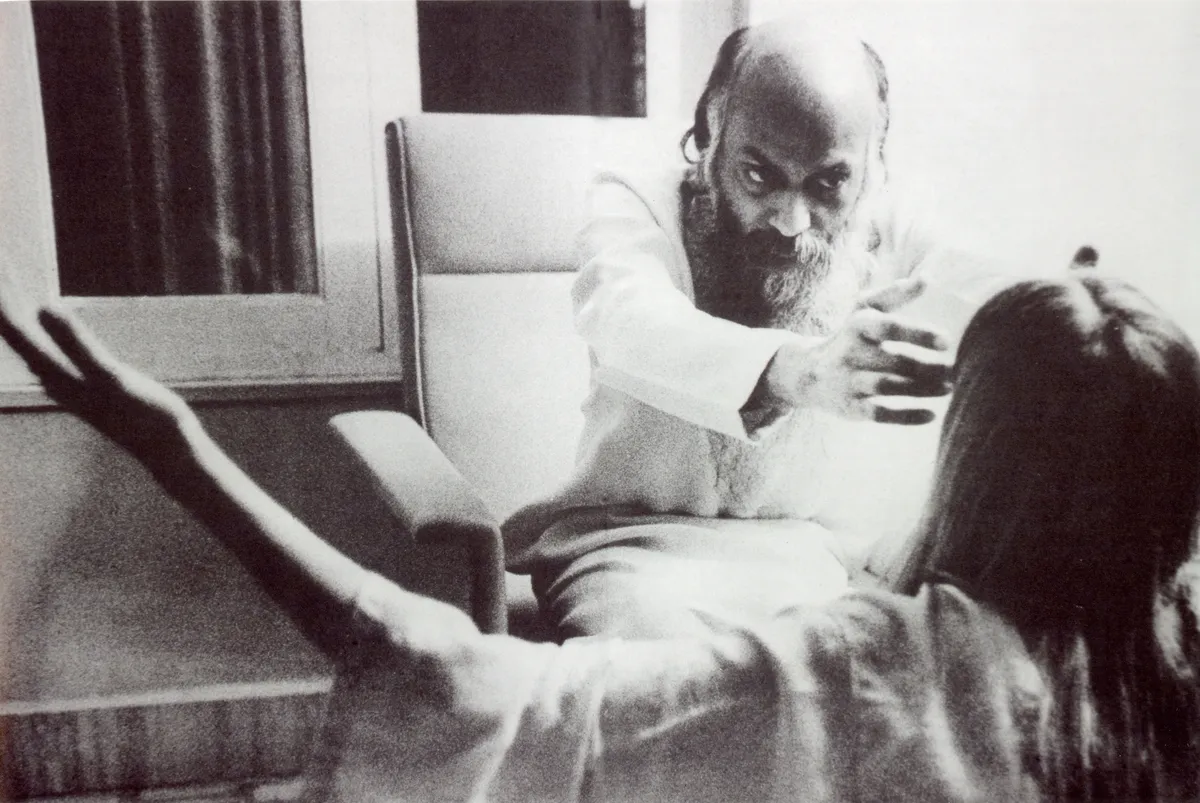
Osho's original Hindi beside Osho Live's English translation, matched passage by passage.
मेरे प्रिय आत्मन्!
My beloved Atman!
योग का आठवां सूत्र। सातवें सूत्र मैं मैंने आपसे कहा, चेतन जीवन के दो रूप हैं--स्व चेतन, सेल्फ कांशस और स्व अचेतन, सेल्फ अनकांशस।
Yoga’s eighth sutra. In the seventh sutra I told you: conscious life has two forms — self-conscious and self-unconscious.
आठवां सूत्र है: स्व चेतना से योग का प्रारंभ होता है और स्व के विसर्जन से अंत। स्व चेतन होना मार्ग है, स्वयं से मुक्त हो जाना मंजिल है। स्वयं के प्रति होश से भरना साधना है और अंततः होश ही रह जाए, स्वयं खो जाए, यह सिद्धि है।
The eighth sutra is: Yoga begins with self-awareness, and ends in the dissolution of the self. To be self-aware is the path; to be free of the self is the goal. To be filled with alertness toward oneself is sadhana; and finally only alertness remains, the self is lost — that is siddhi.
स्वयं को जो नहीं जानते, वे तो पिछड़े ही हुए हैं; जो स्वयं पर ही अटक जाते हैं, वे भी पिछड़ जाते हैं। जैसे सीढ़ी पर चढ़ कर कोई अगर सीढ़ी पर ही रुक जाए, तो चढ़ना व्यर्थ हो जाता है। सीढ़ी चढ़नी भी पड़ती है और छोड़नी भी पड़ती है। मार्ग पर चल कर कोई मार्ग पर ही रुक जाए, तो भी मंजिल पर नहीं पहुंच पाता। मार्ग पर चलना भी पड़ता है और मार्ग छोड़ना भी पड़ता है, तब मंजिल पर पहुंचता है। मार्ग मंजिल तक ले जा सकता है, अगर मार्ग को छोड़ने की तैयारी हो। और मार्ग ही मंजिल में बाधा बन जाएगा, अगर पकड़ लेने का आग्रह हो।
Those who do not know themselves remain backward; and those who get stuck in themselves also remain behind. Like someone who climbs a ladder and then stops on the ladder — the climbing becomes futile. The ladder must be climbed, and it must also be left. One walks on the path, but if one stops on the path, the destination is never reached. One must walk the path, and one must also leave the path — only then is the goal attained. The path can take you to the goal, but only if you are ready to leave the path. The path itself becomes a hindrance to the goal if you cling to it.
स्वयं के प्रति होश से भरना सहयोगी है स्वयं के विसर्जन के लिए। लेकिन अगर स्वयं को ही पकड़ लिया जाए, तो जो सहयोगी है वही अवरोध हो जाता है।
To be filled with awareness toward oneself is a helper for the dissolution of the self. But if you grasp the self, then what was a helper becomes an obstacle.
इस सूत्र को समझना बहुत--शायद सर्वाधिक--महत्वपूर्ण है। स्वयं को पाने की तो हमारी उत्कट आकांक्षा होती है, लेकिन स्वयं को खोना कठिन बात है। इसलिए बहुत से साधक योग के सातवें सूत्र तक आते हैं, आठवें सूत्र पर नहीं आ पाते। सातवें सूत्र तक हमारे अहंकार को कोई भी बाधा नहीं है। सातवें सूत्र तक की यात्रा ईगो-सेंट्रिक है, अहंकार-केंद्रित है। इसलिए सातवें सूत्र तक साधक से अगर कहें कि धन छोड़ दो, तो साधक धन छोड़ देगा। कहें कि परिवार छोड़ दो, तो परिवार छोड़ देगा। कहें कि यश छोड़ दो, महत्वाकांक्षा छोड़ दो, सिंहासन छोड़ दो, सब छोड़ देगा। लेकिन सब छोड़ने के पीछे मैं मजबूत होता चला जाता है। साधना में भी उत्सुक होगा इसीलिए कि वह मैं और निखर जाए। साधना में भी इसीलिए लगेगा कि मैं कुछ हो जाऊं। परमात्मा को भी इसीलिए खोजेगा कि कहीं मैं परमात्मा के बिना न रह जाऊं।
To understand this sutra is very — perhaps supremely — important. Our intense longing is to attain the self, but to lose the self is hard. That is why many seekers come up to the seventh sutra, but cannot enter the eighth. Up to the seventh, the ego meets with no obstruction. Up to the seventh, the journey is ego-centric. Therefore, up to the seventh sutra, if you tell the seeker: renounce wealth — he will renounce wealth. Renounce family — he will renounce family. Renounce fame, ambition, the throne — he will renounce everything. But behind all renunciation, the I goes on becoming stronger. He will be eager even in sadhana so that this I may be refined. He will practice so that “I” may become something. He will even seek Paramatma lest “I” be left without God.
सातवें तक आने में अड़चन, कठिनाई नहीं है। असली कठिनाई सातवें के बाद आठवें सूत्र को समझने में है, क्योंकि आठवां सूत्र स्वयं को खोने का सूत्र है, स्वयं के विसर्जन का सूत्र है। सातवें सूत्र तक सिद्धियां मिल सकती हैं, शक्तियां मिल सकती हैं। सातवें सूत्र तक अपार ऊर्जा, अपार शक्ति का जन्म हो जाएगा। लेकिन परमात्मा से मिलन नहीं हो सकता है। सातवें सूत्र तक स्वयं से ही मिलन होगा।
To reach the seventh is not really difficult. The real difficulty begins after the seventh — in understanding the eighth — because the eighth sutra is the sutra of losing the self, of dissolving the self. Up to the seventh, siddhis may come, powers may come. Up to the seventh, immense energy, vast power will be born. But union with Paramatma does not happen. Up to the seventh there is only meeting with oneself.
स्वयं से मिलन भी छोटी बात नहीं है, बहुत बड़ी बात है। लेकिन पिछले छह सूत्रों की दृष्टि से बड़ी बात है, आठवें सूत्र की दृष्टि से बड़ी बात नहीं है। स्वयं को पा लेना भी बहुत कठिन है। स्वयं को भी पूरा जान लेना बहुत कठिन है। लेकिन उससे भी ज्यादा कठिन स्वयं को खोना और विसर्जित करना है।
Meeting oneself is no small thing; it is great — great from the perspective of the previous six sutras, but not great from the vision of the eighth. To find the self is difficult indeed. To fully know oneself is difficult indeed. But more difficult still is to lose oneself and dissolve.
अगर एक व्यक्ति कारागृह में कैद हो, तो कारागृह से मुक्त होने के लिए पहली शर्त तो यही होगी कि वह जाने कि कारागृह में कैद है। अगर उसे यह पता ही न हो कि वह कारागृह में कैद है, तब तो कारागृह से मुक्त होने का कोई उपाय नहीं है। पहली शर्त होगी कारागृह से मुक्त होने की: यह जानना कि मैं कारागृह में हूं। दूसरी शर्त होगी कि कारागृह को ठीक से पहचानना कि कारागृह क्या है? कहां है दीवाल? कहां है द्वार? कहां है मार्ग? कहां हैं खिड़कियां? कहां हैं सींखचे? कहां है कमजोर रास्ता? कहां से निकला जा सकता है? कहां पहरेदार है? दूसरा सूत्र होगा: कारागृह से पूर्णतया परिचित होना, कारागृह के प्रति पूरी तरह सचेतन होना। तब कहीं कारागृह से छुटकारा हो सकता है।
If a man is imprisoned, then the first condition for being free of the prison is to know that he is imprisoned. If he does not even know he is in prison, there is no way to get out. The first condition of freedom is to know: I am in prison. The second condition is to recognize the prison accurately: What is the prison? Where is the wall? Where is the door? Where is the passage? Where are the windows? Where are the bars? Where is the weak spot? From where can one get out? Where do the guards stand? The second sutra will be: to be fully acquainted with the prison, to be wholly conscious toward it. Only then can one be freed from it.
मनुष्य के गहरे व्यक्तित्व में स्व ही कारागृह है; सेल्फ, मैं, अहंकार ही कारागृह है। छोटा कारागृह नहीं है, बड़ा है। बड़ी शक्तियों से भरा है, बड़े खजाने डूबे हैं, पर है कारागृह। उसके बाहर और विराट का विस्तार है, जहां स्वतंत्रता है, जहां मुक्ति है।
In the profound personality of man, the self itself is the prison; the self, the I, the ego is the prison. It is no small prison — it is vast. It is filled with great energies, great treasures lie sunk within — but it is a prison. Beyond it is the boundless expanse of the Vast, where there is freedom, where there is liberation.
पहले तो हमें इस अपने स्व का ही कोई पता नहीं है कि कितना बड़ा है? क्या है? इसका पता लगाना सातवें सूत्र तक पूरा होता है। और जब इसका पूरा पता लगता है तो खतरा है बड़ा, वह खतरा आपसे कहूं। वही खतरा जो पार कर ले वह आठवें सूत्र को समझ पाएगा। जैसे ही पता चलता है कि इतनी संपत्तियां, इतने हीरे-माणिक, इतने खजानों का मैं मालिक हूं, वैसे ही कारागृह कारागृह नहीं, सम्राट का महल मालूम पड़ने लगता है।
At first we have no measure of our own self — how big it is, what it is. That discovery completes itself by the seventh sutra. And when its full measure is known, a danger arises — let me tell you that danger. He who passes beyond it will understand the eighth. As soon as one comes to know, “I am the owner of such wealth, of such jewels and treasures,” the prison no longer appears a prison; it seems a palace of an emperor.
अगर एक कैदी को भी यह पता चल जाए कि कारागृह में इतने खजाने गड़े हैं, इतना सोना है, इतनी संपदा है, अगर उसको भी कारागृह के खजानों को पता चल जाए, तो शायद वह भी यह बात इनकार कर दे कि यह कारागृह है। यह महल है सम्राट का! और शायद ये खजाने ही उसे अब कारागृह से बाहर जाने के लिए बाधा बन जाएं। हो सकता है पहरेदार इतना न रोक सके होते और जंजीरें इतना न रोक सकतीं, हो सकता है सारा इंतजाम कारागृह का न रोक सका होता उसे बाहर जाने से, लेकिन कारागृह में मिले खजाने रोक सकते हैं।
If even a convict discovers that the prison has buried treasures — so much gold, so much wealth — he may refuse to accept that this is a prison. “This is the palace of a king!” And perhaps those treasures alone may prevent him from leaving the prison. The guards might not have been able to stop him so much, nor the chains, nor the whole prison arrangement — but the treasures found within could stop him.
जिस दिन हमें अपनी स्वयं की पूरी संपदा का, अपने स्वयं के पूरे सुख का, अपनी स्वयं की पूरी शक्ति का पता चलता है, उस दिन यह खतरा है कि हम भूल जाएं कि यह स्व बड़ी छोटी भूमि है, यह बड़ी अनंत भूमि का एक छोटा सा टुकड़ा है। यह ऐसे ही है, जैसे किसी ने मिट्टी के घड़े में पानी भर कर सागर में छोड़ दिया हो। वह मिट्टी के घड़े के भीतर पानी है सागर का ही। लेकिन बाहर के सागर, उस मिट्टी के घड़े के बाहर जो सागर है, उससे क्या तुलना है!
The day we come to know our entire inner wealth, our entire bliss, our entire power, on that day there is danger that we forget: this self is a very small tract — a tiny piece of an infinite land. It is like someone filling a clay pot with water and letting it float in the ocean. The water inside the clay pot is oceanic, yes — but what comparison with the ocean outside!
हम भी मिट्टी के घड़े हैं। बहुत है भीतर। वही है जो परमात्मा का है, सागर का ही है। लेकिन बाहर जो है उसका क्या? उसकी क्या तुलना है? यह मिट्टी के घड़े को भी एक दिन तोड़ना ही पड़ता है। यह जो सेल्फ है, यह जो मैं हूं, यह जो आत्म का भाव है, यह जो ईगो है, अहंकार है, यह घेरे हुए है। लेकिन जिस दिन स्वयं की पूरी गरिमा का पता चलता है, उस दिन मिट्टी का घड़ा सोने का घड़ा हो जाता है। तोड़ना बहुत मुश्किल हो जाता है।
We too are clay pots. Much is within — and it is of the ocean, of Paramatma. But what of the outside? What comparison? One day this clay pot must be broken. This self, this I, this sense of “I am,” this ego — it encircles us. But the day we know the full glory of the self, that day the clay pot turns into a pot of gold. To break it then becomes very difficult.
इसलिए बहुत बार साधक को अदभुत तरह के अहंकारों का जन्म होता है। बहुत बार साधना के पथ पर चलने वाले को जो अंतिम चीज आखिर में रोक लेती है, वह वह जगह है जहां उसका मैं सोने का हो जाता है, जहां उसे लगता है कि मैं अनंत वीर्य, अनंत ज्ञान, अनंत शक्ति का मालिक हूं। यह घोषणा उसके भीतरी मैं की बड़ी गहरी घोषणा बन जाती है। जो इस पर रुक जाते हैं वे सातवें सूत्र पर रुक जाते हैं। और यह रुक जाना वैसा ही है जैसे कोई आदमी अपनी मंजिल के करीब आकर और द्वार पर रुक जाए। सारा रास्ता तय करे और मंदिर के बाहर ठहर जाए।
Thus very often the seeker gives birth to a strange kind of ego. The last barrier that stops one on the path of sadhana is precisely that spot where the I turns to gold, where one feels, “I am the owner of infinite vigor, infinite knowledge, infinite power.” This proclamation becomes the deep declaration of the inner I. Those who stop here stop at the seventh sutra. And stopping here is like a man who comes close to his destination and then stands at the door — the whole road traversed, and he halts outside the temple.
ऐसा होता भी है। हजारों मील आदमी चल लेता है, और मंजिल के पास आकर एक-एक कदम उठाना मुश्किल हो जाता है। हजारों मील चल लेता है, जब तक दूर होती है मंजिल तब तक दौड़ लेता है, जैसे-जैसे पास आने लगती है वैसे-वैसे थकान पकड़ने लगती है। अक्सर ऐसा हुआ है कि लोग मंदिरों के बाहर आकर विश्राम को चले गए हैं।
It happens too. A man can walk thousands of miles, and when he comes near the goal, each step becomes difficult. While the goal was far, he ran; as he nears it, fatigue catches him. Often it has happened that people reached outside the temples and went off to rest.
अनेक साधक सातवें सूत्र पर आकर अटक जाते हैं। आठवां सूत्र छलांग है, बड़ी छलांग है। स्वयं को पाने की बात बहुत बड़ी नहीं है, स्वयं को खोने की बात बहुत बड़ी है।
Many seekers get stuck at the seventh sutra. The eighth is a leap — a great leap. To attain oneself is not the great thing; to lose oneself is the great thing.
फिर मन में सवाल उठता है कि स्वयं को खोना किसलिए? स्वयं ही न होंगे तो जो भी होगा उसका क्या प्रयोजन है, क्या अर्थ है? स्वयं ही न होगा तो फिर क्या होगा मोक्ष? क्या होगा परमात्मा? क्या होगा योग? क्या होगा धर्म? स्वयं के लिए मुक्ति छोड़ी जा सकती है; स्वयं से मुक्ति बड़ी कठिन बात है। फ्रीडम फॉर दि सेल्फ, स्वयं के लिए मुक्ति तो आसान है; मन करता है कि मैं स्वतंत्र हो जाऊं, मुक्त हो जाऊं। लेकिन फ्रीडम फ्रॉम दि सेल्फ, वह स्वयं से मुक्ति, वहां जाकर एकदम अटकाव आ जाता है। मन वहां आखिरी छलांग की तैयारी है।
Then the mind raises a question: Why lose oneself? If the self will not be, whatever remains — what is the use, what meaning will it have? If the self is not, what will be Moksha? What will be Paramatma? What will be Yoga? What will be Dharma? One can renounce for the sake of the self; but to be free from the self is very hard. Freedom for the self is easy; the mind desires, “May I be free, may I be liberated.” But freedom from the self — there the last blockage arises. The mind recoils before that final leap.
लेकिन योग के पास मार्ग हैं, जिनसे उस आखिरी छलांग को भी पूरा किया जा सकता है।
But Yoga has ways by which even that ultimate leap can be completed.
सातवें सूत्र के बाद आठवें सूत्र में प्रवेश के लिए जो सबसे बड़ी खोज शुरू होती है वह होती है, मैं कौन हूं? इसकी खोज शुरू होती है। मैं क्या हूं? यह सातवें सूत्र तक पता चल जाता है। क्या हूं? मैं कहां तक हूं? यह सातवें सूत्र तक पता चल जाता है। लेकिन मैं कौन हूं? यह सातवें सूत्र तक पता नहीं चलता। इसकी खोज ही आठवां सूत्र बनती है--कि मैं कौन हूं? और जितना गहरे हम खोजते हैं, उतना ही हम पाते हैं कि यहां भी मेरा अंत नहीं है, यहां भी मैं नहीं हूं और आगे भी हूं, बियांड एंड बियांड। खोज चलती जाती है, खोज चलती जाती है और सब सीमाएं टूट जाती हैं और आखिर में पता चलता है कि जो भी है वह सभी कुछ मैं हूं। जिस दिन यह पता चलता है कि जो भी है वह सभी कुछ मैं हूं, उस दिन मैं नहीं बचता, क्योंकि तू नहीं बचता, कोई तू नहीं रह जाता बाहर फिर। सभी कुछ मैं हूं, फिर कोई तू नहीं रह जाता।
After the seventh sutra, when entering the eighth, the greatest inquiry begins: Who am I? This search begins. What am I — this much becomes known by the seventh. How far do I extend — that too is known by the seventh. But who am I — this does not become known by the seventh. Its very search becomes the eighth sutra — “Who am I?” And the deeper we search, the more we discover: even here there is no end to me; even here I am not — and yet I am, beyond and beyond. The quest goes on and all boundaries break; and finally it is known: whatever is — all of it is I. The day it is known that whatever is, is I — that day the “I” does not remain, for then there is no “you” outside anymore. If all is I, no “you” remains.
गदर, अठारह सौ सत्तावन की क्रांति के समय एक संन्यासी को अंग्रेज सिपाहियों ने मार डाला था। वह तीस वर्ष से मौन था, चुप था। लोगों ने उससे पूछा था कि चुप्पी क्यों ले रहे हो? मौन क्यों हो रहे हो? तो उसने कहा था, जो मैं कहना चाहता हूं वह कह नहीं सकता हूं, क्योंकि शब्द असमर्थ हैं; और जो मैं कह सकता हूं उसे कहना नहीं चाहता हूं, क्योंकि वह व्यर्थ है। इसलिए चुप हो गया हूं।
During the uprising of 1857, a sannyasi was killed by British soldiers. He had been silent for thirty years. People had asked him, “Why this silence? Why be mute?” He said, “What I want to say cannot be said — words are incapable; and what I can say, I do not want to say — it would be futile. Hence I have become silent.”
फिर वह तीस साल चुप था। नग्न, चुप, मौन भटकता रहता था। रात गुजर रहा था रास्ते से, अंग्रेज सिपाहियों की छावनी थी, उन्होंने उसे कोई डिटेक्टिव, कोई जासूस समझ कर पकड़ लिया। उससे बहुत पूछा कि तुम कौन हो? लेकिन जब वे उससे पूछते थे--तुम कौन हो? तो वह हंसता था।
For thirty years he was naked, quiet, wandering. One night he was passing by a British camp; they seized him, thinking he was a spy. They asked much, “Who are you?” But whenever they asked, “Who are you?” he would laugh.
वह मौन था, उत्तर भी नहीं दे सकता था। और कौन हूं मैं, इसका उत्तर अब तक किसने दिया है? उत्तर दिया भी नहीं जा सका है। जब उत्तर मिलता है तब तक मैं खो जाता है, और जब तक मैं होता है तब तक उत्तर नहीं मिलता। तो वह जो पहेली है, वह अब तक हल नहीं हो पाई, कभी हल होगी भी नहीं। वह खोजने वाला जब खत्म हो जाता है तब उत्तर मिलता है। तब उत्तर का कोई मतलब नहीं है। और जब तक वह खोजने वाला मौजूद रहता है तब तक उत्तर मिलता नहीं। तब तक उत्तर दिया नहीं जा सकता, क्योंकि मिलता ही नहीं।
He was vowed to silence; he could not answer. And who has ever answered the question “Who am I?” When the answer comes, the “I” is already lost; and as long as the “I” is there, the answer does not come. The riddle cannot be solved — it never will be. When the seeker ends, the answer is. Then the answer has no meaning. And while the seeker remains, the answer never comes — it cannot be given, for it is not found.
वह हंसता था खिलखिला कर। जितना वह हंसता था, उतने सिपाही नाराज होते गए। अंततः उन्होंने संगीन उसकी छाती में भोंक दी। वे समझे कि वह धोखा दे रहा है। मरते वक्त उसने दो शब्द जरूर कहे थे, तीस साल का मौन उसने मरते वक्त तोड़ा था। बड़ा अजीब था उसके तीस साल के मौन का टूटना। और जो उसने उत्तर दिया था वह और भी अजीब था। क्योंकि पूछ रहे थे वे सिपाही कि कौन हो तुम? इसका उसने कोई उत्तर नहीं दिया। मरते वक्त आंख खोल कर वह फिर हंसा था और उसने उपनिषद के एक महावाक्य का प्रयोग किया था और मारने वाले, संगीन भोंकने वाले अंग्रेज सिपाहियों से कहा था: तत्वमसि श्वेतकेतु! तुम भी वही हो श्वेतकेतु, तुम भी वही हो!
He laughed, a peal of laughter. The more he laughed, the more the soldiers grew angry. In the end they thrust a bayonet into his chest. They thought he was deceiving them. As he died he spoke two words — he broke his thirty-year silence at death. The breaking of that silence was strange indeed, and what he said was stranger yet. For when asked, “Who are you?” he did not answer that. Opening his eyes as he died, he laughed again and used a Mahavakya of the Upanishads, saying to the soldiers who stabbed him, “Tat tvam asi, Shvetaketu! You too are That, Shvetaketu — you too are That!”
पूछा था, कौन हो तुम? मरते वक्त उत्तर दिया था, तुम भी वही हो! यह नहीं कहा था कि मैं कौन हूं, कहा कि तुम भी वही हो। बाकी छोड़ दिया, वह अंडरस्टुड है। वही हूं मैं, उसे छोड़ दिया। क्योंकि कौन कहे वही हूं मैं, अब वह बचा ही नहीं। इसलिए उत्तर बड़े चक्कर से दिया था, बहुत राउंड अबाउट था। कहा कि तुम भी वही हो, दैट आर्ट दाऊ।
They had asked, “Who are you?” At death he answered, “You too are That!” He did not say who he was — he said, “You too are That.” The rest was left understood: “That am I” — left unsaid. For who is there now to say, “I am That”? The one who could say is no more. Therefore the answer was given in a roundabout way: “You too are That — That art thou.”
पता नहीं वे सिपाही समझे, नहीं समझे। मुश्किल ही है कि समझे हों।
Who knows if the soldiers understood. It is unlikely they did.
मैं कौन हूं? इसकी खोज अंततः मैं का विसर्जन बन जाती है। इसकी खोज सातवें सूत्र के बाद ही हो सकती है, इसके पहले बहुत कठिन है। सातवें सूत्र के बाद सरल है। पूछ सकते हैं हम, क्योंकि अब जाग गए हैं, प्रकाश से भर गए हैं, पूछ सकते हैं--मैं कौन हूं? और यही प्रश्न एकमात्र धार्मिक प्रश्न है। इसका उत्तर कभी नहीं मिलता। ऐसा नहीं है कि आपको उत्तर मिल जाता है कि आप परमात्मा हो। जब तक ऐसा उत्तर आए, समझना आपकी स्मृति ही उत्तर दे रही है। शास्त्र पढ़े हैं, वे ही बोल रहे हैं। शब्द सुने हैं, वे ही बोल रहे हैं। सिद्धांत सीखे हैं, वे ही बोल रहे हैं।
The search “Who am I?” finally becomes the dissolution of the I. This search is possible only after the seventh sutra; before that it is very difficult. After the seventh it is simple, for now we are awake, filled with light — we can ask, “Who am I?” And this question is the only religious question. Its answer never comes in words. It is not that you receive the answer, “You are Paramatma.” If such an answer appears, know that memory is answering. Scriptures you have read are speaking. Words you have heard are speaking. Doctrines you learned are speaking.
यह आठवां सूत्र शास्त्रों से हल नहीं होगा, सिद्धांतों से हल नहीं होगा। इसलिए इस आठवें का उत्तर अगर आपका मन दे दे कि ब्रह्म हो। या मैंने अभी कहा, तत्वमसि श्वेतकेतु, आपने भी पढ़ा है। पूछें अपने से कि मैं कौन हूं? और मन कह दे, वही हो! इससे हल नहीं होगा। जब तक आप उत्तर दे सकते हो तब तक उत्तर नहीं मिलेगा, क्योंकि आपके पास उत्तर नहीं है, सिर्फ शब्द हैं। मैं कौन हूं? यह प्रश्न इतना गहरा बन जाए कि आपके भीतर उत्तर उठे ही न, बस प्रश्न ही रह जाए--मूक प्रश्न ही रह जाए, साइलेंट क्वेश्चनिंग ही रह जाए। श्वास-श्वास पूछने लगे--मैं कौन हूं? रोआं-रोआं पूछने लगे--मैं कौन हूं? धड़कन-धड़कन पूछने लगे--मैं कौन हूं? उठते, बैठते, चलते, पूछते, न पूछते प्रश्न मन में गूंजने लगे कि मैं कौन हूं? और उत्तर कोई भी न हो। उत्तर है ही नहीं। क्योंकि अगर उत्तर ही आपके पास हो तब तो पूछने की कोई जरूरत नहीं है।
This eighth sutra will not be resolved by scriptures, nor by doctrines. Therefore if, at this eighth, your mind answers, “Brahman,” or if, having just heard me say “Tat tvam asi, Shvetaketu,” you ask yourself “Who am I?” and the mind replies, “You are That!” — nothing is solved. As long as you can answer, the answer has not come, for you have no answer — only words. “Who am I?” must become so deep a question that no answer rises within; only the question remains — a mute question, a silent questioning. Breath upon breath begins to ask, “Who am I?” Every hair, every pore begins to ask, “Who am I?” Beat by beat the heart asks, “Who am I?” Standing, sitting, moving — whether asking or not — the question resounds within: “Who am I?” and there is no answer. There is no answer. If you had an answer, what need to ask?
लेकिन हम सबके पास उत्तर हैं। इसलिए आठवें सूत्र में समस्त शास्त्र बाधा बन जाते हैं, समस्त ज्ञान बाधा बन जाता है। वह जिसको हम नालेज कहते हैं, ज्ञान कहते हैं, जो हमने सीखा है, समझा है, याद किया है, वह सब बाधा बन जाता है। श्रेष्ठतम भी वचन बाधा बन जाते हैं। गीता, कुरान, बाइबिल, सब बाधा बन जाते हैं। जो भी हमने पढ़ा है, जो भी हमने सीखा है, वह उस आठवें सूत्र में बाधा देने लगता है। क्योंकि हमारी स्मृति उत्तर देती है कि यह हूं मैं, यह हूं मैं, यह हूं मैं। इन सब उत्तरों को तोड़ डालना पड़ेगा। ये कोई उत्तर हमारे नहीं हैं। ये जिन्होंने दिए होंगे, उन्होंने जान कर दिए हैं। जिन्होंने दिए होंगे, उन्होंने समझ कर दिए हैं। लेकिन ये उत्तर हमारे नहीं हैं। यह उत्तर मेरा नहीं है। यह जानना मेरा नहीं है। यह बारोड है, उधार है, बासा है।
But all of us have answers ready. Hence at the eighth sutra, all scriptures become obstacles, all knowledge becomes an obstacle — what we call knowledge, what we have learned, understood, memorized. Even the noblest utterances become hindrances — the Gita, the Quran, the Bible — all become obstacles. Whatever we have read, whatever we have learned, begins to obstruct at the eighth, for memory answers, “This I am, this I am.” These answers must be shattered. They are not our answers. Those who gave them knew — but they are not ours. The answer is not mine; the knowing is not mine. It is borrowed, secondhand, stale.
इस आठवें सूत्र के पहले सब ज्ञान छोड़ कर मनुष्य को पुनः अज्ञानी हो जाना पड़ेगा। और जो अज्ञानी होने को समर्थ हैं...यह अज्ञान बहुत और तरह का है। सुकरात ने एक छोटा सा अच्छा विभाजन किया है। और वे लोग जो आठवें सूत्र के करीब पहुंचे, उनमें से सुकरात एक है।
Before the eighth sutra, man will have to drop all knowledge and become ignorant again. And those who can become ignorant… this ignorance is of a very different kind. Socrates made a small but beautiful distinction. Of those who reached near the eighth sutra, Socrates is one.
सुकरात को गांव के कुछ लोगों ने आकर कहा कि डेल्फी की देवी ने घोषणा की है कि सुकरात से बड़ा ज्ञानी और कोई भी नहीं है। तो उन लोगों ने आकर कहा कि डेल्फी की देवी का वचन है कि सुकरात से बड़ा ज्ञानी और कोई भी नहीं है--आप क्या कहते हैं? सुकरात ने कहा, जरूर कहीं कोई भूल हो गई है। क्योंकि मैं तुमसे कहता हूं, सुकरात से बड़ा अज्ञानी और कोई भी नहीं है। पर उन्होंने कहा, यह तो बड़ी मुश्किल हो गई। अब हम अगर डेल्फी की देवी की बात मानें कि सुकरात ज्ञानी है तो सुकरात की बात माननी पड़ेगी। और सुकरात कहता है, सुकरात से बड़ा अज्ञानी और कोई भी नहीं। और अगर हम सुकरात की बात मानें कि सुकरात से बड़ा अज्ञानी कोई नहीं, तो डेल्फी के वचन का क्या होगा? उन्होंने कहा, हमें मुश्किल में डाल दिया सुकरात। सुकरात ने कहा, हमारा काम ही मुश्किल में डालना है। हम भी बहुत मुश्किल में पड़े तब यहां तक आ पाए। पर उन्होंने कहा, अब हम क्या समझें? तो सुकरात ने कहा, जाकर वापस डेल्फी की देवी से पूछो।
Some villagers came to Socrates and said, “The oracle at Delphi has declared that none is wiser than Socrates.” They asked, “What do you say?” Socrates said, “Surely there is some mistake, for I tell you: none is more ignorant than Socrates.” They said, “This is difficult. If we accept the oracle that Socrates is wise, we must accept Socrates; and Socrates says none is more ignorant than Socrates. If we accept Socrates — that none is more ignorant — what of the oracle?” They said, “You have put us in a bind.” Socrates replied, “Our work is to put you in a bind. We ourselves were caught in great difficulty before we came this far.” They asked, “What should we understand?” Socrates said, “Go back and ask the oracle again.”
वे वापस गए और उन्होंने डेल्फी की देवी से पूछा कि सुकरात तो कहता है कि उससे बड़ा अज्ञानी और कोई भी नहीं है और आप कहती हैं कि उससे बड़ा ज्ञानी कोई नहीं है! डेल्फी की देवी ने कहा, इसीलिए, इसीलिए! इसीलिए कहती हूं कि उससे बड़ा ज्ञानी कोई भी नहीं है, क्योंकि जिसको अपने अज्ञान का पता चल गया वह ज्ञान के द्वार पर खड़ा हो गया है। वे लौट कर आए, उन्होंने सुकरात से कहा कि देवी कहती है, इसीलिए! अब तो यह पहेली और भी उलझ गई। वह कहती है, इसीलिए कि सुकरात अपने को अज्ञानी कह सकता है तो वह मंदिर के द्वार पर खड़ा है। सुकरात ने कहा, तुमने खयाल किया! तुम जब मुझसे आकर कहे तो मैंने भी सोचा कि डेल्फी की देवी को यह भ्रम कैसे हो गया? लेकिन उसका वचन बहुत अर्थपूर्ण था। इस वचन में उसने यह नहीं कहा था कि सुकरात महाज्ञानी है। उसने कहा था, सुकरात से बड़ा ज्ञानी और कोई भी नहीं है। निगेटिव था। उसने यह नहीं कहा था...।
They returned and asked the oracle, “Socrates says none is more ignorant than he, and you say none is wiser!” The oracle replied, “Precisely for this reason! I say none is wiser, because the one who has recognized his ignorance stands at the door of wisdom.” They came back and told Socrates, “The goddess says ‘for this reason.’” Socrates said, “Did you notice? When you told me earlier I also wondered how the oracle could be so mistaken — but her words were meaningful. She did not say ‘Socrates is supremely wise.’ She said, ‘None is wiser than Socrates.’ It was negative; she did not say…”
तो सुकरात ने कहा, तुम देवी के पास वापस गए, मैं गांव में पता लगाने गया कि मुझसे कोई बड़ा ज्ञानी है या नहीं? तो मैंने एक-एक ज्ञानी से जाकर पूछा। सब सवालों के जवाब उनके पास थे, सिर्फ एक सवाल का जवाब उनके पास न था--कि तुम कौन हो? मैं कौन हूं, इसका भर उनके पास जवाब न था। तो मैंने उनसे कहा, कैसे ज्ञानी हो? जिन्हें अभी यह भी पता नहीं कि हम कौन हैं, उनके और पता होने का मतलब भी क्या है? जो अभी यह भी नहीं जान पाए कि वे कौन हैं, वे और क्या जान पाए होंगे?
Socrates continued, “While you went back to the oracle, I went into the village to see if anyone was wiser than me. I asked every wise man. They had answers to all questions — but not to one: ‘Who are you?’ They had no answer to ‘Who am I?’ So I asked them: How are you wise? If you do not even know who you are, what meaning is there to all that you know? He who still does not know who he is — what else could he know?”
तो वह गांव के एक-एक ज्ञानी के पास जाकर लौट आया और उसने कहा कि देवी बहुत होशियार है, उसने कहा कि सुकरात से बड़ा ज्ञानी और कोई नहीं है। इसका कुल मतलब इतना ही है कि इस गांव में अज्ञानी तो सभी हैं, सिर्फ सुकरात को इतना ज्ञान है कि उसे अज्ञान का पता है। और कोई बात नहीं है। इतना ज्ञान भी गांव में किसी को नहीं है।
Socrates returned and said, “The goddess is very intelligent. Saying ‘none is wiser than Socrates’ means only this: in this village all are ignorant; only Socrates has enough knowledge to know that he is ignorant. Nothing more. Even this much is not with anyone else.”
सातवें सूत्र को पार वही कर पाएगा जो अपने अज्ञान को अनुभव करे; जाने कि मुझे कुछ भी पता नहीं है; यह भी पता नहीं कि मैं कौन हूं। और जब यह गहन रूप से जाना जाता है, सघन, तब इसकी पीड़ा बहुत अदभुत है। यह रोएं-रोएं और पोर-पोर में इसकी पीड़ा फैल जाती है--कि मैं कौन हूं? तब यह प्रश्न नहीं रह जाता, तब यह कोई इंटलेक्चुअल इंक्वायरी नहीं रहती, तब यह कोई बौद्धिक सवाल नहीं रहता जिसका कोई जवाब है कहीं। तब यह प्राणों की अकुलाहट, यह प्राणों की प्यास, तब यह प्राणों की सतत धुन बन जाती है--सतत प्राण कंपित होने लगते हैं उसी एक जिज्ञासा से--मैं कौन हूं? और जब कहीं कोई उत्तर नहीं मिलता--और कहीं कोई उत्तर है नहीं; जो कहीं से उत्तर पा लेगा वह अपने को धोखा दे रहा है; कहीं कोई उत्तर नहीं है--जब कहीं कोई उत्तर नहीं मिलता और प्रश्न पीड़ा बनाए चला जाता है और पागल कर देता है, विक्षिप्त कर देता है भीतर, जब प्रश्न ही प्रश्न रह जाता है, उत्तर की आशा भी मिट जाती है, उत्तर की संभावना भी मिट जाती है, उत्तर की अपेक्षा भी मिट जाती है, उत्तर मिलेगा, इसकी संभावना भी मिट जाती है, जब प्रश्न ही रह जाता है, बल्कि कहना चाहिए जब पूछने वाला और प्रश्न एक ही हो जाता है, उस क्षण प्रश्न भी खो जाता है। उत्तर नहीं मिलता, प्रश्न भी गिर जाता है। निष्प्रश्न, उस क्षण में आदमी सातवें सूत्र से आठवें सूत्र में प्रवेश कर जाता है। उस क्षण वह यह नहीं कहता कि मैं कौन हूं, उस क्षण वह यह कहता है, मुझे वह बताओ जो मैं नहीं हूं। उस क्षण वह कहता है, कहां मैं नहीं हूं?
Only he who experiences his ignorance will cross beyond the seventh; who knows, “I know nothing; not even who I am.” When this is known deeply, intensely, its pain is wondrous. It spreads through every pore — “Who am I?” Then it is no more a question; it is no intellectual inquiry, no academic puzzle with a ready answer. It becomes a restlessness of the life-breath, a thirst of being; a constant tuning of the life-force — the very prana trembles with one longing: “Who am I?” And when no answer is found anywhere — and there is none; whoever gets an answer from somewhere is deceiving himself — when no answer is found and the question keeps burning, driving one mad within; when only the question remains, and even the hope of an answer is gone, even the possibility, even the expectation; when only the question is — rather, when the questioner and the question become one — in that instant the question too is lost. No answer appears; the question falls. In that questionless moment, man steps from the seventh sutra into the eighth. In that instant he no longer says, “Who am I?” In that instant he says, “Tell me what I am not.” In that instant he asks, “Where am I not?”
नानक गए हैं और मक्का के मंदिर के बाहर सो गए हैं। उनके पैर मक्का के पवित्र पत्थर की तरफ हैं। पुजारियों ने आकर कहा, पैर हटाओ! नासमझ, इतना भी तुझे पता नहीं कि पवित्र पत्थर की तरफ पैर नहीं करने चाहिए! परमात्मा की तरफ पैर करता है!
Nanak went and slept outside the shrine in Mecca. His feet were toward the sacred stone. The priests came and said, “Move your feet! Fool, do you not even know you must not stretch your feet toward the holy stone? You point your feet toward God!”
तो नानक ने कहा कि मैं भी बड़ी मुश्किल में हूं। तुम मेरे पैर उस तरफ कर दो जहां परमात्मा न हो। पकड़ो मेरे पैर और उस तरफ कर दो जहां परमात्मा न हो।
Nanak said, “I too am in difficulty. Turn my feet to where God is not. Take hold of my feet and place them where He is not.”
वे मुल्ला, वे पंडित बहुत मुश्किल में पड़ गए। यह हिम्मत वे भी न कर पाए कि नानक के पैर कहीं और करें, क्योंकि परमात्मा सब जगह है।
Those mullahs, those pundits, were confounded. They did not dare move Nanak’s feet anywhere, for God is everywhere.
जिस दिन यह ‘मैं कौन हूं?’ प्रश्न भी गिर जाता है, उस दिन यह सवाल नहीं रह जाता, मैं कौन हूं। उस दिन अगर कोई पूछे भी तो हम यही पूछेंगे कि मैं कौन नहीं हूं? सभी कुछ मैं हूं! उस दिन वह जो दीवाल है बीच की, सेल्फ की, वह विसर्जित हो जाती है, वह गिर जाती है। वह बिलकुल ड्रीम, स्वप्न की दीवाल है। विचार की दीवाल है, स्मृतियों की दीवाल है, मान्यता की दीवाल है, माना है कि मैं हूं ऐसा, इसलिए वह दीवाल है। वह गिर जाती है। उसके गिरते ही व्यक्ति अनंत के साथ एक हो जाता है। तब सेल्फ सेंट्रिक, स्व केंद्र विसर्जित हो जाता है।
The day the question “Who am I?” falls, that day the question remains no more. If anyone asks, we would ask instead, “What am I not?” I am all. That day the wall in between — the wall of the self — dissolves, falls. It was but a dream-wall, a wall of thought, of memories, of beliefs — we had assumed “I am this,” therefore the wall. It falls. And with its fall one becomes one with the Infinite. The self-centric, the self-center, dissolves.
ऐसा नहीं है कि आप मिट जाते हैं। ऐसा नहीं है कि आप समाप्त हो जाते हैं। नहीं, आप तो होते ही हैं, और भी पूर्णता से होते हैं। लेकिन आप ‘मैं’ नहीं रह जाते, आप ‘सब’ हो जाते हैं। आप तब लहर नहीं रह जाते, सागर हो जाते हैं। आप तब बूंद नहीं रह जाते, विराट हो जाते हैं। आप आपकी तरह मिट जाते हैं और परमात्मा की तरह हो जाते हैं।
It is not that you are annihilated. You are — more fully than ever. But you are no longer an “I”; you are the Whole. You are no longer a wave; you are the ocean. You are no longer a drop; you are the Vast. You disappear as “you,” and you are as Paramatma.
इसलिए मैं को खोकर कोई कुछ भी नहीं खोता है। जैसे रात के स्वप्न से जाग कर कोई कुछ भी नहीं खोता है, ऐसे ही मैं के स्वप्न से जाग कर भी कोई कुछ नहीं खोता है। रात के स्वप्न से जाग कर पाता ही है कुछ--जागरण। मैं के स्वप्न से जाग कर भी पाता ही है कुछ--परमात्म जीवन, परमात्मा का जीवन। क्षुद्र दीवाल गिर जाती है। वह क्षुद्र घेरा टूट जाता है। वह लक्ष्मण रेखा मैं की मिट जाती है। उसकी कोई जरूरत भी अब नहीं है।
Therefore, by losing the I, one loses nothing. Just as waking from the night’s dream you lose nothing, so waking from the dream of I you lose nothing. From the dream of night, you gain awakening; from the dream of I, you gain the life of Paramatma. The petty wall falls. The little enclosure breaks. The Lakshman-rekha of the I is erased. It is no longer needed.
अब तक थी। सातवीं सीढ़ी तक, सातवें सूत्र तक उसकी जरूरत है। उस मैं के सहारे इतनी यात्रा हुई है। अगर वह मैं न हो तो इतनी यात्रा नहीं हो सकती। झूठ भी यात्रा में सहयोगी होते हैं। इल्यूजंस भी, भ्रम भी यात्रा में सहयोगी होते हैं। मंजिल पर नहीं ले जा सकते, मंजिल पर साथ नहीं जा सकते।
Up to now it was. Up to the seventh step, up to the seventh sutra, it is needed. By the support of that I the journey has come so far. Without it, so long a journey would not be possible. Even falsehood assists in the journey — illusions too. They cannot take you to the goal; they cannot go with you into the goal.
एक ईसाई फकीर रूस के जेलखानों में बीस साल तक बंद था। उसने एक बहुत अदभुत किताब लिखी है: इन गॉड्स अंडरग्राउंड! प्यारा आदमी है। जेलखाने को, जो जमीन के नीचे अंधेरी कोठरी थी, उसको भी ‘इन गॉड्स अंडरग्राउंड’ नाम से उसने एक छोटी सी किताब लिखी है। वह भी परमात्मा का ही जमीन के नीचे छिपा घर। बीस साल तक बंद था अंधेरी कोठरी में, जहां बीस साल तक रोशनी नहीं दिखाई पड़ी। रोटियां फेंक दी जाती हैं एक बार। आदमी की आवाज सुनाई नहीं पड़ी।
A Christian fakir was imprisoned twenty years in Russian jails. He wrote a marvelous little book: In God’s Underground. A lovely man. He called that underground, that dark cell, “God’s Underground” — God’s hidden house beneath the earth. For twenty years he had no glimpse of light. Bread was thrown once a day. No human voice was heard.
लेकिन पांच-सात दिन के बाद अचानक बगल की दीवाल पर कोई खट-खट करके आवाज करने लगा। सुनने की कोशिश की, लेकिन खट-खट से क्या समझ में आ सकता है! लेकिन एक बात समझ में आ गई कि कोई पड़ोसी कैदी भी है। फिर बीस साल तक दोनों साथ रहे, बीच में दीवाल थी। उस पार कोई था। फिर उन्होंने खट-खट करके धीरे-धीरे भाषा ईजाद कर ली। ए के लिए एक चोट, बी के लिए दो, सी के लिए तीन, ऐसी उन्होंने भाषा धीरे-धीरे ईजाद कर ली। फिर उन्होंने एक-दूसरे का नाम जान लिया, फिर एक-दूसरे को मैसेज और संदेश भी देने लगे। फिर एक-दूसरे को सुबह उठ कर नमस्कार भी करने लगे। फिर एक-दूसरे को रात विदाई का नमस्कार भी करने लगे। फिर तो उनका कम्युनिकेशन धीरे-धीरे गति पकड़ गया, कोड विकसित हो गया।
After five or seven days, suddenly someone began tapping on the wall next to him. He tried to listen, but what could be understood from taps? Yet one thing became clear: there was a fellow prisoner. For twenty years they lived side by side with a wall between. Across that wall someone was there. By tapping, slowly they invented a language — one knock for A, two for B, three for C. Little by little they devised a code. Then they learned each other’s names. Then they began to send messages. They greeted each other at dawn; they said goodnight at night. Their communication gained speed; the code developed.
ये दोनों आदमी अगर कैदखाने के बाहर आ जाएं तो क्या ये अब भी दीवालों को ठोंक कर बात करेंगे? नहीं करेंगे। वह तो एक संकेत लिपि विकसित करनी पड़ी, जिसके बिना दीवालों के पार काम नहीं चल सकता था।
If these two men were freed from prison, would they still talk by knocking on walls? No. That sign-language was needed only because of the wall.
आदमी का मैं भी एक कोड लैंग्वेज है, जो चारों तरफ की दुनिया, जहां हम सब अपनी-अपनी दीवालों में बंद हैं, वहां से खट-खट करके एक-दूसरे से बातचीत करनी पड़ती है। तो हम नाम रखते हैं दूसरे का, कहते हैं राम। किसी को कहते हैं कृष्ण, किसी को कुछ, किसी को कुछ। सब नाम झूठे हैं। कोई बच्चा नाम लेकर नहीं आता। लेकिन बिना नाम के तो दीवालों के आर-पार बात करनी बड़ी मुश्किल हो जाएगी। तो कृष्ण यानी खट-खट दो दफा। राम यानी तीन दफा। तो हम खट-खट करके एक-दूसरे से परिचय बना लेते हैं कि जब हम तीन ब
ार खटखटाएं तो समझना कि तुमको बुला रहे हैं। तुम हुए राम, तुम हुए कृष्ण। हम आदमियों पर नाम चिपका देते हैं। यह कोड लैंग्वेज है, जिसमें दीवालों के पार बात करने का और कोई उपाय नहीं है। सबको हम नाम दे देते हैं। मुझे किसी को बुलाना हो तो मैं कहता हूं, राम, इधर आओ! मेरा भी नाम हो सकता है। मेरा भी नाम है। लेकिन अगर मैं भी अपना नाम बुलाऊं तो बड़ी दिक्कत होगी समझने में कि मैं किसी दूसरे को बुला रहा हूं कि अपने को बुला रहा हूं। इसलिए कोड लैंग्वेज दोतरफा है। जब अपने को बुलाना हो तो मैं कहता हूं--मैं। और जब किसी दूसरे को बुलाना होता है तो लेता हूं नाम। जब आपको भी अपने को बुलाना है तो आप कहते हैं--मैं। और जब दूसरे को बुलाना है तो आप बुलाते हैं नाम।
Man’s I is also a code language. We are all enclosed in our own walls, and we must knock to speak to each other. So we give names — one we call Ram, one Krishna, someone something else. All names are false. No child brings a name with him. But without names, speaking across walls would be difficult. So “Krishna” means two knocks; “Ram” means three. We create acquaintance by tapping — “When we knock thrice, know we are calling you. You are Ram. You are Krishna.” We paste names upon people. It is a code language to speak across the walls. I too have a name. But if I call my own name, confusion will arise — am I calling someone else or myself? Therefore the code is two-sided: to call oneself we say “I,” to call the other we use the name. When you call yourself, you say “I”; when you call another, you use the name.
स्वामी राम अमेरिका गए। तो वे अपने को भी राम ही कह कर बुलाते थे। तो उन्होंने मैं कहना बंद कर दिया। स्वभावतः कोड लैंग्वेज तोड़िएगा तो गड़बड़ होगी। वे अपने को भी राम ही कहते थे। रास्ते में कोई हंस दिया, किसी ने गाली दे दी, तो वे लौट कर आकर कहते कि आज राम बड़ी मुश्किल में पड़ गए। कुछ लोग मिल गए और गालियां देने लगे।
Swami Ram went to America. He referred to himself as “Ram.” He stopped saying “I.” Naturally, if you break the code, trouble follows. He called himself “Ram.” If someone laughed at him on the street, or someone abused him, he would return and say, “Today Ram got into great difficulty. Some people met and began to abuse.”
तो जो लोग अपरिचित थे अमेरिका में, वे पूछते कि क्या मतलब? क्या कह रहे हैं आप? कौन राम?
Those unfamiliar in America would ask, “What do you mean? Who is Ram?”
तो वे कहते, ये राम। ये बड़ी मुश्किल में पड़ गए थे।
He would say, “This Ram — he was in trouble.”
धीरे-धीरे कोड को समझे लोग कि यह अपने को भी राम ही कहता है आदमी।
Gradually people understood the code: this man calls himself Ram.
लेकिन हम अपने को राम कहें या मैं कहें, नाम दें या सर्वनाम का उपयोग करें, मैं का उपयोग करें--न तो हम मैं को लेकर पैदा होते हैं और न हम नाम लेकर पैदा होते हैं। बच्चों को पहले तू का पता चलता है, बाद में मैं का पता चलता है। बच्चे पहले दाऊ कांशस होते हैं, तू के प्रति चेतन होते हैं, पहले उन्हें दूसरों का पता चलता है, मैं का पता बाद में चलता है। जब तू बहुत सुनिश्चित हो जाते हैं तब। इसलिए कई बच्चे ऐसा कहते हुए पाए जाते हैं कि इसको भूख लगी है। छोटे बच्चे कहेंगे कि इसको भूख लगी है। अभी मैं विकसित नहीं हुआ, अभी मैं विकसित होगा।
But whether we say “Ram” or “I,” whether we use a name or a pronoun — neither do we bring the I with us when we are born, nor do we bring a name. Children first become thou-conscious; later they become I-conscious. Children first become aware of the other; only later does the I take shape. When the thou is well established, then the I arises. Hence small children often say, “This is hungry.” A child will say, “This is hungry.” The I has not yet developed; it will develop later.
इस जिंदगी के व्यवहार में, कम्युनिकेशन में, जहां हम सब अपने-अपने घेरों में बंद, दीवालों में बंद हैं, कोड लैंग्वेज विकसित करनी पड़ती है। मैं सूचक शब्द है, इशारा है उसके बाबत जिसका मुझे भी पता नहीं है कि कौन है। कृष्ण, राम सूचक है, इशारा, उसके बाबत जिसका मुझे भी पता नहीं है कि कौन है। हम सब दीवालों के पार खड़े हैं, उन कैदियों की तरह जो अपनी-अपनी दीवाल के पार से खट-खट करते रहते हैं।
In the business of life, in communication, where we are all shut in our own enclosures, we must develop a code. “I” is a pointer, an indication — toward that about which I myself do not know who it is. “Krishna,” “Ram” — pointers toward that about which I too do not know. We all stand across our walls, like those prisoners who keep tapping.
लेकिन ऐसी ही जिंदगी है, हमें पहचान में नहीं आती यह बात, क्योंकि हम अपनी-अपनी सेल को, अपनी-अपनी दीवालों को अपने साथ लिए चलते हैं। वे कैदी बंद हैं एक जगह, दीवालें थिर हैं। हम जन्म के साथ अपने कारागृह को लेकर साथ चलते हैं, इसलिए हमें कभी पता नहीं चलता कि मैं अपनी दीवालें अपने साथ लिए हूं।
But such is our life; we do not recognize it because we carry our cells, our walls, with us. Those prisoners are confined in one place — their walls are fixed. We carry our prison from birth, so we never notice that we carry the walls with us.
एक पति और पत्नी भी जिंदगी भर दो दीवालों के पार कोड लैंग्वेज में बात करते हैं, जो बहुत मुश्किल से कभी समझी जाती है, कभी नहीं समझी जाती। अक्सर तो नहीं समझी जाती है। पिता और बेटे भी बात करते हैं, मित्र भी बात करते हैं, लेकिन दीवालों के पार। खटखटाते कुछ हैं, दूसरा कुछ समझता है। उधर से खटखटाता है, यहां कुछ समझते हैं। लेकिन एक बात भूल जाते हैं कि मैं भी और तू भी, दोनों ही शब्द कामचलाऊ, यूटिलिटेरियन हैं, ट्रुथ नहीं हैं, सत्य नहीं हैं। उपयोगिता है, सत्य नहीं हैं।
A husband and wife spend their whole life talking across two walls, in code — sometimes understood, often not. Father and son speak across walls; friends speak across walls. One taps something; the other understands something else. The other taps; we understand something else. One thing we forget: both “I” and “you” are utilitarian words — makeshift — not Truth. They are useful, not true.
इसलिए जैसे ही हम मैं की खोज में निकलेंगे, हम पाएंगे--मैं कहीं भी नहीं है, नो व्हेयर टु बी फाउंड। है ही नहीं कहीं। जैसे जिस आदमी का नाम कृष्ण है, वह अगर अपने भीतर कृष्ण की खोज में जाए तो क्या कहीं कृष्ण मिलेगा? वह लेबल तो डिब्बे के बाहर चिपका हुआ है, कंटेनर के बाहर। उसे भीतर खोजने जाइएगा तो कहीं भी नहीं पाइएगा। मैं भी भीतर कहीं नहीं हूं। ये कामचलाऊ शब्द हैं, भाषा की ईजादें हैं। लेकिन जरूरी हैं। और सातवें सूत्र तक साधक को इनसे बाधा नहीं पड़ती, बल्कि सहयोग मिलता है। क्योंकि सातवें सूत्र तक वह मैं की ही खोज में आता है। मैं के लिए शक्ति, मैं के लिए शांति, मैं के लिए मुक्ति, मैं के लिए परमात्मा, वह इसकी खोज में आता है सातवें तक। सातवें तक मैं उपयोगी है, सत्य नहीं। सातवें के बाद मैं बाधा बनना शुरू हो जाता है, उसकी उपयोगिता व्यर्थ हो गई। आठवें पर वह कोड लैंग्वेज तोड़ देनी पड़ती है। आठवें पर तोड़ते वक्त पीड़ा होती है, क्योंकि इसी मैं के लिए सब कुछ किया, इसी मैं के लिए जीए, इसी मैं के लिए मरे, इस मैं के लिए न मालूम कितने जन्म लिए।
Therefore, as soon as we set out in search of the I, we find — the I is nowhere to be found. As the man named Krishna, if he searches within for Krishna, will he find “Krishna” anywhere? The label is pasted outside the container. If you search inside, nowhere will you find it. The “I” too is nowhere inside. These are makeshift words, inventions of language. Yet they are necessary. And up to the seventh sutra the seeker is not hindered by them; he is helped. For up to the seventh he comes in search of the I — power for the I, peace for the I, liberation for the I, God for the I. Up to the seventh the I is useful — but not true. After the seventh, the I begins to be the obstacle; its usefulness is exhausted. At the eighth, the code must be broken. At the eighth, breaking it hurts, for we have lived, died, and taken countless births for the sake of this I.
हिंदुस्तान से एक फकीर चीन गया। बोधिधर्म उसका नाम था। चीन का सम्राट उसका स्वागत करने आया था। रास्ते पर जब साम्राज्य प्रवेश के समय स्वागत किया बोधिधर्म का, तो उस सम्राट ने मौका देख कर कहा कि मैं बहुत अशांत हूं, कुछ रास्ता बताएं। बोधिधर्म ने कहा कि कल सुबह तीन बजे आ जाओ तो शांत कर देंगे।
A fakir from India went to China — Bodhidharma. The Chinese emperor came to welcome him. At the gateway he saw his chance and said, “I am greatly restless. Show me a way.” Bodhidharma said, “Come at three in the morning, and I will make you peaceful.”
उस सम्राट ने बहुत से फकीरों से सवाल पूछे थे, किसी ने कुछ रास्ता, किसी ने कुछ रास्ता बताया था। लेकिन यह आदमी अदभुत मालूम पड़ा। इसने कहा, कल तीन बजे आ जाओ, शांत कर देंगे। उसे थोड़ा तो शक हुआ कि मामला इतना आसान नहीं हो सकता। जिंदगी भर अशांत रहा, सब उपाय कर लिए और शांति नहीं हुई। उसने फिर कहा बोधिधर्म से कि शायद आपको मेरी जटिलता का पता नहीं। धन जितना चाहिए पा चुका हूं, लेकिन शांति नहीं मिलती। उपवास जितने कहे हैं करने को फकीरों ने, उतने किए हैं, शांति नहीं मिलती। मंदिर बनवाए हैं लाखों, शांति नहीं मिलती। पुण्य जितना बताया, किया है उससे दुगुना, शांति नहीं मिलती।
The emperor had asked many sages and had been given many methods. But this man was unusual: “Come at three, and I will make you peaceful.” He doubted — it could not be so easy. All life he had been restless; he had tried all means, and peace had not come. He said again, “Perhaps you do not know my complexity. I have all the wealth I wanted, but peace eludes me. I have fasted as told; I have built temples by the hundreds of thousands; I have earned twice the merit prescribed — but peace does not come.”
उस फकीर ने कहा, ज्यादा बातचीत नहीं, सुबह तीन बजे आ जाओ, शांत कर देंगे।
The fakir said, “No more talk. Come at three, I will make you peaceful.”
उसको और हैरानी हुई। ठीक, सोचा कि तीन बजे देखेंगे। वैसे शक हुआ कि इस आदमी के पास आना भी कि नहीं आना। सीढ़ियां उतरता था मंदिर की, जहां बोधिधर्म ठहरा था, आखिरी सीढ़ी पर पहुंचा था कि बोधिधर्म ने चिल्ला कर कहा कि सुन! मैं को साथ ले आना, नहीं तो मैं शांत किसको करूंगा।
The emperor was even more surprised. He thought, “Let us see at three.” He even wondered whether to go at all. As he descended the steps of the monastery where Bodhidharma was staying, he had reached the last step when Bodhidharma shouted, “Listen! Bring your I with you; otherwise whom shall I make peaceful?”
उसने कहा, और पागलपन! उसने कहा, जब मैं आऊंगा तो मैं तो साथ रहेगा ही।
The emperor said, “More madness! When I come, the I will be with me.”
उसने कहा, ध्यान रख कर ले आना, घर मत छोड़ आना।
Bodhidharma said, “Be careful to bring it — don’t forget it at home.”
रात में उसने कई दफे सोचा कि जाना कि नहीं। लेकिन फिर सोचा, इतना हिम्मतवर आदमी भी कभी नहीं मिला जिसने कहा शांत कर देंगे।
In the night he thought many times whether to go. But then he thought, “Never have I met so courageous a man who says, ‘I will make you peaceful.’”
सुबह तीन बजे हिम्मत जुटा कर आया। चढ़ा सीढ़ियां। चढ़ भी नहीं पाया था कि बोधिधर्म ने कहा कि मैं को साथ लाया या नहीं?
At three he gathered courage and came. He had not even climbed all the steps when Bodhidharma asked, “Did you bring your I with you?”
सम्राट वू ने कहा, आप कैसी मजाक की बातें करते हैं! मैं आ ही गया हूं तो मैं को साथ लाने की बात क्या है?
Emperor Wu said, “Why do you joke? If I am here, how could my I not be?”
उस बोधिधर्म ने कहा कि नहीं, मैं पूछता हूं जान कर ही। मैं हूं, तुझे दिखाई पड़ रहा हूं और फिर भी मेरा मैं अब मेरे साथ नहीं है। इसलिए मैंने कहा कि साथ लाया कि नहीं, अन्यथा मैं शांत किसको करूंगा?
Bodhidharma said, “I ask knowingly. I am here; you see me, yet my I is no longer with me. Hence I asked, ‘Did you bring it?’ Otherwise whom shall I make peaceful?”
उस बोधिधर्म की बात उस सम्राट वू की समझ में कुछ आई नहीं। फिर भी उसने कहा, ठीक है, अब तू आ ही गया। और तू कहता है साथ ले आया है, तो बैठ। आंख बंद कर और पकड़ अपने मैं को कि कहां है? और पकड़ कर मुझे दे दे तो मैं उसे शांत कर दूं।
The emperor could not understand. Still Bodhidharma said, “Now you are here; you say you brought it — sit. Close your eyes and catch hold of this I — where is it? Catch it and give it to me; I will silence it.”
उस सम्राट ने कहा, मुझे रात ही शक होता था कि नहीं आना चाहिए। आप किस तरह की बातें कर रहे हैं? मैं क्या कोई ऐसी चीज है जो मैं पकड़ कर आपको दे दूं!
The emperor said, “I suspected in the night I should not come. What are you saying? Is the I some thing I can catch and hand over?”
तो बोधिधर्म ने कहा, मुझे न दे सके छोड़, अपने भीतर खुद तो पकड़ ही सकता है?
Bodhidharma said, “If you cannot give it to me, at least hold it within yourself.”
उस सम्राट ने कहा, मैंने कभी कोशिश नहीं की।
The emperor said, “I have never tried.”
बोधिधर्म ने कहा, कोशिश कर।
Bodhidharma said, “Try.”
आंख बंद करके वह सम्राट बैठा है, बोधिधर्म एक बड़ा डंडा लेकर उसके सामने बैठा है। वह सम्राट घबड़ा भी रहा है। रात है, अंधेरी है, अकेला आ गया है इस भिक्षु का भरोसा करके। पता नहीं यह क्या करने पर उतारू है! बोधिधर्म बीच-बीच में उसका सिर डंडे से हिलाता है और कहता है, खोज! एक भी कोना छोड़ मत देना! जहां भी मिले, पकड़!
The emperor sat with eyes closed. Bodhidharma sat before him with a big staff. The emperor was also afraid. It was night, dark; he had come alone, trusting this monk. Who knew what he would do! From time to time Bodhidharma nudged his head with the staff and said, “Search! Don’t leave a single corner! Wherever you find it — catch it!”
आधा घंटा बीत गया, पौन घंटा बीत गया, घंटा भर बीत गया, दो घंटे बीत गए, और वह सम्राट न मालूम कहां खो गया है! फिर सुबह का सूरज निकलने लगा। फिर बोधिधर्म ने कहा कि अब मैं स्नान वगैरह करूं? अभी तक नहीं पकड़ पाया?
Half an hour passed, then three quarters, then an hour, two hours — and the emperor lost himself in the search. The sun began to rise. Bodhidharma said, “Shall I go for my bath? Still not found?”
सम्राट ने आंखें खोलीं और उस बोधिधर्म के चरणों पर गिर पड़ा। उसने कहा, यह तो मैंने कभी खयाल ही नहीं किया था कि यह मैं जैसी कोई चीज भीतर है ही नहीं। जब मैं खोजने गया तो कहीं पाता ही नहीं हूं। सब कोने-कांतर देख डाले। सब तरफ, इस कोने से उस कोने तक खोज डाला, मैं तो कहीं भी नहीं है।
The emperor opened his eyes and fell at Bodhidharma’s feet. He said, “I had never considered that there is no such thing as the I inside. When I went to search, I found it nowhere. I looked in every nook and corner. The I is nowhere.”
तो बोधिधर्म ने कहा, अब मैं किसको शांत करूं? मैं डंडा लिए तीन घंटे से बैठा हुआ हूं!
Bodhidharma said, “Whom shall I silence now? I have sat here three hours with a stick!”
उस सम्राट ने कहा, अब शांत हो ही गया, क्योंकि जहां मैं नहीं है, वहां अशांति कैसी? ये तीन घंटे मेरे शांति के ही घंटे थे। जैसे-जैसे मैं खोजने लगा और जैसे-जैसे पाने लगा कि नहीं पा रहा हूं, वैसे-वैसे कुछ शांत होता चला गया। अब मैं कह सकता हूं कि मैं अशांत था, ऐसा कहना ही गलत था। मैं ही अशांति थी।
The emperor said, “Now silence has happened by itself, for where there is no I, what unrest can be? These three hours were hours of peace. As I searched and found it not, peace descended. I can now say: it was wrong to say, ‘I am restless.’ I was not restless — I was the unrest.”
बोधिधर्म ने कहा, जा! और अब दुबारा जरा मैं से सावधान रहना, इसको फिर मत पकड़ लेना।
Bodhidharma said, “Go — and beware of the I. Don’t catch it again.”
सम्राट वू अपनी कब्र पर लिखवा गया है कि लाखों संन्यासियों और साधुओं के वचन सुने, हजारों शास्त्र सुने, लेकिन कुछ राज पकड़ में न आया; और एक अजीब से फकीर की बात में आकर भीतर झांक कर देखा और सब राज खुल गए। वहां कोई मैं था ही नहीं, जिसे शांत करना था। वहां कोई मैं था ही नहीं, जिसे शुद्ध करना था। वहां कोई मैं था ही नहीं, जिससे लड़ना था और जिसे जीतना था। वहां कोई मैं था ही नहीं, जिसके लिए मोक्ष और परमात्मा खोजना था। वहां मैं था ही नहीं।
On his tomb Emperor Wu had carved: “I heard millions of monks and sages, I read thousands of scriptures — nothing was grasped. Then, on the word of a strange fakir, I looked within — and all secrets opened. There was no I to be silenced, none to be purified, none to be fought and won, none for whom Moksha or God was to be sought. There was no I.”
आठवां सूत्र मैं की खोज और मैं के खोने का सूत्र है। जैसे ही मैं खो जाता है, सब मिल जाता है। मैं का मतलब है, हमने कुछ पकड़ा है, सबके खिलाफ। मैं को अगर ठीक से कहें तो मैं का मतलब है प्रतिरोध का बिंदु, ए प्वाइंट ऑफ रेसिस्टेंस। यह मैं हमने पकड़ा है सबके खिलाफ, सबकी दुश्मनी में, सबको छोड़ कर इसे पकड़ा है।
The eighth sutra is the sutra of the search for the I and the losing of the I. As soon as the I is lost, everything is found. The I means we have gripped a point against the All — a point of resistance. The I is held against everything else, antagonistic to all, excluding all.
यह मैं ऐसा ही है, जैसे राष्ट्रों की सीमाएं हैं--हिंदुस्तान, पाकिस्तान। कहीं भी खोजने जाएं, कहीं कोई सीमा नहीं जहां हिंदुस्तान खत्म होता है और पाकिस्तान शुरू होता है। कहीं कोई सीमा नहीं जहां हिंदुस्तान खत्म होता है और चीन शुरू होता है। सिर्फ राजनीतिज्ञों के मस्तिष्कों को छोड़ कर ये सीमाएं कहीं भी नहीं हैं। और राजनीतिज्ञों के पास अगर मस्तिष्क होते तो भी ठीक था। राजनीतिक नक्शों को छोड़ कर कहीं कोई सीमाएं नहीं हैं। जाएं ऊपर, जरा ऊपर आकाश से देखें, तो कोई हिंदुस्तान नहीं कोई पाकिस्तान नहीं, कोई चीन, कोई जापान नहीं। कोई सीमाएं नहीं हैं। अगर मंगल पर कोई होगा और जमीन की तरफ देखता होगा तो कोई सीमा दिखाई पड़ेगी?
This I is like national borders — India, Pakistan. Wherever you go to find them, there is no line where India ends and Pakistan begins; none where India ends and China begins. Except in the minds of politicians these boundaries do not exist — and if politicians had minds, that too would be good! Except on political maps, nowhere are there borders. Rise above — from the sky look down — there is no India, no Pakistan, no China, no Japan. No lines. If someone is on Mars looking at earth, would he see borders?
जब पहली दफा यूरी गागरिन अंतरिक्ष में गया, तो आशा कर रहे थे उसके देशवासी कि वह वहां से, अंतरिक्ष से संदेश भेजेगा, चिल्लाएगा--सोवियत रूस की जय! कुछ कहेगा। लेकिन जो पहला शब्द यूरी गागरिन के मुख से निकला, वह समझने जैसा है। वह योग का बहुत पुराना अनुभव है किसी और आकाश में उठने का। यूरी गागरिन के मुख से नहीं निकला माई रशा। उसके मुंह से निकला--माई वर्ल्ड, माई अर्थ! उस ऊंचाई से देखने पर कोई देश नहीं रह गया। उस ऊंचाई से देखने पर पूरी जमीन एक हो गई, सारी दुनिया एक हो गई। उसके मुंह से निकला, मेरी पृथ्वी! मेरी दुनिया!
When Yuri Gagarin went into space for the first time, his countrymen hoped he would shout from there “Long live Soviet Russia!” But the first words from his lips are worth understanding. It is an ancient yogic experience of rising into another sky. From Gagarin’s mouth did not come “My Russia.” He said, “My world, my earth!” From that height, no country remained. From that height, the whole earth became one. “My earth! My world!”
लौट कर उससे पूछा मास्को में कि तुमने क्यों न कहा, मेरा रूस?
When he returned they asked in Moscow, “Why didn’t you say ‘my Russia’?”
तो उसने कहा, वहां कोई रूस न रह गया। वहां सब सीमाएं खो गईं।
He said, “There was no Russia there. All borders disappeared.”
ऐसे ही भीतर के आकाश में जब कोई जाता है, तो वहां मैं और तू की सीमाएं खो जाती हैं। वे भी मनुष्य की कामचलाऊ, एक नक्शे पर खींची गई सीमाएं हैं। मेरा मकान जितनी झूठी सीमा बनाता है, मेरा मैं भी उतनी ही झूठी सीमा बनाता है। मेरा देश जितनी झूठी सीमा बनाता है, मेरा मैं भी उतनी ही झूठी सीमा बनाता है। मेरा धर्म जितनी झूठी सीमा बनाता है, मेरा मैं भी उतनी ही झूठी सीमा बनाता है।
Similarly, when one rises into the inner sky, the borders of I and you vanish. They too are makeshift lines drawn on a map. My house creates a false boundary; my I creates a boundary just as false. My nation creates a false boundary; my I creates one just as false. My religion creates a false boundary; my I creates one just as false.
लेकिन ये झूठ सातवें तक चलेंगे, सातवें के बाद नहीं चल सकते। जमीन पर ही चलना हो, हॉरिजेंटल चलना हो, तो रूस और हिंदुस्तान और पाकिस्तान चलेंगे; लेकिन वर्टिकल उड़ान लेनी हो, आकाश में उठना हो, तो रूस-हिंदुस्तान खो जाएंगे। जिसको भीतर के आकाश में ऊपर उठना हो उसे मैं और तू सब खो जाएंगे। और जब मैं और तू खो जाते हैं तो जो शेष रह जाता है, दि रिमेनिंग, वह जो बच रहता है, वही परमात्मा है। यह आठवां सूत्र।
These falsehoods will do up to the seventh; beyond the seventh they cannot. On the ground, moving horizontal, Russia and India and Pakistan remain; but if you take the vertical flight into the sky, Russia and India disappear. Whoever rises in the inner sky — his I and you disappear. And when I and you are lost, what remains — the Remaining — that is Paramatma. This is the eighth sutra.
और नौवां सूत्र छोटा सा है, उसे कह कर अपनी बात मैं पूरी करूंगा।
And the ninth sutra is brief — I will say it and complete my talk.
पहला सूत्र मैंने कहा था: जीवन ऊर्जा है।
The first sutra I gave was: Life is energy.
नौवां सूत्र है योग का: मृत्यु भी ऊर्जा है। डेथ इज़ टू एनर्जी।
The ninth sutra of Yoga is: Death too is energy. Death is too energy.
जीवन ही ऊर्जा है, ऐसा नहीं; मृत्यु भी ऊर्जा है। जीवन ही जीवन है, ऐसा नहीं; मृत्यु भी जीवन है। और जीवन ही चाहने योग्य है, ऐसा नहीं; मृत्यु भी बहुत प्यारी है। और जीवन ही स्वागत योग्य है, ऐसा नहीं; मृत्यु के लिए भी खुला द्वार चाहिए। और जो मृत्यु के लिए राजी नहीं है, जीवन से वंचित रह जाएगा। और जो मृत्यु के लिए राजी है, वह परम जीवन का अधिकारी हो जाता है।
It is not that only life is energy; death also is energy. It is not that only life is life; death too is life. It is not that only life is desirable; death too is very lovely. It is not that only life is to be welcomed; the door must be open for death as well. Whoever is not ready for death will be deprived of life; whoever is ready for death becomes entitled to the Supreme Life.
मृत्यु भी ऊर्जा है, मृत्यु भी परमात्मा है, मृत्यु भी प्रभु है। यह योग का परम सूत्र है। अंतिम सूत्र है। जो मृत्यु को भी जीवन की तरह देख पाएगा...है ही, सिर्फ देखने की बात है। और आठवें सूत्र के बाद देखना संभव हो जाएगा। जिस दिन पता चलेगा मैं नहीं हूं, उसी दिन पता चलेगा, मृत्यु किसकी? मृत्यु कैसी? कौन मरेगा? कौन मर सकता है?
Death too is energy; death too is Paramatma; death too is the Lord. This is Yoga’s supreme sutra, the final sutra. Whoever can see death as life itself — and it is so; it is only a matter of seeing — and after the eighth sutra, this seeing becomes possible. The day it is known there is no “I,” that very day it is known: Whose is death? What death? Who will die? Who can die?
लोग जब तक कहते हैं कि मैं नहीं मरूंगा, मैं अमर हूं, मेरी आत्मा अमर है, तब तक समझना कि सब बातचीत सुनी-सुनाई है। जब कोई कहे कि मैं नहीं हूं और जो है वह अमृत है, तब समझना कि कोई बात हुई। मैं तो अमर होना चाहता हूं, लेकिन मैं हूं ही नहीं। जो अमर होना चाहता है वह है नहीं और जो अमर है उसका हमें पता नहीं।
As long as people say, “I will not die; I am immortal; my Atman is immortal,” know that all this is secondhand talk. When someone says, “I am not — and That which is, is the deathless,” then know something real has happened. I want to be immortal — but I am not. He who wants to be immortal is not; and That which is immortal, we do not know.
रामकृष्ण मरे। तो मरने के तीन दिन पहले पता चल गया था कि रामकृष्ण अब विदा होते हैं। तो उनकी पत्नी शारदा परेशान, चिंतित, रोती थी। तो रामकृष्ण ने कहा कि लेकिन तू क्यों रोती है? क्योंकि वह जो है, वह तो मरेगा नहीं। और तू मुझे प्रेम करती थी कि उसे जो है? शारदा ने कहा, मैं उसी को प्रेम करती हूं जो है। रामकृष्ण ने कहा, फिर फिकर छोड़ दे। फिर जब यह मर जाए जो नहीं है, तो चूड़ियां मत फोड़ना।
Ramakrishna died. Three days before, it was evident he was departing. His wife, Sharda, was anxious, weeping. Ramakrishna said, “Why do you weep? That which is — will not die. And whom did you love — that which is?” Sharda said, “I loved That which is.” Ramakrishna said, “Then drop the worry. When that which is not dies, do not break your bangles.”
हिंदुस्तान में एक ही विधवा थी, शारदा, जिसने चूड़ियां नहीं फोड़ीं। फिर रामकृष्ण मर गए। सब रोए, लेकिन शारदा चूड़ी फोड़ने को राजी नहीं हुई। वह वैसी ही रही जैसी थी। सबने कहा, यह क्या करती हो? रामकृष्ण मर गए। तो उसने कहा कि जो मर गया, वह था ही नहीं; जो था, वह है। चूड़ियां ये उसके स्मरण में हैं। शारदा रामकृष्ण के मरने बाद सधवा रही। उसके मुंह से कभी नहीं निकला फिर कि रामकृष्ण मर गए। और जब भी कोई पूछता तो वह कहती, शरीर जीर्ण-शीर्ण हो गया था, उन्होंने वस्त्र बदल लिए हैं।
In India there was only one widow — Sharda — who did not break her bangles. Ramakrishna died. All wept, but Sharda would not break her bangles. She remained as she was. People said, “What are you doing? Ramakrishna is dead.” She said, “What died, was never. What is — is. These bangles are in remembrance of That.” After Ramakrishna’s death, Sharda remained as a married woman. Never did she speak, “He died.” If anyone asked, she would say, “The body had grown worn — he changed garments.”
वस्त्र ही बदलते हैं, आवरण ही बदलते हैं। जिस दिन यह पता चलेगा--आठवें सूत्र पर पता चलेगा--कि मैं तो हूं ही नहीं, तब कौन मरेगा? तब कैसा मरना है? तब मरने का कोई उपाय न रहा। तब कोई तलवार से काटे तो किसे काटेगा? मैं को काट सकता है। और किसे काटेगा? जब मैं न रहा तो कोई कटने वाला न रहा।
Only garments change, only coverings. The day it is known — it is known at the eighth — “I am not,” then who dies? What death? No means remains to die. If someone cuts with a sword — whom will he cut? He can cut the I — whom else? When the I is not, there is no one to be cut.
कृष्ण ने जो अर्जुन को कहा है कि नहीं कोई मरता है, नहीं कोई मारता है, उसका अर्थ? उसका अर्थ इतना ही है कि नहीं कोई है। जो दिखाई पड़ रही हैं छायाएं, वे सूरज के बढ़ने और ढलने से छोटी-बड़ी हो जाती हैं। हैं नहीं, सूरज की छाया से छोटी-बड़ी होती रहती हैं। शैडोज़ हैं।
What Krishna told Arjuna — “No one kills, no one is killed” — what does it mean? It means simply: there is no one. What appear are shadows — shrinking and lengthening with the rising and setting of the sun. They are not; they lengthen and shorten by the sun’s shadow. They are shadows.
जिब्रान ने एक कहानी लिखी है कि एक लोमड़ी सुबह-सुबह निकली है भोजन की तलाश में। सूरज उग रहा है, लोमड़ी के पीछे है सूरज। बड़ी छाया पड़ती है उस लोमड़ी की, दूर दरख्तों जैसी। उस लोमड़ी ने सोचा, आज तो बहुत भोजन की जरूरत पड़ेगी। इतना बड़ा शरीर है उसके पास। अब लोमड़ी के पास कोई दर्पण तो नहीं है कि शरीर को देख ले, उसके पास छाया है। और दर्पण में भी छाया ही दिखेगी, और क्या दिखेगा? और दर्पण के इस पार जो खड़ा है वह भी, जो जानते हैं, कहते हैं, छाया है।
Gibran tells a story: A fox set out at dawn to find food. The sun was rising behind her, and her shadow was huge, like a distant tree. The fox thought, “Today I will need a lot to eat — such a large body!” A fox has no mirror to see her body; she has only her shadow — and in a mirror too, only a shadow appears. Even that which stands before the mirror, those who know say, is also shadow.
देखी है, छाया लंबी, वृक्षों जैसी। सोचा मन में, बड़ी मुश्किल है, आज तो बड़े भोजन की तलाश करनी पड़ेगी। कम से कम एक ऊंट मिले तो काम चले। फिर खोजती रही, दोपहर हो गई, सूरज ऊपर आ गया, छाया सिकुड़ कर छोटी हो गई। उस लोमड़ी ने नीचे देखा, कहा, भूख तो बहुत लगी है, अब तो कुछ छोटा भी मिल जाए तो चलेगा।
She saw a long shadow like a tree and thought, “This is difficult — today I must find something big to eat; at least a camel will do.” She kept searching. Noon came, the sun rose overhead, the shadow shrank. She looked down and said, “I am very hungry; something small will do now.”
छाया सिकुड़ गई है, छोटी हो गई है। लेकिन वह लोमड़ी छाया को ही अपना होना समझती है।
The shadow had shrunk — become small. But the fox took the shadow to be her being.
जिसे हम शरीर कहते हैं, वह बहुत एक गहरे डायमेंशन में छाया से ज्यादा नहीं है, ए शैडो मैटीरियलाइज्ड; एक छाया, जो रूपाकृत हो गई है, रूपायित हो गई है; एक छाया, जो शक्ति के कणों के सघन परिभ्रमण से दिखाई पड़ने लगी है। उस छाया का आना और जाना है। लेकिन जब तक मैं है, तब तक उस छाया के साथ तादात्म्य है, आइडेंटिटी है।
What we call the body, at a very deep dimension, is nothing more than a shadow — a shadow materialized; a shadow that has taken form; a shadow that appears due to the dense gyration of energy-particles. That shadow comes and goes. But as long as the I is there, there is identification with the shadow.
नौवां सूत्र है: मृत्यु भी जीवन है, मृत्यु भी ऊर्जा है, मृत्यु भी परमात्मा है।
The ninth sutra is: Death is also life, death is also energy, death is also Paramatma.
और जो मृत्यु को भी परमात्मा जान लेता है, वह निर्वाण को उपलब्ध हो जाता है। निर्वाण का अर्थ है: ऐसे व्यक्ति की मृत्यु जिसको अब मृत्यु नहीं रही। निर्वाण का अर्थ है: ऐसा मरना, जहां मरना नहीं है।
He who knows death as Paramatma attains Nirvana. Nirvana means: the death of a person for whom there is no death. Nirvana means: a dying where there is no dying.
ये नौ सूत्र मैंने योग के आपसे कहे। ये नौ सूत्र बारह डायमेंशन्स में कहे जा सकते हैं, बारह ढंग से कहे जा सकते हैं। यह मैंने सिर्फ एक ढंग से कहा। ये नौ सूत्र बारह ढंग से कहे जा सके हैं। और बारह और नौ का गुणा आप करते हैं तो एक सौ आठ हो जाता है। संन्यासियों के गले में जो मालाएं आपने देखी हैं, वह एक सौ आठ, योग के नौ सूत्रों के बारह ढंग से कहे जाने के सूचक के अतिरिक्त और कुछ भी नहीं है। और उन एक सौ आठ मनकों के नीचे एक सौ नौवां फल भी रुद्राक्ष का लटका हुआ देखा होगा। इन एक सौ आठ ढंगों से कोई कहीं से भी चले, वह उस एक पर पहुंच जाता है।
These nine sutras of Yoga I have told you. They can be told in twelve dimensions, from twelve angles. I have spoken only from one angle. Nine sutras can be told from twelve angles. And when you multiply twelve by nine, you have one hundred and eight. The malas you have seen around a sannyasi’s neck — those one hundred and eight beads indicate nothing but the nine sutras of Yoga said from twelve modes. And below those one hundred and eight beads there is a one hundred and ninth rudraksha hanging; by any of these one hundred and eight approaches, from wherever one starts, one comes to the One.
यह मैंने सिर्फ एक डायमेंशन, एक आयाम में योग के नौ सूत्र आपसे कहे। ये बारह ढंग से कहे जा सकते हैं। और उस तरह एक सौ आठ ध्यान की विधियां बन जाती हैं। प्रत्येक सूत्र से एक ध्यान की विधि विकसित हो जाती है। लेकिन कोई कहीं से भी पहुंचे, वहीं पहुंच जाता है। और कोई न भी पहुंचे कहीं से, तो जहां खड़ा है, वहीं खड़ा है। सिर्फ पता नहीं चलता कि कहां खड़ा हूं।
I have said these nine sutras to you only in one dimension. They can be said in twelve ways. In that way, one hundred and eight methods of meditation arise. From each sutra a method of meditation can be developed. But whoever approaches from anywhere — arrives there. And if one does not approach from anywhere, then one remains where one stands — only one does not know where one stands.
एक फकीर के संबंध में मैंने सुना है कि वह एक तीर्थयात्रा के मार्ग पर पड़ा रहता था। तीर्थयात्री चढ़ कर पहाड़ जाते थे तो उस फकीर से कहते थे, यहीं पड़े हो! यहीं पड़े हो! ऊपर न चलोगे तीर्थयात्रा पर?
तो वह फकीर कहता, तुम जहां जा रहे हो, मैं वहीं हूं।
I have heard of a fakir who lay by the path of a pilgrimage. Pilgrims would climb the mountain and say to him, “You lie here! You lie here! Won’t you go up on pilgrimage?” He would say, “Where you are going, I am there.”
फिर वे लौटते। फिर लौटते में कोई उससे पूछता, तुम यहीं पड़े रहोगे, कभी ऊपर की यात्रा न करोगे?
तो वह फकीर कहता, तुम जहां से आ रहे हो, मैं वहीं हूं।
When they returned, someone would ask, “Will you keep lying here? Will you never go up?” The fakir would say, “From where you are returning, I am there.”
वे तीर्थयात्री समझे, न समझते, वहां से चले जाते होंगे।
Whether those pilgrims understood or not, they went on their way.
जिस दिन पता चलता है यात्रा के बाद, तो बड़ी हंसी आती है। झेन फकीर कहते हैं कि जब पता चलता है तो बड़ी हंसी आती है। झेन फकीरों में एक कहावत है कि जब पता चलता है तो सिवाय चाय की प्याली में चुस्की लेकर और हंसने को कुछ भी नहीं बचता।
The day it is known after the journey — great laughter arises. Zen fakirs say that when it is known, there is great laughter. A saying among Zen masters goes: when awakening happens, nothing remains but to sip a cup of tea — and laugh.
जब कोई फकीर रिंझाई से पूछ रहा था कि यह क्या बला है, यह कैसी बात है कि हमने सुना है कि जब निर्वाण की स्थिति उपलब्ध होती है तो सिवाय चाय पीने और हंसने के कुछ भी नहीं बचता। तो रिंझाई ने कहा, सच में कुछ नहीं बचता। क्योंकि जब पता चलता है, तब यह भी पता चलता है कि यह तो मैं सदा से था। जो मुझे मिला है, वह मिला ही हुआ था। और जो मैंने खोजा है, उसे कभी खोया ही नहीं था। लेकिन फिर भी इतनी यात्रा करनी पड़ती है।
When someone asked Rinzai, “What is this? We have heard that when Nirvana is attained, nothing remains but tea and laughter.” Rinzai said, “Truly, nothing remains. For when it is known, it is known that I have always been This. What I have found, was always found. What I searched, was never lost. And yet, such a long journey had to be made.”
एक छोटी सी कहानी, और अपनी बात मैं पूरी कर दूं।
One little story, and I will finish.
मैंने सुना है, एक अरबपति आदमी को मृत्यु के पहले, मरने के पहले पता चला कि उसे सुख अभी तक नहीं मिला है। सौभाग्यशाली होगा। कुछ को तो मरने के बाद ही पता चलता है। उसे पहले पता चला कि मुझे सुख अभी तक नहीं मिला है। मौत करीब थी, ज्योतिषियों ने कहा, दिन ज्यादा नहीं हैं। जल्दी करो! उसने कहा, जल्दी तो मैं सदा से कर रहा हूं। लेकिन सुख है कहां? और अब मेरे पास खरीदने के साधन हैं। कोई भी कीमत हो, मैं खरीदने को राजी हूं। उन ज्योतिषियों ने कहा, हमें इसका पता नहीं। हम सिर्फ इतना कह सकते हैं, जल्दी करो, क्योंकि मौत करीब है। और अगर तुम्हें पता चल जाए तो हमें भी खबर कर देना, क्योंकि जल्दी हमें भी करनी है, मौत करीब है। लेकिन उसने कहा, मैं खोजूं कहां? उन्होंने कहा, यह हमें पता नहीं। तुम कहीं भी, एनी व्हेयर, तुम कहीं भी खोजो।
I have heard: A billionaire discovered before dying that he had not found happiness. Fortunate man — some discover this only after death. He realized before death, “I have not found joy.” Death was near; astrologers said, “There is little time. Hurry.” He said, “I have always hurried — but where is joy? Now I have the means to buy it. Whatever the price, I am ready.” The astrologers said, “We do not know about that. We can only tell you: hurry, for death is near. If you find it, inform us too — we must hurry as well.” He asked, “Where should I search?” They said, “We do not know. Anywhere — search anywhere.”
वह अपने तेज घोड़े पर सवार हुआ। उसने करोड़ों रुपये के हीरे-जवाहरात अपने घोड़े पर रख लिए और गांव-गांव जाकर चिल्लाने लगा कि कोई मुझे सुख की झलक भी दे दे, तो यह सब मैं देने को तैयार हूं! फिर वह उस गांव में पहुंचा, जिसमें एक बहुत अदभुत सूफी फकीर का निवास था। गांव के लोगों ने कहा, तुम ठीक जगह आ गए। इस तरह की उलटी-सीधी बातों को हल करने वाला एक आदमी इस गांव में है।
He mounted his fast horse. He piled crores worth of jewels on the saddle and rode village to village crying, “Whoever shows me even a glimpse of happiness — I will give all this.” He came to a village where a wondrous Sufi, Nasruddin, lived. People said, “You have come to the right place. In matters upside-down like this, there is a man here.”
उसने कहा, उलटी-सीधी बातें! तो उन गांव के लोगों ने कहा कि हम भी उसके सत्संग में रहते हुए कुछ उलटी-सीधी बातें सीख गए हैं। एक तो हम यह सीख गए हैं कि यह उलटी ही बात है, क्योंकि धन से कभी कोई सुख की झलक भी नहीं खरीद सकता, सुख तो बहुत दूर है। लेकिन फिर भी तुम आ गए तो ठीक किया। तुम ठीक जगह आ गए। इस गांव में वह आदमी है।
He said, “Upside-down matters!” The villagers said, “Living in his company, we too have learned some upside-down truths. One we have learned is that this is an upside-down matter indeed — happiness cannot be bought with wealth, not even a glimpse. But since you have come — you have come right.”
उसे खोजा गया। गांव वाले उसके पास ले गए। वह सूफी फकीर, नसरुद्दीन, एक झाड़ के नीचे बैठा था। सांझ ढल रही थी। गांव के लोगों ने कहा, यह रहा वह आदमी। उस अरबपति ने अपने सोने की थैली, हीरे-जवाहरातों की, नीचे पटक दी और कहा, यह है, मैं देने को तैयार हूं, करोड़ों का इसमें सामान है। मुझे सुख की एक झलक चाहिए।
They brought him. Nasruddin was sitting under a bush at dusk. The villagers said, “Here is the man.” The billionaire threw down his bag of gold and gems and said, “This — all of it — I am ready to give. Give me a glimpse of joy.”
उस फकीर ने नीचे से ऊपर तक देखा। और उसने कहा, बिलकुल पक्की झलक चाहिए?
Nasruddin looked him up and down. “A sure glimpse?”
पक्की झलक चाहिए।
वह इतना कह भी नहीं पाया था कि उस फकीर ने वह झोली उठाई और भाग खड़ा हुआ। एक क्षण तो अवाक रह गया वह अमीर, फिर चिल्लाया कि मैं लुट गया, मैं मर गया। लेकिन तब तक तो अंधेरे में वह फकीर काफी दूर निकल गया था। गांव के लोग तो जानते थे उस फकीर को कि वह कुछ उलटा करेगा। उन्होंने कहा, हमने पहले ही कहा था कि यही एक आदमी है जो उलटी-सीधी बातों का जवाब दे सकता है।
“A sure glimpse.” He had barely said it when Nasruddin snatched the bag and ran. For a moment the rich man stood stunned — then he screamed, “I’ve been robbed! I am ruined!” By then in the dark the dervish had gone far. The villagers knew he would do something upside-down. They said, “We told you — only this man can answer such crooked questions.”
उस आदमी ने, अमीर ने कहा, यह कोई जवाब है! पकड़ो इसे!
भागे लोग। वह अमीर भागा। वह गांव तो परिचित था फकीर का। गली-कूचे में चक्कर देने लगा। पूरा गांव जग गया। पूरे गांव को जगाने के लिए उसने चक्कर भी दिया। फिर सारा गांव दौड़ रहा है। फिर भाग कर वह वापस उसी जगह आया जिस झाड़ के नीचे घोड़ा खड़ा था। थैली नीचे पटक दी जहां से उठाई थी, झाड़ के पीछे खड़ा हो गया।
The rich man cried, “Is this an answer? Catch him!” They ran; the rich man ran. Nasruddin knew the village lanes — he roused the whole town, ran through the alleys, and finally came back to the very bush where the horse stood. He threw the bag where it had been and hid behind the bush.
अमीर हांफता, भागता, पसीने से लथपथ पहुंचा। झोली देखी, उठाई, छाती से लगाई और परमात्मा को कहा--तेरा बड़ा धन्यवाद!
Panting, sweating, the rich man arrived, saw the bag, grabbed it, pressed it to his chest, and cried, “O Lord, thank you!”
उस फकीर ने कहा पीछे से झाड़ के, कुछ झलक मिली?
From behind the bush the fakir said, “Got a glimpse?”
उस अमीर ने कहा, बिलकुल मिली। बड़ा सुख मालूम पड़ रहा है।
The rich man said, “Absolutely — what bliss!”
उस फकीर ने कहा, बस अब तुम अपने घोड़े पर बैठो और जाओ।
The fakir said, “Good. Now mount your horse and go.”
जिस चीज के हम मालिक ही हैं, उसको भी जब तक हम खो न दें, तब तक पता नहीं चलता सुख का। यह पूरे संसार की यात्रा उसी को खोने की यात्रा है जिसे पाना है। जो मिला ही हुआ है, उसे एक दफे खोए बिना हमें पता नहीं चल सकता। हमने खोया है, अब खोजना पड़ेगा। जिस दिन खोज लेंगे, उस दिन चाय पीने और हंसने के सिवाय कुछ बचेगा नहीं।
That which we already own — until we lose it, we do not taste joy. The whole pilgrimage of the world is the journey of losing what is to be found. What is already given — unless we lose it once, we cannot know it. We have lost it — now we must seek. The day we find, nothing remains but to drink tea and laugh.
चीन में तीन फकीर जब उपलब्ध हो गए ज्ञान को तो गांव-गांव में हंसते हुए घूमने लगे। और जब भी कोई उनसे कुछ पूछता तो वे हंसते। एक हंसता, दूसरा हंसता, तीनों हंसते, फिर हंसी पूरे गांव में फैल जाती, फिर चौरस्ते पर पूरे लोग इकट्ठे होकर हंसते। और लोग उनसे पूछते कि किसलिए हंस रहे हो? तो वे फिर एक-दूसरे को देख कर हंसते, फिर हंसी का फव्वारा छूट जाता। फिर वे तीनों प्रसिद्ध हो गए पूरे चीन में--थ्री लाफिंग सेंट्स, तीन हंसते हुए फकीर। मरने के पहले वे एक कागज पर लिख कर रख गए कि हम अपने पर हंसते थे, क्योंकि जिसे खोजते थे वह हमारे पास था; और हम तुम पर हंसते हैं, क्योंकि तुम जिसे खोज रहे हो वह तुम्हारे पास है।
In China, when three fakirs attained, they roamed village to village laughing. Whenever anyone asked anything, they laughed. One laughed, then the second, then the third; then the laughter spread through the village; at the crossroads people gathered and laughed. When asked, “Why do you laugh?” they would look at each other and laugh, and a fountain of laughter would burst. They became famous throughout China — the Three Laughing Saints. Before they died they left a note: “We laughed at ourselves because what we sought was with us; and we laugh at you because what you seek is with you.”
ये नौ सूत्र इन चार दिनों में मैंने आपसे कहे। इसलिए नहीं कि आपकी थोड़ी सी बौद्धिक समझ बढ़ जाए। इसलिए भी नहीं कि आप थोड़े से और ज्ञानी हो जाएं। ज्ञानी वैसे ही आप काफी हैं, सभी हैं। इस ज्ञान में थोड़ा और एडीशन करने से कुछ भी नहीं होगा। यह वैसे ही काफी है, बहुत जन्मों का ज्ञान है सबके पास। ये सूत्र मैंने आपके ज्ञान बढ़ाने के लिए नहीं कहे। ये सूत्र मैंने आपसे आपका ज्ञान छीन लेने के लिए ही कहे। ये सूत्र आपको कुछ सिद्धांत मिल जाएं, जिनको आप पकड़ कर सहारा बना लें, इसलिए मैंने नहीं कहे। आपके पास बहुत सिद्धांत हैं और आपके पास बहुत सहारे के लिए शास्त्र हैं और अगर उनसे ही आप बच सकते होते तो बच गए होते। इन मेरे थोड़े से शब्दों को और सहारा बना कर आप नहीं बच सकेंगे।
These nine sutras I have told you in four days — not so that your intellectual understanding increases a little; not so that you become a little more knowledgeable. You are already knowledgeable — everyone is. Adding a little more to this knowledge will do nothing; you have enough — knowledge of many births. I have not spoken these sutras to increase your knowledge. I have spoken them to steal your knowledge away. I have not said these things so that you get a few doctrines to hold on to as supports. You already have many doctrines, many scriptures; if they could save you, you would have been saved by now. Do not turn these few words of mine into another support — they will not save you.
सब सिद्धांत, सब शास्त्र, सब शब्द बोझ बन जाते हैं सिर पर और डुबा देते हैं।
All doctrines, all scriptures, all words become loads upon the head and drown you.
मैंने इसलिए ये बातें नहीं कहीं कि आपका सहारा बन जाएं। मैंने तो इसीलिए आपको ये बातें कहीं कि आपको अपने बेसहारा होने का पता चल जाए। मैंने इसलिए ये बातें नहीं कहीं। ऐसा नहीं है कि मैं समझता हूं कि आपको समझाने से कुछ समझ आ जाएगी, बिलकुल नहीं समझता। ऐसी नासमझी मैं करता ही नहीं। मेरे समझाने से आपको समझ आ जाएगी, ऐसा होता, तब तो बड़ी आसान बात थी। तब तो एक आदमी समझ लेता और सबको समझा देता और अब तक सारी दुनिया समझदार हो गई होती। लेकिन बुद्ध थक कर मर जाते हैं, कृष्ण थक कर मर जाते हैं, जीसस थक कर मर जाते हैं, महावीर थक कर मर जाते हैं, दुनिया की नासमझी इंच भर इधर-उधर नहीं टलती। इसलिए अब कोई समझदारी से कुछ हो जाएगा, ऐसा मेरा मानना नहीं है।
I have not spoken to become your support. I have spoken so that you may come to know your supportlessness. Nor do I believe that by my explaining you will understand — I have no such naiveté. If understanding could come by explanation, it would be easy — one man would understand and explain to all, and by now the whole world would be wise. But Buddhas tire and die, Krishnas tire and die, Jesuses tire and die, Mahavirs tire and die — the world’s foolishness does not shift even an inch. So I do not believe that something will happen through understanding alone.
फिर मैंने आपसे ये बातें क्यों कहीं?
Why then did I speak?
मैंने ये बातें आपसे इसलिए कहीं कि आपको अगर अपनी समझदारी पर थोड़ा शक आ जाए तो काफी है। अगर आप थोड़े संदिग्ध हो जाएं और आपको अपनी समझदारी पर थोड़ा शक आ जाए तो काफी है, पर्याप्त है। मैंने ये बातें इसलिए आपसे कहीं कि कब आप समझेंगे कि समझ पर्याप्त नहीं है। कुछ और करना पड़ेगा। समझते रहने भर से कुछ भी नहीं होगा। नासमझी ढंक जाएगी और मौजूद रहेगी, मिटेगी नहीं। समझना काफी नहीं है, टु नो इज़ नाट इनफ। कुछ करना भी पड़ेगा। असल में, बिना किए असली समझ कभी नहीं आती। बिना किए जो समझ आती है वह सिर्फ समझ का धोखा होती है, डिसेप्शन होती है। और झूठे सिक्के असली सिक्कों का धोखा दे देते हैं।
I spoke so that a little doubt may arise about your cleverness — that is enough. If a suspicion arises about your understanding, it is enough. I spoke so that you might someday come to see that understanding is not sufficient. Something must be done. Merely understanding will not do. Unawareness will be covered but will remain — it will not be destroyed. To know is not enough. One must do. In truth, without doing, true knowing never arises. What comes without doing is only the deception of understanding. Counterfeit coins deceive real ones.
मैंने ये बातें इसलिए कहीं कि आप करने की यात्रा पर निकल सकें। एक इंच भी चलें तो हजार इंच सोचने की बजाय बेहतर है। और एक रत्ती भर करें तो पहाड़ों ज्ञान की बजाय बेहतर है। क्योंकि पहाड़ भर ज्ञान भी बचा नहीं सकता, रत्ती भर ज्ञान बचाने के लिए काफी हो जाता है। वह किया हुआ, जो जाना हुआ है करके, वही नाव बनता है। और जो सुन कर, पढ़ कर, समझ कर जाना हुआ है, वह भी नाव बन जाता है, लेकिन कागज की नाव बन जाता है। कागज की नाव, अगर बैठें न, तो शायद नदी पार भी कर जाए। और अगर बैठें, तब तो पक्का ही नदी पार नहीं होती, डुबाती है।
I have spoken so that you may set out on the journey of doing. To walk one inch is better than to think a thousand inches. To do a grain’s worth is better than a mountain of knowledge. A mountain of knowledge cannot save, but a grain of doing is enough. What is done — known by doing — becomes a boat. What is heard, read, mentally grasped — that too becomes a boat, but a paper boat. A paper boat, if you do not sit in it, may perhaps drift across the river; but if you sit in it, certainly it will not cross — it will drown you.
लेकिन हम सब कागज की नाव में बैठे हैं। कागज की नाव के अलग-अलग नाम हैं। किसी की कागज का नाम कुरान है। किसी की कागज का नाम बाइबिल है। किसी की कागज का नाम वेद है। किसी की कागज का नाम कुछ और है। लेकिन सब कागज की नाव हैं। कागज पर लिखे गए काले अक्षरों के अतिरिक्त और कुछ भी नहीं है।
We are all sitting in paper boats. Paper boats have different names — one calls his paper “Quran,” one “Bible,” one “Veda,” one something else. But all are paper boats — nothing more than black letters written on paper.
परमात्मा को खोजना हो जो जीवन की ऊर्जा में उतर कर खोजना पड़ता है। वहीं मिलती है गीता जो सच में कागज की नहीं है। वहीं मिलती है कुरान जो कागज की नहीं है। वहीं मिलता है वेद जो कागज का नहीं है, जो परमात्मा का है।
To seek Paramatma one must descend into the energy of life itself. There one finds the Gita that is not on paper, the Quran that is not on paper, the Veda that is not of paper — that is of Paramatma.
ये सब बातें इस आशा में कहीं कि शायद आपको थोड़ा धक्का लग जाए और आप किसी यात्रा पर निकल जाएं।
I have said all this with the hope that perhaps you will feel a little push — and set out on a journey.
मेरी बातों को इतने प्रेम और शांति से सुना, उससे बहुत अनुगृहीत हूं। और अंत मेंसबके भीतर बैठे परमात्मा को प्रणाम करता हूं, मेरे प्रणाम स्वीकार करें।
You have listened to my words with such love and peace — I am deeply obliged. And in the end, I bow to the Paramatma seated in everyone’s heart. Please accept my pranam.