
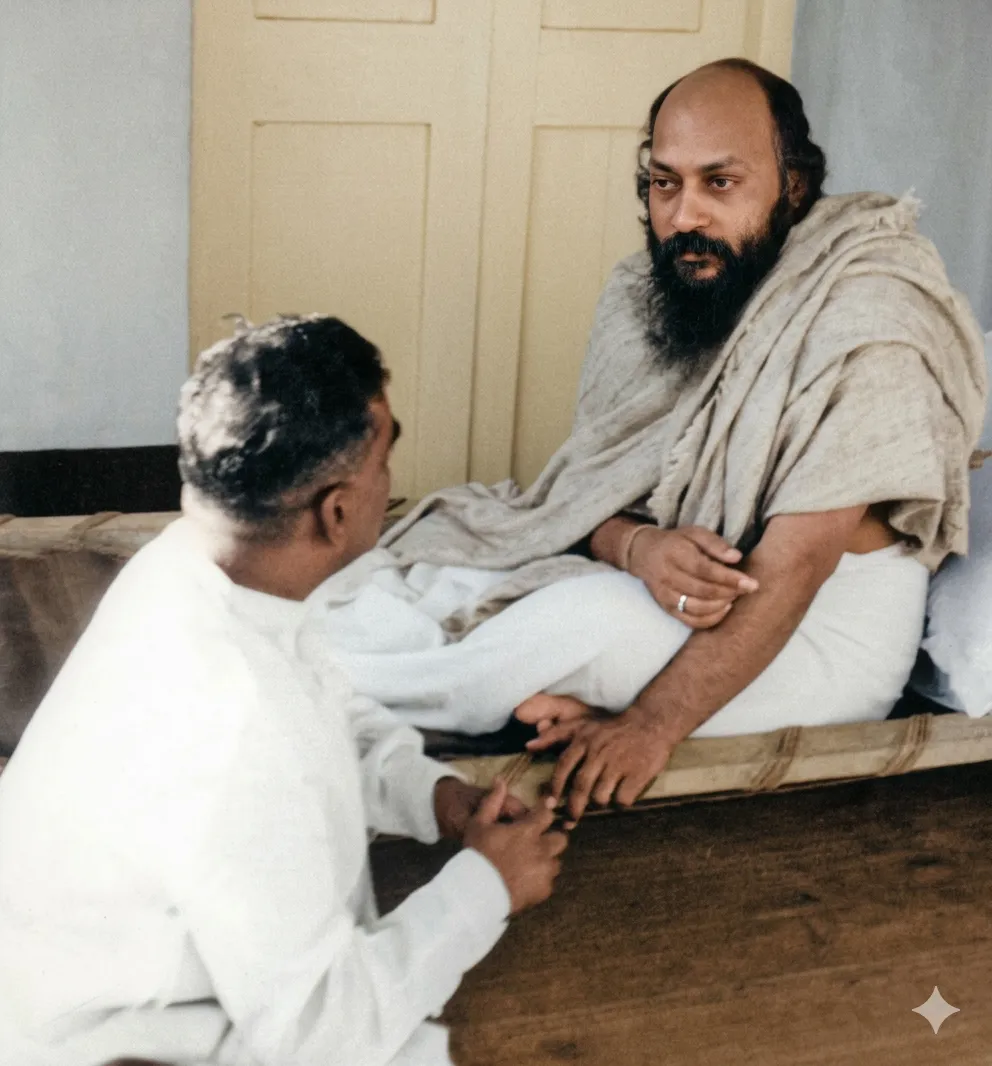
Osho's perspective on Sahaj Samadhi
When Osho Spoke About Sahaj Samadhi
Passages from the discourses where this theme comes alive.
Osho, how is the breathing of a person who lives in the state of effortless samadhi?
It becomes very rhythmic, very cadenced, musical. And many things happen. One who is in sahaj samadhi twenty-four hours a day, whose mind does not waver, does not wander here and there, remains just as he is—who does not “live” in the ordinary sense but simply is, abides in existence—such a person’s breath takes on a rhythm all its own. And when he is doing nothing—not speaking, not eating, not walking—then the breath becomes for him a state of great bliss; then just being, just the movement of breath, gives a savor no other thing can give. It becomes very musical, very resonant with inner sound. A little taste of that experience can also be had through arranging the breath. That is why breath-regulations arose: that if one who is not established in samadhi moves his breath in the same rhythm and meter as the breath of one established in…
प्रश्न: ओशो, सहज समाधि की अवस्था में जो व्यक्ति जीता है, उसकी श्वास की अवस्था कैसी होती है?
बहुत ही रिदमिक हो जाती है, बहुत लयबद्ध हो जाती है, संगीतपूर्ण हो जाती है। और बहुत सी बातें होती हैं। जो आदमी चौबीस घंटे ही सहज समाधि में है, वह जिसका मन डोलता नहीं, इधर-उधर नहीं होता, जैसा है वैसा ही बना रहता है, जो जीता नहीं अस्तित्व में होता है, ऐसा जो आदमी है, उसकी श्वास एक बहुत ही अपने तरह की लयबद्धता ले लेती है। और जब वह कुछ भी नहीं कर रहा है--बोल नहीं रहा है, खाना नहीं खा रहा है, चल नहीं रहा है--तब श्वास उसके लिए बड़ी आनंदपूर्ण स्थिति हो जाती है; तब सिर्फ होना, सिर्फ श्वास का चलना इतना रस देता है जितनी और कोई चीज नहीं देती। और बहुत संगीतपूर्ण हो जाती है, बहुत नादपूर्ण हो जाती है। उस अनुभव को थोड़ा-बहुत श्वास की व्यवस्था से भी अनुभव किया जा सकता है। इसलिए श्वास की व्यवस्थाएं पैदा हुईं: कि जैसा सहज समाधिस्थ व्यक्ति की श्वास होती है, जिस रिदम, जिस छंद में चलती है, उसी छंद में दूसरा आदमी भी अपनी श्वास चलाए, तो उसे शांति का अनुभव होगा। …
Questioner: what is the state of breathing in what we call sahaj samadhi or natural ecstasy?
It becomes very rhythmic, very harmonious, it becomes musical; and there are many other things to it. The person who is twenty four hours in sahaj samadhi, whose mind does not waver, who is still and quiet, who is established in existence, who is one with it, his breathing takes on a rhythm of its own. And when he is not doing a thing--neither eating, nor speaking nor walking--then breathing becomes exceeding blissful for him. Then just being, just breath ing brings him such joy and bliss that nothing else can bring. His breathing is very rhythmic and harmonious; it turns into a soundless sound, the sound of one hand clapping. A taste of that unearthly experience can be had through breathing in a particular way. That is why disciplines of breathing--yogic and others--were developed in the past. For instance, if a person makes his breathing as rhythmic and harmonious…
Osho, in this verse the fourth and final yajna is called the Yoga Yajna. In the Gita Press translation it is called the Ashtanga Yoga Yajna. Please clarify this as well.
Now a lovely thing: Om has A, U, and M. If you emphasize M, vibration immediately occurs at the navel. Islam has the word Allah. Sufi fakirs use the word Allah as with Om. “Allah”—the H lands just where M lands. “Allahu”—the Hu lands exactly at the navel where Om lands. Allah and Om are entirely different words, but the intent is one, and the result is one; the meaning too is one. The Sufi begins with Allah—Allah, then Lah, then Lahu, and finally only Hu remains. And Hu’s blow lands on the navel; and at the navel the sleeping master begins to awaken. By a thousand methods yoga awakens the sleeping master. And as soon as that master awakens, integration arises in the personality—yoga happens. Fragments gather together. The marketplace disappears; soldiers in formation stand. Then the personality obeys command. In the market’s crowd no one obeys; there is…
प्रश्न: ओशो, इस श्लोक का चौथा और आखिरी यज्ञ योग यज्ञ कहा गया है। गीता प्रेस के अनुवाद में इसे अष्टांग योग यज्ञ कहा गया है। कृपया इसे भी स्पष्ट करें।
अब यह बड़े मजे की बात है। ओम में अ, उ और म हैं। म आप जोर से कहें, तो नाभि पर फौरन कंपन होगा। इस्लाम के पास शब्द है, अल्लाह। सूफी फकीर ओम की तरह अल्लाह शब्द का प्रयोग करते हैं। अल्लाह, तो ह की चोट वहीं पड़ती है, जहां म की पड़ती है। अल्लाहू, तो हू की चोट ठीक वहीं पड़ती है नाभि पर, जहां ओम की पड़ती है। अब अल्लाह और ओम बिलकुल अलग-अलग शब्द हैं। लेकिन प्रयोजन एक है, और परिणाम एक है। अर्थ भी एक है। सूफी फकीर अल्लाह से शुरू करता है। अल्लाह, फिर लाह, फिर लाहू। और फिर हू ही रह जाता है। और हू की चोट नाभि पर पड़ती है। और नाभि पर सोया हुआ मालिक जगना शुरू होता है। हजार विधियों से योग सोए हुए मालिक को जगाता है। और उस सोए हुए मालिक के जगते ही व्यक्तित्व में इंटीग्रेशन, योग पैदा हो जाता है। खंड इकट्ठे हो जाते हैं। बाजार समाप्त हो जाता है। पंक्तिबद्ध सैनिक खड़े हो जाते हैं। फिर व्यक्तित्व आज्ञा मानता है। बाजार की भीड़ में कोई आज्ञा नहीं मानता। मानने का कोई सवाल भी नहीं है। …
A friend has asked: Osho, is the samadhi attained when consciousness is lost a state of swoon? Sri Ramakrishna Paramhansa would lie for days as if near death!
In the West they have invented new ways: even blows are not enough; so they set up many lights, rapidly changing, deafening sound, assorted dances and songs; a completely deranged atmosphere is created. After an hour in that derangement one feels: ah, there is some life, some experience of living! We have died so much that unless the blow is enormous, there is no experience of life. Soft tones we cannot hear at all. Yet the natural tones of life are all soft. We cannot hear the night’s silence, nor the heart’s own beat. Have you ever heard the sound of your blood’s flow? It is very soft; you cannot hear it; but there is a sound. Buckminster Fuller wrote that for the first time he went into a building—a scientific laboratory—completely soundproof, where no sound from outside could enter. Inside he began hearing two kinds of sounds. He asked…
एक मित्र ने पूछा है कि ओशो, चेतना के खो जाने पर प्राप्त समाधि क्या मूर्च्छा की अवस्था है? रामकृष्ण परमहंस कई दिनों तक मृतप्राय अवस्था में लेटे रहते थे!
पश्चिम में उन्होंने नए रास्ते निकाले हैं। केवल चोट से भी काम नहीं चलता, तो बहुत तरह के प्रकाश लगा लेते हैं। प्रकाश बदलते रहते हैं तेजी से। बहुत जोर से शोर मचता रहता है। कई तरह के नाच, कई तरह के गीत चलते रहते हैं। एक बिलकुल विक्षिप्त अवस्था हो जाती है। तब घंटेभर उस विक्षिप्त अवस्था में रहकर किसी आदमी को लगता है, कुछ जिंदगी है; कुछ जीवन का अनुभव होता है! हम इतने मर गए हैं कि जब तक बहुत चोट न हो, तो जीवन का भी कोई अनुभव नहीं होता। धीमे स्वर तो हमें सुनाई ही न पड़ेंगे। और जीवन के नैसर्गिक स्वर सभी धीमे हैं। वे हमें सुनाई नहीं पड़ेंगे। रात का सन्नाटा हमें सुनाई नहीं पड़ेगा। हृदय की अपनी धड़कन हमें सुनाई नहीं पड़ेगी। आपने कभी अपने खून की चाल की आवाज सुनी है? वह बहुत धीमी है; वह सुनाई नहीं पड़ेगी। लेकिन आवाज तो हो रही है। बक मिनिस्टर फुलर ने लिखा है कि मैं पहली दफा एक ऐसे भवन में गया, एक विज्ञान की प्रयोगशाला में, जो पूर्णरूपेण साउंड-प्रूफ थी, जहां कोई आवाज बाहर से भीतर नहीं जा सकती थी। …
Profound Quotes on Sahaj Samadhi
Explore our structured collection of meaning-mapped quotes regarding Sahaj Samadhi.