
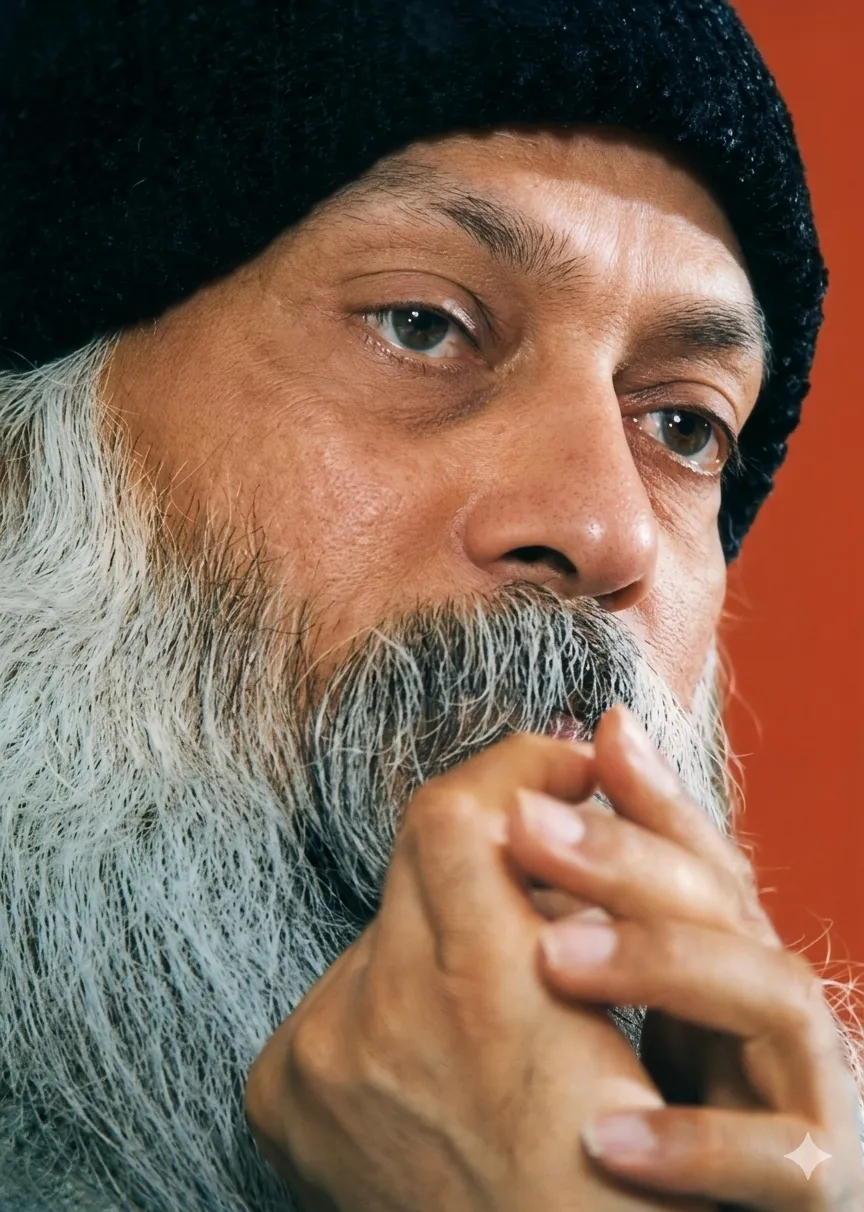
Osho's perspective on Dialectics
When Osho Spoke About Dialectics
Passages from the discourses where this theme comes alive.
A friend has asked: Osho, while explaining the vast form of the Divine, yesterday you spoke of the dialectical existence of birth and death, creation and dissolution, the beautiful and the terrible, and so on. Please explain whether that supreme truth which is called Amrit or Sat-Chit-Ananda is the sum of these opposites, or whether it is some third reality beyond the two.
Duality is all around. Wherever you look in the world, you will never see the One; the opposite will always be present. The very way the world exists is impossible without the opposite. Understand this one thing well. Just as a mason builds an arched doorway by fitting opposite bricks together—if the bricks are laid all in one direction, the arch will collapse. Opposing bricks, by working against each other, become the very support that holds the doorway up. The whole universe is made of opposing bricks. There is light only because there is also darkness; and darkness can be only so long as there is light. Light and darkness are opposite bricks, for two reasons. First, all the bricks are of the same substance, so we can set them in opposition. Darkness and light are two forms of the same reality. The bricks are alike, yet they are placed…
एक मित्र ने पूछा है कि ओशो, परमात्मा के विराट स्वरूप को समझाते हुए आपने कल जन्म और मृत्यु, सृजन और संहार, सुंदर और भयानक आदि के द्वंद्वात्मक अस्तित्व की बात की। समझाएं कि जिस परम सत्य को अमृत या सच्चिदानंद के नाम से कहा गया, वह उपरोक्त द्वंद्वों का जोड़ है, अथवा इन दो के अतीत वह कोई तीसरी सत्ता है?
द्वंद्व चारों ओर है। संसार में जहां भी देखेंगे, वहां एक कभी भी दिखाई नहीं पड़ेगा। विपरीत सदा मौजूद होगा। संसार के होने का ढंग ही विपरीत के बिना असंभव है। इस एक बात को ठीक से समझ लें। जैसे कि कोई मकान बनाने वाला राजगीर विपरीत ईंटों को जोड़कर गोल दरवाजा बनाता है। अगर एक ही रुख में ईंटें लगाई जाएं, तो दरवाजा गिर जाए। विपरीत ईंटें एक-दूसरे के प्रति विरोध का काम करके दरवाजे को सम्हालने का आधार बन जाती हैं। सारा जगत विपरीत ईंटों से बना हुआ है। वहां प्रकाश है, तो केवल इसीलिए कि अंधेरा भी है। और अंधेरा भी हो सकता है तभी तक, जब तक प्रकाश है। प्रकाश और अंधेरा विपरीत ईंटें हैं। …
Beloved Osho, I remember you saying once that the growth of man is dialectical; and you have also explained about thesis, antithesis and synthesis. Would you please give more clarity in this reference on the growth towards enlightenment?
That feeling cannot be expressed by "I" because "I" is just another way of saying "ego." Before enlightenment there was ego; ego can exist only in conflict. This state can be spoken of only as "am"-ness, without any "I." It is a very strange feeling: you are not, and yet you are. You are not your old self; you are no longer a self, but you have not lost the feeling of am-ness. So the question of what happens to individuals when they dissolve into the universal.... They still remain individuals, but with no assertion of "I" in them... just a silent song of am-ness or isness. It is as if we put hundreds of candles in this room; all their light will become one. You cannot differentiate in the light -- which part belongs to which candle -- it has become a universal phenomenon. But still, each candle has…
Although this logos is eternally valid, yet men are unable to understand it -- not only before hearing it, but even after they have heard it.
WE SHOULD LET OURSELVES BE GUIDED BY WHAT IS COMMON TO ALL. YET, ALTHOUGH THE LOGOS IS COMMON TO ALL, MOST MEN LIVE AS IF EACH OF THEM HAD A PRIVATE INTELLIGENCE OF HIS OWN. HUMAN NATURE HAS NO REAL UNDERSTANDING; ONLY THE DIVINE NATURE HAS IT. MAN IS NOT RATIONAL; ONLY WHAT ENCOMPASSES HIM IS INTELLIGENT. WHAT IS DIVINE ESCAPES MEN'S NOTICE BECAUSE OF THEIR INCREDULITY. ALTHOUGH INTIMATELY CONNECTED WITH THE LOGOS, MEN KEEP SETTING THEMSELVES AGAINST IT. HOW CAN ANYONE HIDE FROM THAT WHICH NEVER SETS? ... A man who rejects anything does not know what he is doing. And if a man rejects sound he will reject silence also, because they exist together. Have you known any silence without sound? -- because silence has its own sound. If the night is completely silent, no traffic, nobody moving, everybody gone to sleep, watch and listen and you will find
Osho, today I shall ask about contradiction. To me, sir, this issue has been very confusing. Socrates cleansed the system by advocating democracy; over time Aristotle’s attitude shifted toward changing the system. I agree with your view that our future organizations will be organizations of love, not of domination. But I must admit, sir, that to run a government—whether of small units or of work organizations—we will have to frame a code of conduct which checks the malpractices of bad elements and keeps the system sound. May I have, sir, the details?
Large nations are antagonistic to this; they obstruct. They too call for international government, but what they mean is to dominate—to become the international government themselves. The call for internationalism is very old, and it has come in two kinds: Alexander and Genghis Khan too wanted an international government—one world under their rule. But that could not be; the very feeling was wrong. In that way, an international government can never be formed. It will arise on the basis that the units are small—so small as to be negligible in terms of power—and thus able to unite and come together. Therefore the nation must go. In the future, there can be no place for nation-states. There will be small towns, small districts, small clusters that wish to associate. Those small clusters will organize themselves; they can manage within their small bounds. They will have no great power. Their administrative thread…
ओशो, टुडे आई शैल आस्क अबाउट कंट्राडिक्शन। टु मी सर दिस इस्यू हैज बीन वेरी मच कनफ्यूजिंग। साक्रेटीज क्लीन्स दि सिस्टम बाई प्रोनाउंसिंग दि डेमोक्रेसी, व्हेयर इन ड्यूरेशन ऑफ टाइम चेंज्ड द एटिट्यूड ऑफ अरिस्टोटल टु चेंज दि सिस्टम। आई एग्री विद योर व्यूज़ दैट अवर फ्यूचर आर्गनाइजेशंस विल बी दि आर्गनाइजेशंस ऑफ ओवर लव नॉट ऑफ डॉमिनेशंस। बट आई हैव टु एडमिट सर दैट टु रन ए गवर्नमेंट व्हेदर ऑफ स्माल यूनिट आर ऑफ वर्क आर्गनाइजेशंस, वी शैल हैव टु फ्रेम ए कोड ऑफ कंडक्ट व्हिच शैल चेक दि माल-प्रेक्टिसस ऑफ दि बैड एलिमेंट्स एण्ड कीप दि साउंड सिस्टम। शुड आई हैव फ्रॉम यू सर दि डिटेल्स ऑफ अकाउंट?
बड़े राष्ट्र उसमें विरोधी हैं, बाधा डालते हैं। बड़े राष्ट्र भी अंतर्राष्ट्रीय सरकार चाहते हैं लेकिन उसका मतलब यह होता है कि वे हावी हो जाएं और वे अंतर्राष्ट्रीय सरकार बन जाएं। अंतर्राष्ट्रीयता की पुकार बहुत पुरानी है, वह दो तरह की है। दुनिया में सिकंदर ने और चंगीज ने भी अंतर्राष्ट्रीय सरकार चाही है। पर वह सरकार उनकी हो। वे छा जाएं, एक राष्ट्र हो जाए सारी दुनिया। लेकिन वह नहीं हो सका। वह भावना ही गलत थी। उस भांति कभी कोई अंतर्राष्ट्रीय सरकार नहीं बन सकती। अंतर्राष्ट्रीय सरकार बनेगी इस आधार पर कि छोटे यूनिट, इतने छोटे यूनिट कि उनका कोई अर्थ नहीं है शक्ति के मूल्यों में, वे ही संयुक्त हो सकते हैं और इकट्ठे हो सकते हैं। इसलिए राष्ट्र जाना चाहिए। राष्ट्रों की कोई जगह नहीं हो सकती है भविष्य में। होंगे छोटे-छोटे नगर, होंगे छोटे-छोटे जिले, होंगे छोटे-छोटे टुकड़े, जो आपस में इकट्ठे होना चाहते हैं। वे छोटे टुकड़े इकट्ठे होंगे और जो अपने को छोटी सीमा में मैनेज और व्यवस्थित कर सकते हैं, ये इकट्ठे होंगे। …
What is the meaning of dialectical?
definitionProfound Quotes on Dialectics
Explore our structured collection of meaning-mapped quotes regarding Dialectics.