
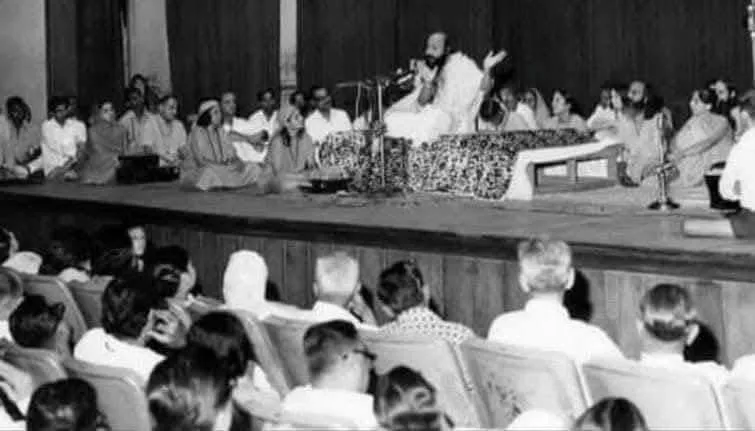
We stay busy with unimportant things because we’re scared to feel empty inside; if we sit quietly and face it, the fear and ego fade and we feel peaceful.
From the Discourses
Passages where Osho speaks to this question — each links to the complete discourse.
Osho, why does a person keep getting entangled in futile things?
Because of fear. Out of fear. Fear of what? There is only one fear that follows people like a shadow, twenty-four hours a day, awake or asleep—and that fear is that if I don’t stay busy, if I don’t stay entangled, I might catch sight of the emptiness within, I might glimpse that bottomless abyss. And that abyss is there. So the fear is not a total lie, not baseless. If you become completely unoccupied, with nothing to do, you will suddenly begin to experience your inner void—you will feel empty, hollow. You will quickly rush to busyness. Because in emptiness the ego dies, it melts. The egoist has to remain busy. Only by staying busy can the egoist assure himself that he is somebody. That is why people want to do big things—not small ones, big things. They want to do such things that the whole world will know:…
In reality he is not running towards something, he is trying to escape from something. But it is impossible to escape from one place without fixing one's sights on another -- and that is why he focuses on material objects. The root cause of man's escapism is his inner emptiness, but outwardly it takes the form of trying to attain something, of trying to reach somewhere else. In fact he is running to escape from his self. But to accept this as a fact is to expose our own escapism and so we indulge ourselves in theories about freedom from the wheel of birth and death. This self-deception is very deep-rooted and unless one breaks this chain of deceit he will never free himself from ambition. If a man fails at one ambition he simply selects another, if he fails in the world he will create an ambition for God.
Osho, you have titled this series of talks “Sahaj Yoga.” Do “sahaj” and “yoga” not seem mutually opposed?
Anand Maitreya! They don’t just seem opposed, they are opposed. But no ultimate truth of life can manifest without contradiction. Life is made of opposites—darkness and light, day and night, woman and man, negative electricity and positive electricity, birth and death. The very structure of life is woven of opposites. Hence the opposites are not only opposed; they are complementary to each other. If you have labored hard all day, you will be able to sleep deeply. Labor and rest are opposites, yet only the one who has worked can rest deeply—and the one who has not worked cannot. So the opposites are not only opposed, they complete each other. And only the one who has rested deeply at night can rise in the morning and engage in work again. One who has not rested through the night will not be able to work in the morning. Look closely at…
Osho, why is there so much secrecy in the ashram?
The ashram is not a marketplace; it is not open to the crowd. Here I am available to those few who genuinely want to be transformed. Sightseers, passersby—there is no purpose in their coming here. The invitation is only for those who have truly come close to transformation, for that small number. Therefore there is privacy in every respect. And the privacy will increase. Because as I see that more of the unnecessary can be sifted out, I will sift them out—since they themselves gain nothing, and by their presence they do not let others gain either. I have remained open to all for a long time and have seen what happens. I found that the crowd of the pointless becomes so thick that the meaningful person gets no chance at all. The merely curious surround so much that the true inquirer is left standing at the back. The mumukshu—the…
Osho, your discourse yesterday touched me very deeply. That saying—that even fish have learned to recognize the hook hidden in the dough, but man has not—shook me. It compelled me to think that I am living a futile life, going round and round like an ox at the oil press. Please accept my pranam for this realization, and bless me that I may live consciously.
If it has all vanished as the insubstantial, fallen like houses built on sand, erased like lines drawn on water”—on that very day begins the search for that which is eternal: Esa dhammo sanantano—such is the eternal law. The journey toward the eternal begins when the transience and futility of life are seen. Good; do not panic—because in that moment panic will seize you. When the whole life looks futile, all thinking an insanity, everything you have done turns to dust; so much effort made, so many buildings raised, and all have fallen—suddenly a panic grips you. In that panic many people start running even faster, thinking perhaps we were not running properly. Others are arriving—someone became an Alexander, someone a Napoleon—others are getting there; only I am not. Surely there is some deficiency in my running. Some panic and begin to run faster still. Do not make that mistake!…