
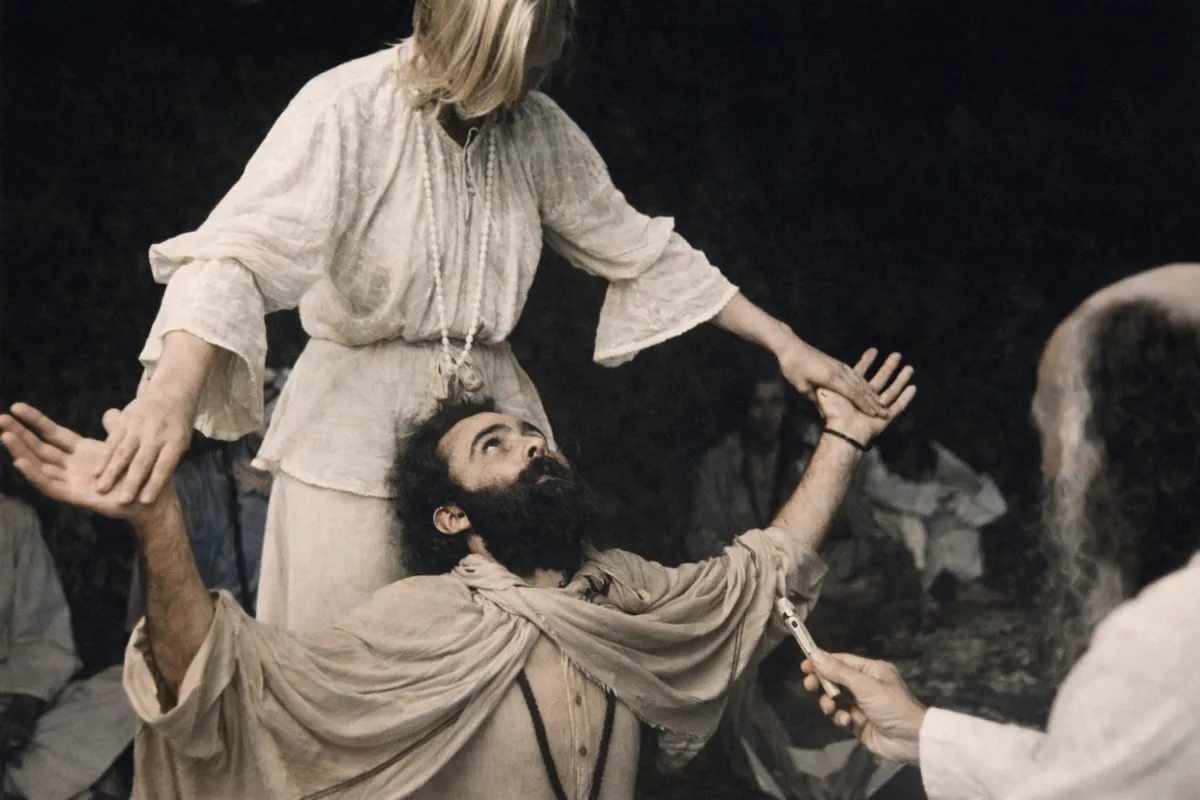
According to Osho, people become sannyasins for countless personal reasons, yet the authentic impulse is unreasonable: a heart-born love affair and inner communion that defies explanation. When reasons are given, it’s from the head—a sign of the pseudo. True sannyas happens mysteriously, like falling in love; individuals open in different ways and times, drawn by an inexplicable click with the master.
People join because their heart suddenly clicks with the master and path, not because of logical reasons—if you can neatly explain it, it’s probably not the real thing.
From the Discourses
Passages where Osho speaks to this question — each links to the complete discourse.
Question: BELOVED MASTER, WHY DO SO MANY PEOPLE BECOME SANNYASINS? Murphy.... My God, are you the same Murphy I have been quoting and misquoting? You should have told me before! But you must be, I hope, some other Murphy, because if you were the same Murphy you would not ask such a question. That old guy is so wise he only gives answers, he never asks questions. You ask me, "Why do so many people become sannyasins?" Everybody does so for a different reason; hence it is very difficult to answer. The real sannyasins cannot even give any reasonable answer why they have become sannyasins. It is a kind of love affair; they fall in love with this madman. It is utterly mad, it is absurd. They simply find some inner communion; something happens to their heart, not to their head.
Beloved Osho, why do you give sannyas to almost anybody who comes to see you? What is your concept of sannyas? What obligation does it involve?
But once you know a greater phenomenon -- a greater bliss, a greater happiness -- then you are not renouncing things. They just drop away, just like dry leaves from the tree. No one knows and no one hears, the dry leaves just drop. The tree remains oblivious to it and there is no wound left behind. So, to me, everything has a moment to happen, a moment of ripeness -- ripeness is all. One must ripen; otherwise one will be wandering unnecessarily and harassing himself unnecessarily and destroying himself unnecessarily. One should ripen, then the opportunity comes by itself. So renunciation is through positive growth. That is what I mean by my sannyas -- renunciation through positive growth. There is no negativity at all, no denial, no suppression. I accept the human being as he is. Of course, now much is potential, but as he is, he is not…
A:* There is. Rajneeshee is the name given by others to my people. Sannyas is my peoples' decision to be with me, to allow me, reach their hearts, to be open to me, to remain available to me. Sannyas simply means your decision, that you would like to be in as intimate contact with me as possible. It is a totally individual decision and all my sannyasins are related to me directly, individually. They are all together because they all love me, otherwise there is no ism that is binding them together. Their love is the only thing that is binding them together: because they love me, naturally they have started loving each other. Sannyas is a totally different thing. It is not an ism. It is a love affair. Yes, exactly a love affair.
Sannyas is a quantum leap, a jump into the unknown, a great courage to become discontinuous with your own past. It is a rebirth. It is a change so great... as if the old dies, and dies utterly and totally and the new comes into being from nowhere, from nothingness, out of nothing. If the new comes from the old it remains the old. If the new is continuous with the old then it is only a modification of the old -- maybe a little bit colored and decorated and changed, with a new dress, with a new mask, but it is not a revolution, it is not a conversion. And sannyas to be true has to be a revolution so total that the old identity is simply dropped -- just as the snake slips out of the old skin and never looks back.
The sannyasins who are coming to me, I have nothing to offer to them. In fact, they will be condemned by their societies, by their religions. They will be condemned by their families, by their friends. They are not going to gain anything, they are going to lose much. But still something in their hearts starts moving -- it is beyond the control of their mind. In spite of themselves they become sannyasins. It takes time. For a time there is a conflict between their hearts and their minds. The mind is trying to pull them back, telling them to remain where they were, giving all the arguments that they will be simply a loser and will not gain anything. But sooner or later the mind must lose. If there is something that is pulling your heart, mind can fight for a time but cannot win.