
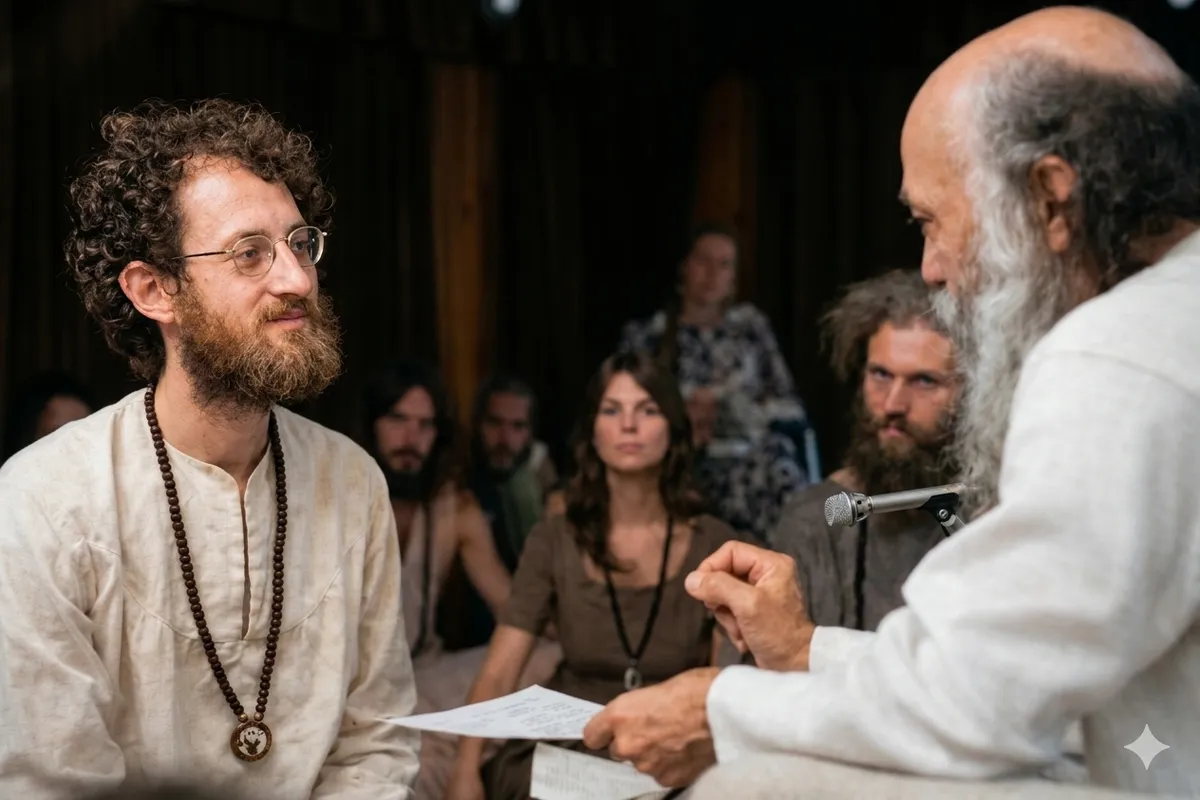
Stories grow around sages to show the deep truth and human feelings inside, not just dates and facts.
From the Discourses
Passages where Osho speaks to this question — each links to the complete discourse.
Why do Puranic, mythic tales gather around enlightened ones? Please explain.
The full moon is a symbol of fullness. Grasping that symbol, the Purana says: the Buddha was born whole—born on a full-moon night—born cool, radiant, with the complete beauty, carrying a unique ambrosia. Then, on a full-moon night, that hidden nectar within him flowed forth, blossomed, opened like a lotus—he attained. And on a full-moon night he departed, for even the death of a buddha is full, as his birth was full. Everything in the Buddha’s life is complete. To say this—that everything in the Buddha’s life is complete—we chose the symbol of the full moon. People choose different symbols, but the value lies not in the symbol itself; the value is in the meaning we pour into it. That is why Puranas arise around enlightened ones; mythic stories are created. Through the meanings hidden in those stories you can understand what buddhahood signifies. There are two kinds of fools…
चौथा प्रश्न: बुद्धपुरुषों के साथ पुराण कथाएं क्यों जुड़ जाती हैं। कृपा करके समझाइए।
पूर्णिमा तो प्रतीक है पूर्णता का। उस पूर्णता के प्रतीक को पकड़कर पुराण कहता है, बुद्ध पूरे पैदा हुए--पूर्णिमा की रात पैदा हुए--शीतल पैदा हुए, पूरी छवि से पैदा हुए, पूरे सौंदर्य से पैदा हुए, अपूर्व अमृत को लेकर पैदा हुए। फिर पूर्णिमा की रात्रि ही उनके भीतर छिपा हुआ यह अमृत बहा, प्रगट हुआ, स्फुटित हुआ, यह कमल खिला। फिर पूर्णिमा की रात को ही बुद्ध ज्ञान को उपलब्ध हुए, क्योंकि ज्ञान भी पूर्णिमा की रात्रि है। फिर बुद्ध पूर्णिमा की रात्रि ही विदा हुए, क्योंकि मृत्यु भी बुद्ध की पूर्ण होगी, जन्म भी पूर्ण होगा। बुद्ध के जीवन में सभी पूर्ण है। इस बात को कहने के लिए कि बुद्ध के जीवन में सभी पूर्ण है, हमने यह प्रतीक चुन लिया, यह पूर्णिमा की रात्रि। प्रतीक लोग अलग-अलग चुनते हैं, लेकिन प्रतीक मूल्यवान न होकर, प्रतीकों में जो हम अर्थ डालते हैं वह मूल्यवान है।
Osho, there is a story in the life of paramahansa ramakrishna, and we have heard it from you more than once, about his lust for the palate which sharada devi told about. Doesn't it indicate that desire is intrinsically related to living, to life itself?
One way is through something else. I give you a message, then you give it to somebody else, then he to somebody else. Then it reaches to whomever it was to be given -- to whom it may concern. Then it reaches -- and it has changed. Every time it is given to someone, it is changed. With our eyes we don't see alike. We cannot see alike because in a subtle way every instrument is different. So when I see light I feel it in a different way. When you see light you feel it in a different way. When a Van Gogh sees the sun, certainly he sees it in a different way, because he will become just mad, begin to dance, cry, scream. He will just be mad when he sees the sun. For one year Van Gogh continuously painted only sun pictures. He would not sleep:…
Those like Buddha or Christ, who wear clothes, are as capable of nakedness as Mahavira. They have nothing to hide. But perhaps others are not ready to see nakedness—why assault them? To veil the eyes of others, the simplest way is to put cloth on one’s own body. I have heard—when thorns first troubled people’s feet, a king summoned wise men to find a protection. They proposed—cover the whole earth with leather. The king said—where will you find so much leather? The earth is vast. A servant suggested—cover the feet with leather; then wherever you go, there will be leather. Likewise, the simplest way to cover everyone’s eyes is to cover your own body. Going to cover all eyes is impossible. Even so, this remains hard. Hence two opinions arose about Mahavira’s nakedness. Certainly he was naked; there is no second option.
ये बुद्ध या क्राइस्ट जैसे लोग, जो वस्त्र पहने हुए हैं, ये भी नग्न होने की उतनी ही हैसियत रखते हैं, जितनी महावीर। इनके भीतर कुछ छिपाने को नहीं है। लेकिन हो सकता है दूसरा नग्नता न देखना चाहे, तो दूसरे पर आक्रमण भी क्यों करना! तो दूसरे की आंख पर उन्होंने वस्त्र डाला हुआ है, अपने शरीर पर नहीं। और दूसरे की आंख पर भी वस्त्र डालने का सबसे सरल उपाय यही है कि अपने शरीर पर डाल दो। क्योंकि मैंने सुना है कि जब सबसे पहले जमीन पर कांटों ने तकलीफ दी, तो एक सम्राट ने बुद्धिमान लोगों को बुला कर पूछा कि क्या करें? कैसे बचें? तो बुद्धिमानों ने कहा कि एक काम करें, सारी पृथ्वी को चमड़े से ढंक दें। इसलिए कि हम चमड़े पर चलें और कांटे न गड़ें। सम्राट ने कहा, इतना चमड़ा कहां से लाओगे? पृथ्वी बहुत बड़ी है। बड़ी मुश्किल में पड़ गए बुद्धिमान लोग। बहुत सोचा। बुद्धिमानों को बड़ी चीजें जल्दी सूझ जाती हैं, छोटी चीजों से चूक जाते हैं। तब राजा के एक नौकर ने कहा कि आप भी कैसी पागलपन की बातों में पड़े हैं! …
Many western historians feel that humanity is constantly making progress. If this is the case, then how is it that human consciousness is so unevolved?
Mark and Luke are contradictory because they are writing history. But Tulsidas and Valmiki are not contradictory. They are not writing history, they are not concerned with history at all. They are reliving, in their imaginations. They say, "We cannot say much. We cannot say enough because we are not capable. All that is said is only a fragment. It is not the whole story." If you yourself see Krishna, you will see something else altogether. But you are at liberty to see it because the event is not historical. So the life of Krishna or of Ram, becomes very rich. Jesus' recorded life was very poor because his followers were obsessed with history. They could not write anything that was beyond history. The eastern mind could see that we cannot do justice to Krishna or Buddha if we limit ourselves to bare events. This will be an injustice because…
Performing samyama on the present moment, the moment gone, and the moment to come brings knowledge born of the awareness of the ultimate reality. From this comes the ability to distinguish between similar objects which cannot be identified by class, character, or place.
THE HIGHEST KNOWLEDGE BORN OF THE AWARENESS OF REALITY IS TRANSCENDENT, INCLUDES THE COGNITION OF ALL OBJECTS SIMULTANEOUSLY, PERTAINS TO ALL OBJECTS AND PROCESSES WHATSOEVER -- IN THE PAST, THE PRESENT, AND THE FUTURE AND TRANSCENDS THE WORLD PROCESS. ... The chronological time is fixed, it has to be fixed, because it is a social necessity; but the psychological time is fluid, it is not so solid, because each person has his own psychology, his Own mind. Have you watched? When you are happy, time goes fast. Your clock will not go fast; the clock has nothing to do with you. It moves at its own pace -- in sixty seconds it moves one minute, in sixty minutes it moves one hour. It will continue; whether you are happy or unhappy doesn't matter. If you are unhappy your mind will be in a different time; if you are happy your mind