
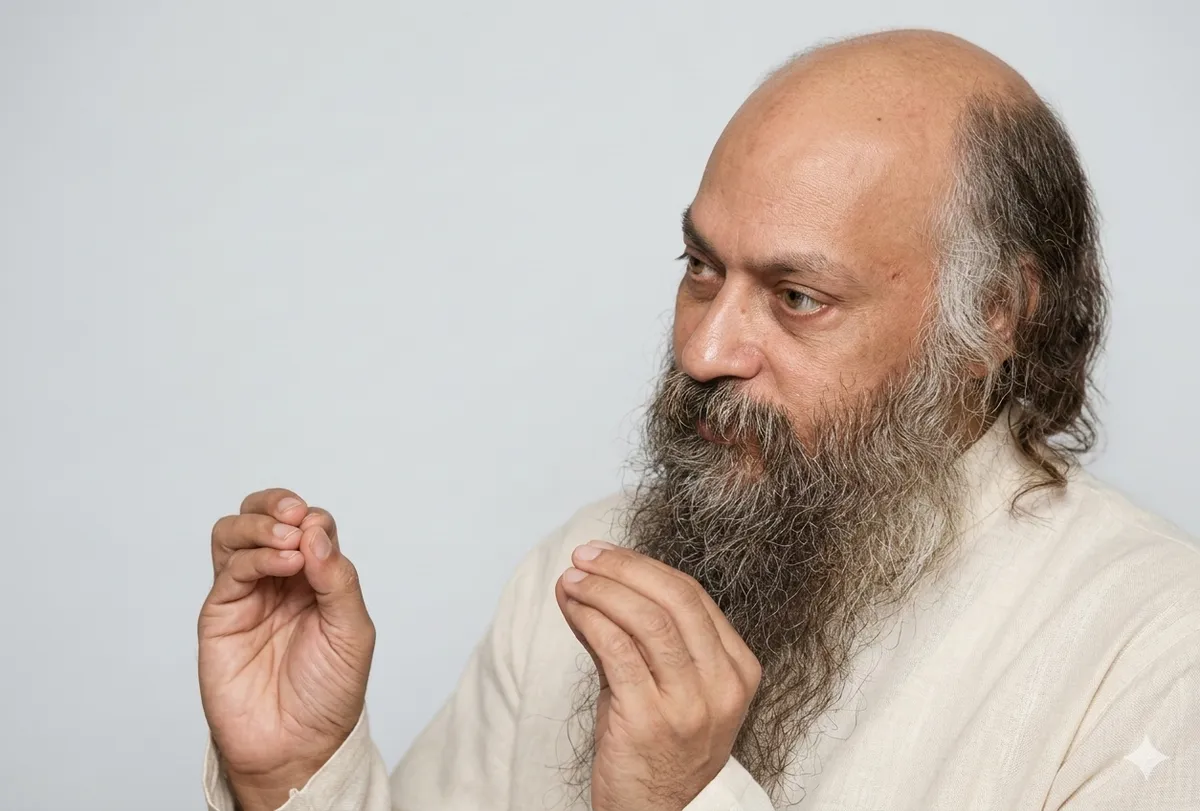
There’s a pretend ‘me’ that sleeps and a real me that wants to wake up; when waking happens, the pretend me disappears and the real, peaceful me remains.
From the Discourses
Passages where Osho speaks to this question — each links to the complete discourse.
Osho, why do I want to wake up when, as you say, awakening only happens when I am not? This seems very paradoxical.
Deva Satyarthi, THE EGO IS NOT YOUR REAL SELF; the ego is a false entity, arbitrary. It is the ego that is your sleep, that surrounds you like a darkness, like a cloud. Hidden behind this darkness is your real self, your real being, which wants to wake up, which wants to get out of all this smoke, out of all this darkness, which wants to get out of the prison of the ego. There is really no paradox, it only appears so. It appears paradoxical. Your question seems relevant... but you have two selves. One is the real: the one that you were born with, the one that was even before your birth, the one that will be there even when death has happened, the one that is running underneath like a hidden current. And the other is created by you, by your family, by your church, by your…
Such is our unconsciousness! We do not know our own condition—we hear from others that we are troubled. The awakened come and shout in your ears that you are asleep—but you, even in sleep, are dreaming that you are awake. You are engaged in all ways to avoid—lest the sleep be broken. You have invested so much self-interest in sleep, you have decorated such sweet dreams, that you are afraid this sleep might end—then what will happen to this golden palace I have built? What of these apsaras I have invoked! Are you asleep, O unknowing one? Wake up. Make your life true by awakening. For only those who have awakened have known the truth of life. Only they have made life true. The rest live untrue lives. Had I had more awareness in the course of life, with each breath a revolution would have happened within me.
ऐसी हमारी बेहोशी है! हमें अपनी हालत का खुद ही पता नहीं हैं। औरों से सुना है कि परेशान हूं मैं! लोग कहते हैं कि तुम सोए हो। तुम्हें पता नहीं कि तुम सोए हो। आते हैं बु़द्ध और चिल्लाते हैं तुम्हारे कानों में कि तुम सोए हो, लेकिन तुम नींद में भी जागने का सपना देख रहे हो। तुम हर तरह से बचने की कोशिश में संलग्न हो--नींद न टूटे, नींद बनी रहे। तुमने नींद में इतने न्यस्त स्वार्थ जोड़ दिए हैं, तुमने इतने मीठे-मधुर सपने सजा लिए हैं कि तुम्हें डर लगता है कि कहीं सच में ही यह नींद न हो। नहीं तो इस महल का क्या होगा--सोने का महल जो मैंने बनाया! ये जो अप्सराएं उतरी हैं, इनका क्या होगा!
If life is an interdependence and an organic whole, how can one awaken while the rest of humanity is fast asleep?
But I can understand your difficulty. When you see millions of waves on the surface of the ocean, and if those waves are conscious like you, then each wave will think that it is separate from the other waves. And it will be as logical as your question is logical -- because each wave will say, 'I am separate. I can see it.' And it can prove it also. The wave can say, 'When the other wave disappears I remain, so how is it possible? If we were together and the same, in the disappearance of the other I would also disappear.' Or, 'I disappear but other waves remain, so how can we be together?' That's what you are asking. A man dies. Now you can ask, 'If he is one with the whole existence then how can he die alone? The whole existence should die.' A child is born…
Osho, you spoke of two kinds of sleep. One is the ordinary sleep from which we wake in the morning when it is complete. The other is what we call spiritual sleep, in which we are all asleep—even during the day. To wake from that sleep too, is it necessary that it also be allowed to complete itself?
When Buddha was born, astrologers said that when he grew up he would either become a renunciate or a great emperor. His father grew very anxious. To become a great emperor—this a father can desire—but if he becomes a renunciate, that would be a painful event. It is easy to touch the feet of a renunciate, but if your own son wants to renounce, it hurts deeply. If someone else’s son renounces, you even go and touch his feet. The father was troubled. He asked the astrologers, “Then what can be done so that he does not become a renunciate?” They said, “Only one thing: see that his sleep is never disturbed at all. Because sometimes, through a disturbance, a man wakes.” It is not necessary that only an alarm awakens you—the alarm is merely a disturbance. Clouds may thunder in the sky and your sleep may break. Some circumstance…
ओशो, आपने दो तरह की नींद की चर्चा की। एक तो साधारण नींद है, जिससे हम सुबह जागते हैं जब वह नींद पूरी हो जाती है। दूसरी नींद, जिसे हम आध्यात्मिक नींद कहते हैं; जिसमें हम सब सोये हैं, दिन में भी सोये हैं, उससे जागने के लिए भी क्या जरूरी है, कि वह नींद पूरी हो जाये?
बुद्ध का जन्म हुआ, ज्योतिषियों ने कहा कि यह युवक होकर या तो संन्यासी हो जायेगा, और या महाप्रतापी सम्राट होगा। पिता बहुत चिंतित हुए। महाप्रतापी सम्राट हो यह तो पिता चाहे, लेकिन पिता...यह तो दुखद घटना बने अगर यह संन्यासी हो जाये। संन्यासी के चरण छूना आसान है, लेकिन तुम्हारा बेटा संन्यासी होना चाहे तो बड़ी पीड़ा होती है। दूसरे का बेटा संन्यासी हो तो तुम पैर भी छू आते हो। पिता बहुत परेशान हुए। ज्योतिषियों से कहा कि फिर क्या उपाय है कि यह संन्यासी न हो? उन्होंने कहा एक ही उपाय है, कि इसकी नींद में जरा भी दखल न पड़े। क्योंकि कभी-कभी दखल पड़ने से आदमी जग जाता है।
Oh lotus-eyed one, sweet of touch, when singing, seeing, tasting, be aware you are and discover the ever-living.
WHEREVER SATISFACTION IS FOUND, IN WHATEVER ACT, ACTUALIZE THIS. AT THE POINT OF SLEEP, WHEN THE SLEEP HAS NOT YET COME AND THE EXTERNAL WAKEFULNESS VANISHES, AT THIS POINT BEING IS REVEALED. ILLUSIONS DECEIVE, COLORS CIRCUMSCRIBE, EVEN DIVISIBLES ARE INDIVISIBLE. ... That is why we are so much afraid of death: because the unreal is going to die. The unreal cannot be forever, and we are attached to the unreal, identified with the unreal. You as a Hindu will have to die; you as Ram or Krishna will have to die; you as a communist, as an atheist, as a theist, will have to die; you as a name and form will have to die. And if you are attached to name and form, obviously the fear of death will come to you, but the real, the existential, the basic in you, is deathless. Once the forms and names are forgotten,