
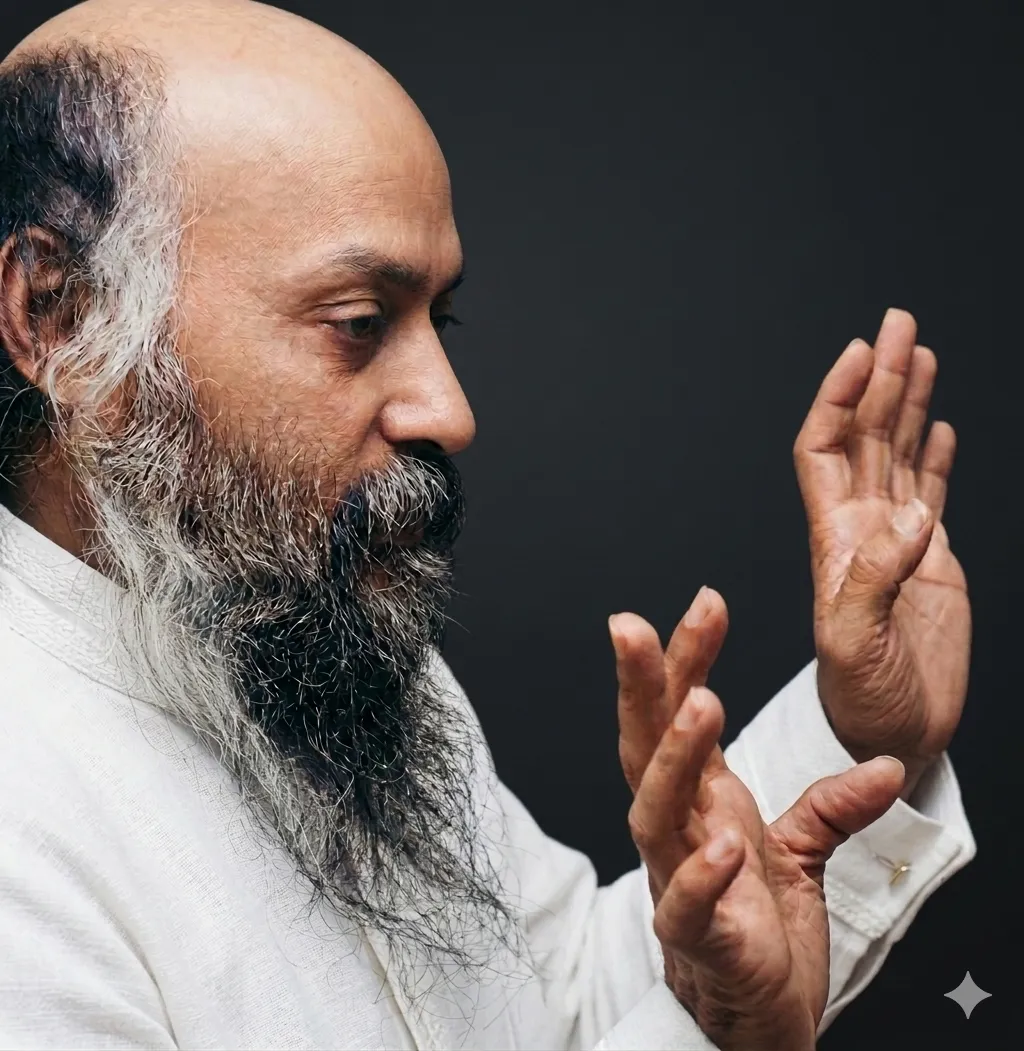
They kept women out because otherwise hostile society would have crushed the movement, so they compromised to keep it alive.
From the Discourses
Passages where Osho speaks to this question — each links to the complete discourse.
Today at the lecture you extolled the virtues of hasidism. But if they are so praiseworthy, so full of feeling of brotherhood, etc., why do they exclude women from their religious practices, and particularly their ecstatic religious dancing?
Pratima has asked the question. It is very relevant, and has to be understood. The first thing to remember, to always remember, is never to judge the past by present standards. That is not compassionate. For example, when Hasidism was arising, to allow women into a religiously ecstatic dance would have been impossible. Not that Hasidic mystics were not aware, not that they would not have liked to allow it -- they would have loved it -- but it was impossible. Even Buddha was afraid to initiate women into his order. What was the fear? Was he an orthodox person? No, you cannot find a more revolutionary mind, but he insisted for many years on not allowing women into his order. No, the reason is to be found somewhere else. A religion has to exist in the society. If the society is too much against a certain thing, even the…
Osho, why is the world in so much misery? Why can't we all be just as blissful as you always are?
He did not die, but I had taken a risky decision. My father stopped telling me to do things from that day. I said, "You can suggest, you cannot order. You have to learn to be polite to your own son, because as far as our beings are concerned, who is father and who is son? You don't possess me, I don't possess you; it is just an accidental meeting of two strangers. You had no idea to whom you were going to give birth. I had no idea who was going to be my father, my mother. It is just an accidental meeting on the roads. "Don't try to exploit the situation. Don't take advantage because you are powerful, you have money, and I don't have anything. And don't force me, because this is ugly. You suggest to me. You can always give me a suggestion that 'this is…
Osho, because women were admitted into the sangha, the religion of Lord Buddha lasted only five hundred years in India instead of five thousand. You, however, are allowing women free entry into your sangha; would you kindly tell us how long-lived your religion will be?
Worrying about the future is part of ignorance. Let tomorrow take care of what tomorrow will be. There is a story that Buddha worried about this, but how true that story is is hard to say. I have also told you many times that Buddha said, “Now my religion will last only five hundred years; women have been admitted.” This can have only one meaning; it certainly cannot mean that Buddha was concerned about the future. Whether a religion lasts five hundred years, five thousand, or fifty thousand—what use is that to Buddha? So the purpose must have been something else. That purpose is simply this: the life-discipline of Buddha was fundamentally developed for men. Mahavira’s life-discipline too was fundamentally developed for men. Both paths are of resolve, not surrender; of austerity, not of the Lord’s grace. In both their paths there is no place for God; there is no…
आखिरी प्रश्न: ओशो, स्त्रियों को संघ में प्रवेश देने के कारण, भगवान बुद्ध का धर्म भारत में पांच हजार की जगह पांच सौ वर्ष ही चला। आप तो अपने संघ में स्त्रियों को मुक्तभाव से प्रवेश दे रहे हैं; क्या बताने की कृपा करेंगे कि आपका धर्म कितना दीर्घजीवी होगा?
भविष्य की चिंता अज्ञान का ही हिस्सा है। कल क्या होगा, इसकी फिकर कल करेगा। बुद्ध ने इसकी फिकर की होगी, ऐसी कहानी तो है, लेकिन कहानी कहां तक सच है, कहना मुश्किल है। मैंने भी बहुत बार तुमसे कही है कि बुद्ध ने कहा कि अब मेरा धर्म पांच सौ वर्ष ही चलेगा, स्त्रियां सम्मिलित कर ली गई हैं। इसका एक ही अर्थ हो सकता है, इसका यह अर्थ तो हो ही नहीं सकता कि बुद्ध भविष्य की चिंता करते हैं। धर्म पांच सौ वर्ष चले कि पांच हजार वर्ष चले कि पचास हजार वर्ष चले, इससे बुद्ध को क्या प्रयोजन है?
Once, when the hasidim were seated together in all brotherliness, pipe in hand, rabbi israel joined them. Because he was so friendly they asked him, 'tell us, dear rabbi, how should we serve god?'
HE WAS SURPRISED AT THE QUESTION, AND REPLIED, 'HOW SHOULD I KNOW?' BUT THEN HE WENT ON TO TELL THEM THIS STORY.. THERE WERE TWO FRIENDS OF THE KING, AND BOTH WERE PROVED GUILTY OF A CRIME. SINCE HE LOVED THEM THE KING WANTED TO SHOW THEM MERCY, BUT HE COULD NOT ACQUIT THEM BECAUSE EVEN A KING'S WORD CANNOT PREVAIL OVER THE LAW. SO HE GAVE THIS VERDICT: A ROPE WAS TO BE STRETCHED OVER A DEEP CHASM, AND, ONE AFTER ANOTHER, THE TWO WERE TO WALK ACROSS IT. WHOEVER REACHED TO THE OTHER SIDE WAS TO BE GRANTED HIS LIFE. IT WAS DONE AS THE KING ORDERED, AND THE FIRST OF THE FRIENDS GOT SAFELY ACROSS. THE OTHER, STILL STANDING ON THE SAME SPOT, CRIED TO HIM, 'TELL ME, FRIEND, HOW DID YOU MANAGE TO CROSS?' THE FIRST CALLED BACK, 'I DON'T KNOW ANYTHING BUT THIS: WHENEVER I…
Osho, what is the meaning of gurdjieff's saying: "practice love to animals first, because they are more sensitive"?
Don't take it literally, because I know my people are dangerous people! He is talking metaphorically! But George Gurdjieff's statement is not complete; it has to be made complete so you don't misunderstand it. Start loving yourself; that has to be the beginning and that is also going to be the end. Then the circle is complete: you begin by loving yourself, because you are the closest to yourself. Of course, when you begin to love yourself your love is from the circumference towards the center, because you exist on the circumference. You turn in: you stand on the door which connects your inside and the outside. You look inwards -- you are still standing on the circumference -- and you fall in love with your center. This is the beginning. And the end will be that you have reached the center and you stand at the center and look…