
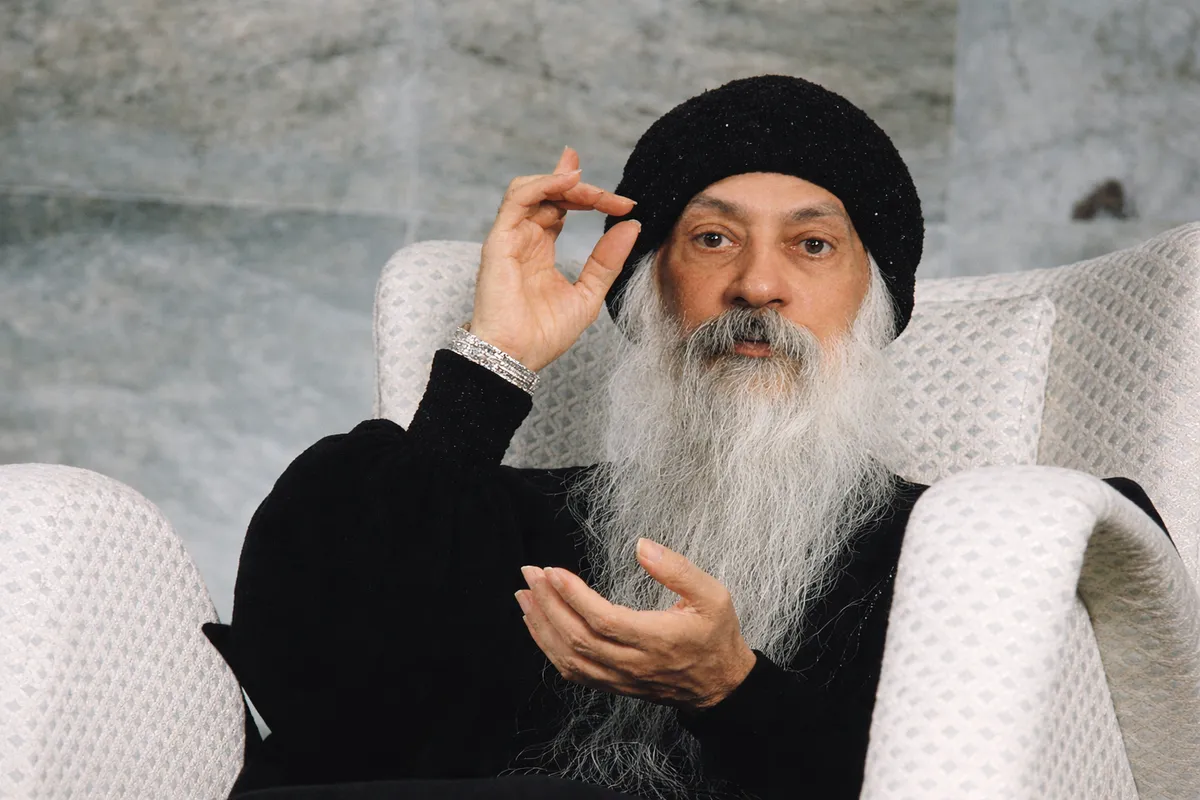
When the founder died, people copied his words and rituals instead of living his spirit, so rules replaced life.
From the Discourses
Passages where Osho speaks to this question — each links to the complete discourse.
You call the hasidim a joyous, enlightened community, yet the hasidism of modern new york appears to be so rigid, austere, dogmatic and contemptuous of both goyim and other jews. How did this transformation take place?
The ego functions in a very traditional way. To be revolutionary, one needs to be beyond the ego. And it is not that you can do it once and forever, you have to do it every moment again and again, because the ego goes on closing in on you, it goes on caving in on you. Each moment that you pass through, whatsoever you have lived, whatsoever you have experienced, becomes your ego. You have to discard it. Renunciation is not once and for all. You have to renounce every moment; whatsoever is gathered you have to renounce. Only then renunciation remains a revolution. And not only do you have to renounce ordinary things of the world, you have to renounce ordinary ideologies also -- Jewish, Christian, Hindu, Mohammedan. You have to renounce thoughts so that you can remain in a pure mirrorlike reflection. Then your consciousness can remain undisturbed,…
Once, when the hasidim were seated together in all brotherliness, pipe in hand, rabbi israel joined them. Because he was so friendly they asked him, 'tell us, dear rabbi, how should we serve god?'
HE WAS SURPRISED AT THE QUESTION, AND REPLIED, 'HOW SHOULD I KNOW?' BUT THEN HE WENT ON TO TELL THEM THIS STORY.. THERE WERE TWO FRIENDS OF THE KING, AND BOTH WERE PROVED GUILTY OF A CRIME. SINCE HE LOVED THEM THE KING WANTED TO SHOW THEM MERCY, BUT HE COULD NOT ACQUIT THEM BECAUSE EVEN A KING'S WORD CANNOT PREVAIL OVER THE LAW. SO HE GAVE THIS VERDICT: A ROPE WAS TO BE STRETCHED OVER A DEEP CHASM, AND, ONE AFTER ANOTHER, THE TWO WERE TO WALK ACROSS IT. WHOEVER REACHED TO THE OTHER SIDE WAS TO BE GRANTED HIS LIFE. IT WAS DONE AS THE KING ORDERED, AND THE FIRST OF THE FRIENDS GOT SAFELY ACROSS. THE OTHER, STILL STANDING ON THE SAME SPOT, CRIED TO HIM, 'TELL ME, FRIEND, HOW DID YOU MANAGE TO CROSS?' THE FIRST CALLED BACK, 'I DON'T KNOW ANYTHING BUT THIS: WHENEVER I…
Osho, why is the world in so much misery? Why can't we all be just as blissful as you always are?
He did not die, but I had taken a risky decision. My father stopped telling me to do things from that day. I said, "You can suggest, you cannot order. You have to learn to be polite to your own son, because as far as our beings are concerned, who is father and who is son? You don't possess me, I don't possess you; it is just an accidental meeting of two strangers. You had no idea to whom you were going to give birth. I had no idea who was going to be my father, my mother. It is just an accidental meeting on the roads. "Don't try to exploit the situation. Don't take advantage because you are powerful, you have money, and I don't have anything. And don't force me, because this is ugly. You suggest to me. You can always give me a suggestion that 'this is…
Osho, reading Martin Buber it felt as if, through Hasidic practice, he had come close to buddhahood—a great man. He wanted to build a commune grounded in Jewish humanism that embraced both the spiritual and the material dimensions of life, yet the Jews themselves rejected him. Especially over Eichmann and the Arabs, Israel tried to prove him a traitor, while he was only calling for forgiveness and friendship rather than revenge. Reviled in his own land, while people across the world—especially Christians—were influenced by him. Osho, as we settle in Kutch, please say something about this in th
Newer religions are eager to expand, imperialistic; hence they readily accept humanism. Christianity is eager for it; so are Jains, Buddhists, and Islam. All, except Hindus and Jews, want all humanity to gather under one flag; they search for pleasant pretexts, craft beautiful principles—but the underlying urge is empire-building. I will certainly call Martin Buber a great man, but not a buddha. I make a basic distinction between a great man and a buddha. A great man is a person like us; the differences between us are of degree and quantity. We know less, he knows more. Perhaps our character is weaker, his stronger. Our lifestyle less graceful, his more so. Our thoughts less logically consistent, his clearer. But between him and us there is no qualitative difference. Between a buddha and us there is a qualitative difference; he belongs to another realm. It is not a matter of more…
पहला प्रश्न: ओशो, मार्टिन बूबर को पढ़ते हुए ऐसा लगा कि वे हसीदी साधना द्वारा बुद्धत्व के करीब पहुंचे हुए एक महापुरुष थे। उन्होंने जीवन के आध्यात्मिक और भौतिक दोनों पहलुओं को स्वीकार करता हुआ यहूदी मानवतावाद पर खड़ा हुआ एक संघ बसाना चाहा, लेकिन यहूदियों ने ही उनका इनकार कर दिया। और खासकर आइसमन और अरब के सिलसिले में तो इजरायल ने उन्हें देशद्रोही सिद्ध करने की कोशिश की, जब कि वे सिर्फ बदला लेने के बजाय क्षमा और मैत्री साधने को कह रहे थे। अपने ही देश में निंदित रहे, जब कि दुनिया भर के लोग, खासकर ईसाई, उनसे प्रभावित थे। ओशो, कच्छ में बसते हुए हमारे अपने कम्यून के संदर्भ में इस पर कुछ कहने की अनुकंपा
हिंदू और यहूदियों को छोड़ कर सब चाहेंगे कि सारी मनुष्यता एक ही झंडे के नीचे आ जाए। अच्छे-अच्छे बहाने खोजेंगे, सुंदर-सुंदर सिद्धांत निर्मित करेंगे, मगर पीछे वही अभीप्सा है--साम्राज्य विस्तार की। मार्टिन बूबर को मैं निश्चित महापुरुष कहूंगा। लेकिन बुद्धपुरुष नहीं। महापुरुष और बुद्धपुरुष में मैं बुनियादी भेद करता हूं। महापुरुष हमारे जैसा ही व्यक्ति है। उसमें और हमारे बीच जो भेद हैं, वे परिमाण के हैं, मात्रा के हैं। हम कम जानते हैं, वह ज्यादा जानता है। शायद हम कम चरित्रवान हैं, वह ज्यादा चरित्रवान है। शायद हमारी जीवन-शैली उतनी सुंदर नहीं, जितनी उसकी जीवन-शैली है। शायद हमारे विचार उतने तर्कशुद्ध नहीं, जितने उसके विचार तर्कशुद्ध हैं। मगर हमारे और उसके बीच कोई गुणात्मक भेद नहीं है।
Osho, why is it that all enlightened ones teach the central transformation of awareness and awakening, yet the religions founded on them shrink into conduct codes and rituals? Aren’t all organized religions merely parts of society?
But the wife would not agree. She said, “I don’t get into talk of mistakes and corrections. Some ill omen might occur! What harm is it to us?” Lines remain: “It happened this way, it was done that way, it was said so.” Then our meanings, our blindness, are added to them. Religion becomes superstition; truth loses its peaks and becomes the falsehood of the valleys. And around that falsehood, crowds gather. Those who reached the Buddha in the beginning reached through their own awakening. Then they had children; those children had nothing to take from the Buddha, nothing to give. For them, religion is only a rite. Born in a Buddhist home—Buddhist; had they been born in a Hindu home—Hindu; in a Muslim home—Muslim. It is a matter of accident. Being born in a Hindu home is as accidental as a white cat sitting by a pot of curd.…
दूसरा प्रश्न: ओशो, ऐसा क्यों है कि सभी बुद्ध पुरुष बोध और जागरण के केंद्रीय संपरिवर्तन का उपदेश देते हैं और उनके स्थापित धर्म आचरण और कर्मकांड में सिकुड़कर रह जाते हैं? क्या सभी संगठित धर्म समाज के ही हिस्से नहीं हैं?
लेकिन पत्नी न मानी। उसने कहा, भूल और सुधार, इन बातों में मैं नहीं पड़ती। कोई अपशगुन हो जाए! अपना बिगड़ता क्या है? लकीरें बनी रह जाती हैं। ऐसा हुआ था, ऐसा किया गया था, ऐसा कहा था। फिर हमारे अर्थ, फिर हमारा अंधापन उनमें जुड़ता है। और धर्म अंधविश्वास हो जाता है, और सत्य अपने शिखर खो देता है और घाटियों का झूठ हो जाता है। फिर उसी झूठ के आसपास भीड़ें बढ़ती चली जाती हैं। बुद्ध के पास जो लोग पहली दफे पहुंचे थे, अपने बोध से पहुंचे थे। फिर उनके बच्चे पैदा होते हैं; इन बच्चों को न बुद्ध से कुछ लेना है, न कुछ देना है। धर्म इनके लिए केवल एक रीति-रिवाज होता है। …