
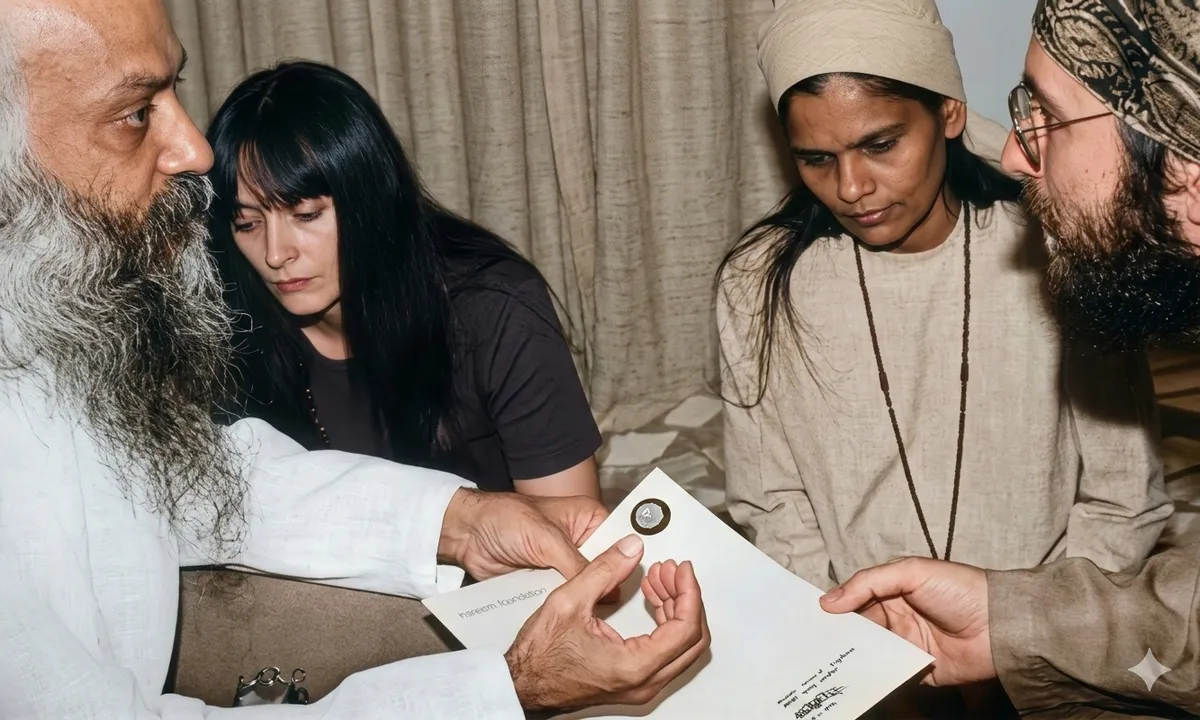
Stories point you to a deeper truth, help it sink into your heart, and then you can forget the story and live the message.
From the Discourses
Passages where Osho speaks to this question — each links to the complete discourse.
Beloved Osho, whenever I read friedrich nietzsche, and feel quite relaxed, it appears as if I have a connection with a spirit which is alive and I talk to him. He is not dead but a living friend and it doesn't sound absurd at all that all the great spirits are in deep communication with one another whether they are dead or alive. But with you, all names and words disappear and I feel bright and enlightened. I love this state of being with you like this. What is your secret?
Ramakrishna said, "That is a way of saying things which cannot be said. You said, `God does not exist.' And I say you are the proof that God exists; otherwise, from where such beautiful intelligence?" Now, how to argue with such a man? After ten minutes, Keshav Chandra was at the feet of Ramakrishna -- "Just forgive me, I had no idea of a man who is not in the mind but in the being. You have made it clear to me. You are not a man of logic, you are a man of love -- but love is far higher, logic is mundane. Please accept me as one of your disciples." Nietzsche is a great logician, a great philosopher, but he knows nothing of reality. All that he says is mind -- guesses, inferences. Assumptions supported by argument may befool people but they cannot befool a man who knows.…
Question: MATTHEW I3 10 AND THE DISCIPLES CAME, AND SAID UNTO HIM, WHY SPEAKEST THOU UNTO THEM IN PARABLES? 11 HE ANSWERED AND SAID UNTO THEM, BECAUSE IT IS GIVEN UNTO YOU TO KNOW THE MYSTERIES OF THE KINGDOM OF HEAVEN, BUT TO THEM IT IS NOT GIVEN. 12 FOR WHOSOEVER HATH, TO HIM SHALL BE GIVEN, AND HE SHALL HAVE MORE ABUNDANCE: BUT WHOSOEVER HATH NOT, FROM HIM SHALL BE TAKEN AWAY EVEN THAT HE HATH. 18 HEAR YE THEREFORE THE PARABLE OF THE SOWER. 19 WHEN ANYONE HEARETH THE WORD OF THE KINGDOM, AND UNDERSTANDETH IT NOT, WHEN COMETH THE WICKED ONE, AND CATCHETH AWAY THAT WHICH WAS SOWN IN HIS HEART. THIS IS HE WHICH RECEIVED SEED BY THE WAY SIDE.
Why did jesus constantly talk in obscure parables which baffled even his disciples most of the time? Was this a deliberate technique? Why couldn't he be more straightforward like you?
You never forget a beautiful story. It is just like -- if you sing a beautiful song, you will remember it better than if it was prose. If it is poetry, it is remembered well. Somehow it fits with the deepest quality of your mind. If it is a parable, if there is a drama in it, it has a tendency to cling to you. It will come again and again and again; it will become an inner climate. Bare principles are soon forgotten. And in the days of jesus, books were not written. All that Jesus was saying was recorded many, many years afterwards. For those many, many years it was just in the memory of the people who had heard him. A parable can be remembered well. You will forget what I say, but you will never forget the parables, the anecdotes, the jokes. You may forget Mahavir…
If truth cannot be expressed in words, then why have all the buddhas used words?
A parable: THE GREAT MYSTIC, Rabia of Basra, was immensely beautiful. And a beauty not of this world. Once a rich young man from Iran comes to Basra. He asks people, "Is there anything that is out of the way, something special here?" "Yes," they all tell him. "We have the most beautiful woman of the world!" The young man naturally becomes interested and he asks, "Where can I find her?" And they all laugh and say, "Well, where else?... in a brothel!" That repulses the rich young man, but finally he decides to go. And when he gets there, the matron asks for an exorbitant fee. He pays the fee and is ushered in. There, in a silent and simple room, a figure is praying. What beauty she has! He has never seen such beauty and grace, not even in his dreams. Just to be there is a benediction,…
Question: SINCE I HAVE BEEN WITH YOU I HAVE COME TO KNOW JESUS IN A NEW LIGHT. AS A JEW I COULD NEVER ACCEPT HIS TEACHINGS. NEVER BEFORE DID I THINK OF HIM AS AN ENLIGHTENED BEING, AS I THINK ABOUT THE BUDDHA. WHEN I FIRST CAME IN CONTACT WITH BUDDHIST TEACHING IN NEPAL. I FELT AN IMMEDIATE AFFINITY TOWARDS IT. HERE NOW IN POONA, JESUS' SAYINGS ARE BECOMING COMPREHENSIBLE AND ACCEPTABLE. YET STILL DOUBTS PERSIST. WHY DID HE SAY IT ALL IN SUCH A ROUNDABOUT WAY, ESPECIALLY CONSIDERING THAT HE WAS TALKING TO THE COMMON PEOPLE? AND LOOK AT ALL THE CONFUSION THAT HAS NOW BEEN CAUSED BY THE MANNER IN WHICH HE SPOKE. IT DOESN'T MAKE ANY SENSE TO ME, AND I WON'T FEEL COMPLETELY AT EASE WITH JESUS AS I DO WITH THE BUDDHA UNTIL THIS QUESTION IS RESOLVED.