
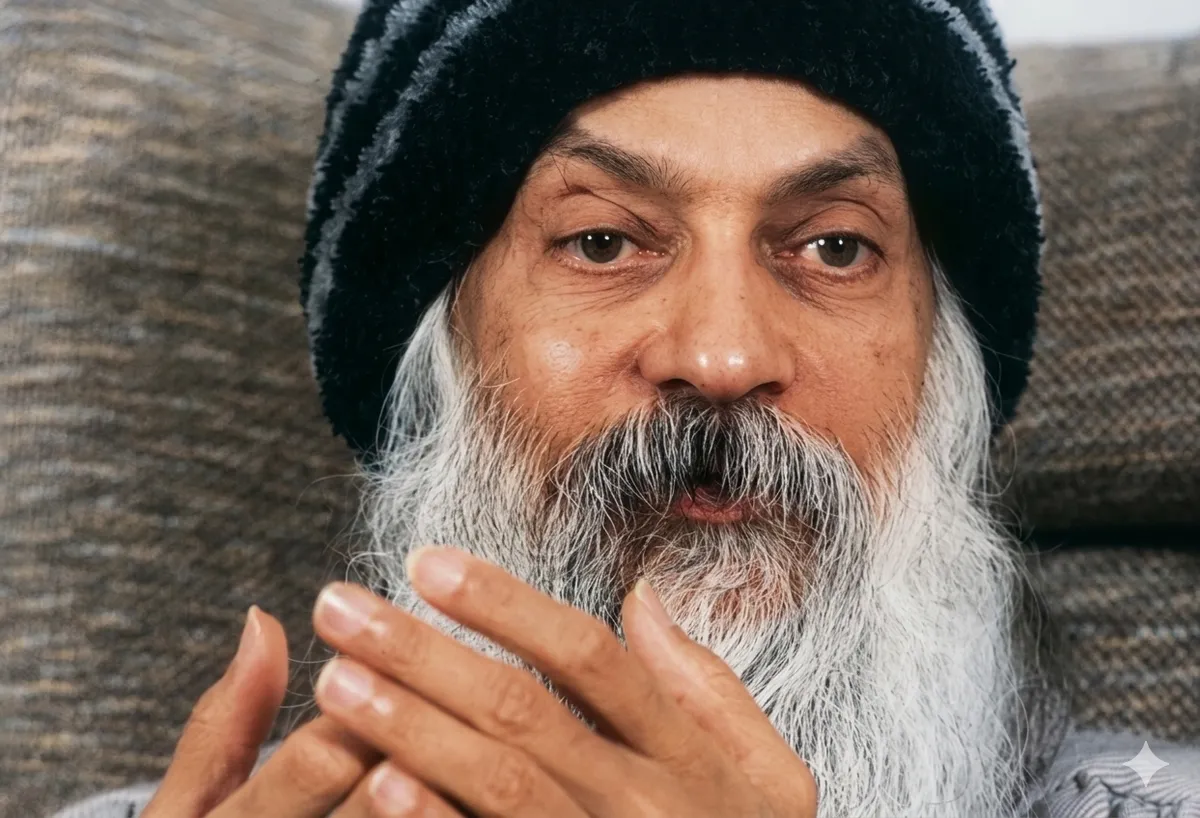
We don’t know who wrote it, and the message matters more than the name on it.
From the Discourses
Passages where Osho speaks to this question — each links to the complete discourse.
Question: Second question: Osho, who is the author of the Mundaka Upanishad? Bholeram! Baba, are you upset with the author of the Mundaka Upanishad? As if to say, “Let’s see who this fellow is! Let’s set him right!” I was afraid someone might ask this! Because I myself don’t know who authored the Mundaka Upanishad. In fact, when I first read it, this very question arose in me. I was quite young when the Mundaka Upanishad first fell into my hands. There was an old copy lying around the house. I picked it up and looked. The very first question that arose was: Mundaka Upanishad! Is that even a name? Who wrote it? And who gave it that name? At least the name could have been decent! People give all sorts of names to stale, rotten things—rasmalai! chamcham! rasgulla! What names they come up with! Mundaka Upanishad!
मैं डर रहा था कि कोई यह प्रश्न न पूछ ले! क्योंकि मुझे भी पता नहीं कि मुंडकोपनिषद के लेखक कौन हैं। असल में मैंने भी जब पहली दफा मुंडकोपनिषद पढ़ा था, तो यह सवाल मुझे उठा था। उम्र तब मेरी छोटी थी जब मेरे हाथ में पहली दफा मुंडकोपनिषद पड़ गया। घर में उसकी कापी पुराने दिनों से पड़ी थी। उठा कर मैंने देखा। पहला ही सवाल यह उठा कि मुंडकोपनिषद! यह भी कोई नाम हुआ! किसने लिखा? और क्या नाम दिया! अरे, कम से कम नाम तो ठीक दे देते!
But it doesn’t make any difference to me. People get upset! Just yesterday someone asked: sometimes you speak in favor of a scripture, and sometimes you speak against that very same scripture!
And it isn’t that they added knowingly. I do not doubt their good intentions. But an unconscious person, no matter how sincere, will go wrong. Here is the sutra: ‘यं यं लोकं मनसा संविभाति विशुद्धसत्वः कामयते यांश्च कामान्। तं तं लोकं जयते तांश्च कामान्— तस्मादात्मज्ञं ह्यर्चवेद भूतिकामः॥’ But the translator blundered: “whose conscience is pure.” Viśuddha-sattvaḥ became “whose conscience is pure.” A grave error. One becomes viśuddha-sattvaḥ only when one is free of conscience. And here the meaning is inverted. “Whose conscience is pure—such a knower, whatever realms he imagines with his mind...” Does a knower still have a mind? What need is there for mind? It’s like the story: Jesus touched a blind man’s eyes and they were healed. Naturally, the blind man used to walk with a stick. His eyes were healed; he thanked Jesus and started to go—taking his stick along. Jesus said, “At least give me…
लेकिन मुझे इससे अंतर नहीं पड़ता। लोगों को तकलीफ होती है! कल ही किसी व्यक्ति ने पूछा है कि कभी आप किसी शास्त्र के पक्ष में बोल देते हैं और कभी उसी शास्त्र के विपक्ष में बोल देते हैं!
भारी चूक हो गई। अंतःकरण से मुक्त होता है कोई, तभी विशुद्धसत्व होता है। और यहां तो बात ही उलटी हो गई। ‘जिसका अंतःकरण शुद्ध है, ऐसा आत्मवेत्ता मन से जिस-जिस लोक की भावना करता है...।’ आत्मवेत्ता का मन रह जाता है? मन की जरूरत क्या है? यह तो यूं हुआ, कहानी है कि जीसस ने एक अंधे आदमी की आंखों को छुआ; आंखें ठीक हो गईं। स्वभावतः, अंधा आदमी था, तो लकड़ी टेक-टेक कर चलता था। आंखें तो ठीक हो गईं, जीसस को धन्यवाद देकर वह जाने लगा, मगर अपनी लकड़ी भी साथ ले चला! जीसस ने कहा, मेरे भाई, कम से कम धन्यवाद में लकड़ी तो मुझे दे जा! लकड़ी तो छोड़ दे! वह अंधा आदमी क्या बोला! उसने कहा, बिना लकड़ी के मेरा कैसे चलेगा? आंखें आ गईं! मगर पुरानी आदत, जिंदगी भर की आदत! लकड़ी से टटोल-टटोल कर चलता था। लकड़ी ही उसकी अब तक की आंख थी। आज आंख भी आ गई, तो वह घटना इतनी नई थी कि अभी तक उस घटना का संप्रेषण भीतर तक नहीं हुआ। उसने कहा, लकड़ी मैं कैसे छोड़ सकता हूं? बिना लकड़ी के मेरा कैसे चलेगा मालिक? बिना लकड़ी के तो मैं एक कदम न चल सकूंगा। …
Question: ONE RESULT, THEY SAY, IS OBTAINED BY VIDYA, AND ANOTHER RESULT, THEY SAY, IS OBTAINED BY AVIDYA; THUS WE HAVE HEARD FROM THE WISE ONES WHO EXPLAINED IT TO US. ... The sage says, "We are passive, not active. When you construct something you are active. When an artist is drawing a flower, he is an active agent. But when he is standing near a roseflower and is looking at it, he is a passive agent. At that time he is doing nothing, he is only receptive. He has simply opened the doors and windows of his being. He invites the flower, he offers it his heart, he welcomes it, and stands still. He is receptive. Then the flower enters his heart and touches it with its petals.
Question: Second question: Osho, please say something about the sage Shandilya. ... But such are our curiosities. We do not ask the fundamental; we ask the secondary. And sometimes we get entangled in disputes over the secondary. All over the world, so-called religious people are caught in the secondary. A Muslim thinks, “Only if I pray facing the Kaaba will my prayer reach. Someone thinks, “Only if I bathe at Kashi will I arrive. They are tangled in the secondary. Prayer is what matters; which direction your hands face—what difference does it make? The Divine is everywhere. Everywhere is the Kaaba. All stones are the stones of the Kaaba. And all waters are the Ganga. If the mind is pure, the Ganges flows even in a washbasin. The water that comes from the tap—that too is Ganga, if the mind is pure.
मगर हमारी ऐसी ही उत्सुकताएं हैं। हम मूल तो प्रश्न पूछते नहीं, हम गौण प्रश्न पूछते हैं। और कभी-कभी गौण के विवाद में उलझ जाते हैं। सारी दुनिया में तथाकथित धार्मिक लोग गौण के विवाद में उलझ गए हैं। मुसलमान सोचता है कि काबा की तरफ हाथ जोड़ कर प्रार्थना करूं तो ही पहुंचेगी। कोई सोचता है, काशी में स्नान करूं तो ही पहुंचूंगा। गौण में उलझ गए। प्रार्थना महत्वपूर्ण है, किस तरफ हाथ किए, क्या फर्क पड़ता है? परमात्मा सब ओर है। काबा ही काबा है। सब पत्थर काबा के पत्थर हैं। और सब जल गंगा है। मन चंगा तो कठौती में गंगा। वह नल की टोंटी से जो आती है, वह भी गंगा है, मन चंगा हो। रोग से भरे हुए मन को लेकर चले जाओगे, गंगा में भी स्नान कर आओगे, तो क्या होगा?
Invocation
AUM, MAY BRAHMAN PROTECT US BOTH. MAY HE NOURISH US BOTH. MAY WE BOTH ACHIEVE ENERGY. MAY THIS STUDY MAKE US BOTH ILLUMINED. MAY WE NEVER HATE EACH OTHER. AUM, PEACE, PEACE, PEACE. AUM, MAY MY LIMBS BECOME STRONG. ALSO, LET MY SPEECH, PRANA -- VITAL AIR -- SIGHT, HEARING, AND ALL THE SENSE ORGANS, BE VIGOROUS. THE ENTIRE EXISTENCE IS THE BRAHMAN OF THE UPANISHADS. MAY I NEVER DENY BRAHMAN; MAY BRAHMAN NOT DENY ME. LET THERE BE NO DENIAL AT ALL. LET THERE BE NO DENIAL AT LEAST ON MY PART. WHATEVER VIRTUES ARE IN THE UPANISHADS, MAY THEY ABIDE IN I WHO AM DEVOTED TO THE ATMAN -- SELF. MAY THEY ABIDE IN ME. ... AUM, PEACE, PEACE, PEACE. ... It is just like heating water. At a particular degree, a hundred degrees, it evaporates. Do not think that at fifty degrees half will evaporate. It will not evaporate